
The hard part is not making a better load forecast. It is deciding what to do when the forecast says demand is arriving faster than the equipment, crews, regulatory approvals, and transmission capacity needed to serve it.
That timing mismatch is now large enough to break comfortable planning routines. Industry reporting cited by GEP puts large transformer lead times at 115 to 140 weeks in early 2026, compared with 16 weeks in 2021, with prices nearly four times 2021 levels.[1] Deloitte’s 2025 AI Infrastructure Survey of 120 utility and infrastructure executives found that 72% cited grid capacity as their top challenge, while its high-end scenario projected U.S. AI data center power demand rising from 4 GW in 2024 to 123 GW by 2035.[2] Utility capital spending is already moving in response: Deloitte cited a $212 billion U.S. utility capex trajectory for 2025, up 22% year over year.[2]
A capital committee can approve a disciplined substation upgrade on paper and still approve a plan that cannot be executed. The transformer may not arrive until the load pocket has already tightened. The crews may be assigned to storm hardening work. The interconnection project assumed in the model may sit behind hundreds of other requests. The regulatory filing may depend on documents scattered across engineering, asset management, and procurement systems.
AI becomes useful here only if it changes that decision surface. A planning model that scores asset risk in one report, load growth in another, sourcing risk in a spreadsheet, and workforce availability in a project management tool is not really optimizing capital. It is reconciling conflicts after priorities have already hardened.
The Investment Decision Has Too Many Separate Clocks
Traditional grid planning cadences were built around periodic prioritization: annual capital plans, quarterly refreshes, engineering studies, procurement updates, and regulatory packages. That rhythm is increasingly mismatched with the pace of load requests and the slowness of physical execution.
The interconnection queue shows the same contradiction from another angle. Major U.S. markets had more than 2,000 GW waiting in interconnection queues in early 2026, with solar and storage representing 95% of queue projects according to Deloitte’s summary of the market.[3][2] Queue volume is not the same as deliverable capacity. Some projects will withdraw, some will be delayed, and some will depend on network upgrades that are not yet funded or built. For utilities trying to plan transformers, breakers, conductors, and crews, the question is not only “how much demand is coming?” It is “which projects are likely enough, soon enough, and consequential enough to change today’s capital decision?”
Data center growth makes that question more uncomfortable. The Deloitte projection of 4 GW to 123 GW by 2035 is a high-end scenario, not a settled outcome.[2] Forecast ranges vary, and overbuilding around an aggressive scenario carries its own cost. But underbuilding is not a neutral choice when transformers, switchgear, and transmission projects move on multi-year timelines. Procurement lead time has become part of the load forecast, not an administrative follow-up to it.
What AI Changes in the Capital Planning Workflow
The stronger use case is not a single algorithm. It is an integrated planning workflow that keeps asset condition, outage probability, customer impact, maintenance cost, capex availability, equipment constraints, labor capacity, and project timing in the same model long enough to change the investment ranking.
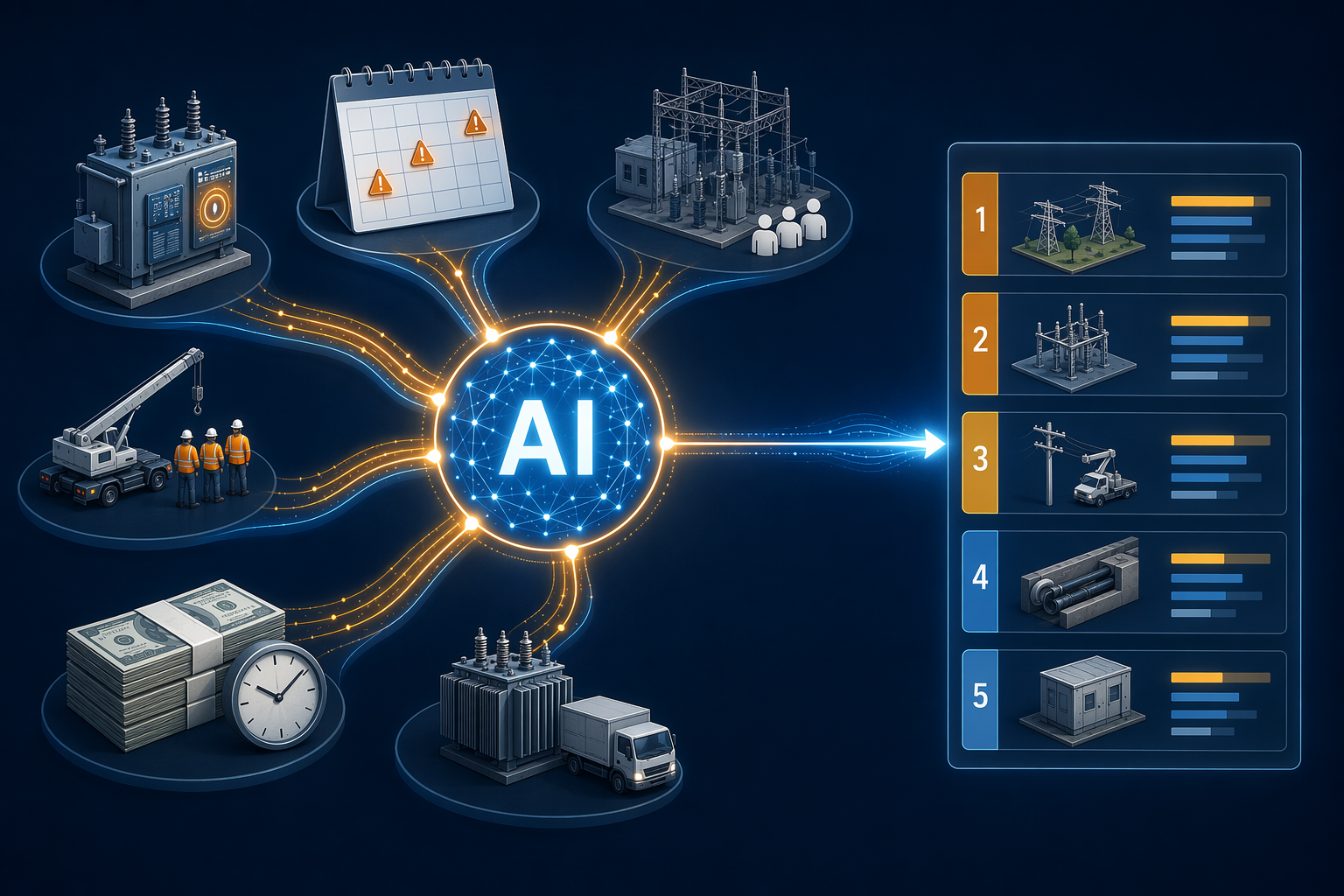
A conventional ranking might elevate a feeder automation project because it has a high reliability score. A more integrated model may still rank it highly, but only after testing whether the required devices are constrained, whether the crew window conflicts with a substation rebuild, whether the customer interruption risk is rising faster elsewhere, and whether a cheaper maintenance action can hold the asset within acceptable risk until a transformer allocation becomes available.
That is where AI planning tools can earn their place. Machine learning can update failure probabilities as inspection, sensor, outage, and maintenance records change. Optimization models can compare project bundles under budget, crew, and equipment constraints. Natural language processing can reduce the time required to assemble regulatory and interconnection documentation. Procurement intelligence can flag categories where a nominal project start date is unrealistic because the supply market cannot support it.
| Planning Input | Why It Matters | What AI Can Change |
|---|---|---|
| Asset condition | Aging equipment does not fail on budget cycles. | Continuously refresh risk scores as inspection, maintenance, and operating data change. |
| Outage probability and customer impact | Reliability value depends on who is affected and when. | Rank work by consequence, not only by age or engineering preference. |
| Capex availability | Approved capital is finite and often tied to regulatory commitments. | Compare project bundles under budget and timing constraints. |
| Equipment supply | A high-value project can become non-executable if transformers or switchgear are unavailable. | Bring lead time, supplier risk, and allocation decisions into prioritization before approval. |
| Workforce capacity | Crews are a binding constraint, especially when storm response and maintenance backlogs compete with new work. | Test whether the portfolio can be executed with available labor windows. |
| Regulatory sequencing | A delayed filing can make an otherwise sound project miss the load need. | Speed document handling and identify missing evidence earlier. |
The important shift is that supply chain planning stops being downstream of capital approval. If a transformer category has a two-year-plus lead time, the model should not wait for procurement to report that problem after the project is sanctioned. It should show the capital planner which projects depend on that category, which suppliers can realistically support delivery, which substitutions are engineering-acceptable, and which projects can proceed with available equipment. The companion procurement problem is explored more directly in How AI Tackles the Transformer Bottleneck in Grid Supply Chains, but the same constraint belongs inside the investment decision itself.
That changes the capital conversation. Instead of asking which assets deserve money in isolation, the utility can ask which sequence of work reduces system risk fastest with the equipment, crews, and approvals it can actually secure. Some projects move up because a constraint is clearing now. Others move down because they look attractive financially but cannot be built inside the required window. A few may be replaced by operating measures or grid-enhancing technologies while the longer buildout catches up.
Where the Use Case Is Already Showing Up
The evidence is still uneven, but it is no longer theoretical. The clearest documented value tends to appear where AI shortens a decision loop that was previously slow, manual, or fragmented.
Predictive Maintenance as a Capital Deferral Tool
NewGen Strategies reported $7.8 million in annual savings at National Grid from predictive maintenance AI.[4] That figure should be treated as a reported example, not a universal benchmark. Still, the planning implication is useful: if AI can identify which assets need intervention now and which can be safely monitored, it can protect capital for projects whose timing is truly driven by load growth, safety, or reliability exposure.
The savings are not the only point. Predictive maintenance can change the shape of the capital portfolio. A utility may defer replacement of some equipment, accelerate targeted repairs, and reserve scarce transformers for assets or substations where failure consequence and demand growth overlap. That is a more disciplined use of capital than a blanket age-based replacement program, provided the underlying asset data is reliable enough to support the model.
Queue Screening Before Engineering Time Is Consumed
With interconnection queues above 2,000 GW, utilities and grid operators need earlier ways to distinguish projects that are more likely to proceed from projects that absorb study capacity but may not reach construction.[3] AI-based screening does not make a project viable by itself. It can, however, combine project attributes, location, developer history, network constraints, study status, and required upgrades to focus scarce engineering attention on requests that are more actionable.
That matters for supply chain planning because speculative queue volume can distort procurement signals. If every queued project is treated as equally probable demand, the utility may overstate equipment needs. If the queue is discounted too aggressively, it may miss a real capacity requirement while lead times continue to stretch. Screening tools are most useful when they convert queue noise into probability-weighted capital and equipment scenarios.
Grid-Enhancing Technologies When New Lines Are Too Slow
Deloitte reported that grid-enhancing technologies using AI can increase transmission capacity by 10% to 30% within three months, compared with 10 to 12 years for new transmission lines.[2] Those figures do not eliminate the need for new transmission. They do make the sequencing question sharper. If dynamic line ratings, topology optimization, or related technologies can unlock near-term usable capacity, a utility may have a bridge while larger capital projects and equipment orders move through their longer timelines.
This is the kind of comparison AI planning tools should make explicit. A new line, a reconductoring project, a grid-enhancing technology deployment, and a transformer replacement may all address the same load pocket, but they do not share the same regulatory path, procurement exposure, construction duration, or reliability impact. The planning model has to compare them as executable options, not as separate departmental proposals.
Load Forecasting for Data-Center-Driven Demand
Data center load is not just large; it is lumpy, site-specific, and sensitive to commercial decisions that can change faster than utility construction cycles. The Financial Times reported that the gap between planned data center capacity and available grid power in North America could reach 19 GW by 2028.[5] Wharton’s discussion of PJM cited a 6,600 MW capacity shortfall below reserve targets for summer 2027 and attributed 94% of load growth to data centers, though that figure should be cross-checked against PJM’s official auction results before being treated as definitive.[6]
AI load forecasting vendors can help utilities refresh scenarios as interconnection requests, customer commitments, site development signals, weather, electrification trends, and market data change. The value is not that the model produces a single clean answer. It is that planners can see which capital decisions are robust across scenarios and which depend on a demand case that may not materialize.
Procurement Intelligence for Constrained Categories
Procurement AI matters most when it makes constraints visible early enough to change project sequencing. For transformers, breakers, cable, control systems, and specialized services, a sourcing model can compare supplier capacity, lead times, price movement, contract coverage, qualification status, and substitution options. That supports should-cost analysis and sourcing scenarios similar to the procurement logic discussed in AI Commodity Price Forecasting Delivers Measurable Procurement Savings, but grid equipment adds an execution constraint: the wrong sourcing assumption can delay energization, not merely raise purchase price.
The procurement team should not inherit an approved capital portfolio and then be asked to make the market comply. If supplier allocation, factory slots, transportation constraints, or qualification timelines are binding, those facts belong in the investment model before the portfolio is approved.
The Vendor Landscape Is Functional, Not Magical
The market is forming around recognizable functions rather than one complete utility brain. Gigawatt AI’s capital planning framework is useful as a vendor perspective on how utilities might connect planning variables, but it should not be read as independent proof of deployment results. GE Vernova GridOS and NVIDIA’s grid planning work sit closer to grid planning and operations. Amperon is more directly associated with load forecasting. EPRI’s Open Power AI Consortium reflects the need for industry coordination. GEP and Ivalua sit nearer procurement intelligence, sourcing, and supplier management.
That grouping is more useful than ranking vendors. A utility evaluating this category should first decide which decision loop is most constrained. If the binding issue is asset replacement prioritization, the starting point is asset risk and maintenance data. If the issue is data center load uncertainty, forecasting and scenario planning deserve more attention. If the issue is transformer availability, procurement intelligence and supplier collaboration need to be tied directly to the capital plan.
The wrong procurement technology can still look impressive in a demo. A sourcing copilot that drafts events faster is helpful, but it does not solve capital planning unless it can inform the investment sequence. A forecasting tool that shows demand growth is helpful, but it does not solve execution unless it connects to equipment and workforce constraints. The test is whether the tool changes an approval, a sourcing commitment, a deferral, or a construction sequence before the constraint becomes unavoidable.
Adoption Is Early Because the Data Problem Is Real
The adoption numbers carry both promise and warning. NewGen Strategies reported that 96% of utility executives view AI as strategically important, but only 26% have moved beyond proof of concept; it also cited an 88% pilot-to-production failure rate and estimated that 70% of machine learning effort goes into data preparation.[4] The methodology and sample behind those figures should be verified before using them as a hard industry benchmark. Directionally, though, they match what utility procurement and asset teams already know: the model is rarely the only hard part.
Asset registries may not match field reality. Maintenance histories may sit in one system, procurement lead times in another, work orders in another, and regulatory commitments in documents rather than structured data. Supplier performance may be tracked at a category level that is too broad to support a transformer-specific decision. Crew availability may be known locally but not visible in the capital planning tool.
That fragmentation is not a side issue to be cleaned up after AI selection. It determines whether the tool can make a better decision than the current committee process. If the model cannot see the supplier constraint, it will approve unbuildable work. If it cannot see customer impact, it may over-optimize cost. If it cannot see permitting or regulatory sequencing, it may produce a capital plan that is financially elegant and operationally late.
Document automation is one of the more practical near-term entry points. NewGen reported 30% to 40% reductions in document processing time for regulatory filings.[4] That is not the same as full capital optimization, but it matters if delayed evidence packages are slowing project approvals. In a constrained grid environment, administrative cycle time can become part of the physical capacity problem.
A Practical Evaluation Standard
Utilities do not need to buy into broad AI transformation language to evaluate this use case. They need a narrow test: can the tool improve a capital decision that currently depends on fragmented asset, procurement, project, workforce, and regulatory data?
- Can it show which projects are high risk and executable, rather than only high risk?
- Can it connect equipment lead times and supplier capacity to project ranking before capital approval?
- Can it refresh priorities when load forecasts, queue status, asset condition, or crew availability change?
- Can planners trace why a project moved up or down, so the output can survive engineering, procurement, finance, and regulatory review?
- Can the first deployment target a decision loop with measurable cycle time, cost, reliability, or execution consequences?
The strongest starting points are usually not the most ambitious ones. A utility might begin with transformer-constrained project sequencing, predictive maintenance for a defined asset class, interconnection queue screening, or regulatory document handling. Each has a clearer operating boundary than an enterprise-wide planning overhaul. Each can also expose whether the underlying data is good enough for broader optimization.
AI-driven grid investment and supply chain planning is a real use case, but still an early-maturity one. It is strong enough to justify evaluation by utilities facing large capital programs, data-center-driven demand uncertainty, and equipment lead times measured in years. It is not mature enough to assume easy deployment, automatic adoption, or guaranteed ROI.
The practical test is whether the utility can connect the data and the decision rights before the delay becomes irreversible. If asset risk, sourcing constraints, workforce capacity, project timing, and regulatory evidence remain separate reports, AI will mostly decorate the old process. If those inputs can be brought into one continuously updated planning workflow, the capital plan has a better chance of matching the grid the utility can actually build.
References
- GEP blog on transformer lead time escalation, GEP, early 2026, link
- 2025 AI Infrastructure Survey, Deloitte, 2025, link
- Interconnection queue data for major U.S. markets, FERC, early 2026, link
- AI adoption and utility deployment report, NewGen Strategies, April 2026, link
- North America data center grid power gap reporting, Financial Times, link
- PJM capacity shortfall and data center load growth discussion, Wharton, link
Comments
Join the discussion with an anonymous comment.