
SCOUT is interesting because it starts where supply chain optimization usually becomes uncomfortable: the decision table. In the World Food Programme’s case, the tool helped save US$6.2 million over 18 months across West/Central Africa and Eastern/Southern Africa by optimizing where food should be sourced, how much should be stored, and when deliveries should move. WFP says those savings were enough to provide one month of food assistance to 300,000 people.[1]
That is a cleaner result than most AI productivity claims because it is tied to upstream planning choices rather than a loose promise of faster work. A buyer did not simply get a better dashboard. A planner got help with the question that becomes expensive when handled by spreadsheet habit: if the same commodity can be bought in several markets, staged in different locations, and routed through competing corridors, which combination preserves service while spending less?
| Planning decision | What SCOUT is used to optimize | Why the decision matters |
|---|---|---|
| Sourcing location | Which markets or suppliers to use for a given commodity | Commodity price is only one part of landed cost; transport, access, and timing can erase a cheap purchase. |
| Inventory placement | How much food to store in which locations | Stock too far upstream delays response; stock too far downstream can raise storage and repositioning costs. |
| Delivery timing | When to move food through the network | Lead times, corridor availability, and service obligations have to be balanced before the shipment is already urgent. |
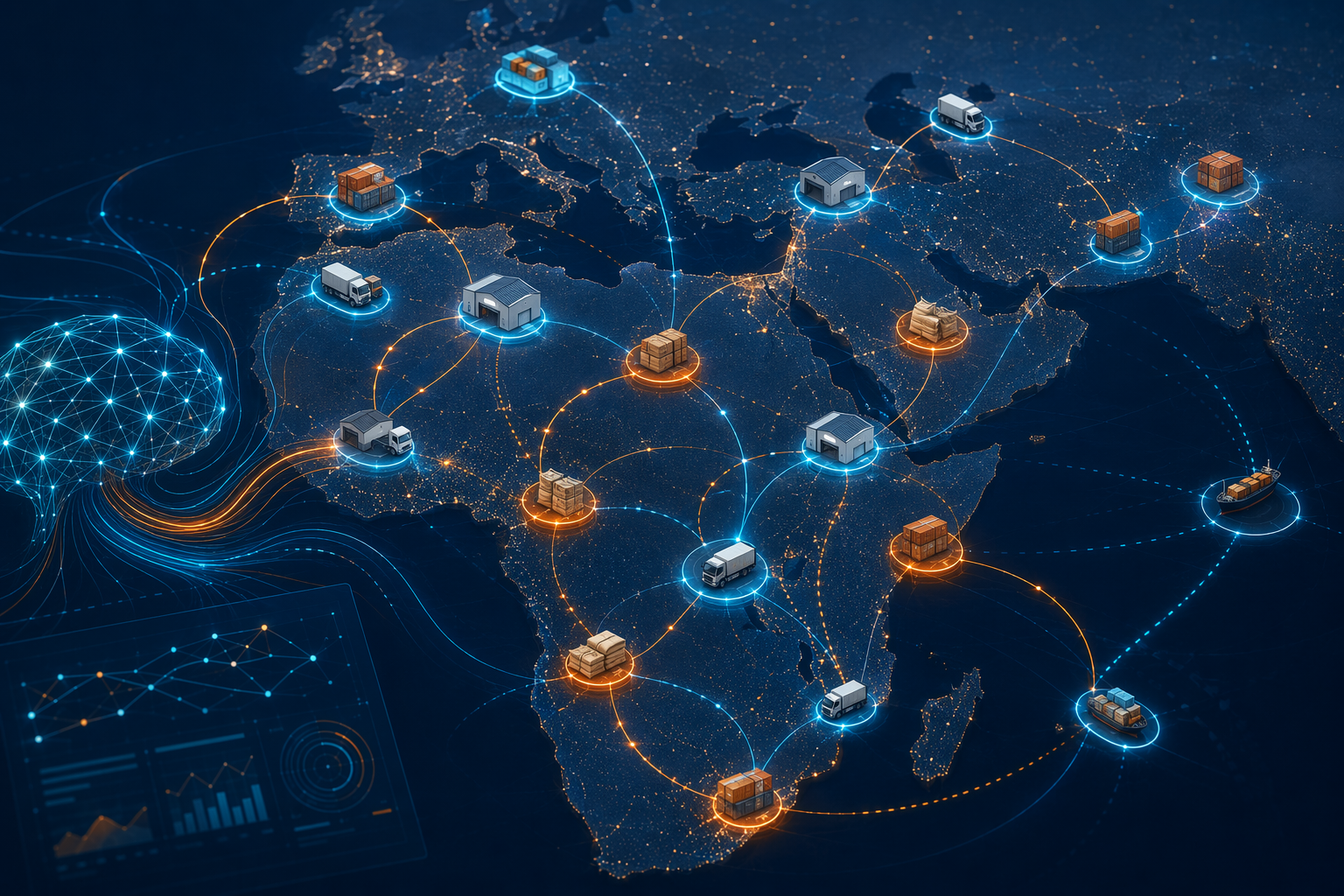
What SCOUT optimizes before logistics becomes firefighting
SCOUT is an upstream supply chain planning tool, not a last-mile routing app and not a control tower by another name. The model considers commodities, prices, transport costs, lead times, market conditions, and access constraints, then recommends sourcing locations, storage quantities, and delivery timing.[2] That bundle of variables is the important part. In a difficult network, the cheapest purchase price is often a false answer if it creates a longer lead time, forces a fragile corridor, or places inventory where it cannot support the next service commitment.
The old version of this work is familiar to anyone who has sat through a procurement planning meeting: Excel files from different teams, commodity prices updated on one tab, transport assumptions somewhere else, lead-time notes carried in email, and a final recommendation that depends on the few people who still remember why last quarter’s route was rejected. That is not incompetence. It is what happens when a network has more feasible combinations than a manual process can reasonably compare.
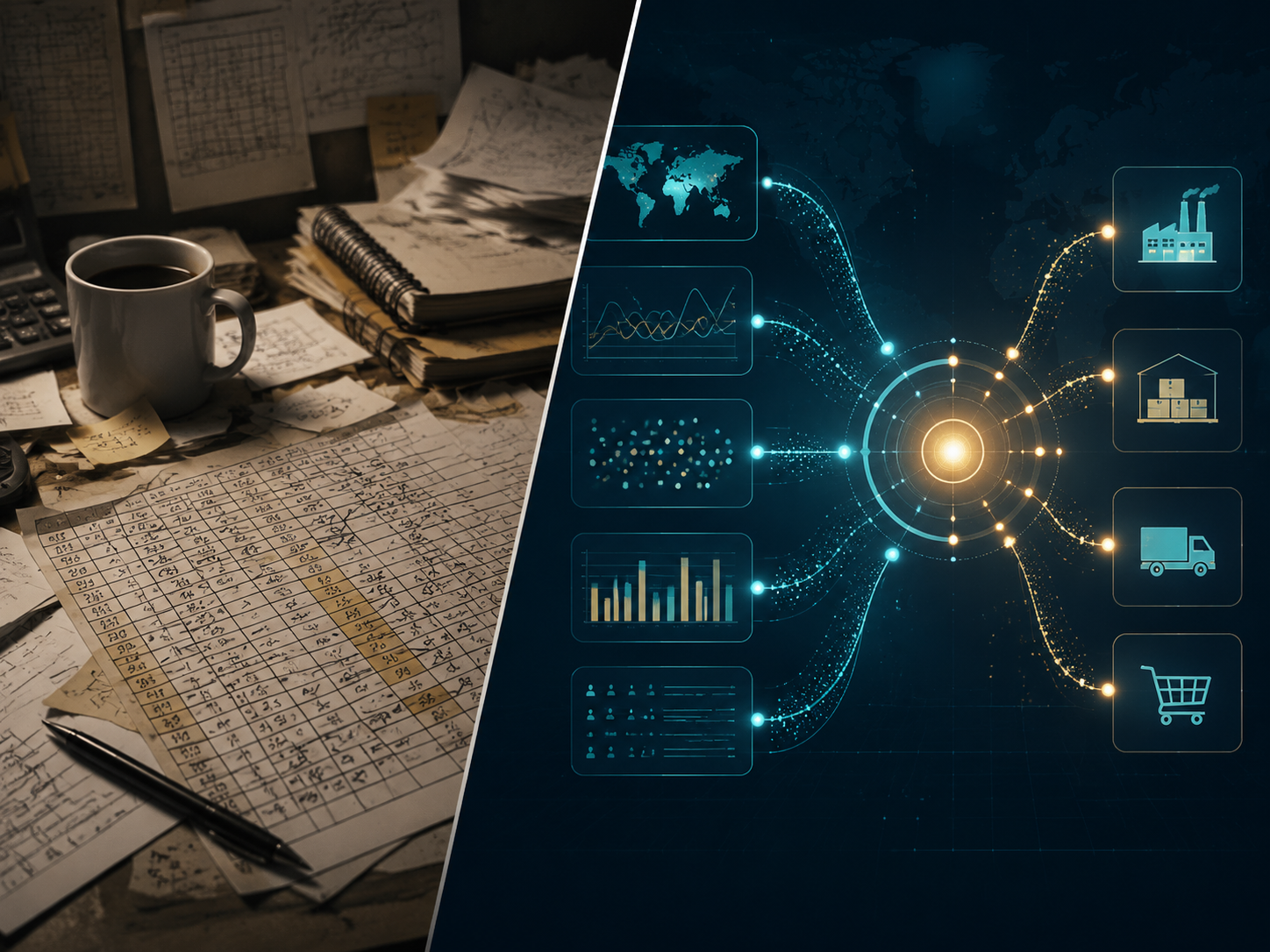
Optimization AI changes that workflow by moving comparison upstream. Instead of asking planners to assemble a preferred plan and then test whether it is affordable, the model evaluates feasible sourcing, storage, and delivery combinations against the constraints that matter. The human decision does not disappear; it moves to reviewing assumptions, exceptions, and trade-offs. Procurement and logistics teams still have to judge whether a market signal is reliable, whether access conditions have changed, or whether a service obligation should override a cheaper scenario. The difference is that they are no longer pretending a spreadsheet can exhaust the option space.
Why WFP is a serious test case for sourcing optimization
WFP is not a useful reference because it is humanitarian. It is useful because its planning environment is structurally hard. The organization says 62% of its food is bought locally or regionally, which means sourcing decisions are tied to local market conditions, regional availability, transport costs, and access risks rather than a single global purchasing lane.[3]
That local and regional purchasing share matters. When most food is sourced close to operations, the procurement decision is not simply “buy from the lowest-cost supplier.” A local purchase may reduce transport distance but expose the plan to market tightness. A regional source may offer better availability but require longer movement and more coordination. Inventory placed early can protect service, but it can also tie up scarce budget in the wrong node. These are ordinary supply chain trade-offs, only with less tolerance for waste and delay.
The deployment history also matters. WFP described SCOUT as beginning with sorghum in West Africa and then expanding to additional commodities and regions.[4] That is a more meaningful signal than a one-off pilot. A model that works for one commodity in one region has cleared only the first hurdle. A model that expands across more commodities and operating contexts is being tested against the messier reality of different price behavior, storage requirements, market depth, and logistics paths.
The savings figures should be read by deployment scope, not blended into one ROI story
The most current WFP figure available here is US$6.2 million saved over 18 months across West/Central Africa and Eastern/Southern Africa.[1] It is the right primary number to use because it is tied to a broader deployment than the earlier one-commodity story. It should still be read as WFP-reported savings; the available material does not provide an independent third-party audit.
Earlier and adjacent figures describe different scopes. WFP’s February 2026 news release said SCOUT had already generated more than US$2 million in savings since 2024 and projected US$25 million in annual savings once scaled globally.[4] A WFP Innovation Accelerator article from April 2025 described a broader aspiration of up to US$50 million in annual savings.[5] Those numbers should not be stacked into a single return-on-investment claim. The cleaner reading is that the savings grew as deployment widened, while the US$25 million and US$50 million figures are forward-looking estimates at different levels of ambition.
From spreadsheet reconciliation to scenario discipline
The practical shift in SCOUT is not that a planner stops thinking. It is that the planner stops being the calculation engine. In a manual process, teams have to reconcile commodity availability, supplier pricing, transport cost, lead time, market conditions, access constraints, storage options, and delivery windows across files that were rarely designed to answer the same question. The final plan can be defensible and still leave money on the table because only a narrow set of combinations was ever compared.
With optimization, the planning conversation can start from scenarios that already reflect multiple constraints. A planner can ask what changes if a regional market tightens, if transport cost increases, if one corridor becomes less reliable, or if demand timing shifts. The model’s value is not a magical forecast of the future. It is the ability to make trade-offs explicit before procurement is locked and transport is scrambling to make the plan work.
That is where upstream supply chain optimization becomes relevant outside WFP. The underlying planning pattern is not unique to food assistance. Commercial networks also decide between local and regional suppliers, forward and central inventory, faster and cheaper lanes, and service levels that customers or contracts will not let them ignore. The difference is usually vocabulary, not structure.
The commercial translation: multi-echelon decisions, not isolated procurement wins
A manufacturer, retailer, distributor, or healthcare network may not face the same access constraints as WFP, but it can face the same multi-echelon planning problem. Materials can be bought from different regions. Inventory can sit at plants, ports, regional distribution centers, forward warehouses, or customer-facing nodes. Transport can be cheap and slow, expensive and reliable, or unavailable at the wrong moment. A sourcing decision made in procurement becomes a logistics and service problem later.
This is why the SCOUT case is more relevant to upstream planning than to generic “AI in supply chain” discussions. Many tools improve visibility after inventory is already moving. Visibility is valuable, especially when exceptions have to be managed quickly. But the larger cost lever is often earlier: choosing the supply source, inventory position, and movement timing that make fewer exceptions likely in the first place.
For commercial leaders, the useful question is not whether their environment is as complex as WFP’s. It is whether their current planning process is being asked to solve a combinatorial problem with tools built for reconciliation. Warning signs are easy to recognize: planners maintain shadow spreadsheets because the system of record cannot compare scenarios; procurement optimizes unit price while logistics absorbs the downstream cost; safety stock is added because lead-time uncertainty is hard to model; and service failures are explained after the fact rather than prevented in the sourcing plan.
In those environments, optimization AI should be evaluated less like a dashboard and more like a planning engine. The necessary data is not just shipment visibility. It includes supplier and market options, commodity or material constraints, landed costs, lead times, storage capacity, service requirements, and the operational constraints that make some theoretically cheap plans unusable. If those variables are missing or politically impossible to standardize, the model will not rescue the process.
Where Prisma and Route The Meals fit
SCOUT sits inside WFP’s broader End-to-End Supply Chain Planning suite. That matters because upstream optimization does not remove the need for visibility or execution tools. WFP’s suite also includes Prisma, described as a control tower, and Route The Meals, focused on last-mile routing; WFP Innovation reported that the broader suite generated more than US$11 million in cost efficiencies.[5]
The distinction is worth keeping. Prisma helps teams see and coordinate the network. Route The Meals addresses delivery routing closer to the last mile. SCOUT is the upstream optimization case: it works on sourcing, inventory placement, and delivery timing before the execution problem has fully formed. Treating all three as the same kind of AI tool would blur the actual lesson. Good planning systems need both better decisions and better visibility into how those decisions perform.
What has to be true for the pattern to travel
No commercial firm should assume it can copy WFP’s savings percentage or dollar value. The available sources do not support that kind of transfer. WFP’s operating model, commodities, constraints, and funding pressures are its own. The transferable part is the pattern: measurable value appears when a complex, multi-region planning problem is moved from manual comparison into disciplined optimization, and when the organization is willing to act on the recommendations rather than admire them in a pilot.
Three conditions matter most. First, the network has to contain enough real choice: multiple suppliers, regions, inventory nodes, lanes, and timing options. Second, the data has to cover the variables that actually drive the decision, including costs, lead times, constraints, and service requirements. Third, planning authority has to move upstream. If procurement, inventory, and logistics teams continue to optimize their own slices independently, the model will identify trade-offs the organization is not prepared to make.
That is the sober value of SCOUT. It is not proof that AI automatically fixes supply chains, and it is not merely a feel-good nonprofit technology story. It is credible evidence that optimization AI can produce measurable savings when the problem is genuinely multi-echelon, the data describes the relevant constraints, and planners are allowed to replace spreadsheet folklore with structured scenario decisions.
References
- 5 innovations transforming how WFP delivers food assistance, WFP, July 2026.
- How AI Can Optimize End-to-End Humanitarian Supply Chains, Logistics Hall of Fame.
- Supply Chain, WFP.
- WFP Brings Proven AI Solutions to India Summit, WFP News, February 2026.
- From innovation to impact: The WFP Innovation Forum 2026, WFP Innovation Medium.
Comments
Join the discussion with an anonymous comment.