
A labor strike becomes a supply chain problem before the first gate closes. The first operational clock starts when a contract deadline hardens, a union statement changes tone, carriers move cutoff dates, or customers ask whether their containers will still make a launch window. By the time the port is actually shut, the good options are already narrower.
That is why AI for strike-related supply chain disruption has to be judged by phase, not by category label. A dashboard that is useful two weeks before a walkout may be too slow during the shutdown. A rerouting engine that saves a shipment during the strike may be irrelevant when the terminal reopens and everyone is fighting the same backlog.
The 2024 International Longshoremen’s Association strike made the pattern visible in unusually concrete terms: 36 ports, about 45,000 workers, three days of shutdown, and billions of dollars per day at risk across U.S. East and Gulf Coast trade flows.[1] The uncomfortable part was not only the shutdown. It was the calendar after the shutdown.
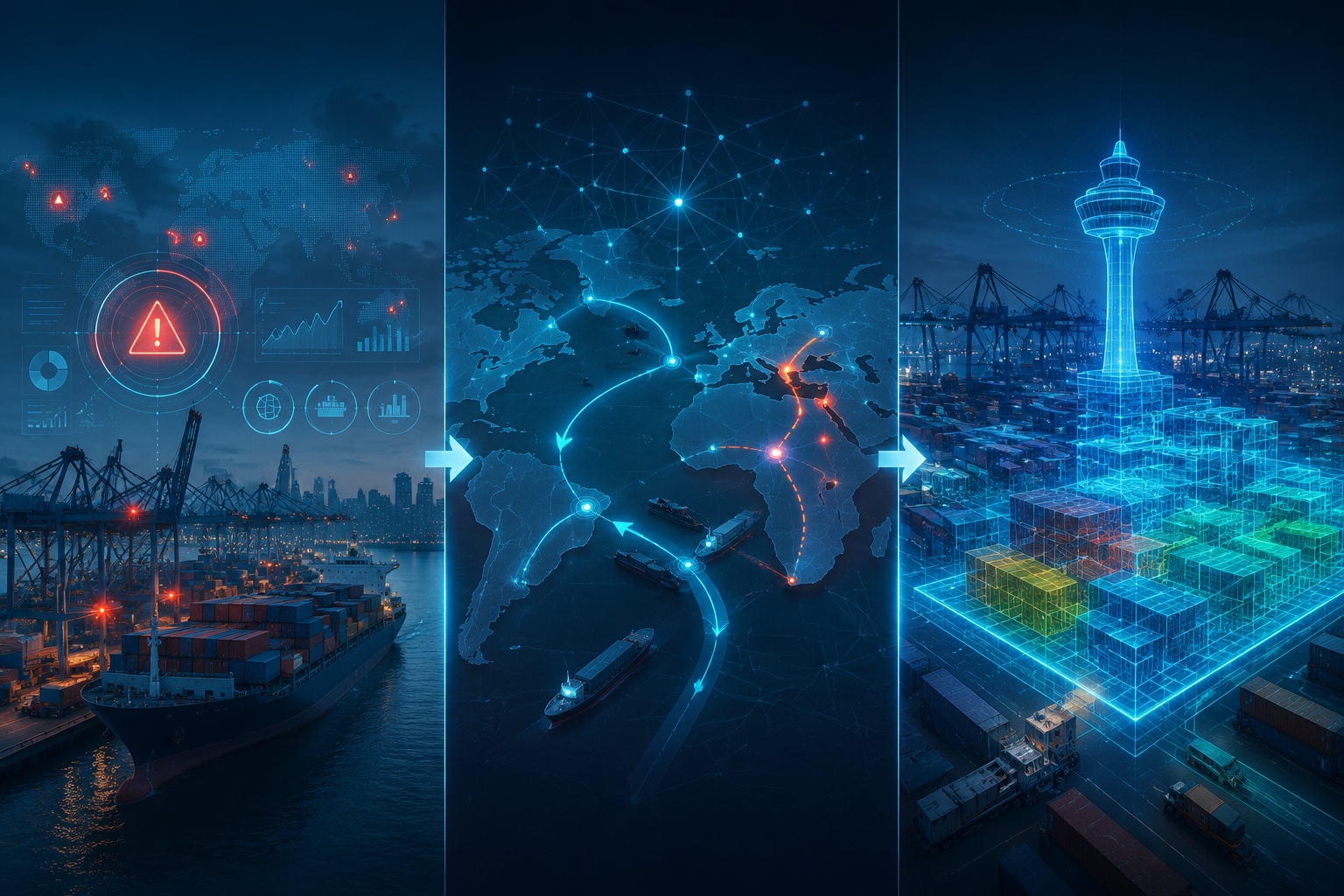
A strike response system has to cover three different operating conditions: warning, interruption, and recovery. Each condition asks a different question.
| Strike phase | Operational question | AI capability that matters most |
|---|---|---|
| Before the strike | Which facilities, suppliers, purchase orders, and lanes are exposed if labor talks fail? | NLP early warning, supplier risk scoring, contract-calendar monitoring |
| During the strike | Which shipments should move, wait, reroute, expedite, or be reallocated from inventory? | Agentic orchestration, shipment visibility, mitigation playbooks |
| After reopening | Which containers, berths, drayage moves, rail slots, and customer orders clear first? | Control towers, digital twins, backlog simulation, recovery sequencing |
Why Strikes Behave Differently From Ordinary Disruptions
A storm announces itself through forecasts and physical damage. A cyberattack often appears as a sudden systems failure. A labor strike is different because it is negotiated in public and private at the same time. The risk can be visible for months, uncertain until the final hours, and then sharply binary at the point of execution: the gate works or it does not.
The broader disruption environment gives planners less margin for waiting. Resilinc reported that supply chain disruption notifications increased 38% year over year into 2026, with human-health-related disruptions up 143%.[2] Z2Data’s 2026 risk outlook also treats labor strikes as a distinct active risk category rather than a footnote under generic geopolitical or logistics risk.[3]
The cost curve is also awkward. FourKites, writing ahead of the East and Gulf Coast port strike, modeled rerouting costs at roughly $1,000 to $1,500 per FEU and estimated that some alternate routings could add 10 to 14 days of transit time.[4] That does not automatically mean rerouting is wrong. It means the decision has to be made with a clear view of which orders justify the cost, which customers can tolerate delay, and which lanes will create a second bottleneck somewhere else.
This is where AI earns or loses trust. If it only paints the affected ports red, it is late. If it connects labor signals to supplier exposure, inventory positions, vessel ETAs, drayage capacity, and customer commitments, it can change the sequence of decisions before the expensive part begins.
Before the Walkout: NLP Turns Labor Signals Into Planning Time
The pre-strike phase is not about predicting human behavior with false precision. It is about noticing credible signals early enough that procurement, logistics, and customer teams can act without inventing a crisis in the final week.
Bronson.AI describes an NLP-driven resilience framework that ingests union publications, labor board filings, contract expiry calendars, regional news, and similar sources to generate probabilistic disruption alerts.[5] Those sources matter because many ordinary risk dashboards over-index on weather, carrier status, and macro news while underweighting the labor calendar that operations teams eventually live by.
A useful alert is not simply “strike possible.” It should narrow the blast radius. Which supplier sites feed through the exposed port range? Which parts have no substitute lane? Which purchase orders are still movable? Which customers have service-level commitments that make a two-week delay commercially different from a five-day delay?
The practical output is a ranked worklist, not a news summary. Supplier risk scoring should absorb the labor signal and push the highest-consequence nodes forward: sole-source components, seasonal inventory, constrained production inputs, launch-critical freight, and orders already sitting inside a carrier cutoff window. That is where the early warning layer connects to disruption planning.
This is also the phase where the vendor landscape is easiest to overbuy. Control tower providers such as Blue Yonder, FourKites, and Resilinc can help consolidate events and exposure views. Predictive visibility platforms such as Portcast and project44 can help estimate shipment-level consequences. Supplier-risk and monitoring tools can strengthen the signal layer. None of those is automatically a strike-response system unless it can map the alert to actual suppliers, lanes, inventory, and accountable owners.
During the Strike: Agentic AI Is a Coordination Tool, Not a Magic Reroute Button
The middle phase is where vague AI claims become dangerous. Once a strike starts, every reroute competes with other shippers’ reroutes. Alternate ports fill. Truck appointments become scarce. Rail dwell changes. Expedited air capacity disappears first for the products that already had the strongest business case. The question is no longer whether there is disruption; it is who gets the next available option.
Agentic AI, in this context, should mean software that can take an approved objective, identify affected entities, trigger predefined playbooks, and coordinate the next actions across systems. Resilinc says its Disruption Agent autonomously identifies affected sites, parts, and suppliers and launches mitigation playbooks, reducing manual coordination from days to minutes.[6] That is a meaningful workflow claim, but it should be read as an orchestration claim, not proof that the software can independently make every commercial tradeoff a logistics director faces.
In a live port strike, the first useful job for an agentic layer is exposure matching. It should pull the list of shipments booked through the affected ports, join them to purchase orders and sales orders, identify whether the goods are raw materials, finished goods, service parts, or promotional inventory, and flag the downstream facility or customer waiting on each one. That removes hours of spreadsheet stitching when people least have hours to spare.
The second job is controlled option generation. For one shipment, the right answer may be to hold and wait because the customer can absorb the delay. For another, it may be to divert before arrival. For a third, the answer may be to keep the ocean move unchanged and reallocate inventory from a regional warehouse. AI can rank those options only if it has current ETA data, inventory availability, customer priority rules, cost thresholds, and constraints from carriers and forwarders.
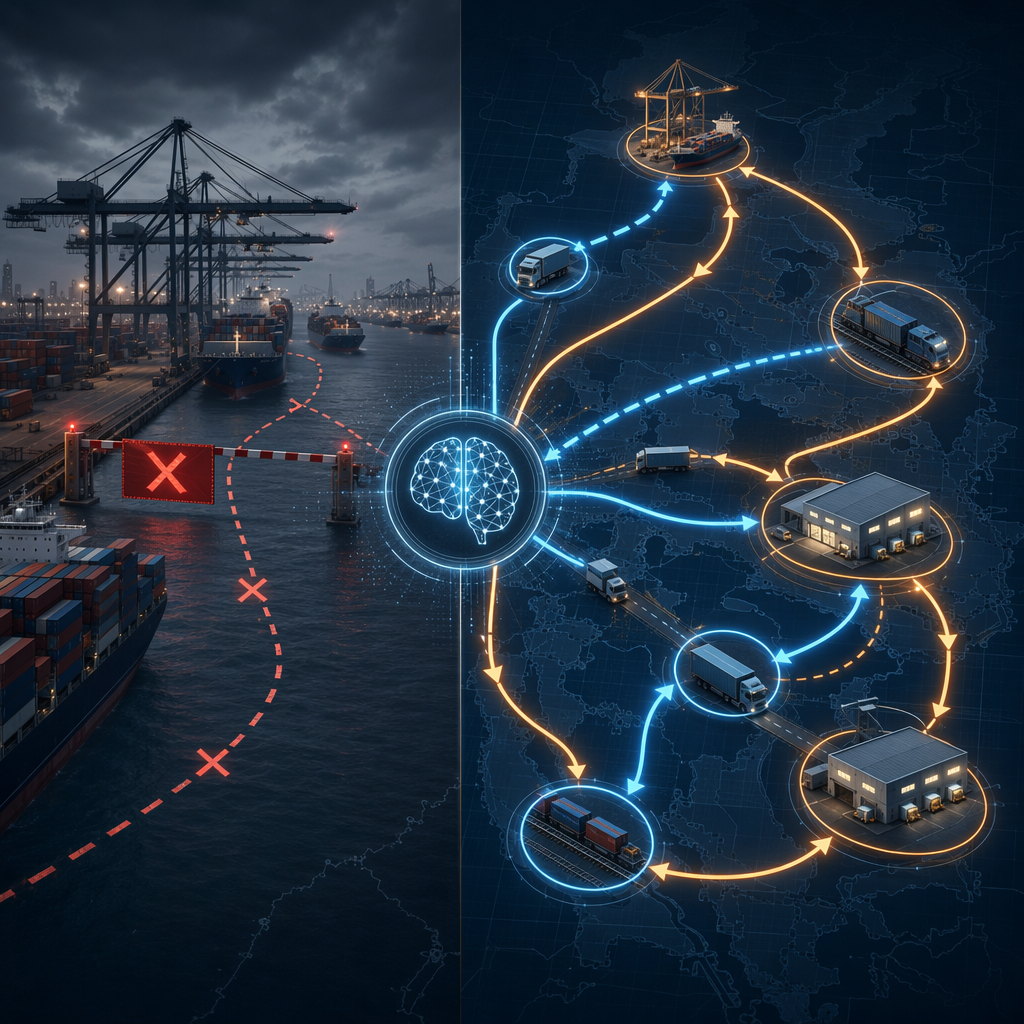
The third job is communication discipline. Strike response breaks down when procurement is asking suppliers for the same updates logistics already received from a forwarder, while customer service promises dates that transportation has not confirmed. An agentic workflow can assign owners, open tasks, request missing confirmations, and update exception records. That is less glamorous than autonomous decision-making, but it is often where the first measurable savings appear.
Some published results point to the kind of activity being reduced. Portcast reports that AI-enabled shipment visibility reduced manual shipment tracking follow-ups by 80% and detention and demurrage charges by 15% in a Siemens-related ocean visibility context.[7][8] Those figures are useful because they correspond to recognizable work: fewer status-chasing emails and calls, fewer late surprises, and better timing around containers that would otherwise sit too long. They are still vendor-published figures, so they should not be treated as portable guarantees across every port network, carrier mix, or operating model.
FourKites’ PFMEA framing is a sober complement to the agentic discussion because it forces teams to map failure modes before the event: which lanes fail first, what the severity is, whether detection is early enough, and which mitigation is already approved.[4] Without that prework, an AI tool can accelerate confusion. It may produce more options than the organization can validate, or recommend moves that finance, sales, or compliance will block.
Adoption interest is clearly rising. ABI Research reported that 65% of supply chain professionals rate AI as important or very important for purchase decisions, and 77% are considering mobile automation.[9] But interest is not the same as operational maturity. A company can buy AI visibility and still lack clean item-location data, current supplier mappings, or decision rights for emergency rerouting.
Dataiku’s 2026 supply chain AI outlook, citing Deloitte and BCG-linked analysis, frames agentic AI as an emerging share of enterprise AI value: 17% in 2025, projected to reach 29% by 2028, with early adopters reporting double-digit efficiency gains.[10] That is a maturity signal, not a strike-response promise. It suggests agentic systems are moving from experimentation toward operating workflows, while leaving open the hard questions: data quality, exception governance, human override, and how much autonomy a company is actually prepared to allow during a labor event.
What the Agent Should Be Allowed to Do
- Automatically identify affected shipments, suppliers, parts, facilities, and customers when a port or terminal becomes unavailable.
- Recommend reroute, hold, expedite, or inventory-reallocation options using approved cost and service rules.
- Open mitigation tasks for logistics, procurement, planning, and customer teams with deadlines tied to vessel cutoffs or appointment windows.
- Escalate decisions that exceed cost thresholds, affect regulated goods, change customer commitments, or require executive approval.
- Record which recommendation was accepted or rejected so the recovery team can see why freight is where it is.
That last record matters later. Post-strike recovery is full of containers that made sense at the time and look irrational two weeks later unless the decision trail is preserved.
After Reopening: The Backlog Is the Event
The most common mistake in strike planning is treating reopening as the end date. Operationally, it is the beginning of a different disruption. The gate may be open, but the terminal is now sorting delayed vessels, stacked containers, chassis shortages, appointment congestion, rail constraints, and customers who all believe their freight should move first.
Sea-Intelligence estimated that one day of port strike activity can require about five days to clear, while a three-day strike can create more than 15 days of backlog.[1] That ratio is the recovery problem in one line: the disruption multiplies after the visible labor action ends.
A control tower helps only if it can move from visibility to sequencing. Seeing all delayed containers is not enough. The recovery team needs to know which boxes should be discharged, drayed, railed, cross-docked, or held in what order, and what happens if a terminal clears import containers faster than inland transport can absorb them.
GEP’s lessons from the 2024 U.S. port strike emphasize AI-powered control towers for recovery tasks such as berth allocation and intermodal balancing.[1] Those are not cosmetic optimizations. A poor berth sequence can leave high-priority cargo behind lower-priority freight. A rail-heavy recovery plan can fail if ramps are already congested. A drayage-heavy plan can burn scarce truck capacity on containers that do not protect revenue, production, or contractual service.
Digital twins matter here because recovery is a sequence of tradeoffs under congestion. Dataiku and Logility describe digital supply chain twins as scenario-modeling environments for testing operating choices before committing them.[10] In a strike recovery window, that means simulating what happens if the company prioritizes production inputs over finished goods, diverts rail volume to truck, extends warehouse receiving hours, or changes allocation rules for constrained inventory.
The value is not that the twin predicts the future perfectly. It exposes collisions before they become calls from the terminal. A recovery scenario may show that clearing containers faster than a distribution center can receive them simply transfers detention risk from the port to the yard. Another may show that expediting every premium customer order delays a factory input that stops a line. The model gives teams a place to argue with consequences visible.
Predictive ocean visibility feeds that model. If a platform can update arrival estimates, transshipment changes, port congestion, and container milestones, the recovery plan can be recalculated as the backlog moves. Siemens’ discussion of smarter sea freight and Portcast’s ocean visibility claims both point toward this operating pattern, though their quantified outcomes remain vendor-published and should be validated against a buyer’s own lanes and exception history.[7][8]
Recovery Decisions AI Can Help Sequence
- Which vessels or services receive priority attention when berth capacity is constrained.
- Which containers should move first based on production impact, customer promise, shelf life, detention exposure, or substitute inventory.
- How much volume should shift among truck, rail, transload, and temporary storage.
- Where warehouse receiving hours, labor scheduling, and yard capacity become the next bottleneck.
- Which customer commitments should be revised first because the recovery model no longer supports the original date.
This is where a control tower architecture deserves close scrutiny. A display layer can show the backlog. A decision layer can test options. An orchestration layer can assign work and update systems. Many products use similar language, but strike recovery exposes the difference quickly because every day of delay produces new cost, capacity, and customer consequences.
How to Read Vendor Claims Without Throwing Them Away
Vendor evidence is not useless. It is just not the same as independent proof across all operating conditions. The strongest claims are the ones tied to a specific workflow: fewer manual follow-ups, faster exposure mapping, reduced detention events, improved ETA accuracy, or shorter coordination cycles. Those can be tested against a company’s own baseline.
The weakest claims are broad statements that imply a platform can “solve disruption” without saying which phase it covers. A labor strike is not one workflow. It is a warning problem, then a flow-interruption problem, then a backlog-recovery problem. A tool may be strong in one phase and thin in the others.
| Vendor category | Where it usually helps | Validation question |
|---|---|---|
| Control towers: Blue Yonder, FourKites, Resilinc | Event visibility, exposure mapping, exception management, recovery coordination | Can the system move from alert display to prioritized action and owner assignment? |
| Predictive visibility: Portcast, project44 | ETA prediction, shipment milestone tracking, congestion awareness | How accurate are predictions on the buyer’s actual lanes during disruption, not normal operations? |
| Agentic and orchestration tooling: Resilinc Disruption Agent, Dataiku-enabled workflows | Mitigation playbooks, task creation, option ranking, cross-functional coordination | Which actions are autonomous, which require approval, and how are rejected recommendations recorded? |
| Supplier risk monitoring and scoring | Pre-strike exposure mapping across suppliers, facilities, and critical materials | Does labor-risk data connect to part numbers, purchase orders, and alternate-source decisions? |
The validation should be practical. Ask for a retrospective replay of a real or representative strike scenario using the company’s lanes, suppliers, inventory rules, and service priorities. The vendor should show what its system would have known two weeks before the strike, what it would have recommended during the shutdown, and how it would have sequenced the first two weeks after reopening.
That replay also reveals missing data. If the system cannot see supplier-site dependencies, the early warning layer will be shallow. If it lacks current shipment milestones, rerouting recommendations will age quickly. If it cannot model warehouse and inland constraints, recovery optimization will stop at the port gate.
The Practical Standard for Strike-Resilience AI
AI can deliver measurable value in strike response, but only when the tool matches the phase. Before a strike, NLP and supplier-risk monitoring are valuable if they turn scattered labor signals into usable planning time. During the strike, agentic AI is valuable if it reduces coordination time and ranks options within approved business rules. After reopening, digital twins and control towers are valuable if they sequence backlog clearance across port, inland, warehouse, and customer constraints.
The standard is not whether a vendor says it has AI. The standard is whether it can prove coverage across the lifecycle: early warning, rerouting, and recovery. A control tower alone does not solve the event. A visibility platform alone does not decide what to do. An agentic layer alone cannot compensate for stale supplier data or unclear approval rights.
For supply chain leaders shortlisting tools in 2026, the cleanest test is phase-specific: show me the alert before the walkout, the decision record during the shutdown, and the backlog sequence after the port reopens.
References
- The 2024 US Port Strike: Key Lessons for Supply Chain Resilience, GEP
- Supply Chain Disruption Is Accelerating into 2026, Resilinc
- 22 Critical Supply Chain Risks to Watch for in 2026, Z2Data
- Looming East and Gulf Coast Port Strike, FourKites
- AI in Supply Chain Resilience: Forecasting Disruptions Before They Hit, Bronson.AI
- Supply Chain Disruption Is Accelerating into 2026, Resilinc
- Impacted by Port Congestion and Shipment Rerouting? Here's How AI Can Help, Portcast
- When sea freight gets smarter, Siemens, September 5, 2025
- Supply Chain Disruptions 2026: How to Build Resilience with AI and Automation, ABI Research
- Supply chain AI trends 2026, Dataiku
Comments
Join the discussion with an anonymous comment.