
The shipment is still green in the transportation dashboard. The purchase order is tied to a production slot, the air waybill has a confirmed booking, and nobody on the supply chain side has received a cancellation notice. But inside the airline network, the picture may already be changing: weather models are shifting, crew legality is tightening, maintenance risk is rising, or an airport flow-control problem is beginning to crowd the schedule.
That is the useful opening for AI supply chain disruption planning around flight cancellations. The value is not that a model can label tomorrow’s schedule as risky with elegant precision. The value is that a planner gets enough time to move a shipment, protect a line, or decide not to burn margin on emergency freight after the cancellation has become everyone’s problem.
Aviation disruption is already expensive inside the airline frame. INFORM Software, citing Wipro and OAG-related figures, places aviation disruption costs at about 8% of revenue, or $60 billion globally, and cites an Airlines for America estimate of about $100.76 for each minute of delay.[1] Those numbers matter, but they are not where the supply chain story ends. A cancelled passenger flight can also mean a missed uplift for cargo, a delayed critical spare, a factory cell waiting on imported components, or a procurement team deciding whether to authorize a premium move before the weekend cutoff.

The cancellation is not the first signal
Many supply chain teams still treat flight disruption information as something that arrives after the airline has made the event official. The exception desk sees the alert, checks whether cargo moved, opens the carrier portal, emails a freight forwarder, and then starts asking the business how much pain a delay will cause. By then, alternative capacity may be gone or materially more expensive.
Airlines are moving earlier than that. A MarketIntelo report says AI-driven weather prediction can reach 85–92% accuracy up to 72 hours ahead, and that predictive models can capture 82–88% of cancellations 24 hours in advance.[2] Those should be treated as reported performance ranges, not as a universal guarantee. Accuracy will vary by geography, carrier network, operational maturity, and data access. Still, the supply chain implication is straightforward: some cancellation risk exists before the official cancellation, and some of that risk is visible enough to support planning.
It is also too narrow to file flight cancellations under weather alone. OAG and Microsoft report that nearly 60% of U.S. flight delays are tied to industry-related causes such as maintenance, crew scheduling, and air traffic control flow rather than weather.[3] That distinction matters because supply chain teams often treat flight disruption as an external shock that cannot be anticipated. Some shocks are genuinely sudden. Others are symptoms of operating systems under stress.
This is where airline-side AI becomes relevant outside the airline. Weather prediction, maintenance forecasting, crew scheduling optimization, airport congestion models, and recovery tools are not supply chain systems by default. But the signals they produce can become supply chain inputs if someone connects them to orders, inventory, service commitments, and alternative transport options.
From airline signal to logistics action
The practical workflow is not complicated in shape. The hard part is making each handoff happen before the exception becomes obvious.
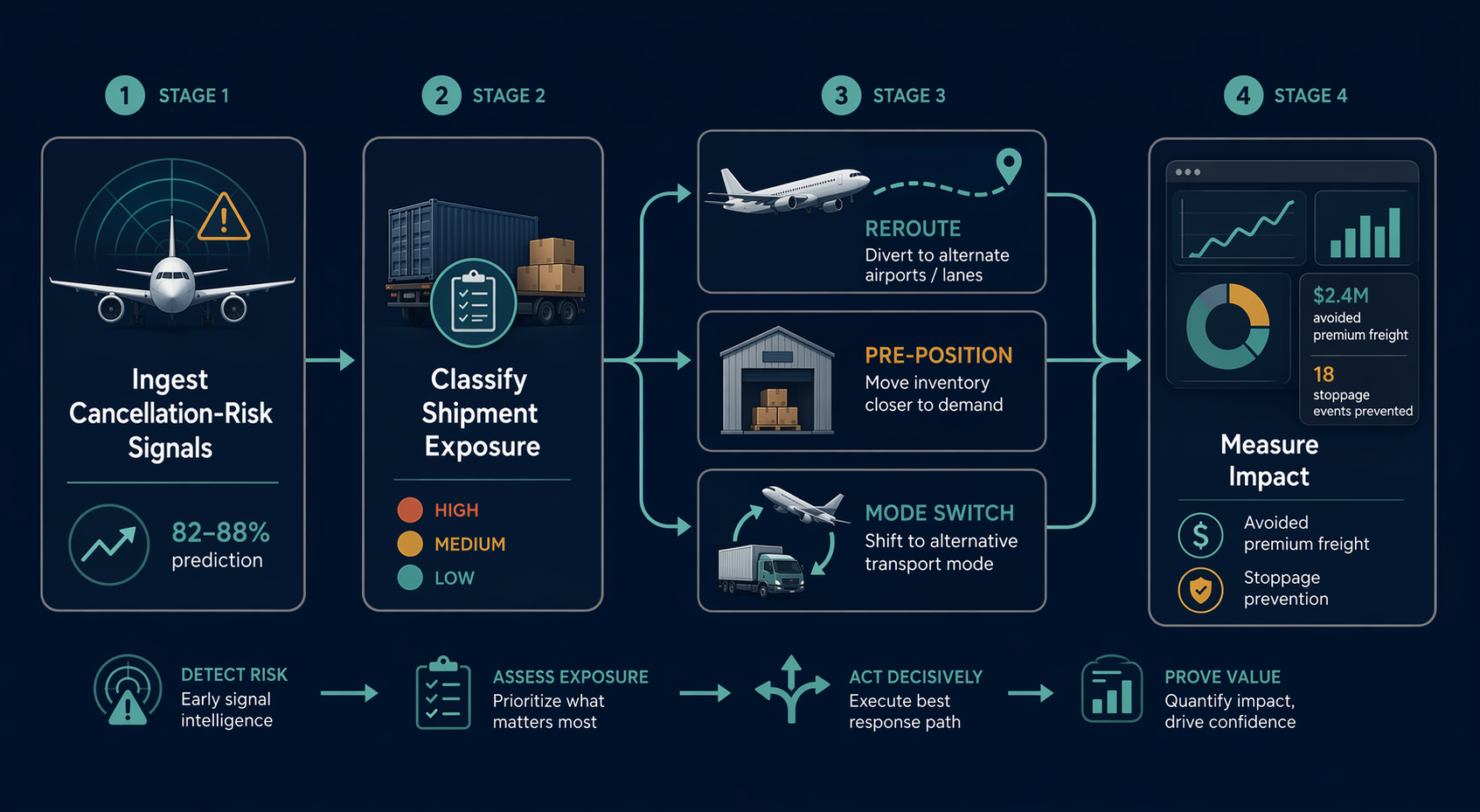
| Planning stage | Operational question | Typical action |
|---|---|---|
| Ingest cancellation-risk signals | Which booked flights or lanes show elevated disruption risk before cancellation is official? | Bring airline, forwarder, airport, weather, and schedule-risk feeds into the transport control tower. |
| Classify shipment exposure | Which shipments on those flights actually matter enough to intervene? | Rank by line-down risk, customer penalty, perishability, inventory coverage, and replacement lead time. |
| Choose a response | Is it better to reroute, pre-position inventory, switch mode, split the shipment, or wait? | Trigger rules that fit cost, time, and operational consequence. |
| Measure impact | Did acting early avoid premium freight, production stoppage, or service failure? | Compare action cost against avoided delay impact and escalation cost. |
Ingest the risk, not just the cancellation
A useful feed is not only a cancelled-flight alert. It includes probability, confidence, time horizon, affected airport pair, reason code where available, and expected recovery pressure. A shipment booked on a flight with elevated cancellation risk is not automatically an emergency. It is a candidate for review.
This is also where many programs fail quietly. The disruption signal may live with the airline, a travel-operations platform, a freight forwarder, a weather provider, or a control-tower vendor. The order consequence lives somewhere else: ERP, production planning, warehouse management, inventory planning, or a spreadsheet maintained by the exception team. If those two worlds do not meet, the AI signal remains an aviation improvement rather than a supply chain capability.
Classify exposure before anyone starts calling
The next step is to separate flight risk from shipment risk. A high cancellation probability on a noncritical replenishment shipment may deserve monitoring. A moderate risk on a shipment that feeds a production launch may deserve action. The ranking should come from business consequence, not from the flight score alone.
- Production exposure: Does the shipment support a line, maintenance event, launch build, or customer commitment?
- Inventory coverage: How many hours or days of supply remain at the consuming location?
- Substitution options: Can another part, supplier, warehouse, or region cover the gap?
- Transport alternatives: Is there another flight, airport, carrier, charter option, truck bridge, or deferred mode?
- Decision authority: Who can approve extra cost, split shipment, customer notification, or production resequencing?
That classification work should happen while the flight is still technically alive. If the team waits for a final cancellation, every exposed shipment enters the same queue at the same time. The result is familiar: manual triage, unclear authority, and late approval for options that were cheaper a few hours earlier.
Choose the smallest useful intervention
An early warning does not mean every shipment should be rebooked. It gives the team a chance to choose a proportional response. The decision can be as light as notifying a plant that a shipment has moved from normal monitoring to watch status. It can be as expensive as moving cargo through another airport or switching to expedited ground for a regional leg.
| If the shipment is... | And the signal shows... | A reasonable response may be... |
|---|---|---|
| Critical with low inventory coverage | Elevated cancellation risk on the booked flight | Hold alternate air capacity, prepare a reroute, or split the shipment before the official cancellation. |
| Critical but covered by nearby inventory | Moderate flight risk | Pre-position inventory from another node and keep the booked flight under watch. |
| Noncritical replenishment | High flight risk | Delay intervention unless the risk threatens a later consolidation, customer promise, or inventory floor. |
| Time-sensitive but regionally movable | Airport or carrier-specific disruption risk | Switch airport, carrier, or mode if the cost is lower than the expected escalation. |
The most important design choice is not the exact threshold. It is the existence of a rule that names who acts. If a risk score lands in a dashboard and no one owns the decision, the organization has purchased awareness, not resilience.
Measure avoided loss, not model elegance
Supply chain teams do not need to prove that every early action was perfect. They need to know whether the program changes the economics of disruption. That means measuring avoided premium freight, avoided production downtime, avoided missed service commitments, reduced weekend escalation, and fewer manual hours spent chasing shipment status.
This measurement should include false alarms. If a team reroutes too aggressively, it can spend more than it saves. If it waits too often, it preserves transport cost while exposing production or customer service. The operating goal is not maximum action; it is better timing under uncertainty.
Why the cascade belongs in the planning room
The July 2024 CrowdStrike outage made the aviation-to-supply-chain connection visible. Forbes, in coverage from SAP, described how the outage grounded flights globally and created supply-chain ripple effects that lasted days to weeks, including delayed cargo flows after the initial IT incident.[4] The lesson is not that every cancellation becomes a global supply chain event. It is that a flight disruption can outlive the day’s flight board when cargo, inventory, and production schedules are attached to it.
The airline-supply-chain link also runs in the other direction. IATA and Oliver Wyman estimated that supply-chain challenges, including aircraft delivery delays, could cost airlines more than $11 billion in 2025 alone.[5] That figure is about pressure on airlines, not a direct estimate of cargo owners’ losses. It is still a useful reminder that aviation and industrial supply chains are entangled systems. A disruption in one does not stay neatly inside its own industry.
Airline AI investment supports the case, but it should not be overclaimed as supply chain ROI. MarketIntelo reports that comprehensive AI-driven disruption management can reduce flight delays by 12–18% and cut disruption costs by 25–40%.[2] Nitor Infotech says predictive AI can reduce unplanned maintenance events by 30–35%.[6] Those figures describe airline-side operational improvement. A shipper only captures value if those improvements or warnings change a logistics decision before the cost is locked in.
Where this use case is ready, and where it is not
This is not yet a fully standardized supply chain capability. The data interfaces are uneven, airline risk signals are not always exposed cleanly to cargo owners, and model performance ranges should be treated as context-specific. A market report can indicate direction, but it cannot tell a manufacturer whether a given route, carrier, product family, or forwarder relationship is mature enough for automated intervention.
The use case is strongest for organizations that already have three things in place: shipment-level visibility, credible transportation alternatives, and decision rights close enough to operations. Without shipment visibility, the team cannot connect a flight-risk signal to affected orders. Without alternatives, the signal only explains the coming delay. Without decision rights, the planner can see the problem early and still wait for an approval chain to consume the available time.
It is weaker where air freight is occasional, inventory buffers are sufficient, or the cost of intervention is consistently higher than the consequence of delay. In those environments, monitoring may be enough. The point is not to turn every cancellation warning into a premium logistics event. The point is to identify the shipments where waiting for official confirmation is the expensive choice.
A practical operating model
A workable program can start with a narrow lane set rather than a grand control-tower rebuild. Choose air lanes tied to high-value production, critical spares, constrained inventory, or severe customer penalties. Map which flights and airports commonly carry those shipments. Then define the risk signals that will trigger review: cancellation probability, severe delay probability, airport disruption, carrier recovery pressure, or missed connection risk.
The operating rule should be plain enough for an exception desk to use during a busy shift. For example, a hypothetical rule might say: if a shipment supports a line with less than a defined amount of inventory coverage and the booked flight moves above a defined cancellation-risk threshold within the next day, the planner must check alternate uplift and notify the plant before the next decision cutoff. The exact thresholds should come from the company’s cost structure, not from a generic model benchmark.
Procurement belongs in that loop when supplier commitments are affected. Manufacturing belongs in it when production sequencing can absorb a delay. Finance belongs in it when premium freight authority is required. Customer service belongs in it when the promised date is more valuable than the freight budget. Flight cancellation planning becomes useful when it moves beyond the transportation desk and reaches the person who can change the consequence.
- Transportation owns signal monitoring, carrier contact, route alternatives, and freight-cost estimates.
- Planning owns inventory coverage, production impact, and whether a delay can be absorbed.
- Procurement owns supplier escalation and replacement-source options.
- Finance or operations leadership owns premium-cost approval rules.
- Customer-facing teams own notification timing when service commitments are at risk.
The best early pilots will probably be modest. A team may start by flagging only the most critical shipments on a small number of lanes and manually comparing predicted risk against actual outcomes. That is enough to learn whether alerts arrive early enough, whether alternatives exist, and whether the organization acts faster than it did under cancellation-only monitoring.
The loss is often in the lag
AI will not prevent weather, maintenance findings, crew constraints, air traffic flow problems, or IT outages from disrupting flights. It will not make every prediction right. It will not remove the judgment call between paying for an early reroute and waiting for the airline to recover.
But for air-reliant supply chains, the avoidable loss is often not the cancellation itself. It is the lag between the moment disruption risk becomes knowable and the moment the supply chain is allowed to respond. Airline AI signals are becoming good enough to make that lag visible, while many logistics workflows are still built around confirmation after the fact.
References
- A Proactive Approach to Managing Disruptions in Aviation with AI, INFORM Software
- Airline Disruption Management AI Market, MarketIntelo
- AI in Aviation Operations, OAG
- CrowdStrike Outage Creates Ripple Across Global Supply Chain, Forbes/SAP, July 25, 2024
- Supply Chain Challenges to Cost Airlines More Than $11 Billion in 2025, IATA, October 13, 2025
- From Reactive to Predictive: Using AI to Anticipate Flight Disruptions, Nitor Infotech
Comments
Join the discussion with an anonymous comment.