
The hard part of multi-state fleet registration usually does not look hard from outside the department. It looks like renewals, titles, odometer readings, insurance cards, plate transfers, lienholder paperwork, and a calendar. Inside the week, it looks different: one state portal timing out, another asking for a document in a slightly different format, a county requirement that did not matter last year, and a truck that cannot be dispatched because the registration packet is not clean.
That is the practical entry point for AI in fleet vehicle registration logistics. The use case is not AI replacing compliance judgment. It is AI taking over the repeatable registration labor that keeps coordinators in DMV portals and spreadsheets: checking packets, reading title and vehicle data, matching requirements by jurisdiction, tracking renewal windows, and moving routine filings forward while returning questionable cases to a person.
Datagrid says fleet managers can lose 25–30 hours per week manually navigating state DMV portals in multi-state operations, a figure worth taking seriously but not treating as an industry average because it is vendor-reported and likely reflects more complex fleets at the upper end of the burden.[1] The more useful question is narrower: when a fleet already has that kind of portal load, how much of the work is structured enough for automation, and where does human accountability still need to stay visible?

Where the registration week actually leaks time
A fleet registration workflow is a chain of small dependencies. Vehicle data has to be right before a renewal can be trusted. The title status has to be known before a transfer or jurisdiction move can be filed. Insurance, inspection, tax, lienholder, and odometer fields have to agree across systems. Then the packet has to satisfy the state and sometimes county-level requirement that applies to that specific vehicle, location, weight class, use case, and timing window.
The administrative pain is not just typing. It is switching context between portals, finding the current requirement, interpreting an exception, chasing a missing document, and proving after the fact that the filing was not missed. When a registration problem reaches operations, the consequence is rarely described as “administrative inefficiency.” It is a parked vehicle, a delayed route, a customer service problem, or a compliance exposure that someone now has to unwind.
Fleetio, citing CVSA data, puts registration-related downtime at an average cost of $841 per vehicle.[4] That number should not be stretched into a universal cost model, but it does clarify why this workflow deserves attention. Registration is not a back-office nicety when a unit is unavailable or a driver is exposed to an avoidable stop.
What AI changes in the workflow
The strongest registration automation pattern combines three capabilities. Agentic AI handles portal navigation and task execution. Document intelligence reads, classifies, and validates registration packets. Rules engines map vehicle and jurisdiction data against state and county requirements. For the broader logistics pattern behind autonomous task execution, see agentic AI in logistics; for the reasoning layer behind multi-rule decisions, see AI reasoning in supply chain problem solving.
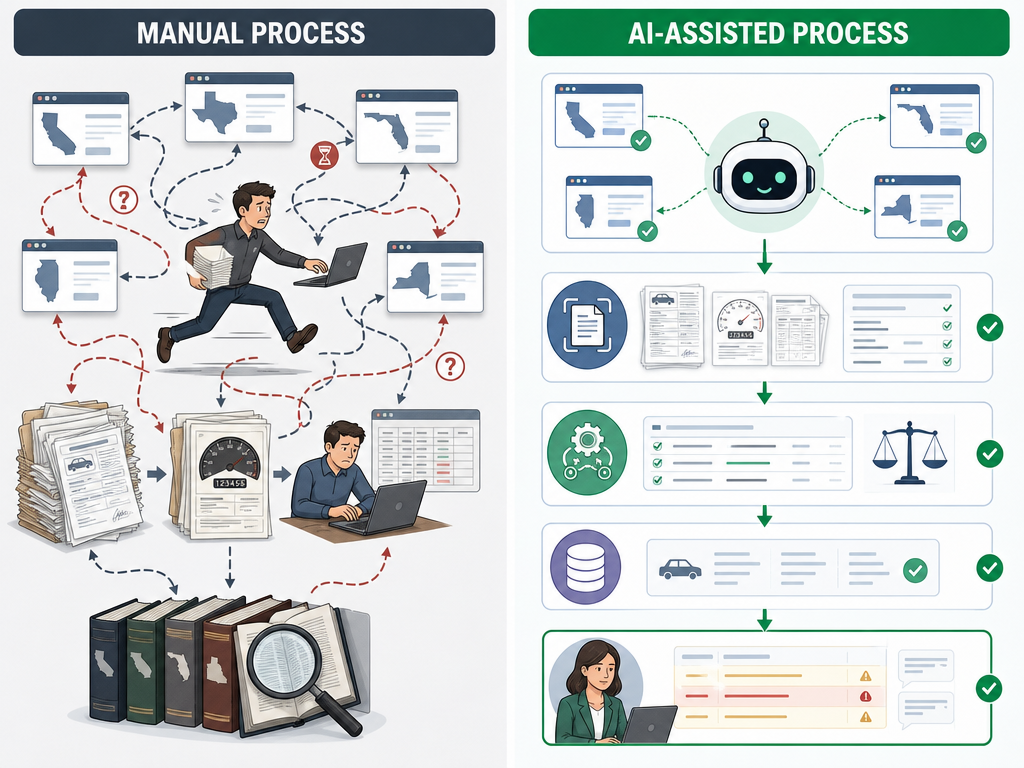
In registration logistics, those capabilities matter only if they reduce specific handoffs. A useful system should be able to identify which vehicles are entering a renewal window, assemble the required packet, validate fields against trusted source data, submit or stage work in the appropriate portal, monitor status, and flag exceptions with enough context for a compliance owner to act.
| Workflow area | Manual burden | AI-assisted change | Human role that should remain |
|---|---|---|---|
| Renewal tracking | Calendars, spreadsheets, reminders, and status checks across states | Prioritizes renewals by deadline, jurisdiction, and missing data | Own deadline policy, escalation rules, and final accountability |
| Portal navigation | Repeated logins, state-specific forms, status checks, and submissions | Agents navigate routine portal steps and return failures or ambiguous cases | Review access controls, exceptions, and any filing that creates compliance exposure |
| Document collection | Chasing insurance, title, inspection, lienholder, and vehicle documents | Classifies documents and detects missing or inconsistent packet elements | Resolve unavailable documents and approve substitutions |
| Odometer and vehicle data | Manual comparison of readings, VINs, plates, garaging locations, and title fields | Validates routine fields against source systems and flags mismatches | Investigate discrepancies and decide whether the record is trustworthy |
| Jurisdiction rules | Manual lookup of state, county, vehicle class, and timing requirements | Applies maintained rules to determine packet requirements and renewal logic | Challenge rules that conflict with agency guidance or operational reality |
| Exception handling | Email chains, rework, unclear ownership, and late discovery | Routes exceptions with reason codes and supporting context | Make judgment calls and document the decision trail |
That last column is not a formality. If a vendor demo makes every DMV variation disappear, the demo is probably skipping the part where fleets actually get hurt: authentication problems, stale vehicle master data, a title record that does not match the operating unit, a portal field that changed, or a county-level requirement that sits just outside the neat state rule.
The evidence is promising, but mostly vendor-reported
The central claim in this use case is a 70–85% reduction in manual portal navigation time. That range is plausible for fleets with enough repeatable, multi-state activity, but the public evidence base is still weighted toward vendors rather than independent audits. The numbers are still useful if they are read as scoped operating claims, not neutral benchmarks.
| Claim | Source | What it appears to measure | How to read it |
|---|---|---|---|
| 25–30 hours per week spent manually navigating state DMV portals | Datagrid | Reported labor burden for multi-state registration and title work | Vendor-reported estimate; useful as an upper-bound signal for complex fleets, not an industry average |
| Autonomous navigation across all 50 state DMV portals | Datagrid | Agentic AI capability across state portal workflows | Capability signal; implementation still depends on authentication, portal change management, and exception handling |
| 6x productivity increase in title and registration processing | Fairway | Throughput improvement in title/registration work | Vendor-published metric; directional evidence, not independently audited proof |
| 50-state and 3,144-county rules coverage with real-time regulatory updates | Fairway | Rules engine coverage for jurisdiction-specific requirements | Important scope claim; buyers still need to test their own vehicle classes, counties, and document edge cases |
| Compliance staff time reduced from 20+ hours per week to 3–5 hours of oversight | FleetRabbit | Shift from manual compliance work to oversight | Useful because it describes the new work shape, but still vendor-reported |
| Odometer validation and registration-risk identification with more than 99% accuracy on routine approvals | Wheels | Machine learning performance on routine approval workflows | Promising for low-risk cases; does not remove review needs for abnormal filings |
Fairway reports a 6x productivity increase in title and registration processing, a 50-state rules engine covering all 3,144 counties with real-time regulatory updates, and AI that catches compliance errors twice as effectively as manual review.[2] Those are exactly the kinds of claims a fleet leader should put into a pilot scorecard, but they should be tested against the buyer’s own packet quality and jurisdiction mix.
FleetRabbit reports that AI compliance automation reduced staff time from more than 20 hours per week to 3–5 hours per week of oversight.[3] That is one of the more operationally believable ways to describe the change. The work does not vanish. It becomes supervision, exception review, deadline monitoring, and cleanup of the records that automation cannot safely resolve.
Wheels says its machine learning program validates odometer readings and identifies registration risks with more than 99% accuracy on routine approvals.[5] The phrase “routine approvals” matters. High accuracy on normal cases is valuable precisely because it lets people spend less time rubber-stamping clean work and more time on records that deserve attention.
State variability is the real test
A 50-state claim is a starting point, not the finish line. Fleet registration is state-by-state work, but it is also county-by-county, portal-by-portal, document-by-document work. Two fleets can both operate in the same states and still have different registration exposure because their vehicle classes, garaging locations, title histories, inspection requirements, acquisition channels, and replacement cycles differ.
Datagrid says AI agents can autonomously navigate all 50 state DMV portals, including unique authentication, document formats, and processing procedures.[1] Fairway says its rules coverage spans all 50 states and 3,144 counties.[2] Those are meaningful capability signals because the portal and rules burden is exactly where registration staff lose time. But neither claim should be translated into “state complexity eliminated.” Complexity that leaves the coordinator’s screen often reappears in system maintenance, data mapping, credentials, exception queues, and audit trails.
Authentication alone can decide whether an agent is practical. Some agencies require account structures, credentials, payment processes, or verification steps that do not behave like a clean API. Legacy fleet systems add another layer: if garaging location, VIN, plate, odometer, title, and operating unit data are inconsistent, the AI will process uncertainty faster unless the workflow is designed to stop it.
Document format variation is just as important. Registration packets include scanned forms, PDFs, images, insurer documents, inspection records, title documents, and agency notices. Document intelligence can reduce the manual read-and-check burden, but the buyer still needs a standard for confidence thresholds: which mismatches can be auto-corrected, which can be queued for review, and which must block filing.
A useful example, not a universal proof
Fairway reports a South Carolina title processing case with a 65% reduction in title processing time.[2] That is a concrete proof point, especially because title processing is often where clean registration schedules get slowed down. It should not be treated as proof that every state, fleet, or packet type will see the same result. Its value is more practical: it shows the kind of workflow segment where AI can remove repeated checking and handoffs when the rules and documents are bounded enough.
The before-and-after labor distribution
Before automation, the registration coordinator is often the integration layer. She checks the fleet system, opens the state portal, confirms whether the vehicle is due, checks the packet, looks up the requirement, sends a document request, waits, reopens the portal, submits, saves the confirmation, updates the tracker, and watches for rejection. The same person may also explain to operations why a vehicle that looked ready in the asset system is not legally ready on the road.
After automation, the better version of the job is not passive monitoring. It is reviewing an exception queue that has already separated clean renewals from suspect ones. The system should show why a filing stopped: missing insurance, odometer mismatch, title not found, lienholder issue, county requirement, portal authentication failure, payment problem, or conflicting vehicle status. That reason code is the difference between useful automation and a new black box that compliance staff have to babysit.
| Before AI | After AI, when implemented well |
|---|---|
| Staff manually check renewal calendars and portal status | System prioritizes filings by due date, state, and risk |
| Coordinators repeatedly enter data into state portals | Agents complete routine portal steps or stage them for approval |
| Document problems are found late, often after submission | Packet gaps and field mismatches are flagged before filing |
| Rules research depends on individual experience and current notes | Rules engine applies maintained jurisdiction logic and records the basis |
| Managers learn about trouble when operations escalates | Exception queues expose blocked filings earlier |
| Compliance review is mixed with clerical navigation | Human time shifts toward judgment, approvals, and exception resolution |
That shift explains why the reported 70–85% reduction in manual portal navigation can be plausible without implying a 70–85% reduction in the whole compliance function. Portal navigation is a large, repeatable slice of the work. Compliance accountability is larger than that slice.
Where humans still belong
The safest automation design keeps people close to ambiguous filings. A human should review exceptions where source data conflicts, where the filing changes legal or financial exposure, where a state rejection is unclear, where the title chain is incomplete, or where the system confidence is below an agreed threshold. Automation should reduce the number of cases that reach that desk, not pressure the reviewer to approve what the system cannot explain.
- Keep a named process owner for renewal policy, exception thresholds, and escalation timing.
- Require reason codes for every exception returned to staff.
- Separate routine approval accuracy from performance on unusual title, odometer, or jurisdiction cases.
- Test the system on the states, counties, and vehicle classes that create the most current workload.
- Measure staff time by task type, not only by total registration department hours.
The audit and penalty claims around compliance deserve extra care. FleetRabbit cites FMCSA data in saying only 7% of motor carriers pass DOT audits without a single violation, that the average penalty is $7,155 per case, and that severe cases exceed $125,000.[3] Those figures may be useful as risk context, but they should be verified against FMCSA source material before they are used in a business case as registration-specific exposure. DOT audit risk is broader than registration logistics.
What to validate before shortlisting vendors
At stakeholder-validation stage, the best question is not “Which AI platform is best?” It is whether the registration workload is structured enough, painful enough, and governed enough for automation to pay back without creating a new control problem.
| Validation area | Question to answer |
|---|---|
| State mix | Which states and counties create the most portal time, rejections, or late-cycle pressure? |
| Portal burden | How many hours per week are spent on navigation, status checks, and duplicate entry rather than judgment? |
| Data quality | Are VIN, plate, title, odometer, garaging, insurance, and operating-unit records consistent enough to automate against? |
| Document quality | Which packet elements are missing, scanned poorly, expired, or stored outside the core system? |
| Exception volume | How many filings are routine, and how many require interpretation, agency contact, or management approval? |
| Control model | Who can approve filings, override rules, update credentials, and sign off on exception thresholds? |
The related tax-optimization use case for fleet registration is a separate evaluation path; registration logistics automation should first prove that it can keep vehicles compliant, filings timely, and exception ownership clear. For teams comparing adjacent fleet AI use cases, accident prevention and fleet safety automation sit in a different operational lane from registration compliance, even if both affect availability and risk.
In Q3 2026, the reasonable conclusion is bounded. Fleet vehicle registration logistics is a strong candidate for AI automation when the fleet has meaningful multi-state complexity, clean enough vehicle and title data, and a process owner prepared to govern exceptions. The 70–85% manual portal navigation reduction claim is plausible for the right workload, but the public proof is still vendor-heavy. The next step is not blind adoption; it is testing vendors against the states, portals, documents, and exception patterns that already consume the registration team’s week.
References
- How AI Agents Automate Vehicle Registration and Title Management Across States, Datagrid
- Title & Registration Software for Fleet Management, Fairway
- AI Fleet Compliance Automation | Avoid Missed Deadlines, FleetRabbit
- Fleet Vehicle Licensing, Registration & Insurance Guide, Fleetio
- Wheels Wins Dual AI Excellence Awards, Wheels
Comments
Join the discussion with an anonymous comment.