
The useful moment for AI earthquake safety precautions in supply chains is not a planning meeting and not a dashboard review. It is the narrow interval after a seismic network detects the first, faster P-waves and before damaging shaking reaches a warehouse aisle, port crane, production line, cold-storage room, bank branch, or charging area. In that interval, a warning that waits for a person to read, interpret, and calmly execute a checklist is already weaker than it looks on paper.
Earthquake early warning matters to supply chains because a few seconds can be enough to trigger actions that people cannot perform consistently under stress: stop conveyors, pause automated storage and retrieval systems, open or restrict dock-door movement, close gas valves, isolate chemical lines, park elevators, protect fragile inventory, and push evacuation prompts to the right zones. The California Earthquake Early Warning Program’s 2025 business plan frames the value of warning in those practical terms, estimating $1 billion to $1.5 billion in damage prevention from a single Loma Prieta-scale event against a $17 million annual program budget.[1]
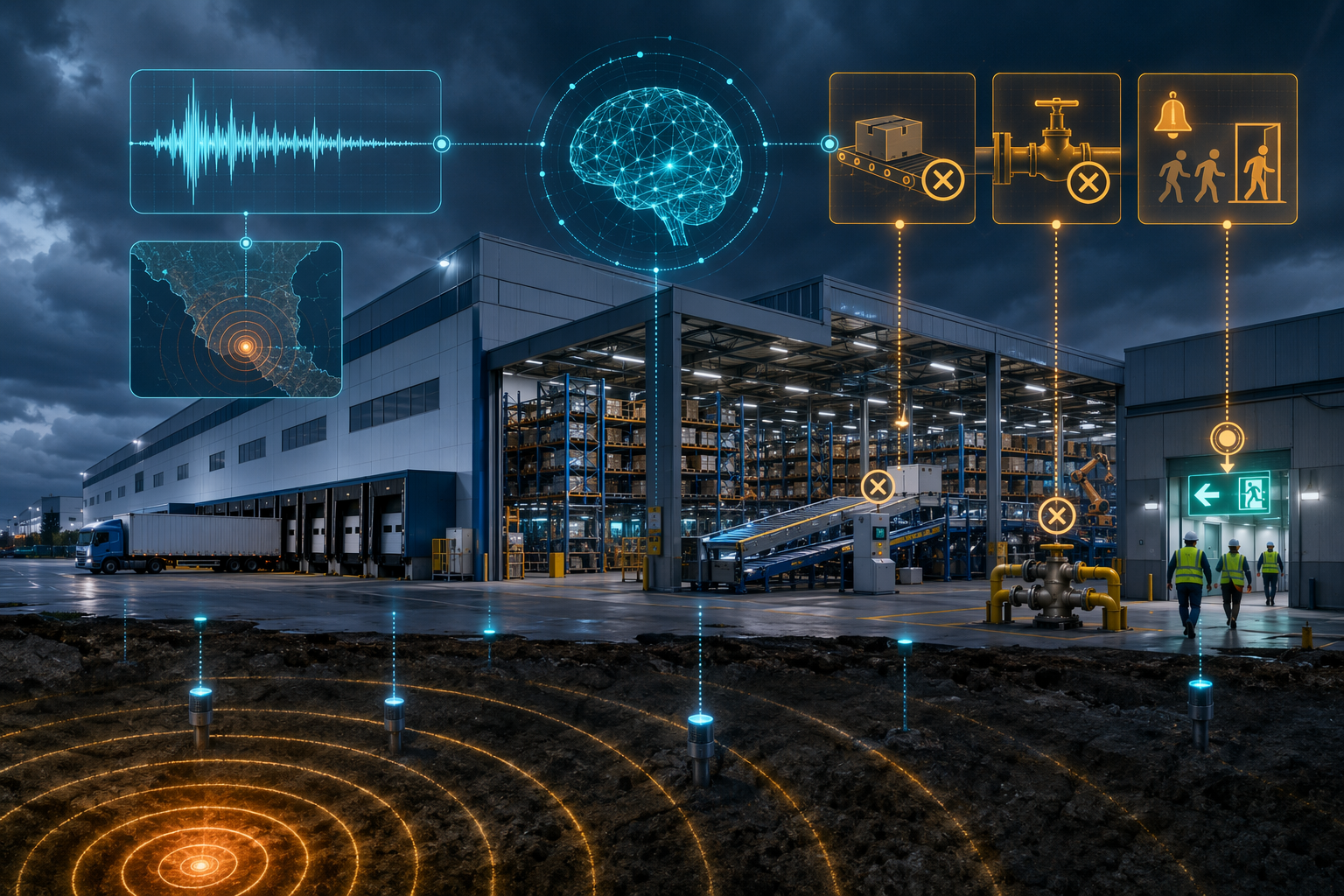
That estimate is not a guarantee for every facility. A wood-frame branch, a high-bay warehouse, a refrigerated distribution center, and a chemical-adjacent manufacturing site have different exposure and different automatic controls available. But the number is useful because it puts the investment question in the right place: not whether AI can produce an impressive earthquake graphic, but whether a warning can be converted into a control action before impact.
Early Warning Is Not Earthquake Prediction
Earthquake prediction and earthquake early warning are often blurred in vendor language and casual coverage. They should not be. Prediction tries to say that an earthquake will happen before it begins, often on a future time horizon of days, weeks, or longer. Early warning starts after an earthquake has already begun. It detects the first seismic energy, estimates what is coming, and sends an alert before stronger shaking arrives elsewhere.
For a supply chain operator, that distinction decides whether a system belongs in research review or in a facility safety design. Prediction may be useful to scientists and long-range planners, but it is not the mature operational control. AI-powered early warning is different because it can be tied to preapproved actions: a relay opens, a programmable logic controller receives a command, a public-address message plays, or a yard protocol changes without waiting for a manager to make a fresh judgment in the shaking window.
This is also where AI earns its place without needing to be theatrical. The system does not have to predict the future in the popular sense. It has to classify incoming seismic signals fast enough, filter noise well enough, estimate likely shaking at the facility well enough, and send the right message to the right control layer.
The Alert-to-Action Chain
A serious earthquake early warning deployment is not just an app alert. It is a chain. Every link has to hold under conditions that are hostile to clear thinking: abnormal vibration, alarms, radio traffic, power uncertainty, and people looking to supervisors for instructions.
| Link in the chain | What it must do | Supply chain implication |
|---|---|---|
| Seismic sensing | Use regional seismic networks, local sensors, or both to detect initial seismic motion | Determines whether the facility is seeing enough signal close enough to the risk |
| P-wave detection and phase picking | Identify the first arriving waves and distinguish useful signal from noise | Creates the warning window before more damaging shaking arrives |
| AI/ML processing | Estimate event characteristics and likely site impact quickly | Reduces dependence on a human interpreting raw data |
| Alert generation | Send warnings to people, devices, and facility systems | Moves the event from awareness to execution |
| Facility integration | Connect alerts to equipment, building systems, and local protocols | Decides whether the warning actually changes physical conditions |
| Automated response | Trigger predefined actions before shaking reaches the site | Protects people first, then reduces secondary damage to assets and flow |
The first half of that chain is where seismic science and machine learning sit. Dense sensor coverage improves the chance that the system sees the event early and from more than one point. Machine learning can help with phase picking, event classification, and rapid filtering, especially when the system is dealing with noisy environments or many incoming signals at once. The second half is where many supply chain projects either become useful or become another alert channel that everyone learns to ignore.
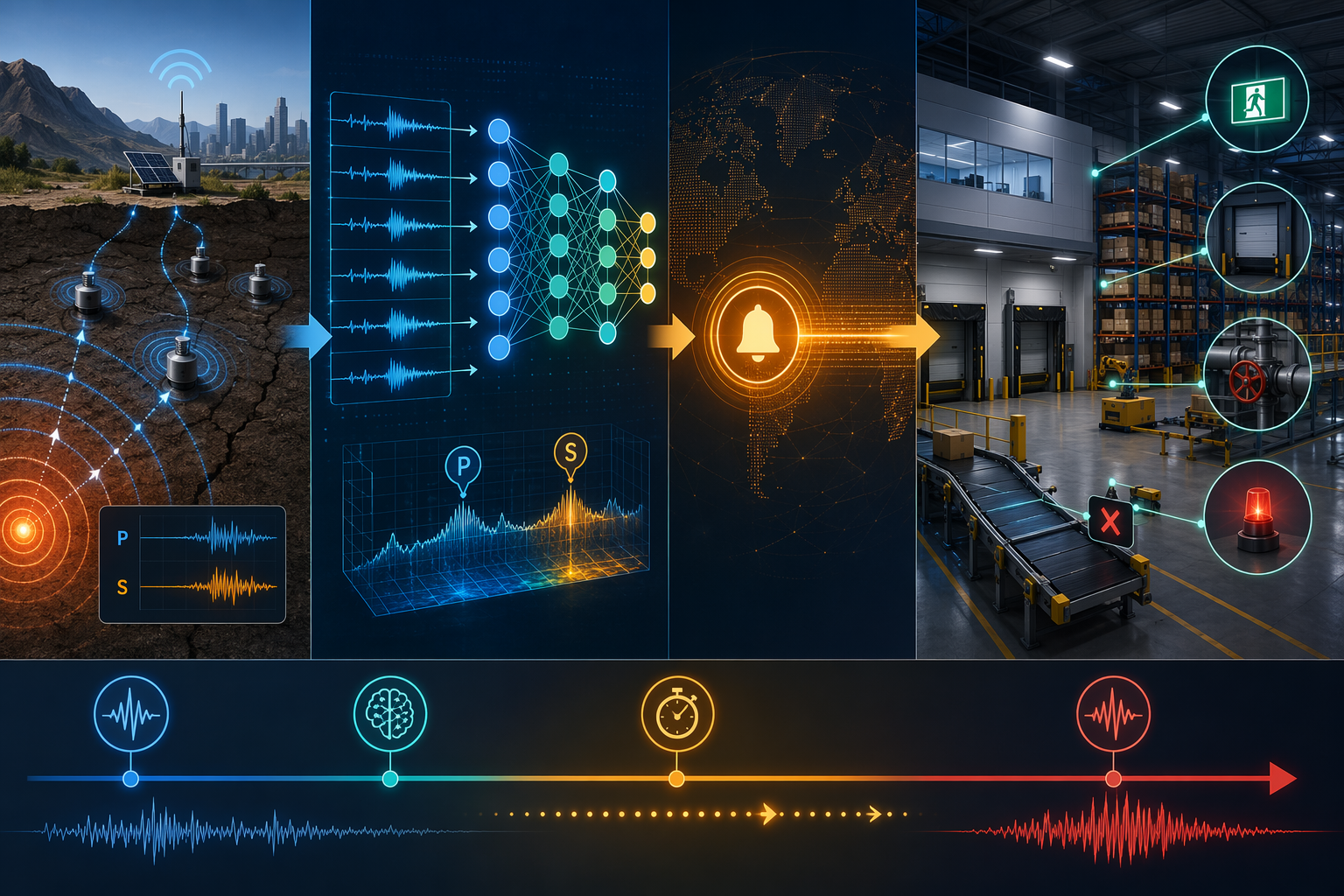
The operational question is blunt: what happens without a person touching a screen? If the answer is only that supervisors receive a message, the system may still help, but it is not exploiting the strongest safety advantage of early warning. A facility that has already mapped warning thresholds to physical actions is in a different position from one that expects a shift lead to improvise during the shortest and most confusing part of the incident.
Where Automation Belongs First
Personnel protection should come before asset protection. That sounds obvious until a project team spends most of its design time on equipment uptime and inventory loss. The first candidates for automation are controls that reduce injury exposure without requiring a worker to evaluate the event: audible and visual alerts, zone-specific evacuation prompts, elevator controls, automated equipment stops, and restrictions on movements that create crush, fall, or collision hazards.
After that, the next layer is secondary-hazard control. Earthquakes do not have to destroy a building to create a supply chain failure. Fires, chemical releases, falling racks, damaged utilities, blocked docks, compromised cold-chain storage, and unsafe forklift movement can do the damage after the first shaking begins. Early warning has value when it reduces those follow-on exposures before they cascade.
- Conveyors and sortation: slow, stop, or put equipment into a safe state before uncontrolled motion creates jams or worker exposure.
- Forklift and charging areas: trigger stop instructions, isolate charging zones where appropriate, and prevent rushed movement near racks.
- Gas, chemical, and utility systems: close valves or shift to safer modes where engineering review has approved the action.
- Dock and yard operations: suspend door cycling, crane movement, trailer positioning, or gate release protocols during the warning window.
- Inventory protection: secure high-value, fragile, hazardous, refrigerated, or regulated goods when the facility has equipment capable of doing so safely.
Some actions should not be automated casually. A gas shutoff can create its own restart hazards. A conveyor stop can trap material in an unsafe position. A dock-door protocol can conflict with evacuation routes. The work is not to automate everything; it is to choose the controls whose failure mode has already been reviewed by safety, engineering, maintenance, and operations.
What Commercial Deployment Already Shows
The strongest evidence for AI-powered earthquake early warning is that it is no longer confined to a lab demonstration. SeismicAI describes a Mexico deployment across hundreds of bank branches in Mexico City and six states, combining regional seismic networks, local sensors, and cloud-based AI algorithms to deliver early warning across a distributed branch footprint.[2]
That matters for supply chain readers because distributed operations are the normal problem. A company may have one large distribution center, several cross-docks, a supplier cluster, a port dependency, and retail or service branches spread across different seismic profiles. A system that has to work across many sites faces harder questions than a single-instrument pilot: which locations get local sensors, which rely on regional networks, how alerts are routed, what thresholds vary by site, and who owns protocol changes after the initial installation.
The same case should still be read with attribution discipline. SeismicAI also cites up to a 50% reduction in non-structural damage, including fires, chemical leaks, and environmental hazards.[2] That is a vendor-claimed outcome, not an independently verified benchmark supplied in the research materials. It is relevant enough to ask about in procurement; it is not strong enough to paste into a board memo as if it applies to every facility.
The California estimate carries a different kind of weight because it comes from a public program business plan rather than a vendor case study. It is still an estimate, and it is tied to a Loma Prieta-scale scenario rather than a universal ROI formula. But for enterprises trying to justify investment, it supports the basic economic logic: if warning can reduce injury, non-structural damage, utility-triggered losses, and operational disruption, then the benefit is not limited to whether the main structure remains standing.[1]
Why the ROI Depends on the Protocol, Not the Alert
A warning message has almost no standalone ROI. The return comes from the avoided consequence of a specific action: a worker not standing beside moving equipment, a valve closed before a line breaks, a crane stopped before uncontrolled movement, a hazardous area isolated before people move through it, or a fragile inventory zone placed into a safer state.
This is where earthquake early warning differs from many AI risk tools used in supply chain management. RAND’s 2025 disaster-management analysis places AI applications across categories including predictive analytics, computer vision, natural language processing and generative AI, robotics, recommendation systems, and fraud detection.[3] Many of those tools help people understand or prioritize a disaster. EEW earns attention because it can also act inside the event window.
That does not make longer-horizon tools irrelevant. Multi-tier supplier mapping, post-event impact assessment, and recovery prioritization still matter after shaking stops; for a deeper look at post-event supplier impact assessment, see our article on AI earthquake risk monitoring. The difference is timing. Early warning is one of the few AI-supported earthquake controls that can change physical conditions before the damaging waves arrive.
A useful ROI model should therefore start with facility-specific actions, not market-size slides. List the automated controls the site can actually execute. Identify the injury, damage, downtime, environmental, compliance, and restart risks each control reduces. Then separate hard assumptions from softer ones. A government scenario estimate, a vendor case study, an insurance discussion, and an internal loss history do not carry the same evidentiary weight.
How to Evaluate Fit for a Supply Chain Facility
The right evaluation starts with geography and site consequence. A facility in a high-seismic region with dense labor, hazardous utilities, tall racking, automated material handling, or time-critical product has a stronger case than a small site with limited equipment and low exposure. Supplier and logistics nodes also deserve attention when their failure would stop flow across a wider network.
- Sensor coverage: Ask whether the site depends on public or regional networks, local sensors, or a hybrid design, and what happens if one input is unavailable.
- Alert latency: Ask how quickly the system detects, processes, and distributes alerts, and how latency is measured from sensor detection to facility receipt.
- Threshold design: Ask which shaking levels trigger which actions, and whether thresholds differ by building, process, equipment type, or occupancy.
- Integration path: Ask how alerts connect to PLCs, building management systems, access control, public address, mobile alerts, emergency lighting, valves, and equipment controls.
- Failure behavior: Ask what the system does during network loss, power disruption, false alerts, missed alerts, maintenance windows, and sensor faults.
- Evidence source: Ask which ROI claims come from public-sector estimates, independent studies, customer deployments, or vendor modeling.
Procurement should include the people who will live with the result: the safety officer, maintenance lead, facilities engineer, IT or OT security owner, operations manager, and floor supervisors. If the system will touch automated equipment, the review cannot be only an emergency-management purchase. It becomes a control-system change.
Drills should test the chain, not the slide deck. A tabletop exercise can confirm roles, but the meaningful test is whether alerts reach the correct zones, whether equipment responds as intended, whether workers understand the audible and visual cues, whether supervisors know when not to override, and whether restart procedures are safer than the shutdown.
A Practical Selection Test
A buyer can cut through a lot of vague AI language with one exercise: pick three facility-specific earthquake consequences and ask the vendor to trace each one backward through the system. For example, if the consequence is a fire risk from a utility break, the trace should show the sensor input, alert threshold, decision logic, command path, valve or system response, human notification, exception handling, and restart protocol.
If that trace becomes hand-waving at the integration layer, the system may still be useful for awareness, but it is not yet a strong automated safety precaution. If the trace is specific, testable, and owned by named functions inside the company, the project has moved from earthquake information to earthquake control.
What EEW Cannot Do
Earthquake early warning cannot stop an earthquake, and it cannot make an unsafe structure safe. It should not be used to excuse weak seismic bracing, poor rack anchoring, blocked evacuation routes, neglected utility maintenance, or incomplete business continuity planning. If a building is not fit for the hazard, an alert will not redeem it.
It also cannot guarantee useful warning for every event at every site. The available window depends on where the earthquake starts, how fast detection and processing occur, how far the facility is from the source, and how the alert is distributed. A nearby rupture may provide little or no useful time. A more distant event may provide enough time for several automated actions. That variability has to be built into training and protocol design.
False alerts and missed alerts also have to be discussed before deployment, not after the first uncomfortable incident. A false stop in a distribution center can create restart work, service delays, and trust issues. A missed alert can create the worse problem: a safety system that people believed would act but did not. The answer is not to avoid automation; it is to choose actions whose safety value justifies the interruption and to monitor performance honestly.
The Adoption Judgment in Q3 2026
For supply chain earthquake risk, AI-powered early warning is the most mature AI safety precaution available in Q3 2026 because it has a deployable operating pattern: detect early seismic waves, process the signal quickly, send a site-relevant alert, and trigger preconfigured controls before people can reliably make and execute the same decisions.
The case is strongest where the warning is wired into actions that protect people first and reduce secondary damage second. It is weakest where AI is treated as a smarter notification layer with no authority to change the physical state of the facility. The difference will be obvious in the first drill: either something stops, closes, isolates, warns, or protects, or the system has merely added another message to the worst seconds of the day.
AI-powered EEW is not earthquake prediction and cannot prevent structural collapse. Its value is narrower and more useful than that: it converts a brief warning window into safety actions human teams cannot reliably execute fast enough.
References
- California EEW Program Annual Business Plan 2025 Update, Cal OES, 2025.
- Making Mexico Seismically Safer, SeismicAI.
- How AI Is Changing Our Approach to Disasters, RAND, August 2025.
Comments
Join the discussion with an anonymous comment.