
After Hurricane Katrina, the most useful number was not the headline estimate of waste. It was the recovery gap. A Senate Homeland Security and Governmental Affairs Committee hearing described FEMA as having potentially lost more than $1 billion to fraudulent or improper payments, while recovering only about $7 million.[1] That is the old failure mode for disaster relief funding: money moves fast, documentation arrives unevenly, field staff are stretched, and by the time investigators can assemble a case, most of the practical leverage is gone.
That is why AI in disaster relief funding is not a technology story first. It is a controls story. The question is whether machine learning can surface the right claims, payments, identities, documents, and networks early enough for human reviewers to act without turning emergency assistance into a slow-moving audit exercise.
The strongest public evidence does not come from a disaster case. It comes from the U.S. Treasury. In fiscal year 2024, Treasury said its expanded use of machine learning helped prevent and recover more than $4 billion in fraud and improper payments, up from $652.7 million in fiscal year 2023; $1 billion of that FY2024 total came from identifying and prioritizing high-risk check fraud.[2] That does not prove every agency can copy the result. It does prove that federal-scale payment integrity systems can use AI to change the financial outcome, not merely decorate a dashboard.

What Changed Between Katrina and the Current Controls Model
Katrina-era controls were not absent. They were brittle. Programs could require forms, review eligibility, match records, and investigate obvious duplicates. But large disasters create precisely the conditions under which manual control layers fail: high claim volume, damaged records, displaced households, political pressure to pay quickly, and uneven local data.
Machine learning changes the order of work. Instead of asking investigators to inspect a broad population of claims with limited triage, models can rank the claims most likely to require attention. That ranking matters only if it is connected to action: a reviewer queue, a case file, a payment hold, a referral, a recovery process, or a documented override.
Treasury’s FY2024 result is important because it sits inside a mature payment environment. The agency was not describing an experimental chatbot. It was describing machine learning used to identify fraud in payment streams, including check fraud, vendor-like payment risks, and improper-payment patterns at a scale large enough to produce a multibillion-dollar prevention and recovery figure.[2]
That distinction is central for disaster relief. A model that flags suspicious activity has adoption value. A model whose alerts feed actual investigations, holds, denials, referrals, or recoveries has integrity value. Treasury’s public numbers speak to the second category.
The FEMA Hurricane Ida Claim Is Promising, But Not Settled
The more dramatic disaster-specific claim is that FEMA’s AI-assisted fraud detection flagged $2.7 billion in potentially fraudulent Hurricane Ida claims with 92% precision and reduced manual investigator workload by 60%.[3] If verified as a production outcome, those are exactly the deltas relief programs need: fewer low-value reviews, better targeting, and a materially smaller queue for human investigators.
But the sourcing matters. The $2.7 billion, 92% precision, and 60% workload-reduction figures come from a Substack aggregation that cites public materials, not from a primary FEMA performance release.[3] FEMA’s own entry in the DHS AI Use Case Inventory lists the Recovery and Resilience Analytics Division Program Integrity, or RRAD-PI, counter-fraud use case as “pre-deployment” as of February 2026.[4] Those two facts can coexist only with care: the Hurricane Ida figures may reflect testing, retrospective analysis, pilot activity, or a program stage not fully captured in the public inventory, but they should not be treated as a settled, audited FEMA recovery result unless FEMA publishes that status plainly.
Precision also needs translation. A 92% precision rate means that, among items the model flags, 92% are expected to be true positives under the measurement approach used. It does not mean the program recovered 92% of fraudulent money. It does not say how many fraudulent claims were missed. It does not, by itself, say whether applicants were delayed, whether reviewers overrode alerts, or how many cases converted into recoveries.
Still, precision is not a cosmetic metric. In a surge operation, every false positive consumes staff time and can slow a legitimate household or supplier. If a model materially reduces the number of weak leads investigators must touch, it changes the operating room. The analyst is no longer trying to boil the ocean while a payment deadline approaches.
What the Systems Are Actually Looking For
The useful lesson is not that FEMA or Treasury “uses AI.” The useful lesson is the variety of weak signals these systems can combine. FEMA’s RRAD-PI inventory describes more than 18 AI techniques, including natural language processing for documents, network analysis, geospatial anomaly detection, behavioral biometrics, and deepfake detection.[4] In disaster relief, those methods map to distinct control problems.
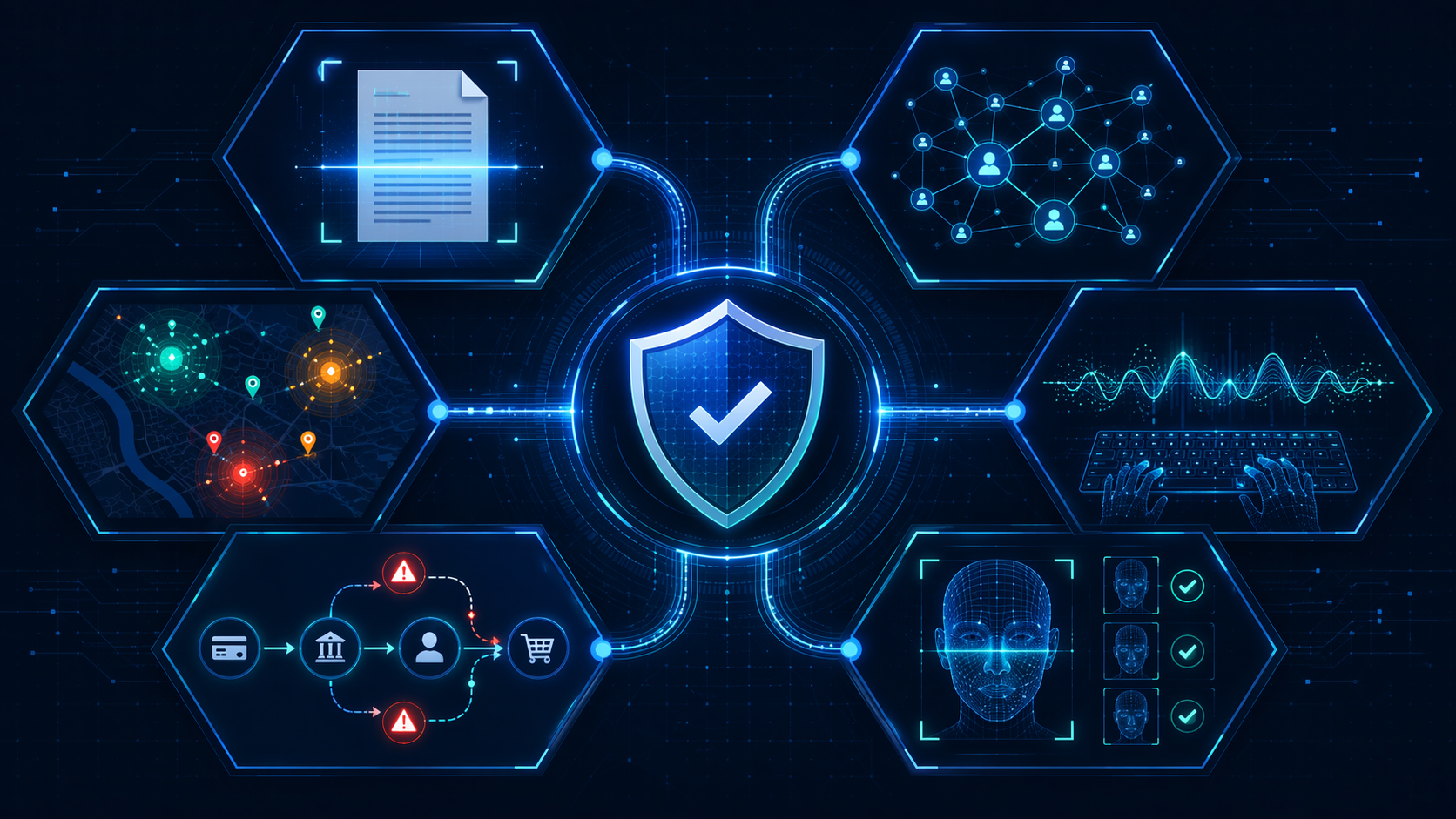
| Detection area | What it can flag in disaster relief funding | Why it matters operationally |
|---|---|---|
| Documents | Inconsistent claims, altered forms, repeated language, missing support, or mismatches between submitted records and program rules | Reviewers can prioritize files where the paperwork itself carries risk signals |
| Identities | Duplicate applicants, suspicious identity attributes, mismatched records, or potential synthetic identities | Programs can reduce duplicate or fabricated claims before payment |
| Geospatial data | Claims that do not align with declared damage areas, property locations, or disaster impact patterns | Field verification and remote review can be directed toward the most anomalous claims |
| Networks | Clusters of related claims, shared contact details, repeated addresses, common bank accounts, or connected intermediaries | Investigators can see organized behavior rather than isolated applications |
| Behavioral and biometric signals | Unusual interaction patterns, identity-verification anomalies, or possible impersonation indicators | High-risk applications can receive additional review without applying the same burden to all applicants |
| Synthetic media | Potentially manipulated images, recordings, or identity artifacts | Programs can challenge suspect evidence before it becomes the basis for payment |
None of those categories is magic. A flood map can be incomplete. A household can have a legitimate reason for shared contact information. A displaced family may submit imperfect documents because the originals were destroyed. The point is not to let the model decide entitlement. The point is to give reviewers a better starting position than chronological order or random sampling.
Commercial procurement fraud tools have used similar supervised and unsupervised methods for years: duplicate-payment detection, vendor relationship mapping, invoice anomaly detection, outlier pricing, and transaction clustering. That transfer is useful, but only up to a point. A disaster applicant is not a supplier in a negotiated sourcing event, and emergency assistance is not simply another spend category. The review posture has to preserve access for legitimate recipients while still protecting public funds.
For teams adapting these methods, the closest internal comparison is often not a fraud product but an analytics workflow: define the risky pattern, connect the right data, rank the exceptions, and route the alert to a decision owner. ChainSignal’s guide to ML-powered spend analytics is a useful parallel for the anomaly-detection layer, though relief programs need more explicit safeguards around eligibility and due process.
Why Alert Quality Matters More Than Dashboard Quality
The investigator’s bottleneck is not awareness that fraud exists. It is the daily question of which file to open next. In a high-volume program, a weak model can make that worse by generating thousands of plausible-looking alerts that staff cannot clear before payments must move.
That is why the reported 60% reduction in manual investigator workload, if confirmed in FEMA’s production environment, would be as important as the $2.7 billion flagged figure.[3] A smaller review queue changes staffing, timing, and escalation. It can let senior investigators handle complex network cases while junior analysts clear lower-risk exceptions. It can also make quality assurance possible because supervisors are no longer sampling from an unmanageable pile.
Precision is the first workload control. Recall is the second. A program that catches only the obvious fraud may look precise but leave too much money exposed. A program that casts too wide a net may catch more suspicious cases but bury the review team. The right balance depends on program rules, payment timing, appeal rights, and the cost of delaying legitimate assistance.
This is where disaster relief differs from ordinary back-office fraud analytics. A false positive is not just an internal inefficiency. It may mean a household waits for rent support, a debris-removal contractor waits for reimbursement, or a local recovery office spends scarce time defending a hold it cannot explain clearly. Automated screening must therefore be paired with documented human review, not treated as a substitute for it.
From Model Output to Recoverable Case
A fraud alert becomes useful only when it enters a governance path. The path does not need to be ornate, but it does need to be explicit:
- The model flags a claim, payment, identity, document, or network based on defined risk features.
- The system assigns a risk score or priority level that determines review urgency.
- A human reviewer sees the underlying indicators, not only a black-box label.
- The reviewer records a decision: clear, request more information, hold, deny, refer, or recover.
- The program tracks whether the alert led to a confirmed outcome and uses that feedback to improve future triage.
Treasury’s FY2024 announcement matters because it reports prevented and recovered dollars, not only detected anomalies.[2] Prevented money and recovered money are not identical. Prevention stops an improper payment before disbursement. Recovery requires finding money after it has left, making a defensible determination, and collecting it. Disaster programs should report those categories separately because they impose different burdens on applicants, agencies, and investigators.
For humanitarian organizations, the same discipline applies. A model that flags a suspicious local vendor network is not the same as a control that prevents diversion. A dashboard showing high-risk partners is not the same as a case process that can suspend, replace, escalate, or remediate them. The control is the full chain from signal to decision.
Organizations building that chain can borrow from phased procurement AI programs, especially where data access, exception routing, and audit trails are introduced before full automation. ChainSignal’s AI in Procurement Implementation roadmap is relevant here because payment-integrity AI fails most often at the handoff between analytics and operating authority.
Data Quality Is a Control, Not a Technical Detail
The hard part in disaster relief is that the data is often worst when the need is highest. Addresses may be damaged or temporarily irrelevant. Household composition may change. Local property records may lag. Applicants may lack reliable connectivity. Suppliers may operate under emergency authorizations that look unusual compared with normal procurement patterns.
A model trained on clean administrative histories can misread that disorder. Shared addresses can indicate fraud, but they can also indicate shelters, relatives, or temporary housing. Rapid changes in bank information can indicate account takeover, but they can also reflect displacement. Geospatial anomalies can expose impossible claims, but they can also reflect mapping errors or incomplete damage assessments.
That is why the review interface matters. Investigators need to see the data elements behind the score: which record matched, which document failed, which location was anomalous, which network link created concern. Without that explanation, the model shifts work from investigation to guesswork.
FEMA’s separate Hazard Mitigation Assistance AI use case is a useful reminder that AI in relief administration is not limited to fraud. DHS says the HMA AI solution reduces document review time by 40% to 70%, saves 15 to 20 analyst hours per week, and identifies eligibility concerns in real time.[4] That is not the same as fraud recovery. It does show how document-heavy relief and mitigation programs can benefit when AI reduces the clerical load and leaves analysts to decide the substantive issue.
What Humanitarian Supply Chains Can Replicate
Humanitarian organizations do not need to copy a federal architecture to learn from it. The replicable pattern is narrower and more practical: combine multiple weak signals, rank risk early, preserve human review, and measure whether alerts become prevented loss, recovered funds, or cleared cases.
The most transferable use cases are usually found where relief funding behaves like a supply chain: cash transfers, emergency procurement, temporary shelter support, debris removal, logistics contracting, beneficiary registration, and partner subawards. Each has a different fraud surface. A cash program may need identity and duplicate-claim controls. A logistics program may need vendor-network and invoice-anomaly controls. A shelter program may need geospatial and documentation checks.
| Relief funding flow | Useful AI control | Decision that must remain accountable |
|---|---|---|
| Cash assistance | Duplicate identity, synthetic identity, account change, and behavioral anomaly detection | Whether to approve, hold, verify, or appeal a payment |
| Emergency procurement | Vendor clustering, invoice outliers, shared banking details, and unusual pricing patterns | Whether to award, pause, investigate, or escalate a supplier |
| Shelter or property claims | Geospatial anomaly detection, document review, and image-consistency checks | Whether damage, occupancy, or eligibility is sufficiently supported |
| Subgrants and partner funding | Network analysis, transaction monitoring, and repeated-control-failure detection | Whether to continue, condition, suspend, or recover funding |
The danger is importing procurement language too casually. “Supplier fraud” and “beneficiary fraud” are not morally or operationally identical categories. Relief systems must assume that many anomalies come from crisis conditions, not bad faith. That assumption does not weaken controls. It makes them more precise.
For government programs, the governance questions are also familiar from broader AI risk management work: who approved the model, what data was used, what bias testing occurred, how alerts are documented, when humans can override, and how affected people challenge decisions. ChainSignal’s coverage of AI governance in government supply chain risk is relevant because the same institutional problem appears here: an AI control is only as credible as the authority structure around it.
The Narrow Claim That the Evidence Supports
Treasury has shown that machine learning can produce federal-scale fraud and improper-payment results: more than $4 billion prevented and recovered in FY2024, including $1 billion tied to check fraud.[2] That is the cleanest evidence in the record.
FEMA’s RRAD-PI inventory shows how a disaster-relief counter-fraud architecture may extend that model across documents, identities, networks, geospatial patterns, biometrics, and synthetic media detection.[4] The Hurricane Ida figures, if later verified by primary FEMA reporting, would make the case more powerful: $2.7 billion in potentially fraudulent claims flagged, 92% precision, and 60% lower manual investigator workload.[3]
Until then, the responsible conclusion is more limited. AI can help protect disaster relief funding when it is embedded in payment controls, case review, recovery authority, and appealable human decisions. It cannot be judged by model claims alone. Production status, data quality, precision, reviewer workload, and confirmed financial outcomes are the evidence that matter.
References
- Hearing Reveals FEMA Potentially Lost Additional Tens of Millions of Dollars, Senate Homeland Security and Governmental Affairs Committee
- U.S. Department of the Treasury Announces Enhanced Fraud Detection Processes Are Expected to Prevent and Recover More Than $4 Billion in Fraud and Improper Payments, U.S. Department of the Treasury, October 2024
- AI Stopped $2.7 Billion in Disaster Fraud, Helfrich, May 2026
- DHS FEMA AI Use Case Inventory, Department of Homeland Security, 2026
Comments
Join the discussion with an anonymous comment.