
The first useful signal in an aircraft supply chain delay is rarely a dramatic one. It is a purchase order revised again, a delivery confirmation that arrives late, a promised shipment that moves from firm to tentative, or a supplier that suddenly needs more time before answering a routine expedite request. By the time that behavior becomes a formal shortage against a production line, the buyer has fewer options: premium freight, allocation fights, engineering substitutions, or an escalation that should have happened weeks earlier.
That is the practical test for AI for aircraft manufacturing supply chain delay: not whether it can draw a prettier dashboard, but whether it can identify supplier delay risk four to eight weeks before the factory feels it. In aerospace, that lead time is not cosmetic. It is the difference between moving demand, qualifying another source, engaging a sub-tier constraint, or simply documenting why the miss was unavoidable.
The pressure behind that test is large enough to overwhelm normal expediting. Bain reported in 2026 that 87% of 15 aerospace and defense programs it studied in the US and Europe cited supplier bottlenecks as the core obstacle to meeting order backlogs, while more than 17,000 aircraft were on order globally.[1] IATA and Oliver Wyman put airline-industry supply chain failure costs at more than $11 billion in 2025, and Roland Berger reported that 64% of aerospace companies still faced an active supply chain disruption that year.[2][3]

The useful warning starts inside procurement records
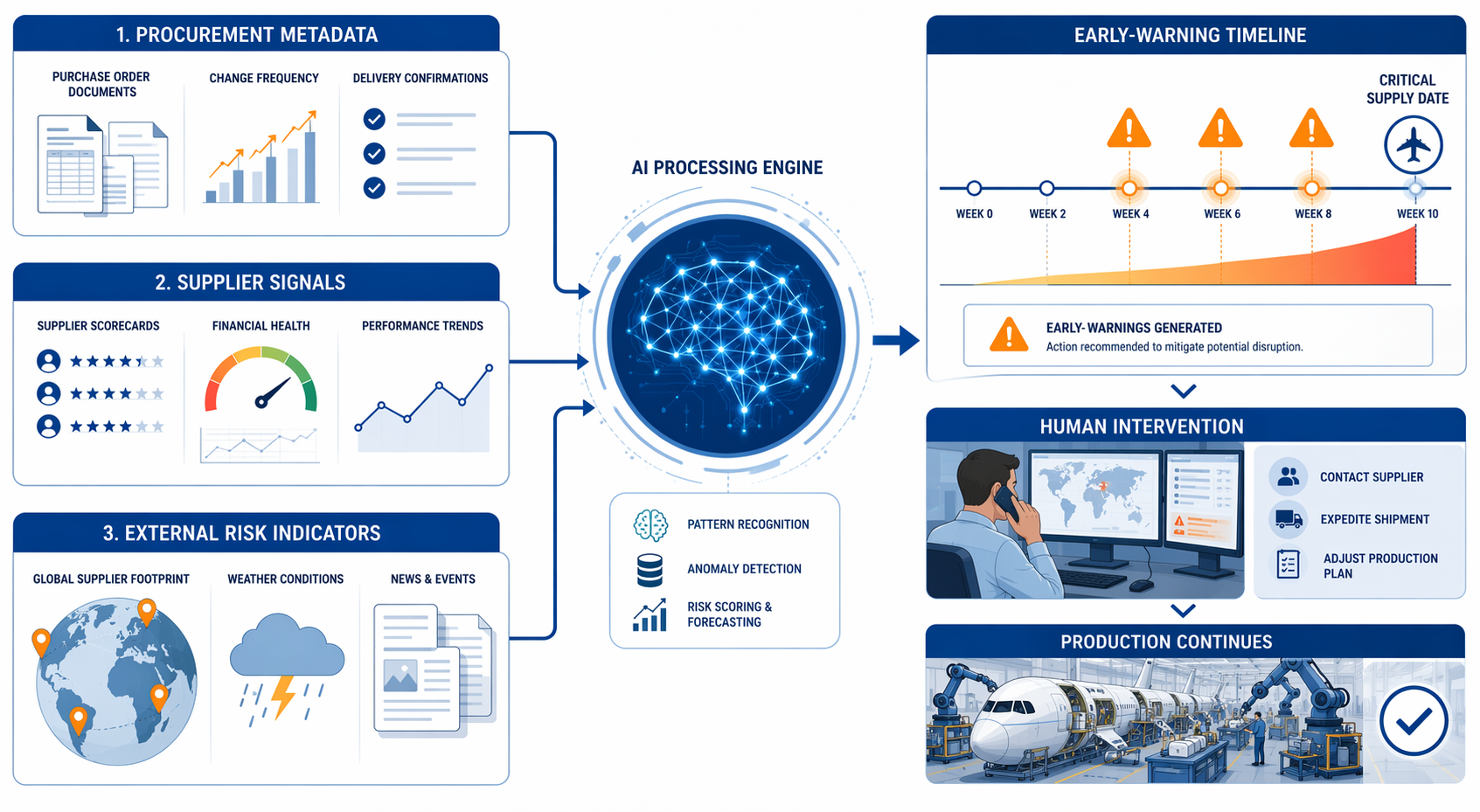
The strongest early-warning systems begin with the work already happening in procurement systems: purchase orders, acknowledgments, promise dates, ship dates, revision histories, supplier records, and delivery performance. A human buyer may notice one late confirmation. A model can compare thousands of ordinary changes against prior delay patterns and flag the combinations that have historically preceded trouble.
PO change frequency is a good example. One revision may mean nothing. A cluster of revisions across the same supplier, commodity, plant, or program can mean something different, especially if the changes move dates outward, split quantities, or repeat close to the original commit date. The warning does not come from the word “late” appearing in a field. It comes from the pattern of hesitation around a commitment.
Delivery confirmations versus actuals carry another signal. A supplier that confirms on time but ships late creates a different risk profile than one that stops confirming cleanly. A part family that repeatedly ships partial quantities may require a different intervention than a single missed truck. AI helps because it can keep the weak signals in view after the daily shortage meeting moves on.
McKinsey describes AI systems using purchase order change frequency, delivery confirmations versus actual performance, and supplier metadata to detect emerging delays earlier than traditional monitoring. In one commercial aerospace OEM case, the company reduced component shortages by 25% using this kind of approach.[4]
| Signal group | What the model watches | Why it matters operationally |
|---|---|---|
| PO behavior | Change frequency, promise-date movement, partial quantities, late acknowledgments | Shows supplier hesitation before a formal shortage appears |
| Supplier performance | Confirmation accuracy, on-time delivery history, recurring expedite patterns | Separates a one-off miss from a deteriorating supply lane |
| Supplier metadata | Commodity, plant, program, part criticality, approved source status | Helps prioritize alerts that can stop aircraft work |
| Financial and external risk | Financial disclosures, news, regulatory filings, geopolitical indicators, weather | Catches risks that do not originate inside the OEM’s ERP |
External signals fill the gap suppliers do not report
ERP data is necessary, but it is not enough for aircraft supply chains where the actual constraint may sit two or three tiers below the contracted supplier. A Tier 1 can be current in the portal while waiting on a casting house, a semiconductor allocation, a special process supplier, or a logistics lane exposed to weather. The OEM may not have direct operational data from those companies, so the model has to work with proxies.
That is where natural-language processing and external risk scanning become useful. Platforms in this category scan news, regulatory filings, financial disclosures, geopolitical signals, and other public or commercial data streams for events that could affect a supplier’s ability to deliver. Fygurs says its aerospace supply chain risk monitoring approach gives procurement teams four to eight weeks of additional lead time compared with reactive monitoring, with benchmark data showing 25% to 40% fewer unplanned supply disruptions.[5]
Those figures should be treated as vendor-reported benchmark evidence, not as audited industry averages. They are still useful because they describe the right operating target: earlier warning and fewer unplanned disruptions. But the number is not portable unless the buyer has enough clean internal data, enough external signal coverage, and enough process discipline to act on the alert.
Weather belongs in this same category. A storm does not become a production problem because it appears on a map. It becomes a production problem when the affected region contains a supplier, a port, a transport lane, or a sub-tier facility tied to a constrained part. The same logic applies to geopolitical and regulatory indicators. The model’s job is to connect the external event to the supplier network and the open demand, not merely announce that something risky happened somewhere.
For related examples of external disruption monitoring outside aircraft manufacturing, see ChainSignal’s work on AI predicting wildfire supply chain disruptions and flood disruption planning. The mechanism is similar: a useful warning ties an outside event to a specific material, supplier, route, or production consequence.
N-tier visibility only matters when someone can intervene
Aerospace leaders have spent years talking about N-tier visibility. The phrase can hide an uncomfortable point: mapping the network is not the same as changing the outcome. A beautiful supplier graph does not recover a late chip, reopen capacity at a special processor, or decide which program gets an allocated part.
Still, the map is valuable when it exposes the dependency early enough. EY describes a defense contractor that used AI-driven supplier insights to expand its visible supplier network from 15,000 to 500,000 relationship nodes, revealing hidden sub-tier dependencies.[6] That kind of expansion matters because many aerospace delays do not originate with the supplier on the purchase order. They originate in the supplier’s supplier, where the OEM has less leverage and less notice.
The better proof is what happens after the hidden dependency appears. McKinsey reports that an aerospace electronics supplier used AI to identify and directly engage sub-tier semiconductor vendors, increasing production throughput by 45%.[4] The intervention is the important part. The company did not stop at discovering the semiconductor constraint; it engaged the sub-tier source directly.
That is the bridge many AI projects underfund. Once the model flags a likely delay, procurement still has to decide who owns the alert, how fast it must be reviewed, what evidence is enough to call the supplier, and when escalation moves from the buyer to supplier development, program management, engineering, or an executive allocation forum.
- A buyer may need to confirm whether the supplier’s promise-date movement reflects real capacity loss or administrative cleanup.
- A supplier-development manager may need to check whether a sub-tier process step has become the actual constraint.
- A planner may need to re-sequence work before the shortage reaches the line.
- A program leader may need to decide whether scarce material goes to one aircraft, one customer, or one certification-critical build.
For a defense-oriented view of this same sub-tier problem, ChainSignal’s article on AI revealing hidden supplier risks in wartime is a useful companion. The common lesson is that sub-tier visibility must be paired with authority to act.
The four-to-eight-week window changes the menu of responses
A shortage found two days before need date usually produces expensive choices. A shortage predicted six weeks out produces different ones. Procurement can ask whether the supplier can protect a partial, whether another approved source has open capacity, whether engineering can approve a substitution, whether demand can be resequenced, or whether the OEM should intervene with a sub-tier supplier before the Tier 1 misses its own commit.
The early-warning workflow is therefore not a single model output. It is a chain of decisions:
- Ingest procurement, supplier, and external risk signals.
- Score delay likelihood against part criticality, open demand, program impact, and available alternatives.
- Route the alert to a human owner who can validate the signal.
- Trigger mitigation: supplier call, allocation decision, alternate source check, engineering review, logistics change, or executive escalation.
- Feed the outcome back into the model so future alerts learn which patterns were real.
That last step is easy to skip and costly to lose. If users cannot mark an alert as valid, false, late, early, resolved, or escalated, the system becomes a broadcast tool rather than a learning loop. Alert governance sounds less exciting than prediction accuracy, but it is what keeps buyers from routing around the system after the first wave of false positives.
Aerospace examples show promise, with different kinds of proof
Not every aerospace AI result is direct evidence of supplier delay prediction. Some cases prove adjacent capabilities: data integration, quality issue resolution, planning improvement, or operational predictability. They matter, but they should not be overstated.
Airbus’s Skywise platform, built with Palantir, is one of the stronger aerospace-specific examples of cross-supply-chain data use. Palantir says Skywise helped cut A350 delivery lead times by 33% through AI-accelerated quality issue resolution across the supply chain.[7] That is not the same claim as predicting every supplier delay. It does show that shared data infrastructure can shorten the time between detecting an operational issue and resolving it.
Embraer’s Smart Planning tool is earlier-stage evidence. Aerospace Tech Review reported that Embraer introduced the AI tool after analyzing 2TB of operational data over 10 months to improve material predictability.[8] The result is relevant because material predictability is the planning side of the same delay problem, but the available evidence comes from a launch-stage report rather than an independent performance audit.
These examples point in the same direction as the procurement-warning cases: aircraft manufacturing does not need AI as a standalone oracle. It needs AI embedded in the operating systems where quality teams, planners, buyers, and supplier managers already make constrained decisions.
What separates a credible warning system from another dashboard
Start with data quality. Aerospace supplier records are often fragmented by program, site, acquisition history, ERP instance, and naming convention. A supplier may appear under multiple legal names. A part may have different planning attributes across sites. A historical delivery problem may be trapped in a local spreadsheet. Models trained on that mess will still produce scores, but the scores may not be trusted enough to change behavior.
ERP and workflow integration come next. If an alert lives outside the system where a buyer reviews open POs, it becomes another tab to check after the urgent work is done. Useful alerts appear in the context of the open order, the supplier record, the part’s demand, the program impact, and the mitigation options available to that role.
Ownership matters just as much. A delay-risk alert needs a service-level expectation: who reviews it, how quickly, what evidence is required, when it gets escalated, and how the outcome is recorded. Without that, the model can be technically right and operationally irrelevant.
Trust is the final separator. Trust does not mean buyers accept every score. It means the system explains enough of its reasoning for a trained user to test it: repeated PO revisions, worsening confirmation accuracy, financial stress signal, weather exposure, or a sub-tier dependency tied to a constrained commodity. A black-box alert that says “high risk” without showing the trail will be ignored when the shortage meeting gets crowded.
The practical judgment
AI can predict certain aircraft manufacturing supply chain delay risks early enough to matter when it combines procurement metadata, supplier performance signals, financial and external risk indicators, and sub-tier relationship data. The evidence is strongest where prediction is tied to intervention: McKinsey’s reported 25% component-shortage reduction at a commercial aerospace OEM, the sub-tier semiconductor engagement that increased throughput by 45%, EY’s expansion of visible supplier relationships, and vendor benchmark claims of four to eight weeks of lead time with 25% to 40% fewer unplanned disruptions.[4][5][6]
The boundary is just as important. These systems do not erase fragmented ERP histories, weak supplier master data, missing Tier 3 operational visibility, or organizations that treat alerts as optional reading. They work best when the warning lands in the buyer’s workflow, has a named human owner, and triggers a real mitigation path before the line discovers the shortage.
References
- Aerospace and Defense: Winning the Race to Scale, Bain & Company, 2026
- IATA press release, IATA, Dec 2025
- Aerospace Supply Chain Report 2025, Roland Berger, 2025
- Addressing continued turbulence: The commercial-aerospace supply chain, McKinsey
- Aerospace Supply Chain Risk Monitoring, Fygurs
- How can digital supply chains help manage aerospace risk?, EY
- Impact: Airbus and Skywise, Palantir
- Embraer introduces AI for supply chain insights, Aerospace Tech Review
Comments
Join the discussion with an anonymous comment.