
The weak point in defense supply chain audit has rarely been the final audit meeting. It is usually the six months before it: supplier files changing hands, certifications expiring quietly, part-origin claims sitting in disconnected systems, proposal assumptions hardening into contract records, and compliance teams trying to reconstruct what happened after the operational decision has already moved on. Periodic, sample-based review can still find problems. It just often finds them after the business has already absorbed the risk.
That is the practical opening for AI for defense supply chain audit. The useful version is not an autonomous machine “passing” an audit. It is a set of models, workflows, logs, and review rights that move detection closer to the transaction flow. Supplier risk is screened while suppliers are active. Documentation is checked while packages are being built. Exceptions are recorded when they occur, not when someone later asks a compliance analyst to explain an old decision from a shared drive.
Guy Beougher, a former Defense Logistics Agency senior executive now advising Seekr and Cypress International, gives the shift a workable frame: demand planning and forecasting, workflow optimization, and audit-process automation. His claim that AI can make the Department of Defense “auditable in a much quicker fashion” is the right kind of claim to test, because it points to time, evidence, and process—not a vague promise of transformation.[1]
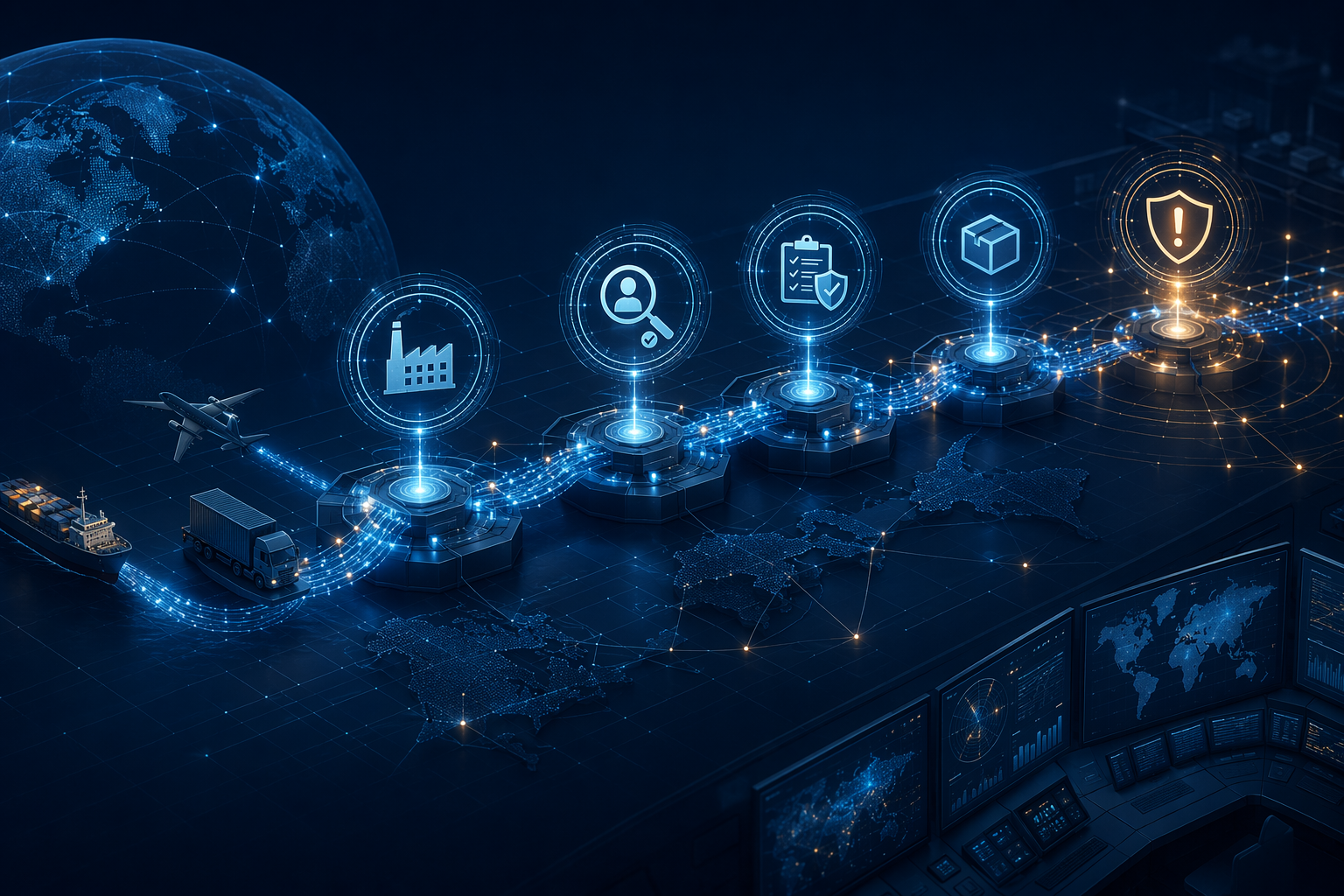
Continuous audit readiness starts before the audit
A traditional audit cycle asks whether the organization can prove compliance for the selected period, sample, supplier, program, or control. Continuous audit readiness asks a harder operational question: can the organization show, as work happens, why a supplier was allowed through, why a document was accepted, why a risk was escalated, and who reviewed the exception?
That distinction matters because defense supply chains do not wait for audit calendars. DLA’s own operating scale makes the point. The agency manages roughly 6 million national inventory item numbers, including about 2 million active items and about 300,000 routinely ordered items.[2] At that size, manual reconciliation is not merely slow; it changes what reviewers are able to see. A team can sample, chase exceptions, and investigate known problems. It cannot manually maintain continuous illumination over every relevant supplier, item, certification, and transaction path.
AI changes the timing and surface area of audit work. It can screen more suppliers, compare more records, identify more inconsistent claims, and keep a running trail of why something was flagged. That does not eliminate human judgment. It changes where judgment enters: earlier, with more context, and with a record that should be easier to defend later.
DLA’s production evidence is the strongest signal
The most useful evidence is not a lab demo or a slide about future audit modernization. It is DLA’s use of AI in production supply chain risk work. In a white paper, DLA Chief Information Officer Adarryl Roberts described the agency’s Business Decision Analytics model screening 43,000 vendors and identifying more than 19,000 as high risk.[3] That is a large number, but it should be read carefully: those are risk flags, not 19,000 proven violations.
That limitation does not make the result less important. It makes it more operationally honest. A continuous audit system does not need every automated flag to be a finding. It needs a defensible way to surface risk, prioritize review, document disposition, and preserve the path from signal to action. In supplier-risk work, the first gain is often not a completed enforcement action. It is visibility that did not exist at workable scale before.
DLA has also tied this work to an actual fraud prosecution. The cited case involved Turkey-sourced parts falsely certified as U.S.-made under Buy American Act and Arms Export Control Act requirements.[3][4] One case does not prove a general rate of fraud across the vendor base. It does show the audit value of moving from passive file review to active supplier illumination: the system can help point investigators toward claims that deserve attention before those claims remain buried in procurement history.
The broader DLA environment is also relevant. The agency has reported 55 AI models in production and more than 200 use cases under development.[2] For audit readiness, that matters less as a maturity badge than as an operating condition. A single model can flag a supplier. A production ecosystem can start connecting supplier risk, demand signals, item records, sourcing patterns, and reconciliation work across the logistics enterprise.
This is where Beougher’s three-part frame becomes practical rather than theoretical. Demand planning and forecasting affect audit because bad forecasts and thin supplier visibility can push rushed sourcing decisions. Workflow optimization affects audit because delays and handoffs create missing records. Audit-process automation affects audit because recurring checks can move from retrospective sampling into continuous exception monitoring. Those are not separate technology stories. In a defense supply chain, they are often the same control environment seen from different desks.
| AI application | Audit-readiness effect | What still requires human control |
|---|---|---|
| Demand planning and forecasting | Earlier visibility into item demand, supplier pressure, and sourcing exposure | Review of assumptions, mission priorities, and sourcing tradeoffs |
| Workflow optimization | Fewer manual handoffs and clearer status on who is waiting for what | Ownership of approvals, exception handling, and record completeness |
| Audit-process automation | Continuous screening, reconciliation, and documentation checks | Disposition of flags, validation of evidence, and defensible signoff |
The distinction is important because “AI found it” is not an audit conclusion. A model can rank supplier risk or identify a certification inconsistency. Someone still has to decide whether the flag is valid, whether the supplier should be paused, whether the file needs remediation, whether legal or contracting staff need to be involved, and how the decision will be recorded. Continuous readiness is the presence of that governed loop, not the mere presence of a model.
What changes inside contractor workflows
DLA’s evidence shows AI operating at government logistics scale. Contractor evidence shows the other side of the problem: the proposal, engineering, compliance, and authorization packages that create the records government buyers later rely on. StackAI reports that a tier-1 U.S. defense contractor deployed on-prem AI agents across acquisition and compliance workflows, reducing proposal drafting time by 60–70%, speeding engineering design compliance reviews by 50–65%, and saving hundreds of hours per RMF/ATO compliance package.[5]
Those numbers are meaningful, but they should not be stretched beyond the source. This is a vendor-reported case study from one contractor deployment, not an independent benchmark for the whole Defense Industrial Base. The stronger detail is that the deployment was on-prem and every agent action was logged for audit trails.[5] That is the line between productivity tooling and compliance infrastructure.
In proposal drafting, an AI agent can pull prior language, map requirements, and generate a first version faster than a manual team starting from scattered artifacts. The audit question is not whether the draft appeared quickly. It is whether reviewers can see what source material the agent used, which requirements it mapped, what it changed, who accepted the text, and which assumptions moved forward into the submitted record.
In engineering design compliance review, speed has a different consequence. A faster check can keep design work from waiting on a compliance bottleneck, but only if the review path remains explainable. If the system flags a requirement mismatch, the contractor needs enough traceability to show why the mismatch was identified and how engineering resolved it. Otherwise the organization has accelerated the same old rework cycle.
RMF and ATO packages make the point even more plainly. Hundreds of hours saved per package is attractive because those packages are document-heavy, control-heavy, and review-heavy.[5] But in an authorization context, a missing rationale can be more expensive than a slow draft. The record has to show what control evidence was used, what was generated, what was reused, what was approved, and what still required human judgment.
The contractor threshold is traceability
The StackAI case is useful because it does not separate agentic automation from audit logging. That pairing should become a minimum expectation for defense contractors evaluating AI in compliance workflows. On-prem deployment will not be required in every case, and different programs will have different security and data constraints. But the audit trail cannot be optional.
- Source traceability: the system should preserve which requirement, record, clause, control, supplier file, or evidence artifact influenced an output.
- Action logging: the organization should be able to reconstruct what the AI drafted, flagged, changed, escalated, or recommended.
- Human review rights: reviewers should have clear authority to accept, reject, override, or require remediation.
- Model governance: owners should know which models are approved, what data they can access, and how performance or drift is monitored.
- Workflow integration: outputs should land where work is assigned and closed, not in a dashboard that becomes another reconciliation burden.
That is also why AI maturity alone is the wrong yardstick. A contractor can buy advanced tooling and still fail at continuous readiness if supplier records live in one system, proposal evidence in another, engineering decisions in another, and compliance signoff in email. The model may be capable. The business may still be unauditable in practice.
Adoption is moving, but the market numbers need care
The contractor market is not waiting for a perfect doctrine. A 2026 PYMNTS/Unanet GovCon Benchmarking Report, cited by Gaurav Bhatnagar, says 36% of government contractors are already using AI in compliance operations and another 42% are actively evaluating adoption.[6] Those figures are useful as a market signal, but the available citation does not provide enough methodology detail to treat them as a fully auditable benchmark.
Still, the direction is hard to ignore. Contractors are under pressure to do more than respond to findings. They need to reduce proposal burden, keep authorization work moving, understand supplier exposure, and preserve records that can survive later review. AI fits that pressure because it can work across repeated, evidence-heavy tasks where humans spend too much time locating, comparing, and reformatting information before they can make a judgment.
Beougher also points to an acquisition-side gap that sits next to audit readiness: roughly 18,000 DOD proposals over three years received no bids.[1] AI will not rebuild the supplier base by itself. It can help identify capable vendors, surface where competition is thinning, and connect sourcing decisions to better supplier intelligence. That matters for audit because a weak supplier base often becomes a compliance problem later, especially when urgency compresses review.
Regulatory pressure is part of the backdrop, including NDAA-driven attention to defense supply chain risk. For the statutory and policy side, Pentagon AI Supply Chain Audits Are Here. What the NDAA Requires Now covers that context. The operational question here is narrower: once the requirement exists, can the organization maintain the evidence continuously enough that audit is no longer a scramble?
The work AI does not remove
Continuous audit readiness creates new work as it removes old work. Someone has to decide which data sources are authoritative. Someone has to define what a supplier-risk flag means. Someone has to determine when a model output becomes an exception, when an exception becomes a finding, and when a finding requires contractual, legal, engineering, or program action.
The people carrying that work are often not the people featured in modernization announcements. They are compliance analysts closing file gaps, program staff waiting on supplier screening, acquisition teams defending a source-selection record, and security teams explaining why an ATO package supports the decision made. AI helps them when it reduces reconstruction. It hurts them when it produces unreviewable outputs that become one more artifact to explain.
A useful implementation therefore starts with evidence flow, not tool selection. For supplier audit, that means connecting vendor records, ownership indicators, certifications, sourcing history, item data, and prior dispositions. For proposal and compliance work, it means connecting requirements, prior submissions, approved language, engineering evidence, control mappings, and reviewer decisions. For both, it means logging enough context that a later reviewer can reconstruct the decision without interviewing everyone who touched the file.
There is a governance burden here that should not be softened. Models need approved use cases. Data access needs boundaries. Outputs need review paths. Exceptions need closure rules. Metrics should distinguish between faster drafting, better detection, fewer rework hours, fewer unresolved findings, and improved supplier visibility. Those are related outcomes, but they are not the same outcome.
What continuous readiness looks like when it is real
The best current evidence supports a narrow but important conclusion. AI can already move defense supply chain audit toward continuous readiness where organizations connect model outputs to source data, governed workflows, human review, and durable logs. DLA’s BDA work shows continuous supplier screening at meaningful government scale. The StackAI deployment shows how AI agents can reduce contractor compliance workload while preserving an action trail. The adoption data suggests the market is moving, even if the exact benchmark deserves caution.
That is enough to retire the idea that AI-enabled audit is speculative. It is not enough to declare the problem solved. The hard part is no longer proving that AI can screen, draft, compare, or summarize. The hard part is making sure those actions are tied to the records, authorities, and review decisions that defense audit actually depends on.
A contractor that can show why the AI flagged a supplier, which source records supported the flag, who reviewed it, what action followed, and how the decision closed has moved toward continuous audit readiness. A contractor that cannot trace why the AI flagged, drafted, approved, or escalated something has automation, not audit readiness.
References
- Agentic AI Could Provide ‘Exponential’ Benefits in Supply Chain, GovCon Expert Guy Beougher Says at Army Summit, Potomac Officers Club.
- DLA applying AI to supply chain risk management, warfighter readiness, Defense Logistics Agency.
- Utilization of Artificial Intelligence (AI) to Illuminate Supply Chain Risk, Defense Logistics Agency.
- Pentagon Uses AI to Identify 19,000 High-Risk Suppliers from 43,000 Vendors, TraxTech.
- AI Agents for a Tier 1 U.S. Defense Contractor’s Acquisition and Compliance Workflows, StackAI.
- PYMNTS/Unanet GovCon Benchmarking Report 2026, cited via Gaurav Bhatnagar / LinkedIn.
Comments
Join the discussion with an anonymous comment.