
A digital coupon becomes a supply chain event the moment it changes what shoppers pull from the shelf. Until then, it can sit comfortably in a marketing calendar: offer depth, audience, channel, redemption window, basket impact. After launch, the same decision shows up as a store-SKU demand spike, a missed replenishment signal, a substituted item, a warehouse pick that was not planned, or a post-promotion forecast that now thinks next week will look like last week.
That is the practical case for AI digital coupon optimization in the retail supply chain. The value is not that an algorithm can make a coupon feel more personal. The value is that it can decide whether the offer should exist for a specific customer, SKU, store, week, and inventory position at all.

The size of the problem is large enough that it should not be left inside campaign reporting. Tellius cites McKinsey in stating that 72% of trade promotions lose money, and notes that CPG companies spend 15–25% of revenue on trade promotion.[1] RELEX, citing Incisiv research, reports that only 12% of retailers use advanced analytics for pricing and promotions.[2] These figures come through vendor-published material, so they should be treated as directional evidence rather than a clean industry census. Still, the operating pattern behind them is familiar: promotion decisions are made with commercial intent, while the service-level and inventory consequences arrive later in planning, allocation, and store operations.
Where Coupons Become Inventory Problems
The first failure mode is the simplest: demand is stimulated where inventory is not positioned. A coupon can perform well on redemption and still push the wrong store into a stockout. The campaign report sees engagement; the shelf sees an empty facing; the replenishment team sees an avoidable emergency move or a lost sale.
The second failure is cannibalization. A promoted SKU may take volume from a neighboring product, another pack size, a private-label alternative, or a later full-price purchase. If the lift report gives the promoted item full credit, the demand planning signal is polluted. The business may reorder as if total category demand expanded when the shopper merely shifted timing or product choice.
The third failure is pantry-loading. A promotion can pull forward demand from future weeks, especially in shelf-stable or frequently purchased categories. If the post-event forecast treats the promotion week as normal demand, replenishment can over-order into a softer period. If it overcorrects in the other direction, it can under-supply the next true demand cycle.
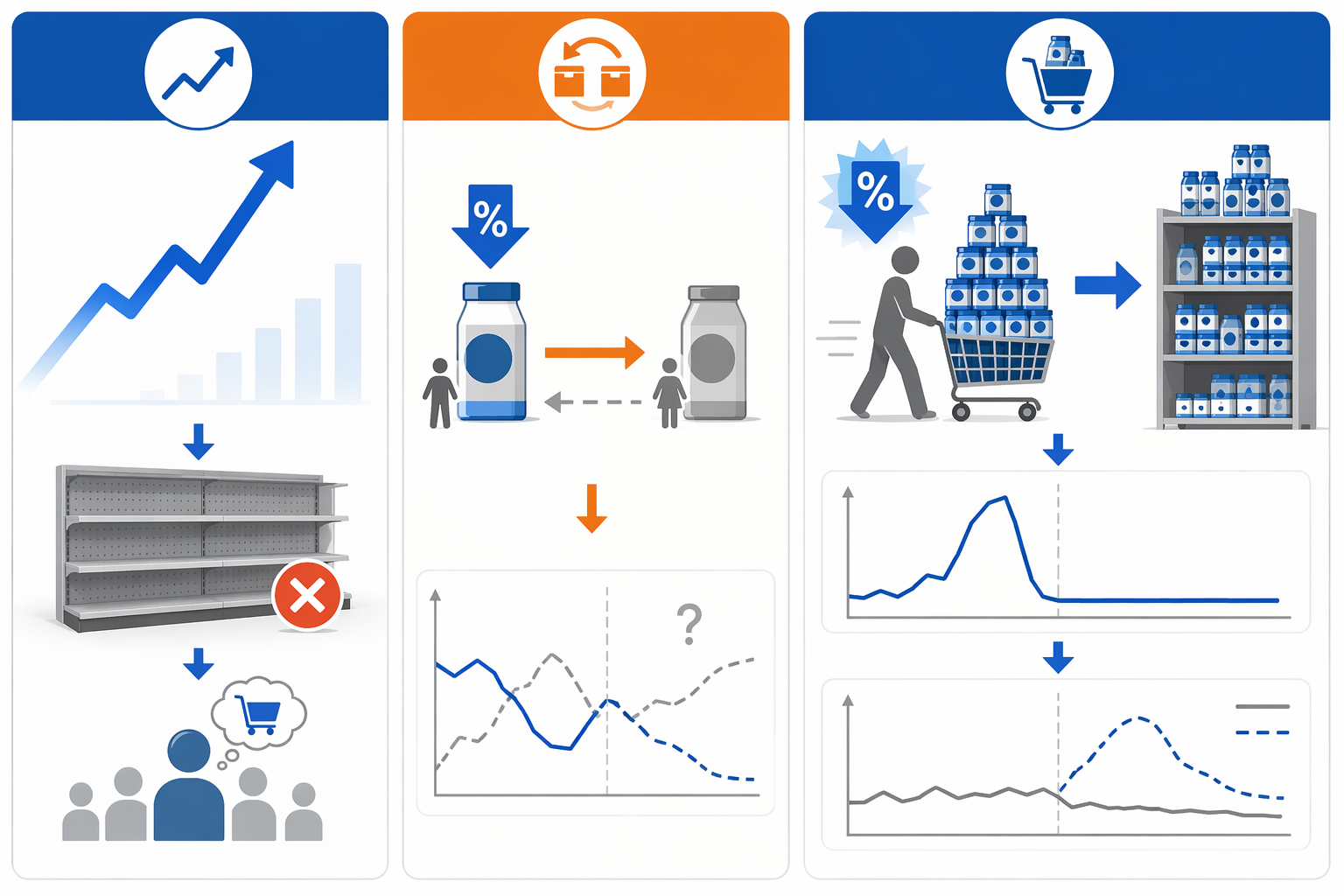
| Promotion signal | What marketing may see | What supply chain must absorb |
|---|---|---|
| High redemption in selected stores | Strong offer response | Store-SKU stockout risk, expedited replenishment, service-level loss |
| Lift on the promoted item | Successful SKU movement | Cannibalized category demand, inflated reorder signals |
| Large promotion-week volume | Volume win during the event | Pantry-loading, post-promotion softness, forecast error |
| Broad coupon distribution | Reach and engagement | Discount leakage to shoppers who would have bought anyway |
This is why traditional lift is a weak operating measure when used alone. Tellius argues that promotion effectiveness is often overstated by 40–60% when cannibalization, pantry-loading, and baseline pull-forward are ignored.[1] The exact range needs the context of the underlying studies Tellius cites, but the warning is sound: lift is not the same as incremental demand, and incremental demand is not the same as profitable, fulfillable demand.
The Decision Loop Has To Move Before Launch
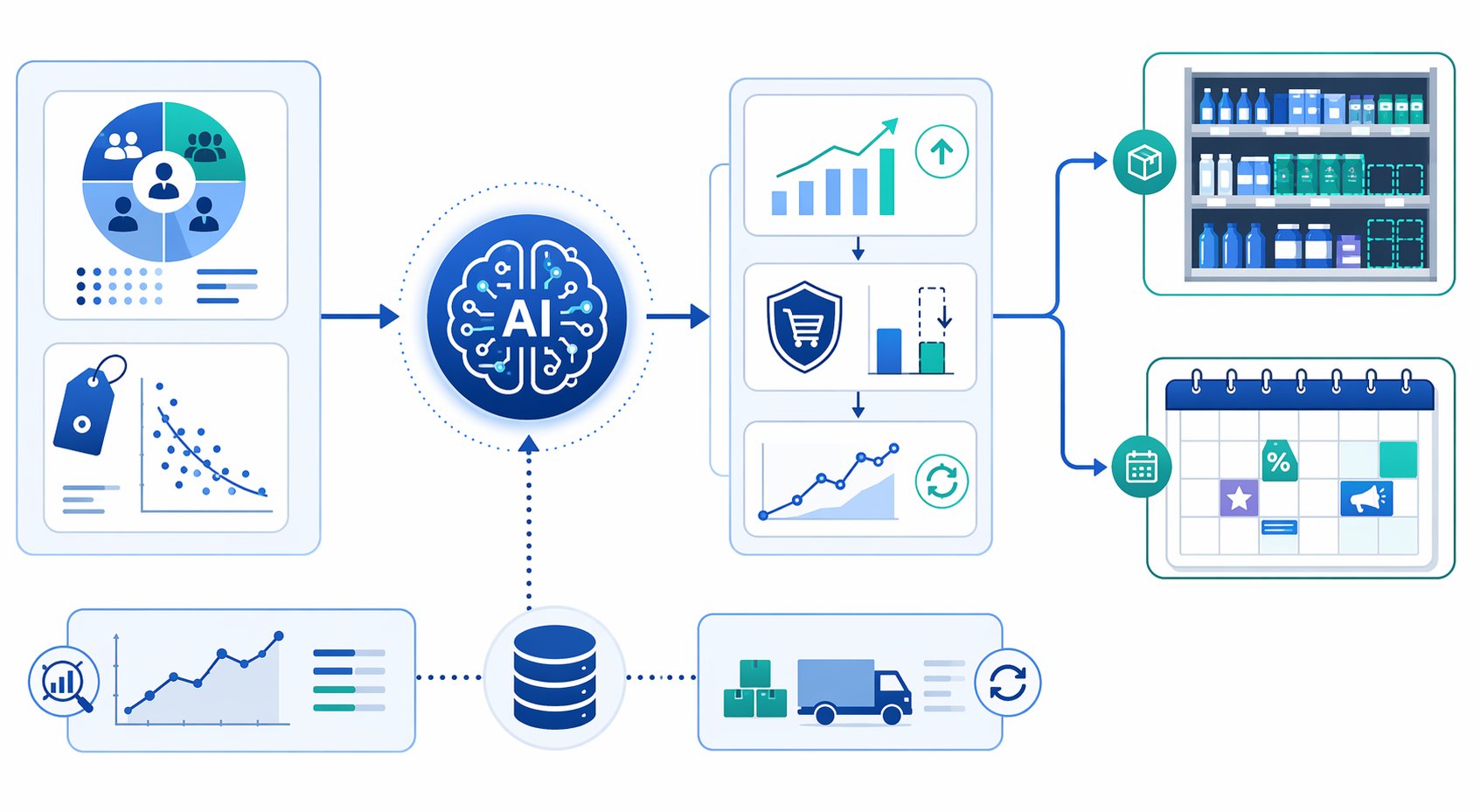
The important shift in AI-driven promotion optimization is not a nicer targeting layer on top of the same calendar. It is the movement of supply chain constraints into the promotion design phase. A useful system asks, before launch, which customers need an incentive, which SKUs can absorb the demand, which stores should participate, how much volume is truly incremental, and whether the replenishment network can support the plan.
That loop usually starts with segmentation, but the segmentation has to be read operationally. In an InXiteOut CPG case, customers were split into Discount Non-Takers, Discount-Sensitive shoppers, and Discount Indifferent shoppers. Discount Non-Takers represented 32% of customers and 40% of revenue; Discount-Sensitive shoppers represented 48% of customers and 35% of revenue; Discount Indifferent shoppers represented 20% of customers and 25% of revenue.[3]
The supply chain lesson is not merely that customers differ. It is that a large share of revenue may not require a discount to convert. In the InXiteOut case, tailoring coupon strategy by segment produced a 12% reduction in discount costs while also delivering roughly 3% sales uplift.[3] Fewer unnecessary discounts mean fewer artificial demand spikes, less leakage to shoppers who would have bought anyway, and a cleaner baseline for planners after the event.
The next layer is SKU elasticity. A coupon on a highly elastic item can generate a very different replenishment burden than the same discount on a low-elasticity item. Tredence describes a global CPG optimization covering a $400 million trade budget across 1,100 SKUs in 13 countries, using SKU-level price elasticity modeling and cannibalization guardrails. The reported result was $10 million in incremental margin and a 5.4-point ROI improvement.[4] This is vendor-published case material, but the mechanism is exactly where planning teams usually need help: identifying where the offer expands demand, where it shifts demand, and where it creates more movement than margin.
Incrementality Is The Bridge Between Coupon ROI And Forecast Quality
A promotion model that cannot separate true incrementality from shifted demand is dangerous to replenishment. It may recommend deeper or broader discounts because the event appears to work, then leave the demand planner with a distorted baseline. The campaign ends; the forecast engine sees history; the allocation team inherits the noise.
Tellius frames the answer as governed incrementality measurement: AI baseline models applied consistently across promotion events to separate true lift from cannibalization, pantry-loading, and baseline pull-forward.[1] That governance point matters. If every category, vendor, or campaign team defines incrementality differently, the planning organization cannot compare events or trust the feed going into demand forecasting.
For supply chain leaders, the useful output is not a prettier post-event scorecard. It is a cleaner forecast input. If the model recognizes that a promotion pulled three weeks of demand into one week, the replenishment plan should not treat the spike as a new steady-state signal. If the model recognizes that promoted-brand volume came from an unpromoted sister SKU, the category forecast should not assume the whole category grew.
Promotion Planning Belongs Inside Forecasting And Replenishment
The cleanest operating model is one where promotion planning, forecasting, and replenishment share the same view of demand before the offer goes live. RELEX describes a unified approach in which the promotion planning module is linked directly to forecasting and replenishment, with real-time alerts for projected stockouts and capacity breaches during the promotion design phase.[2] That is the right placement of the control point. The alert needs to appear while the buyer, marketer, planner, and replenishment lead can still change the offer, store list, timing, or inventory commitment.
In practice, that means the coupon is not approved only against audience size and margin expectation. It is checked against store-level inventory, DC availability, supplier capacity, substitution effects, forecasted baseline demand, and the replenishment calendar. If the system projects that a coupon will break shelf availability in a cluster of stores, the answer may be to narrow the audience, shift the timing, cap redemptions, change the SKU, or pre-position inventory.
- Customer and household segmentation identifies who needs an incentive and who is likely to buy without one.
- SKU elasticity modeling estimates how strongly demand will respond to price or offer depth.
- Incrementality measurement separates true demand creation from cannibalization and pull-forward.
- Forecast updates translate the approved event into baseline and event demand by store-SKU.
- Replenishment and allocation checks decide whether the network can support the expected volume.
- Exception alerts surface stockout, spoilage, labor, or capacity risks before launch.
The difference from a conventional campaign workflow is small on paper and large in consequence. Instead of launching the promotion and asking replenishment to react, the business prices the offer with a view of the inventory system it is about to disturb.
Allocation Is Where Optimization Becomes Physical
Even a well-modeled promotion still has to move through constrained supply. There may not be enough inventory to support every store equally. There may be supplier limits, DC capacity limits, transportation constraints, or shelf-life risk. The allocation decision is where a marketing plan becomes pallets, cases, facings, and store labor.
Solvoyo describes AI-driven promotion planning for grocery that dynamically allocates constrained inventory to the highest-demand stores during promotion periods.[5] The point is not that every retailer needs that vendor’s architecture. The point is that promotion optimization should produce a constrained allocation answer, not just a demand estimate. If supply is short, the model has to help decide which stores receive enough inventory to protect service and which stores should receive a different offer, a smaller audience, or no promotion at all.
This is also where waste enters the discussion in a broader sense than markdowns or spoilage. In perishable categories, excess promotion inventory can become literal food waste. SupplyChainBrain reports a grocery case in which AI-driven demand forecasting led to a 49% decrease in food waste and spoilage.[6] That case is about forecasting rather than coupon optimization specifically, so it should not be stretched beyond what it proves. It does show the downstream value of better demand signals when inventory is perishable and timing is unforgiving.
What Supply Chain Leaders Should Count
The promotion scorecard has to expand beyond redemption, lift, and basket size. Those measures still matter, but they are incomplete if the promotion created preventable service failures or inventory waste. A coupon that drives volume by starving the shelf is not a clean win. A campaign that lifts one SKU by draining another is not category growth. A discount that trains the forecast on abnormal demand is not finished when the campaign report is published.
| Question | Supply chain measure |
|---|---|
| Did the offer create demand where inventory was available? | Store-SKU service level, stockout rate, lost sales estimate |
| Did the event create new demand or shift existing demand? | Incremental units, cannibalized units, baseline pull-forward |
| Did replenishment absorb the event cleanly? | Emergency orders, DC capacity exceptions, expedited freight |
| Did the forecast recover after the event? | Post-promotion forecast error, inventory turns, excess stock |
| Did discount spend go to shoppers who needed it? | Discount leakage, segment-level margin, full-price demand retained |
The InXiteOut result is useful here because the reported 12% discount cost reduction came with roughly 3% sales uplift, not with a tradeoff that simply bought less volume.[3] The stronger interpretation is still cautious: one case does not establish a universal benchmark. But it does show the kind of outcome supply chain teams should prefer—less unnecessary demand distortion and better commercial yield from the demand that is stimulated.
The same caution applies to broader ROI claims in this market. Vendor materials can be useful operating signals, especially when they describe mechanisms planners recognize, but they should not be treated as guaranteed economics. A retailer with poor item-location data, disconnected planning systems, or weak promotion governance will not get the same result as a retailer that can connect coupon decisions to forecast updates and constrained allocation.
The Use Case Is Narrower, And More Important, Than Personalization
AI coupon optimization is often sold in the language of personalization. For retail supply chain leaders, the more useful language is inventory alignment. The system has to decide when a discount should be withheld, when it should be narrowed, when it should be moved to a different SKU, and when it should trigger pre-positioned stock. It has to protect the forecast from false demand signals and protect the store from offers the network cannot support.
That is why the strongest version of this use case lives at the store-SKU level, connected to demand forecasting, replenishment, and allocation. Treated that way, AI-driven coupon optimization can reduce discount leakage, avoid artificial demand spikes, improve post-promotion forecast quality, and place constrained inventory where it is most likely to be needed. Treated as a standalone marketing tool, it may simply make demand distortion more efficient.
References
- Why 70% of Trade Promotions Lose Money — and What AI Can Actually Do About It, Tellius.
- How AI Turns Promos Into Profit, RELEX Solutions.
- AI Discount Optimization CPG Sales Uplift, InXiteOut.
- Trade Promotion Optimization, Tredence.
- AI Promotion Planning in Grocery Retail to Cut Stockouts & Waste, Solvoyo.
- Three Ways AI Is Helping Grocers Cut Waste and Boost Profits, SupplyChainBrain.
Comments
Join the discussion with an anonymous comment.