
A clamshell of strawberries has a short window to earn its margin. If the shelf price holds too long while movement slows, the produce manager inherits the problem as shrink. If the price drops too broadly or too early, the store may clear the fruit but give away margin it did not need to lose. If the markdown happens manually at the end of the day, replenishment may read the sell-through as noisy demand rather than a managed freshness decision.
That is the practical starting point for grocery supply chain leaders evaluating AI pricing. The useful version is not a clever price engine sitting downstream from procurement. It is a working loop among demand forecasts, current inventory, remaining shelf life, markdown timing, store execution, and the next replenishment decision.
The distinction matters because grocery prices do not move in a vacuum. A change on berries, deli prepared foods, meat, or bagged salads changes unit movement before it changes a financial report. That movement affects what is left in the case, what expires tomorrow, what the system orders tonight, how the distribution center sees downstream pull, and whether store teams spend the last hour improvising markdowns with inconsistent judgment.
The strongest evidence for AI pricing in grocery comes from exactly this perishable edge. UCSD Rady School research on dynamic markdown optimization for perishables near expiration found food waste reductions of up to 21%, gross margin increases of 3%, and consumer surplus improvement of 0.3%.[1] Those numbers are modest enough to be believable and operational enough to be useful. They do not require pretending every item in the store should be repriced constantly. They show pricing doing a specific job: moving aging inventory before it becomes shrink.
Fresh forecasting evidence points in the same direction. Afresh documented a 14.8% average food waste reduction per store across two large retailers, while a separate SupplyChainBrain article reported that an unnamed major online grocer achieved a 49% waste reduction through AI forecasting.[2] The second figure should be handled carefully because the grocer is not named, but both examples reinforce the same operating lesson: the value appears when AI is tied to fresh inventory decisions, not when it is sold as generic “dynamic pricing.”
The Price Is One Signal in a Freshness Loop
A grocery pricing model worth taking seriously needs more than elasticity curves and competitor prices. For perishables, the model has to know what the store has on hand, how fast that inventory is aging, how demand has behaved under similar conditions, what promotions or weather may change the next few days, and whether the recommended price can actually be executed before the product loses its selling window.
In a working loop, the model starts with a forecast: expected demand by item, store, daypart, and sometimes remaining shelf life. It compares that forecast with current inventory and inbound supply. If the store is long on product that will age out soon, the system recommends a markdown. If movement is already strong and freshness risk is low, it may hold price. After the price change, actual movement feeds back into the forecast, and replenishment can reduce, increase, or smooth the next order.
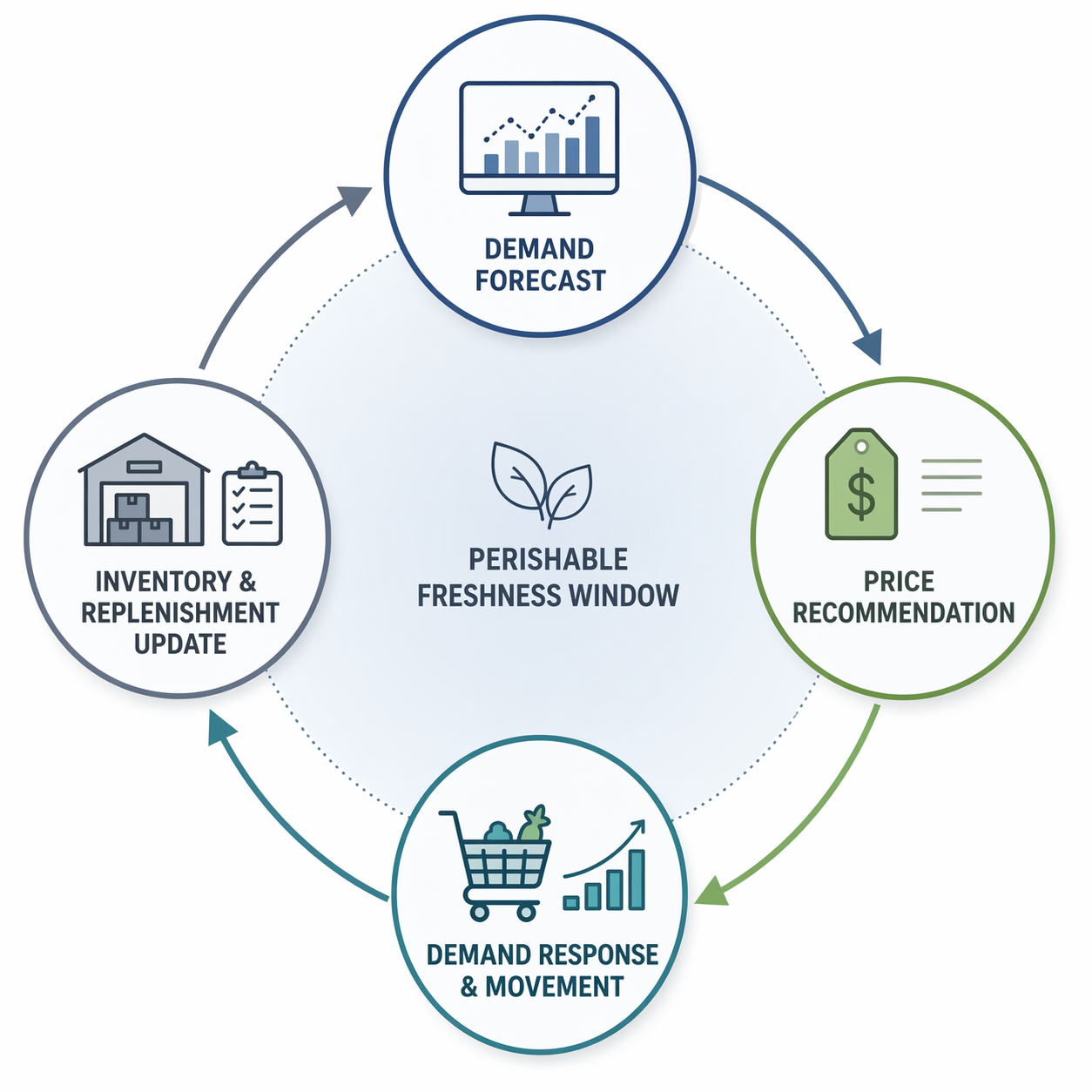
This is where a pricing decision becomes a supply chain decision. The operational benefit is not just that the item sells at a better price. It is that the store avoids a late markdown scramble, the next order reflects managed demand rather than accidental clearance, and the DC receives a cleaner signal from the store network.
The loop also exposes why AI pricing pilots disappoint when they are isolated. A model can recommend the right markdown, but if the store cannot print tags quickly, if POS files update late, if associates do not trust the recommendation, or if replenishment ignores the resulting movement, the gain leaks out through execution. The produce department still owns the shrink report.
What the Model Needs to See
The inputs are not exotic, but they have to be connected. A practical grocery AI pricing system usually needs item-level sales history, current and expected inventory, freshness or expiration information where available, known promotions, local seasonality, competitor context, and store execution constraints. For center-store categories, shelf life may matter less than competitive position or price image. For fresh departments, freshness and remaining selling days move to the center of the decision.
| Input | Why it matters to supply chain pricing |
|---|---|
| Demand history and recent movement | Separates ordinary slow demand from a freshness or availability problem |
| On-hand inventory and inbound supply | Prevents markdowns from being recommended without knowing actual exposure |
| Remaining freshness window | Identifies when margin protection should give way to shrink avoidance |
| Promotion and competitive context | Keeps the model from misreading ad-driven demand as baseline demand |
| Execution capacity | Determines whether the recommended price can be applied while it still matters |
| Replenishment logic | Turns post-price movement into better next-order decisions |
The last two rows are often where a business case either becomes real or stays trapped in a vendor deck. If stores cannot execute the change, the model is late. If replenishment cannot learn from the change, the forecast remains blind.
Electronic Shelf Labels Make the Loop Less Theoretical
Paper tags are not a small detail in this discussion. A pricing team can approve more granular recommendations than stores can physically execute. Once a chain has hundreds or thousands of locations, the labor of changing tags becomes a gating constraint on whether AI pricing can operate inside the freshness window.
That is why electronic shelf labels belong in the supply chain conversation, not just the store technology conversation. Kroger, Walmart, and Whole Foods have been rolling out electronic shelf labels, and Walmart has said it expects the technology in 2,300 stores by the end of 2026.[3] The operational argument is straightforward: if a markdown recommendation has to wait for manual tag changes, perishables may age faster than the process can respond.
Electronic shelf labels do not automatically mean shoppers are being hit with grocery surge pricing. Researchers have not found grocery surge pricing currently occurring.[3] That distinction is important. The same infrastructure that can support faster, storewide execution of markdowns can also raise legitimate consumer concerns if retailers use it for opaque or personalized price discrimination. The technology is neutral only in the narrow engineering sense; the governance around it is not.
Evidence Quality: Useful Numbers Are Not All the Same Kind of Number
For a supply chain leader building an AI pricing case, the hard part is not finding positive numbers. It is deciding which numbers can calibrate an operating plan. Academic research, retailer case studies, vendor collateral, and broad AI savings claims do not carry the same weight.
Raley’s deployment of Eversight’s AI pricing platform covered $3.2 billion in revenue, according to Supermarket News reporting.[4] Scale matters here because a pricing platform that only works in a narrow pilot may not survive the variation across stores, categories, and local demand patterns. Still, the deployment size is not the same thing as a verified ROI figure. It shows scope of use, not by itself the magnitude of operating improvement.
The RNDpoint case study is narrower and easier to map to a business case. It reports that a Dutch grocer with more than 500 stores achieved 0.6% like-for-like growth after a prior 1.5% decline, along with a 1.2% gross margin improvement, using AI pricing models.[5] It is still a case study, not an independently audited sector benchmark. But its strength is specificity: named operating scale, before-and-after commercial movement, and margin effect stated in a range a retailer can pressure-test.
Ahold Delhaize’s reported €1.35 billion in 2024 savings through comprehensive AI deployment is larger, and the figure exceeded a €1 billion target by 35%.[6] It should not be treated as pricing-specific ROI unless the underlying reporting attributes the savings that way. The number is still relevant because it places AI pricing inside a broader operating-system shift across supply chain, merchandising, and stores. It is not evidence that a price optimization module alone produced €1.35 billion.
| Evidence | What it can support | What it should not be stretched to prove |
|---|---|---|
| UCSD Rady markdown optimization research | Perishable markdowns can reduce waste, improve margin, and increase consumer surplus under studied conditions | Every grocery category benefits equally from dynamic pricing |
| Afresh waste reduction reporting | Fresh forecasting can reduce store-level waste across large retailers | Pricing alone caused the entire waste reduction |
| Raley’s Eversight deployment | AI pricing can be deployed across a large revenue base | Deployment scale equals verified ROI |
| RNDpoint Dutch grocer case study | A 500+ store grocer reported like-for-like growth and margin improvement after AI pricing adoption | The same uplift should be assumed for every chain |
| Ahold Delhaize AI savings figure | Broad AI deployment can be material at enterprise scale | Pricing optimization independently delivered the full savings |
| Revionics gross-profit marketing claims | Vendor expectations may frame upside scenarios | Independently verified grocery pricing performance |
Revionics’ marketing collateral has cited gross-profit increases in the 5% to 10% range. That may be directionally useful for understanding vendor ambition, but it is not the same grade of evidence as an academic markdown study or a detailed retailer case. For business-case work, the more conservative numbers are often more useful because they force the team to identify where the gain will physically come from: fewer dumps, better sell-through, cleaner replenishment, or improved margin on items that would otherwise be discounted too deeply.
The Vendor Landscape Is Really a Job Map
It is tempting to compare AI pricing vendors feature by feature, but the better first cut is the job they are being asked to do. Eversight, now part of Instacart, Revionics under Aptos, Competera, and Digital Wave Technology sit closer to enterprise pricing and optimization. RELEX Solutions and Blue Yonder connect more naturally to planning, forecasting, allocation, and replenishment workflows. Afresh and Shelf Engine are more directly associated with fresh forecasting, ordering, and markdown or waste reduction use cases.
Those boundaries are not perfectly clean, and vendor capabilities continue to overlap. The operational question is simpler than the software category: can the system see the inventory condition, recommend a price or markdown in time, execute it reliably at the shelf or digital storefront, and feed the demand response back into forecasting and replenishment?
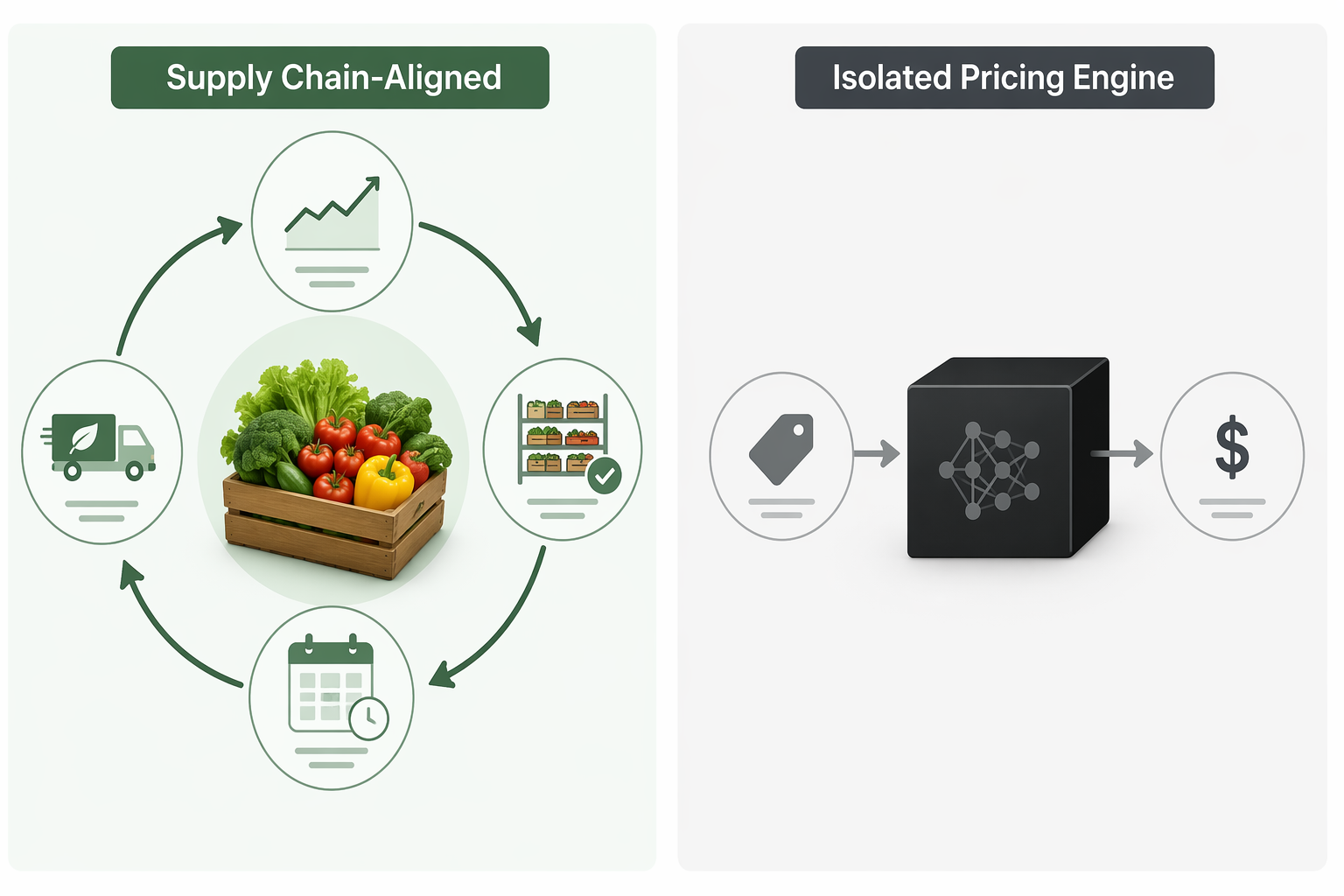
A grocer that already has strong replenishment discipline may want pricing optimization to close the last mile between forecast and sell-through. A grocer with chronic fresh shrink may get more value from fresh forecasting and order optimization before it widens price automation. A retailer with fragmented item files, delayed POS updates, or inconsistent store compliance has a data and execution problem before it has an AI problem.
Markdown Optimization and Personalized Pricing Are Different Governance Problems
Consumer backlash around dynamic pricing is not imaginary. Consumer Reports reported in December 2025 that 75% of items it tested on Instacart showed price variation across shoppers, and Instacart discontinued item-level price tests after the investigation.[7] That episode is a warning for any retailer that wants the operational benefits of AI pricing without eroding trust.
The governance distinction should be explicit. A supply chain-aligned markdown reduces the price of aging inventory so the product sells before spoilage. The logic is tied to item condition, inventory exposure, and a public shelf or digital price. Personalized or surveillance pricing uses customer-level signals to decide who sees which price. Those are not the same practice, and they should not be defended with the same language.
For physical grocery stores, this means pricing policies need to define which variables are allowed in the model and which are not. Inventory position, freshness, store-level demand, promotion calendar, and competitor context are defensible operating inputs. Sensitive customer attributes, inferred willingness to pay, or opaque shopper-level segmentation create a different risk profile, especially when shoppers cannot understand why prices differ.
The issue is not whether prices ever vary. Grocery already runs promotions, loyalty offers, manager specials, zone pricing, and clearance markdowns. The issue is whether the retailer can explain the rule, apply it consistently, and show that the pricing action is solving an operating problem rather than extracting from an information imbalance.
How to Judge an AI Pricing Case Internally
A credible grocery AI pricing pilot should be measured through the demand-to-shelf cycle, not only through sales lift. Sales and margin still matter, but they are lagging summaries. The operating questions come earlier.
- Did markdown timing move earlier in the freshness window rather than concentrating at the end of the day?
- Did unit movement improve on exposed perishable inventory without excessive margin give-up?
- Did shrink decline in the departments where the model was allowed to act?
- Did replenishment orders become smoother or more accurate after demand response fed back into planning?
- Did store teams execute the recommendations consistently, or did manual overrides reveal trust and workflow gaps?
- Did shoppers see understandable public prices, or did the program create unexplained variation that would be hard to defend?
The pilot design should also separate categories. Bananas, prepared meals, packaged salad, milk, center-store cereal, and seasonal candy do not have the same spoilage curve or demand elasticity. If the test averages them together too quickly, the result may hide the only categories where the supply chain case is actually strong.
The cleanest starting point is usually a bounded perishable use case with visible waste, enough sales velocity to learn, and store teams capable of executing changes. That does not make the project small. It makes the learning interpretable.
AI pricing deserves evaluation when it is connected to inventory, freshness, replenishment, and execution capacity. It is much less defensible when it sits inside pricing as a black-box margin engine. The standard is not how fast the retailer can change a price. It is whether that price change produces measurable movement through the demand-to-shelf cycle before the product, the forecast, or the store team absorbs the cost.
References
- UCSD Rady School research on dynamic markdown optimization for perishables near expiration, UCSD Rady School
- Three Ways AI Is Helping Grocers Cut Waste and Boost Profits, SupplyChainBrain
- Research and company reporting on electronic shelf label rollouts at Kroger, Walmart, and Whole Foods
- Supermarket News reporting on Raley’s Eversight AI pricing platform deployment, Supermarket News
- Pricing optimization with AI, RNDpoint
- Revionics blog reporting Ahold Delhaize 2024 AI savings figure, Revionics
- Consumer Reports investigation on Instacart price variation, Consumer Reports, December 2025
Comments
Join the discussion with an anonymous comment.