
The CFO’s problem with AI wildfire forecasting for supply chain disruption is not whether wildfires are dangerous. It is whether a forecasting subscription belongs in the operating budget before the next fire season, when the avoided cost has not happened yet and the invoice has.
That is the right argument to have. Wildfire risk intelligence can start as a relatively small subscription for some organizations, roughly $10,000 to $25,000 annually, or become an enterprise-scale deployment exceeding $500,000 a year. Those are not the same purchase. A regional distributor with a few exposed lanes is not making the same bet as a global manufacturer with plants, suppliers, DCs, and customer demand zones across fire-prone regions.
But the other side of the ledger has also changed. Between 2014 and 2023, wildfires caused an estimated $106 billion in global economic losses and $74 billion in insured losses, and eight of the ten costliest wildfire events occurred since 2015. Wildfire’s share of global insured losses has also moved from roughly 1% before 2015 to about 7% today.[1] That shift matters because most supply chain costs sit outside the clean insured-loss number: expedited freight, emergency sourcing, production resequencing, stockouts, excess safety stock, late fees, and missed sales.
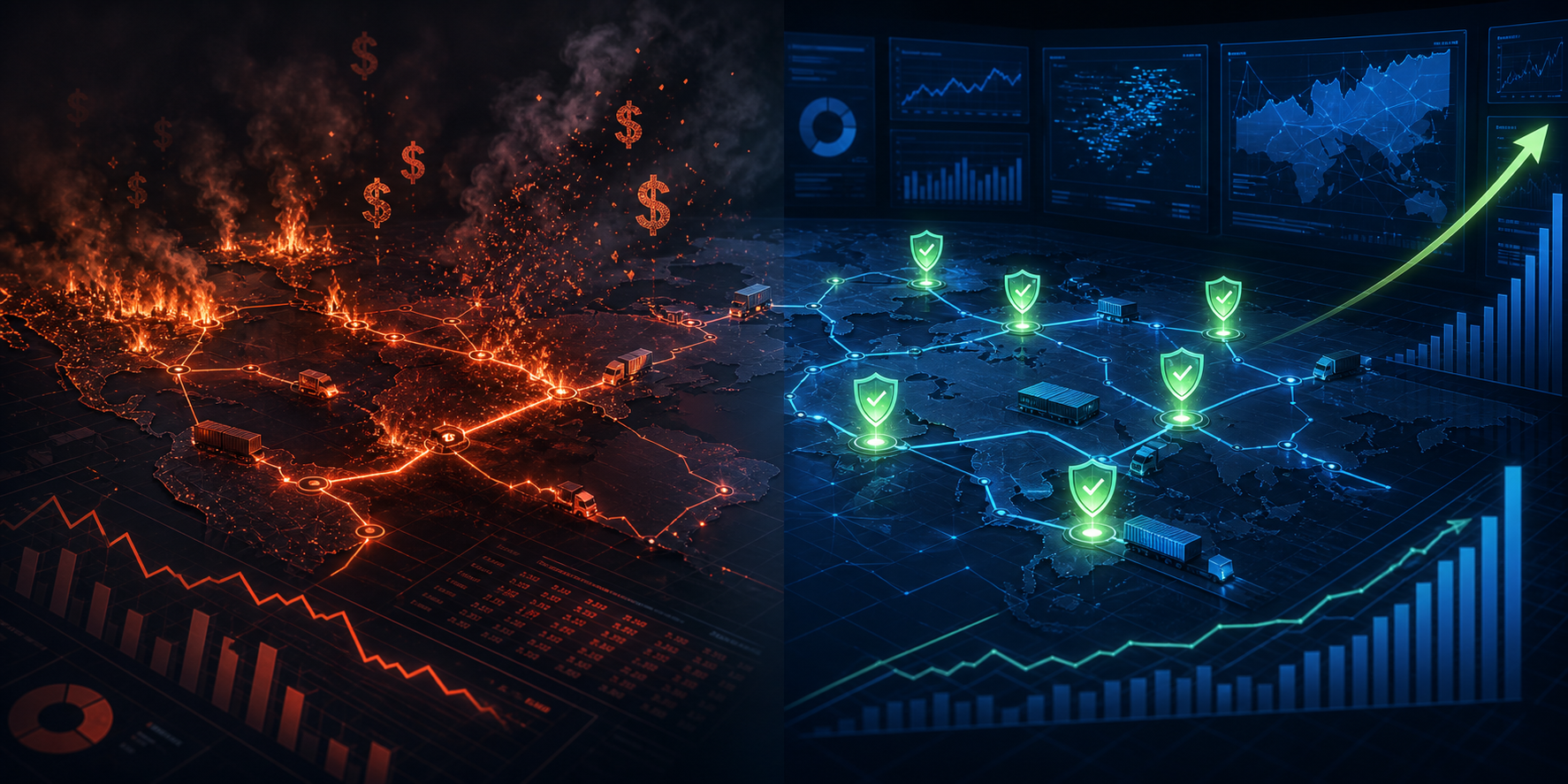
For readers who need the operating mechanics first, the companion guide on how AI predicts and mitigates wildfire supply chain disruptions covers the use case. This article stays with the investment case: which disruption costs enter the ROI model, what evidence exists from early adopters, and where the business case is strong enough to survive finance review.
The Exposure Is Bigger Than the Insured Loss
Insurance figures are useful because they are audited, comparable, and hard to ignore. They are also incomplete. A carrier may reimburse a damaged facility or covered inventory. It usually will not make the sales team whole for a customer who moved volume to a competitor, or the logistics team whole for premium freight used to protect a launch window, or procurement whole for weeks of emergency supplier qualification.
The January 2025 Los Angeles wildfires show the gap. Damage estimates reached $53 billion, including $40 billion in insured losses, while total economic impact estimates that included indirect supply chain costs rose to $250 billion to $275 billion.[1] Those figures should not be copied into every company’s business case as if Los Angeles is a universal template. They are useful because they separate property damage from the wider economic drag that follows when freight corridors, labor availability, suppliers, utilities, customers, and local services are disrupted at the same time.
Industry reporting on the Los Angeles fires pointed to the same operational channels: delays around ports and transportation networks, rerouting pressure, warehouse disruption, supplier interruption, and uncertainty for companies that did not have immediate visibility into affected nodes.[2] That is where a forecasting platform starts to earn or lose its keep. Not in the map view. In the number of decisions it moves from emergency response to planned action.
The broader exposure is not limited to one event. Interos reported that 30.8 million more businesses were at risk of extreme weather in 2025 than in 2024, a 48% year-over-year increase, with financial impact from U.S. events alone estimated upward of $182 billion.[3] That is extreme-weather exposure, not wildfire-specific ROI proof. It does, however, support the budgeting problem supply chain leaders are seeing: risk is no longer a static supplier-location attribute reviewed once a year.
What Actually Goes Into the Wildfire Disruption Cost
A useful ROI model does not start with “wildfire risk” as one line item. It breaks the disruption into costs that already exist in the P&L or working-capital plan. If the company cannot find these costs, the forecasting business case will stay abstract no matter how good the platform demo looks.
| Cost category | Where it appears | How AI wildfire forecasting can affect it |
|---|---|---|
| Expedited freight | Logistics spend, premium freight approvals, spot-market charges | Earlier lane and node warnings let teams reroute, pull forward, or consolidate before capacity tightens |
| Revenue loss | Missed shipments, stockouts, service-level penalties, order cancellations | Earlier impact identification helps protect constrained inventory for the highest-risk customers and demand zones |
| Emergency sourcing | Supplier onboarding, unfavorable spot buys, quality review, engineering approvals | Supplier and sub-tier exposure mapping gives procurement more time to qualify alternatives |
| Inventory buffers | Working capital, carrying cost, obsolescence, warehouse capacity | More granular risk signals can shift inventory to exposed products or regions instead of adding broad buffers everywhere |
| Operational labor | Control-tower hours, planning overtime, manual supplier checks | Automated monitoring reduces the time teams spend identifying which suppliers, sites, and orders are actually in scope |
The last row is easy to underweight. During a wildfire, the first expensive question is often not “What should we do?” It is “Which of our suppliers, lanes, purchase orders, inventory positions, and customers are exposed?” Every hour spent building that answer manually is an hour not spent moving freight, reallocating inventory, or negotiating capacity.
Everstream Analytics reports client outcomes that translate directly into these categories: a 50% to 70% reduction in time to identify disruption impact, a 5% reduction in expedited freight costs, and a 30% reduction in revenue losses from disruption.[4] These are vendor-reported client outcomes, not an independent randomized study, so they should be treated as evidence of achievable business value rather than a guaranteed benchmark. Still, the categories are the right ones. They map to budget owners.
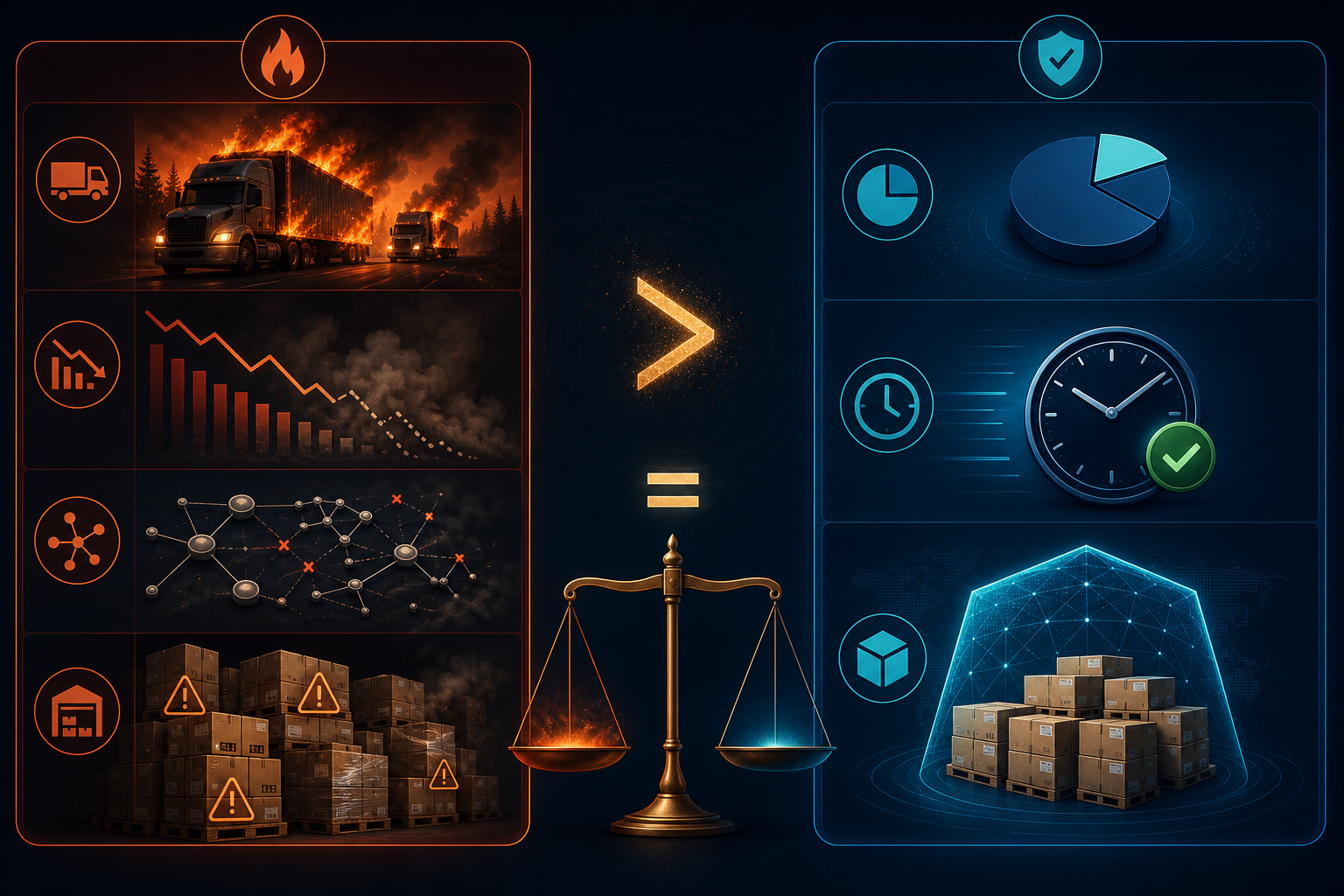
The Platform Cost Band Changes the Decision
Entry-level wildfire risk subscriptions and enterprise risk-intelligence platforms should not be evaluated with the same hurdle. A $10,000 to $25,000 annual subscription can be justified by a small number of avoided premium-freight events or one protected customer shipment. A $500,000-plus enterprise deployment needs a wider benefit pool: multiple facilities, recurring lane exposure, supplier mapping, inventory optimization, business-continuity workflows, and integration into planning or control-tower processes.
The business case is weakest when the platform is treated as a weather dashboard. Dashboards create awareness. ROI comes when the forecast is connected to business objects: supplier IDs, facility addresses, purchase orders, SKUs, transport lanes, inventory positions, customer commitments, and revenue at risk.
| Buyer profile | Likely cost logic | What must be true for ROI |
|---|---|---|
| Smaller exposed operator | $10K–$25K annual subscription | A few avoided expedites, fewer manual checks, or better pre-season inventory placement can cover the spend |
| Mid-market manufacturer or distributor | Broader subscription plus workflow adoption | The tool must reduce recurring lane disruption, supplier-response time, or stockout exposure across more than one site |
| Enterprise supply chain | $500K-plus annual deployment | The platform must support cross-functional decisions across procurement, logistics, inventory, sales, finance, and business continuity |
This is also where market-size numbers should stay in their lane. DataIntelo valued the wildfire risk AI platform market at $2.8 billion in 2025 and projected it to reach $9.4 billion by 2034, a 14.2% compound annual growth rate.[5] That suggests the category is maturing. It does not prove a specific company will save money. Adoption is not effectiveness.
How the ROI Math Should Be Built
The cleanest ROI model compares the annual platform cost with the portion of wildfire-related disruption spend that earlier intelligence can reasonably reduce. The phrase “reasonably reduce” is doing important work. A forecast will not stop a fire, reopen a closed road, or make a damaged supplier ship product. It can change timing, prioritization, and allocation before the expensive options are the only options left.
A practical model has four lines before any softer benefits are added.
- Avoided expedited freight: historical premium freight tied to wildfire or smoke disruption, multiplied by a conservative reduction assumption.
- Avoided revenue loss: margin on orders that could be protected through earlier rerouting, allocation, substitution, or inventory pre-positioning.
- Reduced response labor: planner, procurement, logistics, and customer-service hours no longer spent manually discovering exposure.
- Inventory improvement: working-capital reduction from replacing broad seasonal buffers with more targeted pre-positioning, or service improvement from placing the same inventory better.
Everstream’s reported 5% reduction in expedited freight and 30% reduction in disruption-related revenue losses can be used as reference points, but not as plug-and-play assumptions.[4] A company with poor baseline visibility may have more room to improve. A company that already runs a mature control tower may see smaller incremental gains. Finance should force the operating team to show the baseline: last year’s premium freight, disruption-related lost sales, emergency supplier costs, and seasonal inventory decisions.
A hypothetical example shows the structure without pretending to be a benchmark. If a manufacturer already spends heavily on premium freight during Western U.S. fire season, the model should not ask whether wildfire forecasting is “innovative.” It should ask how much of that premium freight was caused by late discovery. If earlier warning would have allowed the team to move product before a lane tightened, shift demand to another DC, or reserve capacity sooner, that avoided cost belongs in the numerator. If the shipment would have been expedited anyway because the customer changed the order at the last minute, it does not.
The fastest-payback lever is often impact identification
A 50% to 70% reduction in time to identify disruption impact is not just a productivity metric.[4] It changes the option set. Earlier identification can mean procurement starts supplier checks before the supplier’s own inbox is flooded. Logistics can evaluate alternate lanes before spot rates move. Customer service can protect high-margin or contractually sensitive orders before the allocation fight starts.
That time advantage has to be operationalized. An alert that says a county is at risk is not enough for a supply chain team. The useful alert says which supplier sites, inbound lanes, open POs, inventory nodes, and customer commitments are exposed, and who owns the next action.
Inventory pre-positioning only pays when it is selective
The lazy version of wildfire preparedness is adding inventory everywhere before fire season and calling it resilience. That may protect service, but it also ties up cash and warehouse space. Forecasting earns a better argument when it helps decide which SKUs, plants, customer regions, and lanes justify pre-positioning and which do not.
That is the same discipline used in broader severe-weather planning. A company comparing wildfire risk with floods, hurricanes, heat, or convective storms can use a broader guide to AI severe weather prediction for supply chain resilience to decide whether wildfire-specific tooling should stand alone or sit inside a multi-hazard platform.
What AI Adds Beyond a Weather Feed
The technology explanation does not need to be mystical. AI wildfire modeling is valuable to supply chains when it produces earlier, more granular risk intelligence and connects that intelligence to decisions. The WFCA describes AI wildfire modeling as a way to improve decision-making by combining data signals and modeling techniques to support risk assessment and response planning.[6]
For a supply chain operator, the useful output is not the elegance of the model. It is whether the platform can answer questions like these fast enough to matter:
- Which supplier facilities sit inside or near the projected risk area?
- Which inbound and outbound lanes are likely to face closure, congestion, smoke-related delay, or capacity pressure?
- Which open orders and customer commitments depend on those nodes?
- Which inventory can be moved, reserved, substituted, or reprioritized before emergency freight is required?
- Which teams need to act now, and which alerts can be suppressed because there is no material business exposure?
Climate risk mapping vendors make a similar point from a planning perspective: climate risk becomes operationally relevant when it is mapped to suppliers, assets, and network dependencies rather than treated as a general location risk.[7] That distinction is important for ROI. A high-risk map layer may be interesting. A risk layer tied to purchase orders, revenue, and inventory policy is finance-relevant.
Where the Business Case Is Strongest
The strongest buyers are not necessarily the companies with the most dramatic wildfire footage near their facilities. They are the companies with repeated, measurable exposure across one or more of four areas: critical sites, critical suppliers, constrained transport lanes, and demand zones where stockouts quickly become lost revenue.
A food, beverage, medical device, industrial, semiconductor, aerospace, retail, or automotive supply chain may all reach the threshold for different reasons. The common feature is not the industry label. It is that wildfire disruption causes recognizable financial movement: premium freight approvals, production changes, order cuts, supplier escalations, inventory surges, or customer penalties.
Logistics-heavy organizations should also include smoke effects in the cost review. Smoke can create driver health concerns, visibility problems, operational slowdowns, and labor disruption even when flames are not near a facility. The logistics-specific cost argument belongs in the related guide on why logistics needs AI for wildfire smoke risk, while the worker-safety dimension is covered separately in how AI protects supply chain workers from wildfire smoke.
Insurance-market signals can support the case, but they should not carry it. Premium increases and carrier withdrawals tell executives that backward-looking risk transfer is becoming less comfortable. They do not prove that an AI platform will prevent loss. The operating evidence still has to come from the company’s own disruption history and the platform’s ability to change decisions before costs are locked in.
A Finance-Ready Evaluation Flow
The evaluation should be short enough to run before budget season and specific enough to avoid buying a general risk narrative. A workable sequence looks like this:
- Identify wildfire-exposed facilities, suppliers, sub-tiers, lanes, and customer regions.
- Pull the last several fire seasons of premium freight, lost sales, stockouts, emergency sourcing, and inventory-buffer decisions.
- Separate costs caused by late visibility from costs that would have occurred even with earlier warning.
- Estimate conservative reductions for expedited freight, revenue loss, response labor, and inventory movement.
- Compare the resulting benefit range against the relevant platform cost band, not a generic market average.
- Require an operating owner for each alert type before counting the benefit.
The sixth step is where many business cases become honest. If a forecast has no decision owner, it is not yet an ROI lever. If procurement will not act on supplier exposure, logistics will not reserve capacity, planning will not adjust inventory, and sales will not reprioritize commitments, the platform may still improve awareness, but the financial benefit should be discounted.
Companies that already use a hazard-by-hazard investment framework can compare wildfire with other disruption categories. The tornado ROI article, the business case for AI in tornado disruption planning, uses a similar prevention-versus-disruption structure. For geopolitical and seismic comparisons, see AI supply chain risk management in the Middle East crisis and can AI predict earthquake risk in your supply chain.
The Decision Standard
A dedicated AI wildfire forecasting platform is not automatically necessary for every company. A business with limited exposure, flexible suppliers, low service penalties, and little premium-freight history may be able to manage wildfire risk inside a broader weather or business-continuity process.
The case becomes much stronger when wildfire disruptions already show up as expedited freight, lost sales, emergency sourcing, excess seasonal inventory, or recurring manual response work. At that point, the relevant question is no longer whether forecasting costs money. It is whether the company can quantify the disruption costs it is already paying without it.
References
- The invisible costs of wildfire disasters in 2025 — UNDRR
- How Los Angeles Wildfire Impacts Supply Chains — GEP Blog
- Protecting Your Supply Chain from Extreme Weather — Interos.ai
- Climate change is accelerating supply chain disruption — Everstream Analytics
- Wildfire Risk AI Platform Market Research Report 2033 — DataIntelo, 2026
- How AI Wildfire Modeling is Improving Decision-Making — WFCA
- Why Climate Risk Is Now the Core of Supply Chain Risk Mapping — ClimateAi
Comments
Join the discussion with an anonymous comment.