
The hard part of wildfire logistics is not noticing that a fire exists. The hard part is deciding, fast enough to matter, what happens to the five loads already moving toward the closure, the carrier that can still recover one shipment if it gets an answer now, and the customer appointment that turns into detention if everyone waits for perfect confirmation.
That is where the practical question around AI in wildfire supply chain logistics begins. A wildfire can threaten a highway, shift traffic, delay flights, constrain drayage, and force dispatchers to reconcile public alerts with carrier calls and customer commitments. During the January 2025 Los Angeles wildfires, more than 500 flights were delayed at LAX, while logistics teams faced road closures, port-adjacent disruption, and uncertainty around regional movement.[1][2]
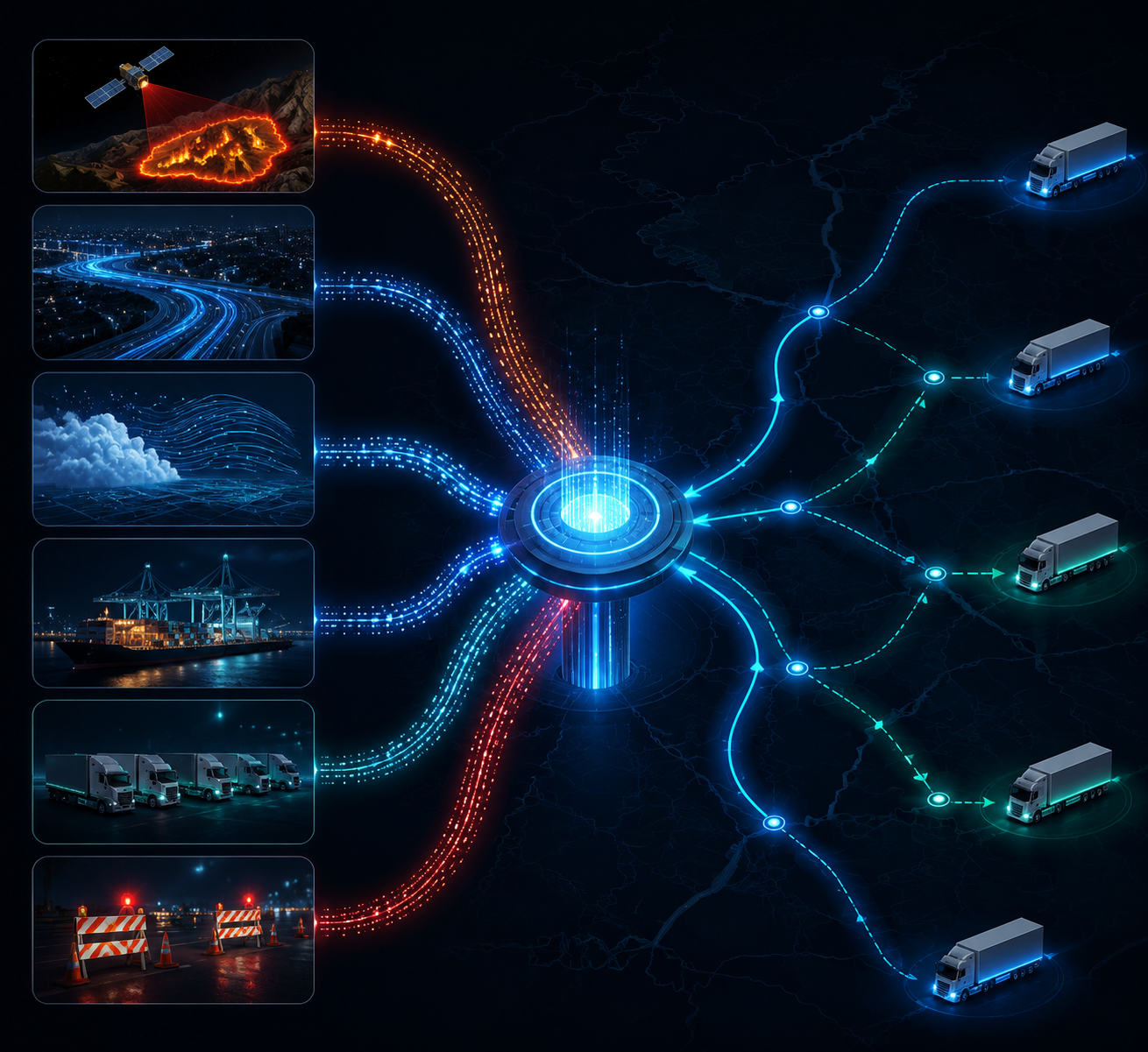
An AI control tower earns attention only if it shortens the distance between signal and action. Satellite fire perimeter data, road closures, live traffic, weather movement, port status, carrier availability, and shipment ETAs are useful because they change a transportation decision. If they sit in separate tabs while a dispatcher manually stitches them together, the network is still waiting on human assembly.
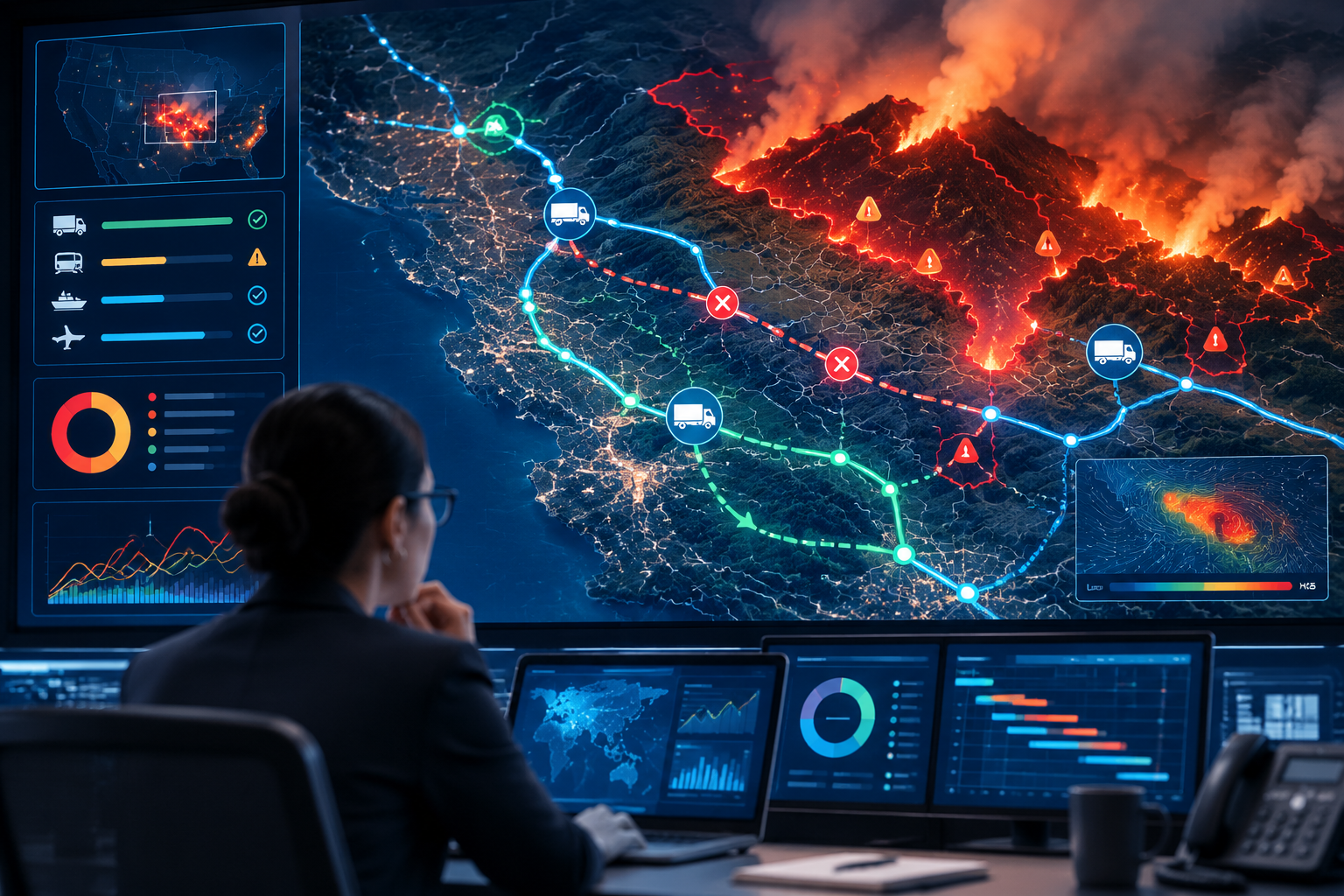
What changes when wildfire signals become routing decisions
In a manual disruption workflow, the order of operations is familiar: someone sees a closure alert, checks a map, calls or messages a carrier, looks at the appointment window, asks whether an alternate lane is feasible, and waits for a rate, a driver, or a manager’s approval. The delay is not always in any one task. It is in the handoff between them.
A control tower changes that sequence by treating the fire as a live network constraint rather than a news event. If a fire perimeter moves toward a route, the platform can flag the affected shipments, compare viable alternatives, estimate downstream ETA impact, and check whether available carriers can execute the change. For adjacent weather-driven route planning, the same operating logic appears in AI weather alerts for logistics routes: the alert matters only when it changes the route, timing, or resource assignment.
| Input | Operational question it answers |
|---|---|
| Satellite wildfire perimeter and hotspot data | Which lanes, facilities, or approach roads are threatened now? |
| Road closures and traffic flow | Which routes are blocked, degraded, or still passable? |
| Weather movement | Could wind, heat, or smoke shift the hazard toward the planned path? |
| Port, airport, or facility status | Will the destination or transfer point still receive the load? |
| Carrier availability and equipment position | Who can execute the reroute without creating a new failure point? |
| Shipment priority and appointment windows | Which loads should move first, wait, or be rebooked? |
The useful output is not a prettier dashboard. It is a ranked set of executable choices: reroute this shipment through a safer corridor, hold that one until a facility confirms receiving capacity, swap carriers where capacity exists, or escalate a customer appointment before detention begins.
Decision latency is the real metric
Wildfire disruption punishes slow coordination. FreightAmigo describes average logistics expense increases of 15% to 25% during wildfire disruptions and trucking delays of 3 to 5 days in the Los Angeles wildfire context.[3] Those figures do not prove that every lane will face that cost or delay, but they make the dispatcher’s clock concrete. Waiting for the second or third confirmation can be expensive when the first safe alternative is already filling up.
Dataiku’s 2026 supply chain AI discussion, citing Deloitte, frames AI-enabled control towers as tools that can reduce decision latency from days to seconds and support double-digit efficiency gains.[4] That is a broad control-tower claim, not wildfire-specific proof. Still, the latency point fits the wildfire operating problem: when the relevant information is fragmented, the team loses time before it even begins evaluating options.
The difference between a recommendation engine and an operational control tower shows up at this point. A recommendation engine may say a route is at risk. A stronger control tower can connect the risk to shipment records, carrier capacity, ETA impact, and approval rules. The platform does not have to be fully autonomous to be valuable; it has to make the next decision easier to take before the disruption cascades.
The Palisades Fire example: useful, concrete, and still vendor-illustrated
The most concrete wildfire routing example in the available material comes from FreightAmigo’s Palisades Fire case. The company says a California importer saved 48 hours during the disruption by using AI-driven alternative routing.[3] That is the kind of number transportation teams can translate immediately: two days less exposure to missed appointments, customer escalations, driver rescheduling, and inventory uncertainty.
It is also a vendor case study. The importer is not named in the material, and the result is not presented as independently audited. That does not make the example worthless. It does mean the claim should be used as an illustration of what the workflow can achieve in a specific incident, not as a guaranteed ROI figure for every wildfire-exposed network.
The workflow implied by the case is straightforward. First, the system detects that the planned path is exposed to wildfire-related disruption. Then it identifies affected shipments and compares alternatives against current traffic and hazard data. Next, it checks whether available carriers can actually move the freight on those alternatives. Finally, it returns a route that can be acted on before the original path produces a multi-day delay.
That last step is where many disruption tools quietly fail. A map can show a cleaner road. A visibility platform can show a late truck. A procurement system can show contracted carriers. The control tower value comes from collapsing those facts into one decision surface: this load, this route, this carrier, this revised ETA, this approval status.
Why the 48-hour claim matters operationally
A 48-hour savings claim is more meaningful than a generic “resilience” claim because it touches real transportation consequences. It may mean a consignee appointment is still recoverable. It may mean a carrier avoids sitting under an unusable plan while waiting for dispatch instructions. It may mean customer service can communicate a revised ETA before the receiver finds out from a late truck.
Placed next to FreightAmigo’s reported 3-to-5-day trucking delay context, the Palisades Fire example suggests the control tower’s value is not disaster prediction in the abstract. It is avoiding avoidable delay after the disruption is already visible.[3]
From recommendations to agentic rerouting
The 2026 buying trend is moving in the same direction as the operational need. ABI Research reported that 65% of supply chain professionals consider AI or GenAI capabilities important or very important in technology purchase decisions.[5] Dataiku also cites BCG estimates that agentic AI represented 17% of total AI value in 2025 and is projected to reach 29% by 2028.[4]
In wildfire logistics, “agentic” should be read carefully. A system that automatically recommends a safer lane is different from one that tenders to a carrier, updates the customer ETA, and commits the shipment to a new route without human approval. Both can reduce latency. They carry different governance requirements.
A reasonable maturity path starts with human-approved recommendations for high-value or high-risk freight. Automation can expand where the rules are clear: preapproved alternate lanes, known carrier pools, defined cost thresholds, customer-specific service rules, and explicit escalation triggers. The control tower glossary entry on AI supply chain control tower capabilities is useful here because not every platform using the control tower label has the same decision rights.
Context matters, but it should not blur the evidence
The broader wildfire cost context is severe. KCH Transportation cites Caltrans data that wildfires caused $3 billion in damage to California transportation infrastructure in 2020 alone.[6] That helps explain why logistics teams in wildfire-prone regions are paying attention. Infrastructure damage, road closures, and emergency restrictions can turn a normal routing decision into a network continuity problem.
But context is not proof of platform performance. A statewide infrastructure damage figure does not establish that a specific AI tool prevented a specific delay. A general AI-in-logistics efficiency estimate does not establish wildfire rerouting effectiveness. A vendor case can show a plausible workflow and a claimed outcome, but buyers still need to ask how the baseline was calculated.
The stronger evaluation standard is narrower and more useful: did the platform identify affected shipments earlier, compare feasible alternatives faster, confirm carrier capacity sooner, and document the difference between the original plan and the executed reroute?
What to ask a control tower vendor before the next fire
- Which wildfire data sources feed the platform, and how often are fire perimeter, closure, and traffic updates refreshed?
- Can the system show which shipments, facilities, carriers, and appointment windows are affected by a specific fire perimeter or closure?
- Does the rerouting engine account for carrier availability and equipment position, or does it only draw alternate map paths?
- Can the platform preserve an audit trail showing the original route, the recommended alternative, the decision time, the approver, and the executed ETA?
- Where is human approval required, and where can the system act automatically under predefined rules?
- How does the vendor calculate delay avoided, and can it separate wildfire-specific results from general network optimization gains?
The audit trail matters because it turns a disruption story into an operational record. Without it, a buyer is left with a case study and a promise. With it, the team can review whether the platform recognized the hazard early enough, whether the alternative route was actually executable, and whether the claimed delay savings survived contact with the shipment record.
AI control towers are credible for wildfire continuity when they integrate live hazard, network, and capacity data into decisions that transportation teams can execute. The best test is not whether the dashboard looks predictive. It is whether the platform can prove that it shortened the time from wildfire signal to transportation decision, and whether it can document the delay avoided when it did.
References
- How Los Angeles Wildfire Impacts Supply Chains — GEP Blog, Jan 2025.
- How California wildfires are affecting supply chains — Supply Chain Dive, Jan 2025.
- Navigating Supply Chain Disruptions Amid Los Angeles Wildfires — FreightAmigo, 2025–2026.
- Supply chain AI trends 2026: building resilient operations — Dataiku, 2026.
- Supply Chain Disruptions 2026: How to Build Resilience with AI and Automation — ABI Research, 2026.
- Wildfires & Supply Chain Disruptions: Impact on Logistics — KCH Transportation.
Comments
Join the discussion with an anonymous comment.