
A fuel farm does not need to be destroyed to stop working. A small drone that starts a fire near the pumps, damages a transfer line, or forces repeated shutdowns can slow the whole logistics rhythm behind a front line. The same is true for ammunition storage points, repair parks, runway aprons, and supply depots. Once cheap airborne threats can reach those places, “rear area” becomes more of a habit of speech than a planning assumption.
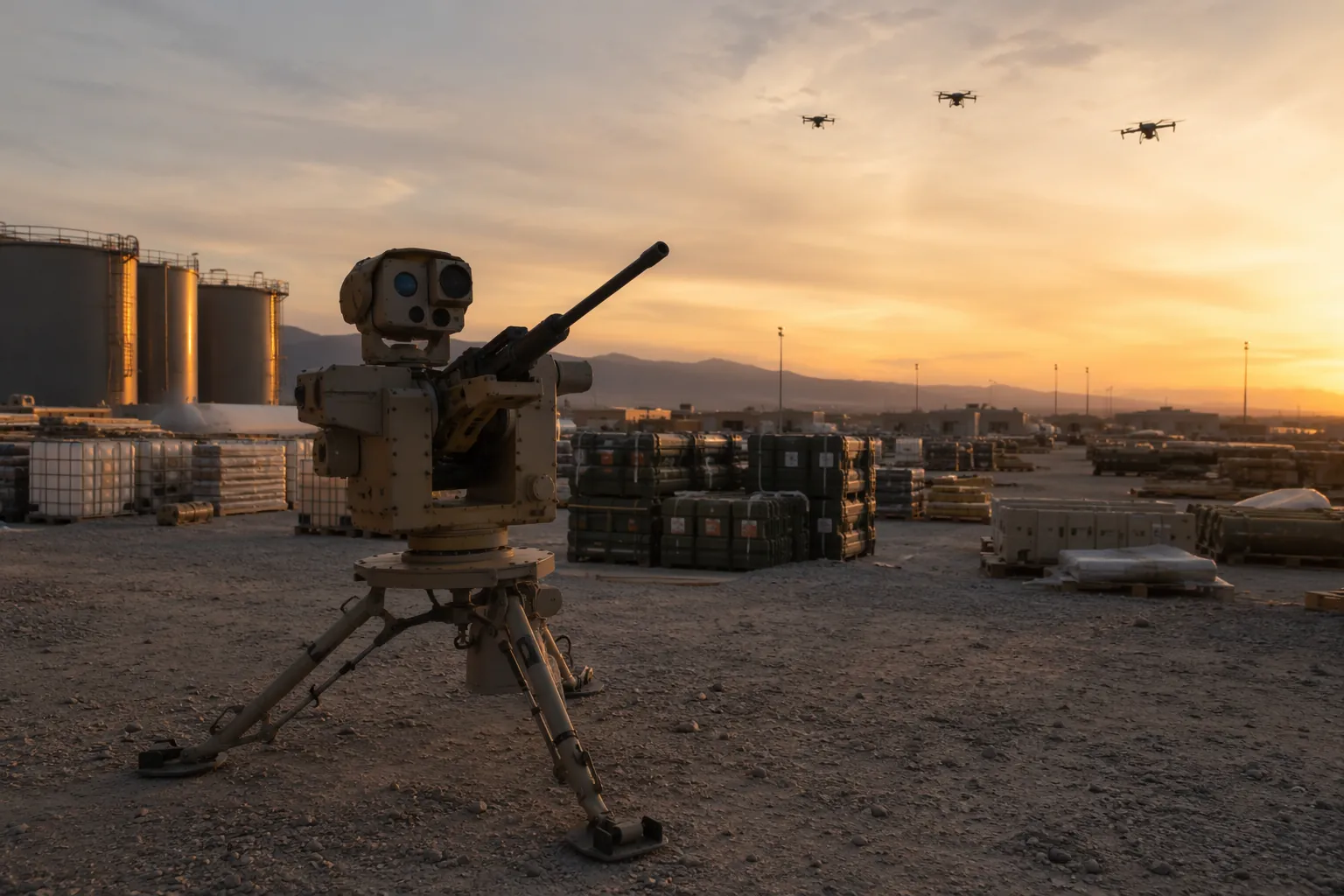
That is where the case for an AI anti-drone turret for military logistics begins: not with autonomy as a fascination, but with the bill after the first raids. During Operation Epic Fury, Patriot PAC-3 interceptors costing roughly $3 million to $4 million were used against Shahed drones estimated at about $4,000 each, a cost exchange of more than 750 to 1 against the defender.[1] A base commander may have no choice in the moment. But if the threat repeats night after night, the procurement question changes from “Can we shoot it down?” to “Can we afford to keep shooting it down this way?”
The Cost Problem Arrives Before the Technology Pitch
Missile defense still matters. Medium- and long-range air defense buys distance, protects population centers, and handles threats a machine gun cannot reach. But using exquisite interceptors against low-cost one-way drones is a bad default for fixed logistics sites that need repeated, close-in protection. A depot does not need one perfect engagement; it needs a defendable operating pattern over weeks and months.
Allen Control Systems puts the sharpest version of the alternative on its Bullfrog M240 page: a claimed $10 cost per kill. That figure is tied to marginal ammunition cost, not the full cost of owning and operating the system.[2] The distinction matters. A turret still has to be bought, mounted, powered, integrated, trained on, maintained, and eventually repaired. Barrels wear. Optics need care. Ammunition handling becomes someone’s job. A $10 shot is not a $10 defense architecture.
Even with that correction, the economics are hard to ignore. Available figures place turret unit and integration costs in the broad range of $150,000 to more than $500,000, depending on configuration and installation. That is not cheap equipment in depot terms, but it is a different class of decision from consuming a multi-million-dollar interceptor against a small drone. The closer the defended asset is to fixed infrastructure — fuel tanks, ammunition pads, aircraft parking, generator farms, communications nodes — the more sense it makes to ask whether a distributed gun layer should take some of the work away from missiles.
What the Turret Actually Does at a Logistics Site
Bullfrog is useful to discuss because its publicly stated details are specific enough to test against a site plan. The M240 version uses a 7.62mm machine gun with an 800-meter stated range and an 850-round-per-minute rate of fire; Allen Control Systems also describes M230 variants.[2] The system uses passive electro-optical and thermal sensing rather than radar emissions, and the company claims sub-1 MOA pointing accuracy.[2] Those are not abstract AI claims. They describe a close-in weapon station that has to see, classify, track, and place rounds on a small airborne target inside a short engagement window.
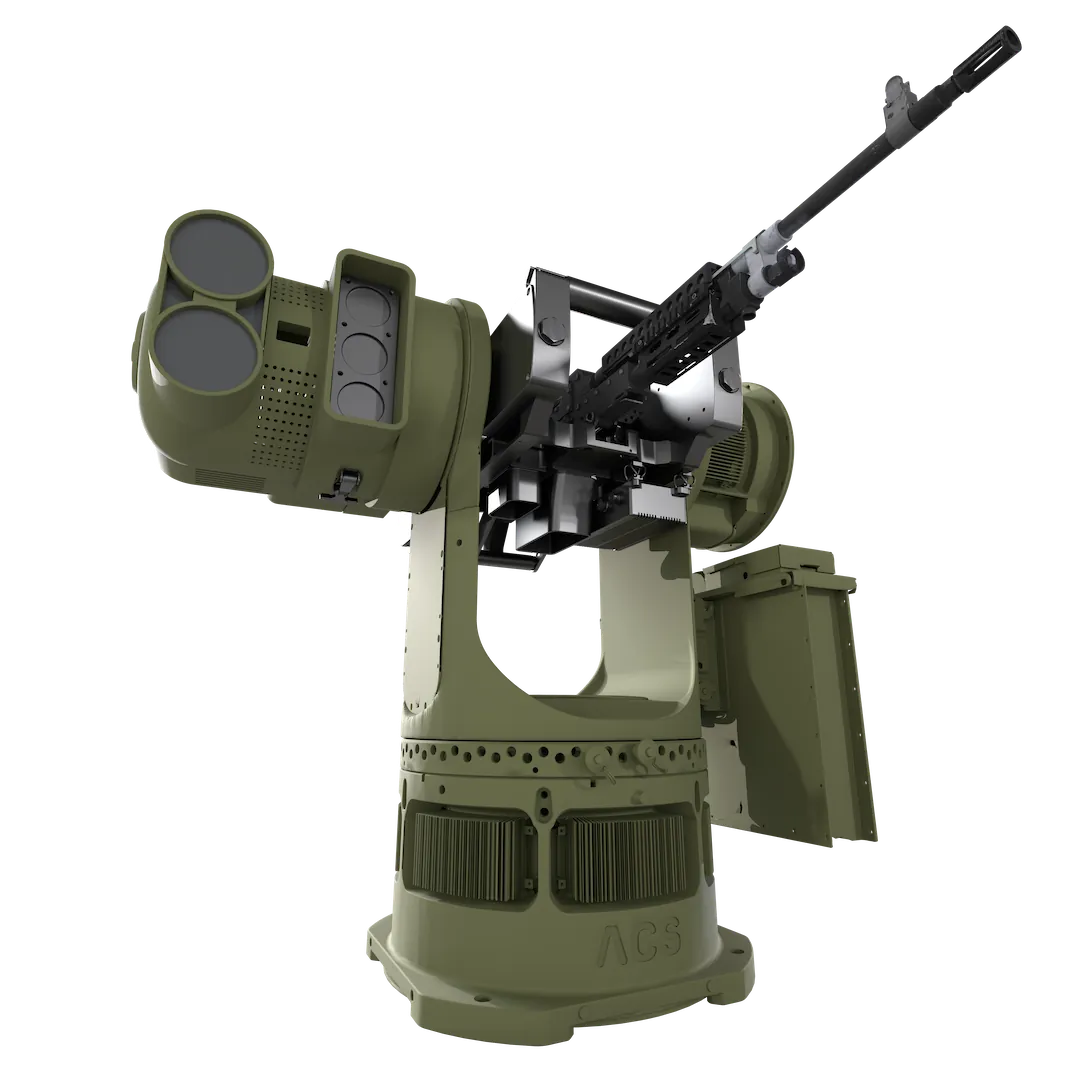
For a logistics planner, those specifications immediately become placement questions. An 800-meter engagement envelope may cover a fuel farm from one corner but leave blind angles behind warehouses, revetments, tree lines, or maintenance sheds. A turret beside an ammunition storage area may have a clean field of fire in one direction and unacceptable danger space in another. A runway or apron may need overlapping arcs so that one system can continue tracking while another is masked by buildings or aircraft tails.
Passive EO/thermal sensing is attractive because it avoids broadcasting a radar signature.[2] It also shifts the burden onto line of sight, thermal contrast, sensor quality, and environmental conditions. Fog, smoke, rain, dust, glare, heat shimmer, and clutter do not disappear because a fire-control system is AI-assisted. A fixed-site defense plan therefore has to treat the turret as a node in a geometry problem, not as a magic object placed near the gate.
The same operating environment is why these systems belong inside a broader military logistics AI map rather than in a stand-alone weapons discussion. Drones are now part of the threat side of military supply movement, as covered in ChainSignal’s analysis of AI drones and military supply chain logistics. Turrets are one defensive response inside the wider operating environment described in AI military supply chain logistics, and their value increases when commanders also model strike disruption paths before the attack rather than merely repairing afterward.
The Close-In Layer Has a Different Job
A gun turret is not trying to replace the whole counter-UAS stack. Its natural job is the last part of the defense, where the incoming drone is close enough that a machine gun can engage it and where the defended asset is valuable enough to justify a permanent installation. That makes fixed military logistics nodes a better fit than open-ended maneuver protection. Depots, airfields, and fuel sites have known boundaries, recurring approach corridors, and infrastructure that can support power, communications, ammunition storage, and maintenance.
| Planning Question | Why It Matters for a Fixed Logistics Site |
|---|---|
| What can the turret see? | Buildings, berms, aircraft, containers, terrain, smoke, and weather can break line of sight before range limits are reached. |
| What can it safely fire across? | A clean tracking solution is not enough if rounds would cross fuel tanks, ammunition pads, maintenance crews, or civilian areas. |
| Who reloads and repairs it? | A high engagement rate creates ammunition, barrel, sensor, and maintenance demand during the same period the site is under stress. |
| What happens when EW works or fails? | Jamming may stop some drones, but fiber-optic or pre-programmed threats can force kinetic defeat options. |
| What layer fires first? | Missiles, EW, directed energy, guns, and small arms need rules of engagement that prevent waste and fratricide. |
The M240 configuration’s stated 800-meter range sets one end of the practical discussion.[2] The broader research brief supports a close-in range band of roughly 800 to 1,500 meters for gun-based AI turret concepts. At those distances, seconds matter. The system’s value depends on early detection, fast classification, accurate tracking, and permission to fire under rules that have already been rehearsed. If every engagement waits for a confused voice approval chain, the weapon may be mechanically ready and operationally late.
There is also the magazine-depth problem. A turret that can fire at a high rate is useful when a small target is crossing the defended zone, but sustained raids turn rate of fire into ammunition consumption and heat. Someone has to track remaining rounds, schedule barrel replacement, protect ammunition resupply, and decide whether the turret is allowed to spend ammunition on low-confidence tracks. Those are not secondary details. They are the difference between a demonstration and a night of base defense.
Combat Evidence Matters More Than Polished Autonomy Claims
Ukraine’s Sky Sentinel deserves attention because it is being discussed in relation to combat use rather than only test-range performance. National Interest reported that Sky Sentinel destroyed six Shahed-136 drones in combat testing.[3] Kyiv Post reported deployment with more than 10 frontline units and emphasized its use against fiber-optic drones, a threat category that can evade electronic warfare jamming because the control link is not a radio signal to be jammed in the usual way.[4]

That does not make Sky Sentinel a proven universal answer. The Kyiv interception figure that has circulated around the same discussion needs careful handling: the reported roughly 90% Kyiv interception rate attributed to President Volodymyr Zelensky in late April 2026 refers to overall air defense, not to Sky Sentinel alone.[4] Treating that number as a turret-only success rate would turn a useful data point into bad procurement analysis.
The more defensible conclusion is narrower and still important. A gun-based AI turret can be useful where electronic warfare is insufficient or inapplicable, especially against drones that maintain control without a conventional RF link. It gives the commander another way to kill a small aerial target without immediately reaching for a missile. That is enough to matter for fuel farms, ammunition points, and airfields under repeated low-cost attack.
Budget Momentum Is Real, but Requests Are Not Fielded Coverage
The procurement signal is no longer fringe. Breaking Defense reported in May 2026 that the U.S. Army’s FY27 counter-UAS procurement request reached $994 million, up 67% from a $596 million FY26 enacted level, with $165 million identified for fixed-site defense and $414 million for operational and expeditionary needs.[5] DefenseScoop reported a DoD-wide FY26 counter-UAS request of $3.1 billion across the services.[6] Those are requests and budget lines, not proof that every depot will receive an adequate defense package, but they show the problem has moved into serious spending channels.
Private capital is also following the same pressure. Allen Control Systems raised a $200 million Series B at a $2.2 billion valuation in July 2026, an indication that investors see machine-gun-based autonomous C-UAS as more than a niche prototype category.[7] That market confidence should not be confused with military effectiveness, but it does suggest enough demand for the company to scale manufacturing, engineering, and support.
The wider anti-drone field is crowded. Lockheed Martin’s Sanctum, AeroVironment’s Titan-MS, Dedrone, Parsons’ DroneArmor, and other systems occupy different parts of detection, command-and-control, electronic attack, and defeat. MarketsandMarkets estimated the global anti-drone market at $4.48 billion in 2025 and projected $14.51 billion by 2030, a 26.5% compound annual growth rate.[8] That growth figure is useful context, not a reason to buy any one system. The depot-level question remains narrower: which layer reduces the cost and operational burden of defending fixed infrastructure against the drones most likely to reach it?
Why Logistics Nodes Are a Special Case
A maneuver unit may move before a perfect turret layout can be built. A logistics node often cannot. Fuel storage, ammunition handling areas, maintenance bays, container yards, and runway infrastructure have physical inertia. They are mapped, revisited, observed, and targeted. That makes them vulnerable, but it also gives defenders something to engineer around: fixed arcs, hardened positions, redundant power, known no-fire zones, protected ammunition supply, and rehearsed maintenance access.
DoD has recognized the shift. A July 2026 DoD report titled “Small Drones, Big Problems” concluded that logistics bases now require dedicated counter-UAS.[9] Small Wars Journal argued in November 2025 that logistics package operations need dedicated counter-UAS capabilities that are not currently reflected in modified tables of organization and equipment.[10] The operational implication is plain: if the supply element is expected to keep moving fuel, ammunition, repair parts, and food under drone threat, drone defense cannot be treated as a favor borrowed from someone else’s air-defense section.
Commercial supply chain leaders should recognize the pattern even if the weapons are military. A high-value node becomes fragile when a cheap disruption tool can repeatedly interrupt flow. The military version is sharper because the disruption may be explosive, but the planning logic overlaps with broader AI scenario planning for strike disruptions: identify which nodes are most exposed, model repeated interruptions rather than one-off damage, and assign mitigation before the crisis.
The Economics Are Compelling Only Inside a Layered Defense
The strongest argument for AI gun turrets is not that they are autonomous. It is that they can put a relatively cheap kinetic defeat option close to assets that are too valuable to leave exposed and too numerous to cover only with missiles. A $10 marginal ammunition cost per kill, even with the necessary lifecycle correction, changes the defender’s cost curve.[2] It lets commanders reserve higher-end interceptors for targets that require them.
But cost-per-kill claims can hide the parts a depot actually has to live with. A turret that fires often needs ammunition resupply. A gun that fires often needs barrel management. A sensor that sits outside needs cleaning, calibration, protection, and spares. A mount that covers one sector may leave another uncovered. A software-assisted classification system still has to operate under local rules of engagement, civilian overflight concerns, friendly drone use, and the possibility of decoys or clutter.
Electronic warfare also remains both partner and problem. Jamming and RF detection can reduce the number of drones that reach the gun line, but the Sky Sentinel reporting around fiber-optic drones is a reminder that some threats are designed to bypass RF-dependent defenses.[4] Conversely, a turret’s communications, power, and control links still need protection. Passive sensing avoids radar emissions, but it does not make the site invisible, invulnerable, or self-sufficient.
Directed-energy systems, nets, and jamming-only tools belong in the same counter-UAS conversation, but they answer different parts of it. Lasers may offer deep magazines where power and atmospheric conditions support them. EW may defeat drones before they enter a kinetic envelope. Nets may suit short-range point defense in specific settings. Gun turrets occupy the close-in kinetic layer: ugly, mechanical, ammunition-fed, maintainable, and useful when a small drone is about to cross into a place where disruption becomes damage.
A Practical Procurement Test
Before buying an AI anti-drone turret for a logistics site, the better test is not whether the system looks advanced. It is whether the installation plan survives ordinary operational questions.
- Can the turret cover likely approach paths without firing across protected assets, friendly positions, or civilian areas?
- Does the site have overlapping coverage so one masked or degraded sensor does not open a clean route to the target?
- Who owns ammunition resupply, barrel replacement, sensor maintenance, software updates, and post-engagement inspection?
- How does the turret exchange tracks and permissions with EW, missile defense, directed-energy systems, base defense forces, and friendly drone operators?
- What weather, smoke, dust, and lighting conditions are expected at the site, and how much performance is lost when sensors degrade?
- Which threats are worth machine-gun engagement, and which still require missiles or other higher-end defeat mechanisms?
A system that passes those questions can be very valuable. It gives a depot commander a repeatable, lower-cost way to contest the last kilometer of airspace around assets that keep the force moving. A system that fails those questions may still shoot down drones in a trial, yet become another maintenance burden sitting beside the very fuel, ammunition, and repair parts it was supposed to protect.
The final judgment is therefore bounded. AI-powered anti-drone gun turrets are an economically rational close-in protection layer for fixed military logistics nodes, especially where cheap drones threaten high-value supply infrastructure. Their cost profile is far better suited to repeated small-drone engagements than million-dollar missile interceptors. Their usefulness is strongest when they are distributed, repairable, tied into site defense, and assigned to the targets they can actually reach. Their limits are just as real: range, geometry, weather, sensor degradation, electronic warfare exposure, rules of engagement, ammunition demand, and barrel wear. They complement missile defense, EW, directed energy, and broader air-defense systems. They do not replace them.
References
- Operation Epic Fury, Breaking Defense
- Bullfrog M240, Allen Control Systems
- Ukraine's AI-Driven Sky Sentinel Turret, National Interest
- Ukraine Deploys AI-Powered Turrets to Counter Fiber-Optic Drones, Kyiv Post
- Army FY27 C-UAS procurement reporting, Breaking Defense, May 2026
- DoD FY26 C-UAS request reporting, DefenseScoop
- Allen Control Systems raises $200M Series B financing reporting, Allen Control Systems, July 2026
- Anti-Drone Market, MarketsandMarkets
- Small Drones, Big Problems, U.S. Department of Defense, July 2026
- LOGPACs need dedicated C-UAS reporting, Small Wars Journal, November 2025
Comments
Join the discussion with an anonymous comment.