
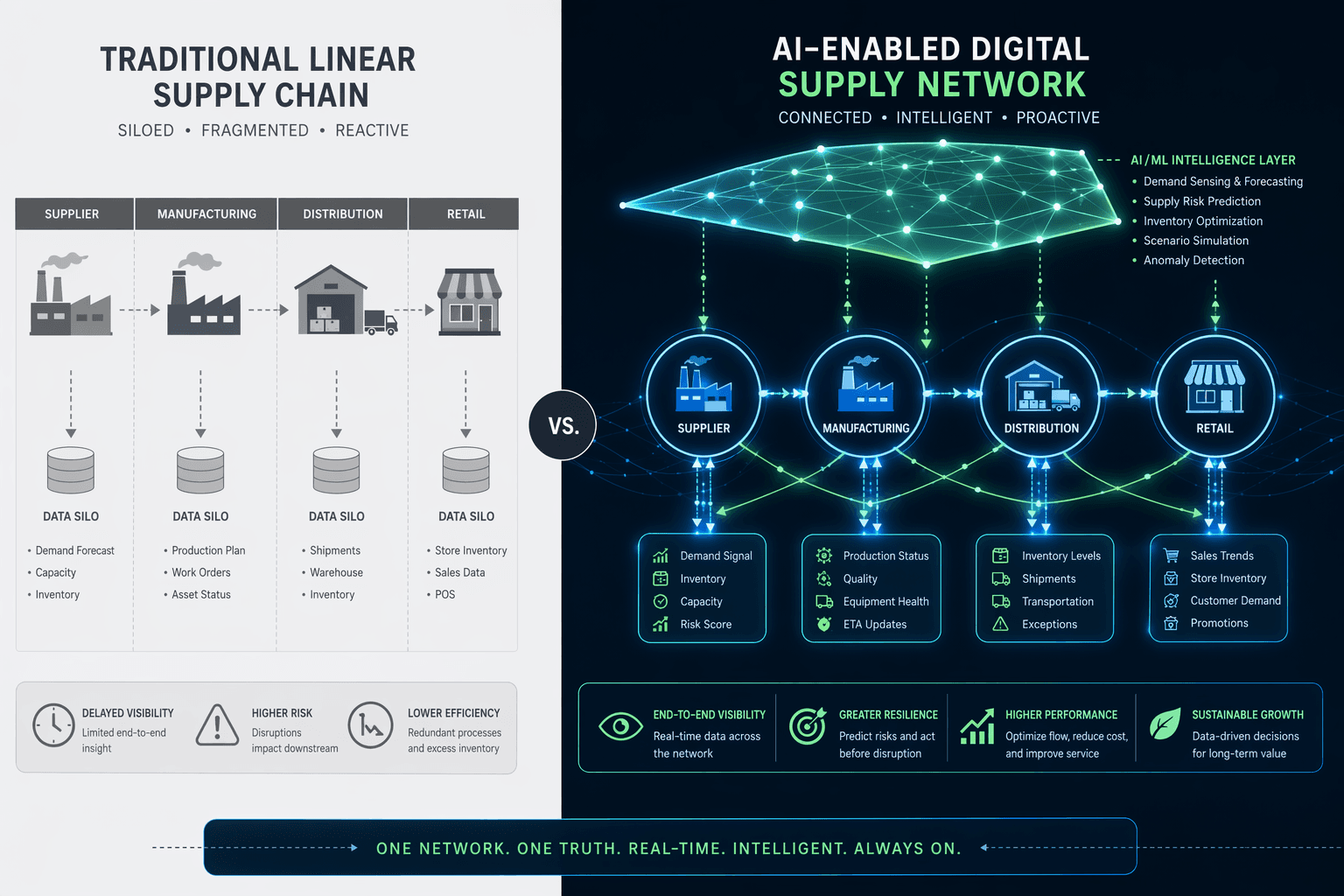
The Three Layers of Supply Chain AI: Predictive, Generative, and Agentic
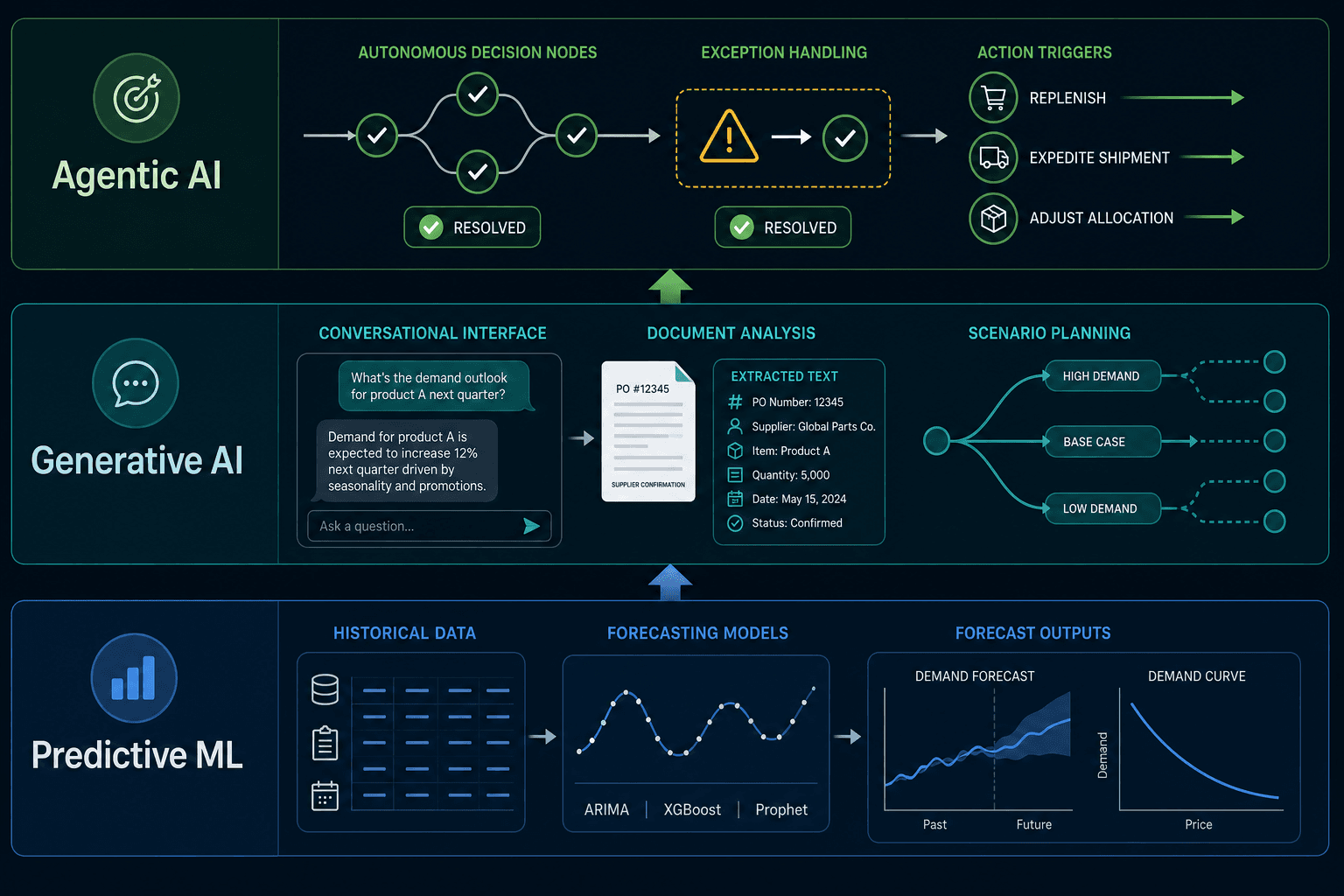
Supply chain technology has long relied on predictive machine learning models for demand forecasting, inventory optimization, and route planning. These systems ingest historical data, identify patterns, and output probabilistic predictions. They are powerful but narrow: a demand forecasting model cannot draft an email to a supplier, and a route optimization algorithm cannot explain why it chose one path over another.
The emergence of generative AI and agentic AI adds two new capability layers that extend far beyond prediction. Understanding the distinction between these three layers is essential for supply chain leaders evaluating technology investments in 2026, because each layer solves a fundamentally different operational problem and carries different data, integration, and governance requirements.
| Layer | Core Capability | Operational Problem Solved | Example Output |
|---|---|---|---|
| Predictive ML | Pattern recognition and probabilistic forecasting | "What will happen?" — demand, lead time, risk prediction | Forecast error reduction, safety stock recommendations |
| Generative AI | Natural language understanding and content generation | "How can I explore what might happen?" — scenario analysis, document intelligence | Conversational planning queries, automated contract analysis |
| Agentic AI | Autonomous reasoning and action within defined rules | "What should be done about it?" — exception resolution, orchestration | Automatic supplier re-routing, inventory rebalancing actions |
Predictive ML remains the foundation. Without accurate forecasts and risk scores, generative and agentic systems lack the data they need to produce useful outputs. But generative AI adds a conversational interface layer that makes predictive insights accessible to non-specialists, while agentic AI closes the loop by taking action on those insights without waiting for a human to interpret a dashboard.
How Generative AI Is Already Used in Supply Chain
Generative AI entered supply chain operations primarily through natural language interfaces that let planners and procurement professionals interact with data conversationally. Instead of navigating complex dashboards or writing SQL queries, users can ask questions in plain English and receive synthesized answers, charts, or document summaries.
Three application categories dominate current deployments:
- Conversational planning assistants. Planners ask "What was our forecast error for SKU 4472 in Q1?" or "Show me the top five suppliers with the highest lead time variability" and receive instant, natural-language responses. This reduces the time spent navigating filtering interfaces and interpreting raw data.
- Natural language scenario queries. Rather than manually adjusting parameters in a planning model, users describe a scenario — "What happens to inventory levels if we shift sourcing from Vietnam to Mexico?" — and the generative AI layer translates that into model inputs, runs simulations, and summarizes the results.
- Document intelligence. Procurement teams use generative AI to extract key terms from supplier contracts, purchase order confirmations, and shipping documentation. The technology can flag non-compliance, identify renewal dates, and summarize lengthy agreements in seconds.
These applications do not replace predictive models. They wrap them in an interface that lowers the barrier to use. A demand planning analyst who previously needed training in statistical forecasting tools can now interact with the same underlying models through a chat interface. The value is speed and accessibility, not new predictive capability.
Agentic AI in Practice: From Assistants to Autonomous Executors
If generative AI is the interface layer, agentic AI is the execution layer. Agentic AI systems — often called AI agents — are autonomous software entities that detect exceptions, evaluate context across multiple systems, and take corrective action within predefined rules without requiring human intervention at each step.
The shift is significant. A generative AI assistant can tell a planner that a shipment from a key supplier is delayed. An agentic AI system can autonomously check alternative suppliers, compare lead times and costs against contract terms, re-route the order, and update the planning system — then notify the planner of the action taken.
Three operational domains where agentic AI is gaining traction in 2026:
- Autonomous disruption response. When a port closure, weather event, or supplier failure occurs, agentic systems can assess the impact across the supply chain network, identify alternative sourcing or routing options, and execute changes within parameters set by planners. Kinaxis reports that planners often spend more than 50% of their time manually sorting through dashboards to track down late supplies and coordinate fixes — and that AI agents could cut that effort by up to 80%.
- Supplier commitment monitoring. Agents continuously track supplier performance against commitments — delivery dates, quality thresholds, pricing agreements — and flag or resolve deviations. Unframe describes this as "autonomous exception handling" where agents evaluate context across systems and take corrective action within predefined rules.
- Exception resolution in order-to-cash and procure-to-pay. Agentic systems can handle routine exceptions like mismatched invoices, delayed purchase order acknowledgments, or inventory allocation conflicts, escalating only the cases that fall outside their authority boundaries.
The critical distinction from generative AI is that agentic systems act. They do not just answer questions — they execute decisions. This makes governance and control mechanisms non-negotiable, a topic addressed in the governance section below.
Real-World Examples: Platforms Putting These Layers to Work
Several enterprise platforms now combine two or three of these AI layers in production environments. The following examples illustrate how the framework maps to real products — they are not endorsements, but reference points for evaluators.
| Platform | AI Layers Applied | Key Capability | Relevant Use Case |
|---|---|---|---|
| Kinaxis Maestro | Predictive + Generative + Agentic | AI agents that sort dashboards, detect disruptions, and orchestrate responses | Autonomous disruption response; planners can cut manual sorting time by up to 80% |
| Unframe | Agentic (with underlying predictive models) | Autonomous exception handling for supplier commitments and order deviations | Supplier commitment monitoring; agentic resolution within predefined rules |
| IBM watsonx Orchestrate | Generative + Agentic | Agentic orchestration with natural language interaction and governance controls | Procurement workflow automation; human-in-the-loop escalation paths |
Kinaxis Maestro combines all three layers: predictive models generate forecasts and risk scores, generative AI provides a conversational interface for planners to query scenarios, and agentic AI handles disruption response and orchestration behind the scenes. The company reports that within its platform, generative AI acts as the interface while agentic AI drives the logic and execution.
Unframe focuses on agentic AI for supply chain, positioning its platform as a system that detects exceptions, evaluates context across systems, and takes corrective action. The company explicitly frames 2026 as "the year of AI agents" — a shift from the assistant paradigm of 2024–2025.
IBM watsonx Orchestrate applies agentic AI to procurement and logistics workflows with an emphasis on governance. It supports human-in-the-loop and human-on-the-loop approaches, ensuring that autonomous actions remain within organizational risk tolerance.
Governance Requirements for Generative and Agentic AI
Traditional predictive ML models in supply chain have well-established governance practices: model validation, backtesting, drift monitoring, and periodic retraining. Generative and agentic AI introduce new governance requirements that many organizations are not yet equipped to handle.
Four governance capabilities are critical for safe deployment:
- Confidence scoring. Every output from a generative or agentic AI system should include a confidence score that tells the user how reliable the result is. A planning assistant that says "I am 92% confident this forecast is accurate" is far more useful — and safer — than one that presents all outputs with equal certainty.
- Audit trails. Agentic systems that execute decisions autonomously must maintain complete, tamper-evident logs of every action taken, including the data inputs, reasoning path, and outcome. This is essential for compliance, post-incident analysis, and continuous improvement.
- Human escalation paths. Not all exceptions should be handled autonomously. Agentic systems need clear escalation criteria — based on financial value, regulatory impact, or novelty of the situation — that route decisions to human planners when they exceed predefined boundaries.
- Explainability. Supply chain decisions have financial and operational consequences. When an agentic system re-routes a shipment or adjusts inventory targets, it must be able to explain why in terms that planners and auditors can understand. Black-box decision-making is unacceptable in production supply chain environments.
IBM emphasizes that AI agents require enterprise-grade controls to operate safely, noting that "AI is a tool; it cannot build relationships" and recommending human-in-the-loop and human-on-the-loop approaches. Unframe similarly stresses that agents need "confidence scoring, audit trails, human escalation paths, and enterprise-grade controls to operate safely."
Adoption Data: How Fast Are Organizations Moving?
Adoption of generative and agentic AI in supply chain is accelerating rapidly, though it remains uneven across functions and company sizes. The following data points, drawn from multiple independent surveys, provide a snapshot of current momentum.
| Metric | Figure | Source | Year |
|---|---|---|---|
| Supply chain leaders planning to implement GenAI within the year | 50% | Gartner | 2024 |
| Supply chain leaders who have already implemented GenAI | 14% | Gartner | 2024 |
| Procurement executives using GenAI tools at least weekly | 94% | AI at Wharton / Hackett Group | 2025 |
| Year-over-year increase in weekly GenAI use among procurement execs | 44 percentage points | AI at Wharton / Hackett Group | 2025 |
| Daily logistics decisions projected to be autonomous by 2028 | 15% | Gartner (via Inbound Logistics) | 2026 |
| Large-scale organizations adopting AI-based forecasting by 2030 | 70% | Gartner | 2025 |
| Executives planning to increase AI spending in 2026 | 85% | Supply Chain Brain | 2025 |
The 94% weekly usage figure among procurement executives is particularly striking — a 44 percentage point increase year-over-year — suggesting that generative AI has moved from experimental to routine in procurement faster than in other supply chain functions. This may reflect the text-heavy, document-intensive nature of procurement work, which aligns well with current generative AI capabilities.
Gartner's projection that 15% of daily logistics decisions will be made autonomously by AI agents by 2028 signals that agentic AI is still early in its adoption curve but poised for significant growth. The 85% of executives planning to increase AI spending in 2026, reported by Supply Chain Brain, suggests that investment intent remains strong despite economic uncertainty.
For a deeper analysis of the business case and ROI benchmarks behind these adoption trends, see our article: From Pilot to Profit: The Real ROI of AI in Procurement and Supply Chain.
Implications for Supply Chain Planners and Organizations
The evolution from predictive ML through generative AI to agentic AI has direct implications for how supply chain organizations structure their teams, invest in technology, and think about the role of human judgment.
- Role shift from data sorting to exception oversight. As agentic systems take over routine monitoring and exception handling, planners will spend less time manually sorting through dashboards and more time managing the edge cases that require human judgment. Organizations should plan for this shift in job design and training.
- Skill requirements are expanding. Traditional supply chain planning skills — forecasting, inventory management, S&OP — remain essential. But organizations now also need capabilities in prompt engineering, AI output validation, and governance oversight. The most effective teams will combine domain expertise with AI literacy.
- Technology investment strategy should be layered. Rather than choosing between predictive, generative, or agentic AI, organizations should evaluate where each layer adds value in their specific context. A company with weak demand forecasting fundamentals should invest in predictive ML before adding generative interfaces. A company with mature planning processes may benefit more from agentic automation of exception handling.
- Governance is a competitive differentiator. Organizations that invest in confidence scoring, audit trails, and human escalation frameworks early will be able to deploy agentic AI more broadly and safely than those that treat governance as a compliance checkbox. The speed of safe deployment, not the speed of experimentation, will determine who captures value.
For readers who want to understand the underlying technology stack that powers these three layers, our AI/ML Technologies in Supply Chain: An Architecture and Capability Reference provides a detailed breakdown of the models, data pipelines, and integration patterns involved.
The three-layer framework — predictive, generative, agentic — is not a prediction about the future. It is a description of the present state of supply chain AI technology in 2026. Organizations that understand these distinctions can make more strategic investments, deploy more safely, and capture more value than those that treat all AI as a single undifferentiated capability.