

The supply chain AI story has a strange shape in 2026: 94% of supply chain companies plan to use AI or GenAI for decision support within two years, yet only 23% have a formal AI strategy.[1] That is not a slow-adoption problem. It is the opposite: artificial intelligence and machine learning in supply chain are moving into operating decisions faster than many organizations have built the management system to control them.
The caveat makes the gap more uncomfortable, not less. The 23% strategy figure comes from a limited, self-selected group of supply chain leaders who had already deployed AI, not from a broad census of companies still thinking about it.[1] In plain operating terms, that means many organizations are not waiting for strategy before deployment. They are already putting models into the workflow, then asking governance, data quality, KPI ownership, and change management to catch up later.
For readers who want the original 94%/23% paradox unpacked in more detail, ChainSignal’s deeper analysis of why 77% of supply chain machine learning deployments have no strategy is the right branch. The question here is what that paradox says about readiness: why so many programs are active, visible, and budgeted, yet still structurally weak.

Deployment is no longer the bottleneck
PwC’s 2026 Digital Trends in Operations Survey, based on 767 operations leaders, shows how far the conversation has moved past awareness. Fifty-seven percent of surveyed leaders say AI has been integrated into at least selected functions. At the same time, 89% say technology investments have not fully delivered expected results, 87% cite poor data quality as a barrier, and only 27% have fully embedded an AI strategy.[2] Because the survey is U.S.-centric, it is best read as a benchmark rather than a universal global measure.
Those numbers describe the executive steering committee problem more accurately than a use-case catalog ever could. A company can have AI in demand planning, warehouse labor planning, transportation exception management, and procurement analytics, while still lacking a coherent answer to four basic questions: which decision is being improved, which data is trusted, who owns the model, and which KPI decides whether the investment is working.
There is also bottom-up pressure. In logistics specifically, 72% of employees already use AI tools, according to a 2025 ActivTrak finding aggregated in OpenSky’s supply chain AI statistics review.[1] That kind of adoption can be useful. It can also create a shadow operating layer: planners, coordinators, analysts, and managers using AI to summarize, prioritize, forecast, or draft decisions before the organization has agreed which outputs are decision support and which ones are merely convenience.
The practical implication is blunt. The board deck may show pilots, platforms, and innovation velocity. The operator inherits the exceptions: duplicate data fields, competing forecasts, model outputs no one wants to override, and a benefits case that was never tied to a baseline.
The readiness gap has three structural causes
The adoption-readiness gap is often discussed as if it were a technical shortage: not enough models, not enough data scientists, not enough automation. The evidence points somewhere less glamorous and more operational. The weak points are fragmented data, insufficient workforce upskilling, and formal governance that arrives after deployment instead of before it.
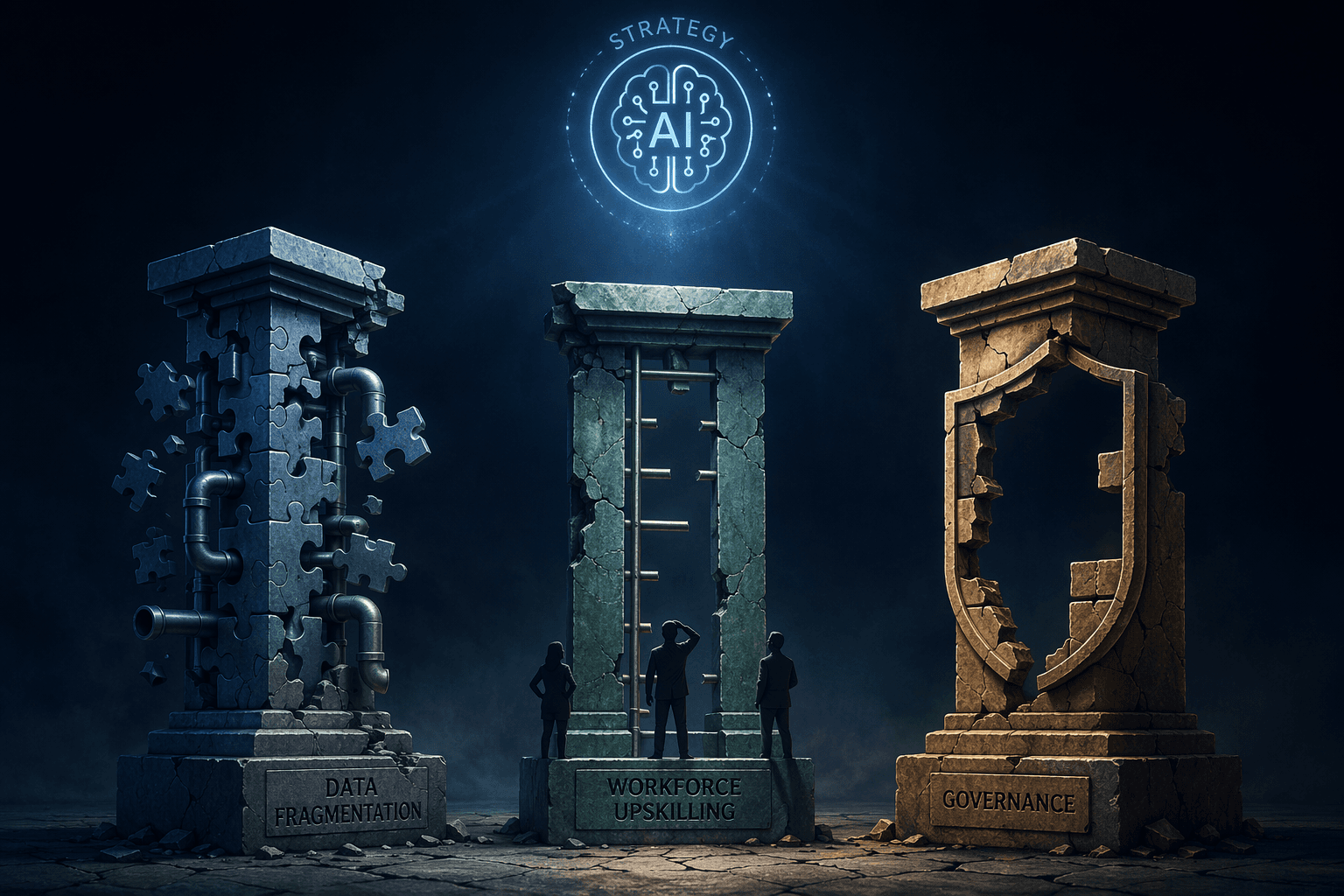
Fragmented data makes AI look smarter than the process
Poor data quality is not an abstract constraint when 87% of PwC’s surveyed operations leaders identify it as a barrier.[2] In supply chain, it shows up in painfully specific ways: item masters that do not match planning hierarchies, supplier lead times that are updated after the fact, transportation events that arrive too late for exception prevention, and inventory positions that differ by system depending on who is asking.
Machine learning does not remove the cost of those inconsistencies. It can expose them, route around some of them, or quantify uncertainty more effectively than a rules-based process. But if the business treats model output as a clean decision layer sitting above dirty operating data, the result is a polished recommendation with unresolved accountability underneath.
Upskilling is not the same as access to tools
The workforce issue is not whether planners and managers can open an AI-enabled application. Many already can. The harder question is whether they know when to trust a model, when to challenge it, how to document an override, and how to recognize when a recommendation is outside the conditions under which the model was useful.
That matters because supply chain decisions rarely stay inside a single screen. A demand signal can affect inventory targets, supplier commitments, transportation capacity, service promises, and working capital. If the user sees only the local recommendation, the organization may automate one function’s improvement while pushing volatility into another.
Governance is where many pilots become liabilities
Weak governance is the most visible in the handoff from proof of concept to production. During the pilot, a small team knows the assumptions, the data quirks, and the boundaries of the model. Six months later, the tool is embedded in a planning cadence, new users have joined, exceptions have multiplied, and no one can say whether the original success metric still applies.
The 23% formal-strategy figure and PwC’s 27% fully embedded strategy figure come from different research contexts, so they should not be treated as identical measures. But they rhyme in an important way: both suggest that documented strategic control is lagging behind functional deployment.[1][2]
| Readiness gap | How it appears in operations | What executives should ask |
|---|---|---|
| Fragmented data | Different systems disagree on demand, inventory, supplier, or logistics events | Which data source is authoritative for the decision this model supports? |
| Insufficient upskilling | Users can access AI outputs but lack clear rules for trust, override, and escalation | Who is trained to interpret the recommendation and document the decision? |
| Weak governance | Pilots enter production without named ownership, baseline KPIs, or review cadence | Who owns model performance, business value, risk, and retirement? |
What leaders appear to get right
The payoff for closing the readiness gap is real, but it should be read carefully. Accenture’s finding, cited in industry syntheses, is that companies with AI-mature supply chains are 23% more profitable than peers.[1][3] That does not mean installing an AI tool makes a company 23% more profitable. It means companies that have reached a higher level of AI maturity in supply chain also show materially stronger profitability.
That distinction matters. Mature organizations are not simply running more pilots. They are more likely to connect use cases to operating metrics, scale successful models beyond isolated teams, and keep humans in control of decisions where accountability, service risk, or supplier relationships are at stake.
The value ceiling is clearest in McKinsey-style benchmark ranges often used to describe AI-enabled supply chain performance: 5–20% logistics cost reduction, 20–30% inventory reduction, and 5–15% procurement spend reduction.[1] These are best understood as what becomes possible under the right conditions, not as a guarantee attached to the phrase “AI-enabled.” For inventory leaders evaluating where AI can actually produce measurable returns, the more focused ChainSignal analysis of AI for inventory management use cases is a better place to test the operational logic.
The same caution applies to breadth of deployment. Leaders are far more likely to use AI broadly, while laggards remain stuck in isolated functional experiments.[1] Breadth itself is not the goal. Broad deployment only creates value when the organization has decided how decisions will be coordinated across functions.
A maturity mirror, not a taxonomy exercise
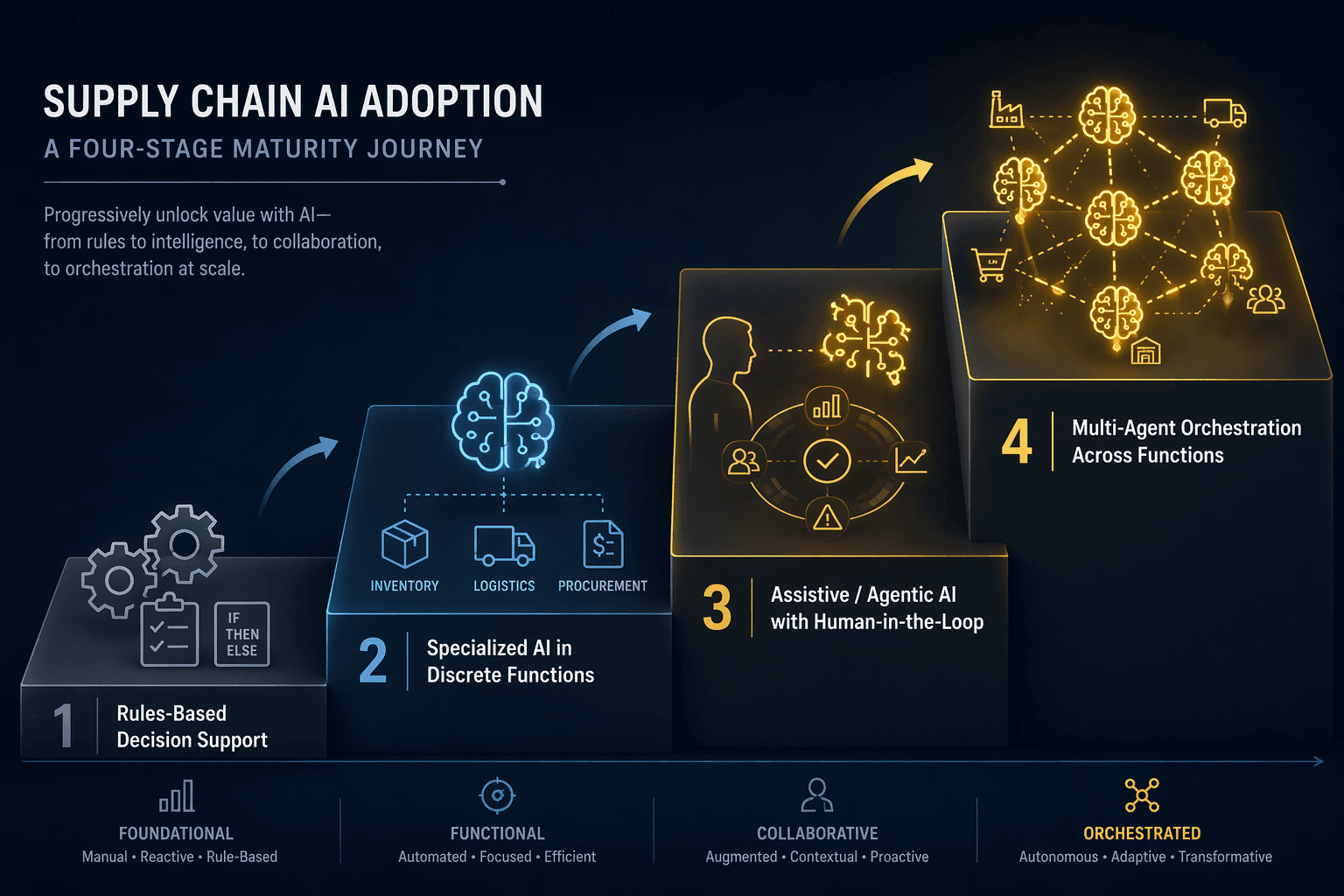
The maturity path for artificial intelligence and machine learning in supply chain can be reduced to a useful executive mirror. The point is not to label the organization neatly. The point is to identify whether the operating model is ready for the kind of AI it is already trying to use.
| Stage | Typical decision pattern | Readiness question |
|---|---|---|
| Stage 1: Rules-based decision-making | Static thresholds, exception rules, manual review, and deterministic workflows | Are rules maintained because they are effective, or because no one trusts the data enough to move beyond them? |
| Stage 2: Specialized AI in discrete functions | Machine learning improves a specific task such as forecasting, slotting, ETA prediction, or anomaly detection | Is the use case tied to a baseline KPI and a named business owner? |
| Stage 3: Assistive or agentic AI with human-in-the-loop controls | AI recommends actions, triggers workflows, drafts scenarios, or coordinates follow-up while humans review material decisions | Are override rights, escalation paths, and audit expectations explicit? |
| Stage 4: Multi-agent orchestration across functions | Multiple AI agents coordinate across planning, procurement, logistics, inventory, and customer commitments | Has the organization defined cross-functional decision rights before automating cross-functional action? |
This staged view draws on maturity frameworks described by RELEX and Dataiku, including the progression from rules-based processes to specialized AI, assistive or agentic workflows, and broader orchestration across functions.[3][4] The uncomfortable middle is where many supply chain organizations now sit: advanced enough to run Stage 2 experiments, but not governed enough for Stage 3 operating dependency.
That middle stage is deceptively attractive. A specialized model can deliver a cleaner forecast, faster classification, or better exception prioritization without forcing the enterprise to redesign decision rights. Assistive and agentic workflows are different. Once AI begins recommending actions, sequencing work, or coordinating across teams, the issue is no longer model accuracy alone. It is who is allowed to act, who is required to review, and who is accountable when the automated workflow creates a downstream consequence.
Market growth will not solve the operating-model problem
The market backdrop is large enough to keep pressure on every supply chain leadership team. One cited estimate projects the supply chain AI market at $64 billion by 2030.[1] That number is useful as context, but it should not be mistaken for readiness inside any one company. Market expansion can produce more tools, more embedded AI features, and more executive urgency. It does not assign a model owner, reconcile a supplier master, or decide whether a planner may override an agentic recommendation.
This is why vendor claims need a narrow reading. A point solution can produce a credible, scoped improvement in a defined workflow. That is different from proving enterprise transformation. Confusing the two is how a useful project becomes an inflated program narrative.
ROI timelines depend on what is being measured
Deloitte’s AI investment data, as summarized in OpenSky’s review, shows 85% of organizations increased AI investment, while only 6% saw ROI in under a year; most achieve returns in a 2–4 year window.[1] That is a sobering enterprise-transformation timeline, especially for leaders under pressure to defend annual budgets.
A Deposco guide presents a much narrower example: a six-month AI supply chain ROI case tied to $847,000 in annual logistics savings.[5] That kind of case should not be dismissed because it comes from a vendor-owned source, but it should be kept in its lane. It is evidence that a constrained use case can show measurable value quickly when the problem, workflow, and KPI are tight. It is not evidence that enterprise AI transformation pays back in six months.
Both timelines can be true because they measure different scopes. A transportation optimization or exception-management use case may show savings inside a budget cycle. A supply chain operating model that embeds AI across planning, procurement, inventory, logistics, and customer service needs longer because the work includes data repair, role redesign, governance, integration, and adoption.
The first move should test governance, not just the model
A serious AI program does not need to begin with an enterprise-wide platform decision. It often begins with one high-impact use case where the data is clean enough to support the decision, the business consequence is visible, and the KPI baseline is not negotiable.
- Choose a use case with a real operating consequence, such as reducing expedited freight, improving inventory placement, prioritizing supply exceptions, or increasing forecast usability for a specific planning cycle.
- Confirm that the data required for the decision is available, current, and owned by someone who can resolve defects.
- Assign a named transformation owner, not only a technical lead or functional sponsor.
- Set baseline KPIs before the model influences the workflow.
- Define human-in-the-loop controls: who reviews, who overrides, who documents, and who escalates.
- Use the first 90 days to prove whether the organization can govern value creation, not to claim full transformation.
For logistics teams that need a more detailed implementation sequence, ChainSignal’s phased roadmap for machine learning in logistics extends this into a practical rollout path.
That first use case is doing more than testing an algorithm. It is testing whether the company can name an owner, trust a data source, measure a baseline, train users, review exceptions, and decide what happens when the recommendation conflicts with experience. If it cannot do that on one bounded problem, scaling the program will multiply the ambiguity rather than the value.
The paradox, then, is not that supply chain leaders are slow to adopt AI. Many are adopting it faster than their operating model can absorb.
References
- Supply Chain AI Statistics — OpenSky Group
- 2026 Digital Trends in Operations Survey — PwC
- Supply Chain AI Trends 2026 — Dataiku
- AI to ROI Framework — RELEX Solutions
- Guide to AI Supply Chain ROI: Timing Is Everything — Deposco
Comments
Join the discussion with an anonymous comment.