
Defining AI vs. ML in the Supply Chain Context
For supply chain practitioners, the distinction between artificial intelligence and machine learning is more than academic — it determines which tools you apply to which operational problem. AI is the broader field: systems that perform tasks requiring human-like perception, reasoning, and decision-making. ML is the engine inside many of those systems: algorithms that learn patterns from historical data without being explicitly programmed for every rule.
In a supply chain context, AI encompasses everything from a demand forecasting platform that adjusts safety stock levels to a computer vision system that inspects pallets on a conveyor belt. ML is the technique that powers the forecast or the inspection — the model trained on years of shipment data or thousands of product images. When a vendor says their platform uses AI, the practical question is always: which ML technique, trained on what data, for which decision?
The adoption data reflects this breadth. According to PwC's 2025 Digital Trends Survey of 610 US-based executives, 57% of operations and supply chain leaders have already integrated AI into selected functions. That figure covers everything from basic anomaly detection in logistics to agentic systems that autonomously renegotiate supplier contracts. The common thread is that these systems move supply chain decisions from reactive — responding to a stockout after it happens — to predictive and, increasingly, automated.
How AI/ML Works in Supply Chains: The Core Pipeline
Understanding the AI/ML pipeline in supply chain terms helps procurement leaders and operations managers evaluate what a system actually does — and what it needs to function. The pipeline follows five stages, each with specific data and infrastructure requirements.
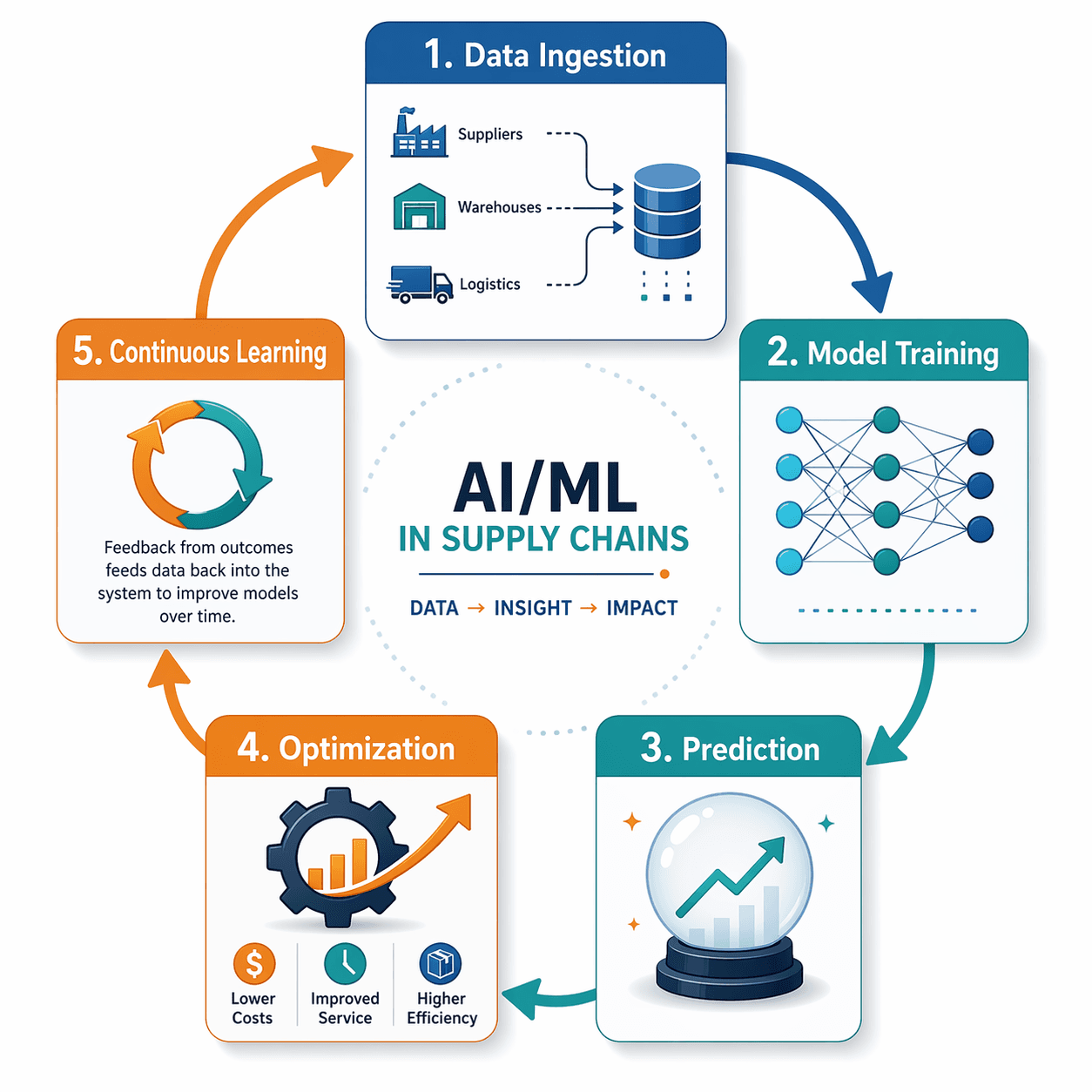
Consider a concrete example: a global consumer goods company using ML to predict late deliveries. The pipeline looks like this:
- Data ingestion: The system pulls shipment status data from the TMS, carrier performance records, weather feeds, traffic data, and port congestion reports. This data is often fragmented across legacy systems — a primary reason 67% of enterprises report stalled ROI from visibility tools, per Tradeverifyd's 2026 compilation.
- Model training: An ML algorithm — typically a gradient-boosted tree or a neural network — learns the patterns that historically preceded late deliveries. It identifies that a combination of port congestion above 72 hours and carrier on-time rates below 85% predicts a 60% probability of delay.
- Prediction: For each in-transit shipment, the model outputs a delay probability and an estimated new arrival window. The system flags shipments above a configurable threshold (e.g., 70% probability) for intervention.
- Optimization: The system recommends actions — reroute through an alternate port, switch to a different carrier for the next leg, or pre-notify the customer. In more advanced deployments, agentic AI executes the rerouting automatically.
- Continuous learning: When the shipment arrives, actual delay data feeds back into the model. The system learns whether its prediction was accurate and adjusts its parameters. This feedback loop is what distinguishes ML from a static rules engine.
This pipeline applies across supply chain functions. The data sources change — ERP for demand planning, WMS for warehouse operations, supplier portals for procurement — but the architecture remains consistent. Organizations that skip the data ingestion and continuous learning stages typically see model accuracy degrade within 6 to 12 months.
The Five Major AI/ML Techniques and Their Supply Chain Applications
AI/ML in supply chain is not a monolith. Five core techniques dominate current deployments, each suited to specific functions and data types. The table below maps each technique to its primary supply chain application, the data it requires, and a representative outcome.
| Technique | Primary Supply Chain Function | Data Inputs | Representative Outcome |
|---|---|---|---|
| Machine Learning Forecasting | Demand planning, inventory optimization | Historical orders, POS data, promotions, weather, macro indicators | 20–50% reduction in forecast errors (McKinsey) |
| Natural Language Processing (NLP) | Procurement, supplier management | Contracts, invoices, emails, supplier news feeds, ESG reports | Automated extraction of 100% of supplier commitment terms (Fortune 500 manufacturer) |
| Computer Vision | Warehouse operations, quality control | Camera feeds, barcode scans, product images | 30–50% warehouse throughput increase (US distribution companies) |
| Reinforcement Learning | Route optimization, logistics | Traffic data, fuel costs, delivery windows, vehicle capacity | 5–20% logistics cost reduction (McKinsey) |
| Generative AI & Agentic AI | Autonomous exception handling, documentation | ERP data, carrier APIs, customer comms, internal knowledge bases | 60% reduction in documentation lead time (McKinsey) |
Machine Learning Forecasting
ML forecasting differs from traditional statistical methods (like moving averages or exponential smoothing) in that it can incorporate dozens of external variables — weather patterns, macroeconomic indicators, social media sentiment — and detect non-linear relationships that human planners miss. According to McKinsey, AI-powered demand forecasting reduces forecast errors by 20–50%, which directly translates to lower safety stock requirements and fewer stockouts. Gartner projects that 70% of large organizations will adopt AI-based forecasting by 2030.
Natural Language Processing for Procurement
NLP enables machines to read and interpret human language in procurement documents — contracts, invoices, supplier emails, and compliance reports. A Fortune 500 manufacturer achieved 100% supplier commitment visibility and 3 weeks' advance disruption warning using AI supplier monitoring, according to Unframe AI's 2026 use-case analysis. NLP models extract key terms (payment terms, delivery obligations, force majeure clauses) from unstructured text, reducing the manual translation burden that 69% of compliance and supply chain teams report spending 11+ hours per week on, per Tradeverifyd.
Computer Vision for Warehouse Operations
Computer vision systems analyze camera feeds in real time to identify products, detect damage, read labels, and monitor worker safety. US distribution companies report 30–50% warehouse throughput increases with AI and robotics integration, per Unframe AI. Ocado's fully automated warehouses use AI robots to handle over 50,000 orders per week. Eric Walters, VP Analytics at DHL Supply Chain, noted in Inbound Logistics' 2026 outlook that AI-driven computer vision helps warehouses process goods faster, reduce errors, and optimize space utilization.
Reinforcement Learning for Route Optimization
Reinforcement learning trains models through trial and error — the system tries a route, measures the outcome (cost, time, emissions), and adjusts its future decisions. Unlike static optimization algorithms, RL adapts to changing conditions in real time. McKinsey reports that AI-enabled distribution operations deliver 5–20% logistics cost reduction and 20–30% inventory reduction. A carrier implementing a three-way messaging platform for 150+ vehicles saved $3.5 million, according to McKinsey's 2025 analysis.
Generative AI and Agentic AI for Autonomous Exception Handling
Generative AI creates new content — documentation, emails, reports — while agentic AI takes autonomous action based on that content. McKinsey found that gen AI can reduce documentation lead time by up to 60% and logistics coordinator workload by 10–20%. A virtual dispatcher agent for a last-mile operator with over 10,000 vehicles led to $30–35 million in savings on a $2 million investment. Agentic systems accounted for 17% of total AI value in 2025, projected to reach 29% by 2028, according to BCG data cited by Dataiku.
Measurable Impact by Function: What the Data Shows
The evidence for AI/ML impact in supply chain is accumulating across multiple functions, though readers should treat self-reported survey data with appropriate skepticism. The table below summarizes sourced impact figures organized by function.
| Function | Impact Metric | Source & Year | Caveat |
|---|---|---|---|
| Demand Planning | 20–50% reduction in forecast errors | McKinsey | Range depends on industry and data quality |
| Logistics | 5–20% logistics cost reduction | McKinsey 2024 | Based on AI-enabled distribution operations |
| Inventory | 20–30% inventory reduction | McKinsey 2024 | Varies by product category and demand volatility |
| Procurement | 5–15% procurement spend reduction | McKinsey 2024 | Includes AI-driven sourcing and negotiation |
| Warehouse | 30–50% throughput increase | Unframe AI 2026 | US distribution companies with AI/robotics integration |
| Overall Profitability | 23% higher profitability for AI-mature companies | Accenture 2024 (1,148 companies) | Correlation, not causation; maturity self-assessed |
| Documentation | Up to 60% lead time reduction | McKinsey 2025 | Gen AI applied to documentation tasks |
| Maintenance | 30–50% reduction in unplanned downtime | McKinsey | Predictive maintenance using ML on sensor data |
The broader market trajectory reinforces these findings. The AI in supply chain market is valued at $9.94 billion in 2025 and projected to reach $236 billion by 2035 at a 37.3% CAGR, according to Precedence Research. However, market size estimates vary significantly across analysts — Strategic Market Research projects $63.8 billion by 2030, while Grand View Research estimates $51.12 billion by 2030 — because of different scope definitions (some include hardware and robotics, others focus on software only).
For readers who want deeper functional dives, the AI Use Case Library provides detailed application-by-application coverage with deployment examples and vendor mappings.
Common Implementation Challenges and How to Address Them
Despite the enthusiasm — 94% of supply chain companies plan to use AI or Gen AI for decision support within two years, per ABI Research's 2025 survey of 490 professionals — adoption remains uneven. Only 23% of supply chain organizations have a formal AI strategy, even among those already deploying, according to Gartner's 2025 survey of 120 deploying leaders. The gap between intent and execution stems from five recurring challenges.
- Data quality and fragmentation: AI models are only as good as their training data. Supply chain data is notoriously fragmented across ERP, TMS, WMS, and supplier portals. SupplyChainBrain's 2025 analysis identifies data quality as the top barrier, recommending a single source of truth and systematic data cleansing before any AI deployment.
- Lack of a formal AI strategy: The 23% figure from Gartner is striking because it comes from organizations that are already deploying AI — meaning 77% are deploying without a coherent strategy. This leads to fragmented pilots that never scale. IBM's preparation framework recommends starting with a current network assessment and creating a roadmap before any technology selection.
- Employee resistance and trust: Fear of automation is a real barrier. SupplyChainBrain recommends transparent communication about role changes and investment in training. The data suggests this pays off: 72% of logistics employees adopted AI tools in 2024, according to ActivTrak's 2025 report, indicating that hands-on experience reduces resistance.
- High startup costs and integration complexity: AI deployment requires upfront investment in data infrastructure, model development, and integration with legacy systems. McKinsey advises starting with a focused domain and scaling methodically, warning that gen AI application costs (GPU usage) can become prohibitive if not architected correctly.
- Overreliance on AI without human oversight: AI systems are not infallible. They can produce confident but wrong predictions, especially when input data shifts (a phenomenon called model drift). IBM and SupplyChainBrain both emphasize that human oversight remains essential, particularly for high-stakes decisions in procurement and logistics.
Definitions of Key Related Terms
Supply chain professionals encounter a cluster of related terms that are often used interchangeably but have distinct meanings. The following definitions clarify the relationships and direct readers to dedicated glossary entries for deeper coverage.
- Predictive analytics: The broader practice of using historical data to forecast future outcomes. ML is one technique within predictive analytics. See the dedicated Predictive Analytics in Supply Chain Management glossary entry for a full definition and technique breakdown.
- Digital twin: A virtual replica of a physical supply chain — warehouses, transportation networks, inventory positions — that can be simulated and optimized. Digital twins often incorporate ML models to predict how changes in one node affect the entire network. See the Digital Twin Supply Chain entry for operational applications.
- Agentic AI: AI systems that can take autonomous action — not just recommend but execute. In supply chain, agentic AI handles tasks like supplier onboarding, contingency planning, and rerouting shipments. BCG estimates agentic systems accounted for 17% of total AI value in 2025, projected to reach 29% by 2028.
- Demand sensing: A subset of demand forecasting that uses real-time data — point-of-sale scans, social media trends, weather — to detect short-term demand shifts. Demand sensing typically uses ML models trained on high-frequency data, distinguishing it from traditional monthly or weekly forecasting cycles.
- Autonomous planning: A planning process where AI systems generate and adjust plans — production schedules, inventory targets, procurement orders — without human intervention at each cycle. Autonomous planning requires mature ML models, robust data pipelines, and clear governance rules for exception handling.
- Cognitive supply chain: An umbrella term describing a supply chain that uses AI, IoT, and advanced analytics to sense, learn, and respond autonomously. It encompasses multiple techniques — ML forecasting, NLP, computer vision, agentic AI — working in concert.
The Bottom Line: AI/ML as a Family of Techniques, Not a Single Solution
AI and ML in supply chain are not a single technology to buy or a switch to flip. They are a toolkit of complementary techniques — ML forecasting for demand, NLP for procurement documents, computer vision for warehouse operations, reinforcement learning for logistics routing, and agentic AI for autonomous exception handling. Each technique requires specific data inputs, infrastructure, and governance. Each delivers measurable impact in the right context, but none works as a universal solution.
The organizations that succeed — the 23% that have a formal AI strategy, the ones that are 23% more profitable according to Accenture — share common patterns: they invest in data quality before model development, they start with focused pilots in a single function, they maintain human oversight, and they build continuous learning loops into their deployments. They do not treat AI as a one-time implementation project but as an ongoing operational capability.
The market trajectory reinforces the urgency. With the AI in supply chain market projected to grow from $9.94 billion in 2025 to $236 billion by 2035 (Precedence Research), and 85% of executives planning to increase AI spending in 2026 (Open Sky Group), the question is no longer whether to adopt AI/ML but how to adopt it effectively. Organizations that build the data infrastructure, governance frameworks, and organizational readiness now will be positioned to deploy the next generation of techniques — agentic AI, autonomous planning, cognitive supply chains — as they mature.