
The useful question in the RTX Spark versus AMD GPU debate in China is not which vendor wins a desktop benchmark. It is whether a buyer in China can source useful AI compute without entering the same queue that has defined data-center GPUs: export licenses, HBM stacks, CoWoS capacity, allocation committees, and the quiet reality that a quoted lead time is not the same thing as a buildable plan.
That question has become commercially relevant because NVIDIA’s China data-center position is no longer the near-monopoly it was before sanctions. IDC estimated NVIDIA at about 55% of China AI accelerator units in 2025, or roughly 2.2 million units out of a 4 million-unit market, down from about 95% before sanctions; the same IDC-based reporting put Huawei-led domestic vendors at about 1.65 million AI GPU shipments, with Huawei at roughly 812,000 units and about 20% share.[1] Bernstein’s estimate is not the same measure, but points in the same direction: it put NVIDIA at about 40% of China’s AI chip market in 2025, roughly matched by Huawei, and projected a fall toward about 8% in 2026.[2]
AMD is trying to push into that opening. It publicly targeted 25% of China’s discrete GPU market in early 2026, while IDC-based data put AMD at about 160,000 China AI accelerator units in 2025, or roughly 4% of that market.[1][3] Those figures describe data-center AI accelerators, not personal AI PCs. They should not be stretched into an RTX Spark demand forecast. They do explain why a lower-friction, non-data-center product lane would matter if OEMs, developers, and enterprise buyers can make it real.
The Fork Is Architectural Before It Is Commercial
RTX Spark is interesting because it is not another China-compliant data-center GPU with the usual caveats. NVIDIA announced RTX Spark at GTC Taipei on May 31, 2026 as a personal AI platform built around a Grace CPU and Blackwell GPU combination, using TSMC 4NP, a 20-core Arm Grace CPU co-developed with MediaTek, 6,144 CUDA cores, up to 128 GB of LPDDR5X unified memory, NVLink-C2C, and a claimed 1 petaflop of FP4 performance.[4] As of July 19, 2026, that is still a vendor claim around a newly announced platform, not an installed China base with field failure data, allocation history, or independently verified throughput.
AMD’s competing path is Strix Halo now and Gorgon Halo next. Strix Halo combines up to 16 Zen 5 cores, 32 threads, 40 RDNA 3.5 compute units, and up to 128 GB of unified memory; Gorgon Halo is described as extending that ceiling to as much as 192 GB of unified memory and is scheduled for Q3 2026.[5] These parts depend on TSMC 4/5nm-class manufacturing and use AMD’s chiplet and Infinity Fabric approach rather than the NVIDIA Grace-Blackwell design. AMD executives have compared RTX Spark unfavorably with Strix Halo, but that is competitive positioning, not independent evidence of sustained supply or adoption.[5]
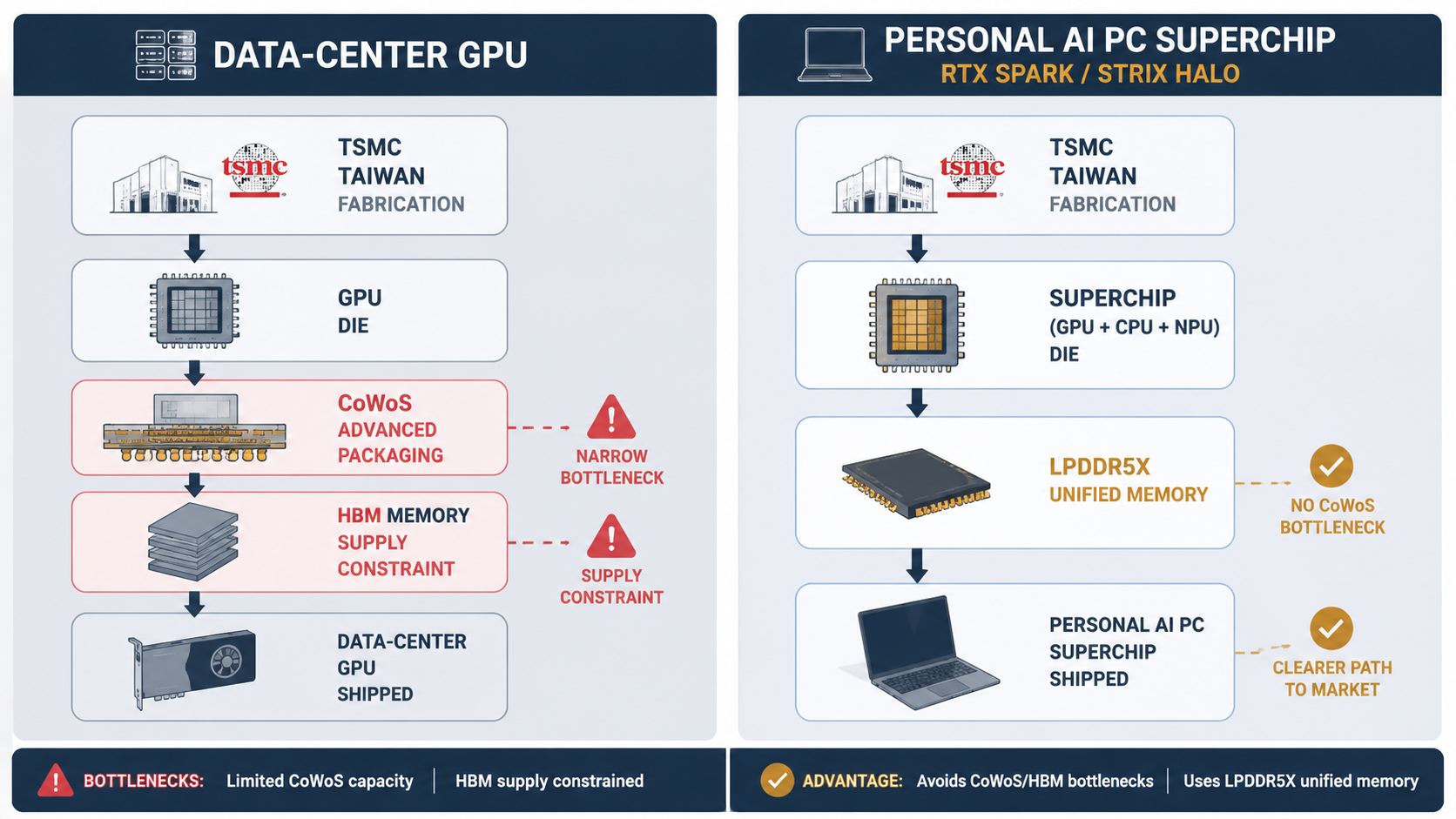
The practical supply-chain distinction is simple enough to matter: RTX Spark and Strix Halo/Gorgon Halo do not require HBM or CoWoS. RTX Spark uses LPDDR5X unified memory around a compact personal AI system design. Strix Halo uses LPDDR5X unified memory in a chiplet-based architecture. Neither is built like the top data-center accelerators whose economics and delivery schedules are wrapped around HBM availability and TSMC’s advanced packaging slots.
That does not make them unconstrained. It changes which constraints have to be booked. For a procurement team, that is the whole point. A data-center GPU sourcing plan starts with questions about export eligibility, HBM stack supply, CoWoS capacity, board allocation, and whether the customer is important enough to get priority. A personal AI superchip plan starts with advanced-node wafer access, LPDDR5X supply, OEM platform commitments, regional compliance, and whether the vendor will allocate enough volume to a category that has not yet proven its China demand.
Why Avoiding CoWoS and HBM Changes the Sourcing Conversation
CoWoS avoidance matters because CoWoS has become one of the narrowest physical passages in the AI accelerator chain. Morgan Stanley-linked estimates cited by Vamsi Talks Tech put TSMC CoWoS capacity around 75,000 to 80,000 wafers per month in early 2026, expanding toward 120,000 to 130,000 wafers per month by the end of 2026; the same reporting said NVIDIA consumed about 60% of that CoWoS capacity.[6] That is the kind of bottleneck that turns a product roadmap into a rationing exercise.
The CoWoS/HBM queue is not just a packaging detail. It affects who gets product first, which SKUs vendors prefer to build, how much buffer a buyer needs, and how much faith anyone should put in quarter-end availability language. ChainSignal’s NVIDIA AI chip lead-time analysis maps the same issue in operational terms: when advanced packaging and HBM are the gate, a purchase order cannot be judged only by the GPU die.
RTX Spark and Strix Halo move the buyer out of that particular line. LPDDR5X unified memory is still a high-volume, contested memory component, but it is not HBM. A monolithic or tightly integrated personal AI package still needs substrate, test, assembly, firmware, OEM integration, thermal design, power qualification, and software support, but it does not need a scarce CoWoS slot for every accelerator package. That is a real change in bill-of-materials risk, not just a relabeling of the same data-center SKU.
| Supply-chain item | Data-center AI GPU path | RTX Spark / Strix Halo path |
|---|---|---|
| Advanced packaging | CoWoS is a major capacity gate for leading accelerators | No CoWoS requirement in the described personal AI PC architectures |
| Memory | HBM supply is central to buildability and allocation | LPDDR5X unified memory replaces HBM in the platform design |
| Fabrication | Advanced TSMC nodes remain central | TSMC 4NP or 4/5nm-class dependency remains central |
| Regulatory exposure in China | Data-center accelerators face export-control and licensing regimes | RTX Spark-class consumer silicon is outside the cited data-center controls |
| Market evidence | China accelerator share estimates exist, though they vary by scope | No cited China installed-base data for RTX Spark or Gorgon Halo as of July 19, 2026 |
This is also why the comparison should not be reduced to peak arithmetic format. NVIDIA’s FP4 claim for RTX Spark, AMD’s unified-memory ceiling for Gorgon Halo, and both vendors’ preferred benchmark framing may all matter to developers later. For sourcing, the first pass is more basic: which wafers, which memory, which package, which factory, which jurisdiction, which customer priority. If the answer removes CoWoS and HBM, it earns attention.
The Lane Is Freer on Rules, Not Free of Constraints
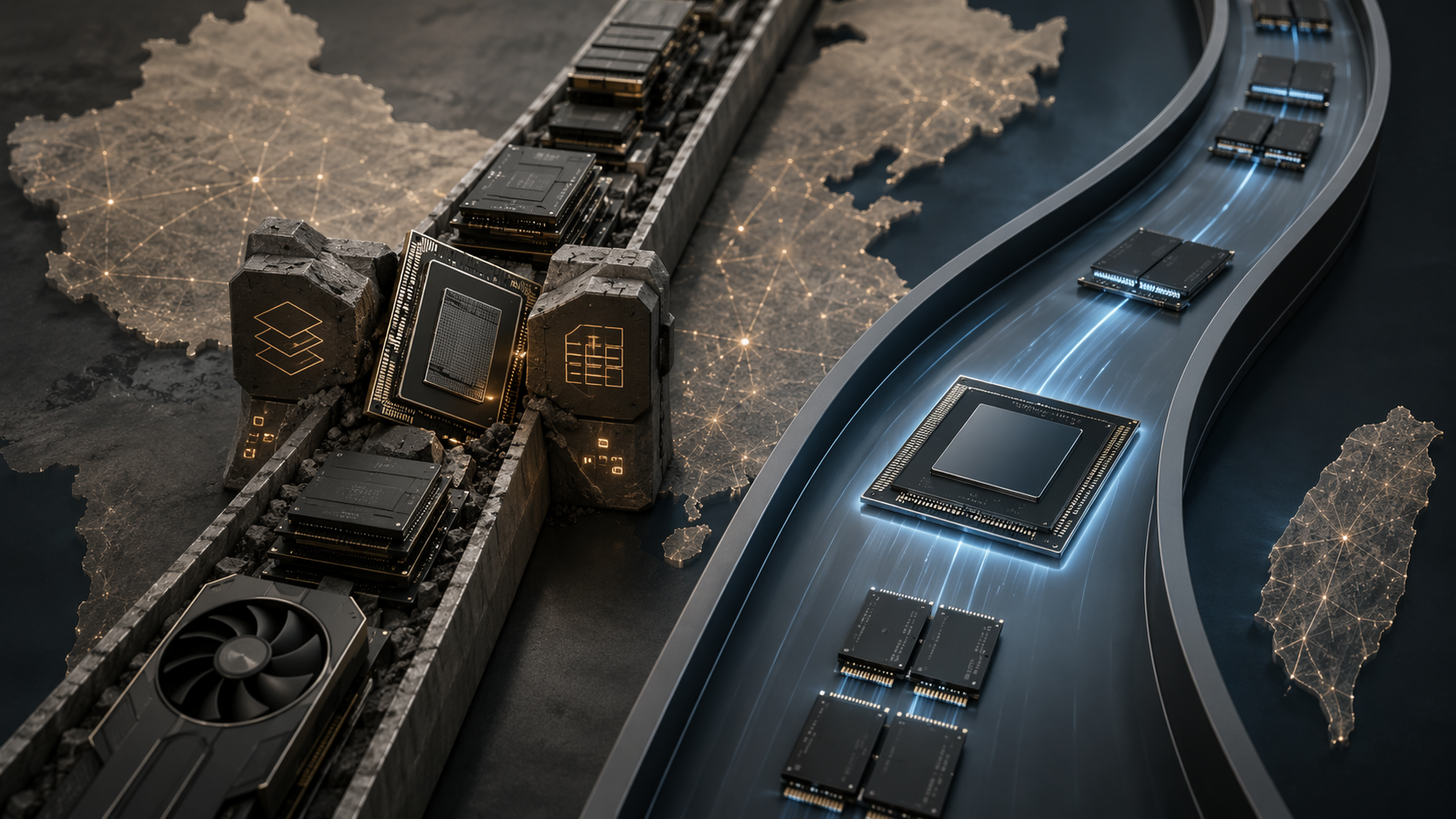
The regulatory contrast is real. The cited China data-center GPU controls cover products such as H200 and the licensing regimes around advanced accelerators, while RTX Spark-class consumer silicon is not subject to those same restrictions. The H200 path alone shows how unstable that terrain has been: H200 was banned in December 2024, unbanned in December 2025, hit with a 25% tariff in January 2026, and moved into case-by-case licensing with an approximately 1 million-unit cap; the Validated End User system expired on December 31, 2025 and was replaced by annual fab licenses.[7] That chronology is exactly why US-China AI competition supply-chain risk has become a procurement issue rather than a policy footnote.
But regulatory availability is not supply availability. RTX Spark’s TSMC 4NP dependency and Strix Halo’s TSMC 4/5nm dependency keep both products inside the same geographic concentration that already makes planners uneasy. The parts may avoid CoWoS, but they still compete for advanced-node wafer starts, engineering attention, test capacity, and downstream OEM readiness. A product can be legal to sell and still be hard to allocate.
LPDDR5X is the next constraint to watch. It is not HBM, and that difference matters. It is also not a magic pool of unlimited memory. A 128 GB unified-memory configuration on RTX Spark or Strix Halo, and a claimed path up to 192 GB on Gorgon Halo, concentrates memory demand into a class of client system that is more memory-heavy than ordinary PCs.[4][5] If the category scales, the purchasing conversation moves from “can we get HBM stacks?” to “who has secured enough high-capacity LPDDR5X packages, at the right speed, for the right platform build?”
Allocation incentives may be the least visible constraint and the one buyers feel most sharply. Data-center silicon still carries the strategic weight, customer urgency, and margin profile that can pull scarce foundry and engineering resources toward accelerator roadmaps. NVIDIA’s and AMD’s personal AI PC parts may be attractive in China precisely because they avoid the data-center choke points, but the vendors still have to decide how much capacity to reserve for a greenfield category when higher-margin AI infrastructure demand remains intense. ChainSignal’s work on AI chip bottlenecks and market risk is relevant here because physical bottlenecks and allocation choices do not stay confined to operations teams; they change revenue timing and investor expectations.
China Demand Is Not Proven by Data-Center Share Loss
NVIDIA’s China accelerator share decline creates the opening, but it does not prove RTX Spark demand. IDC’s 2025 unit estimate and Bernstein’s broader market estimate both describe AI chips or AI accelerator markets dominated by data-center use cases.[1][2] They do not measure how many Chinese OEMs will build RTX Spark systems, how many enterprises will buy personal AI workstations, or how much local developer demand exists for a new category of client-side AI hardware.
The same caution applies to AMD. Its 25% China discrete GPU target is a commercial ambition, not evidence that Gorgon Halo will ship at scale into China.[3] Strix Halo gives AMD an architectural story that can be compared with RTX Spark, and Gorgon Halo’s larger unified-memory ceiling gives procurement teams another spec to track. But as of July 19, 2026, Gorgon Halo is still scheduled for Q3 2026 rather than field-proven in China.[5]
Domestic Chinese silicon also changes the buyer’s reference price and political calculus. IDC-based reporting put domestic Chinese GPU vendors at about 1.65 million AI GPU shipments in 2025, led by Huawei.[1] Separate reporting described government voucher programs reimbursing 30% to 50% of compute costs for domestic silicon.[8] That support applies to a different product lane than personal AI PCs, but it matters because procurement departments do not evaluate imported client AI hardware in a vacuum. They compare it against subsidized domestic alternatives, internal compliance pressure, software maturity, and the risk of buying into a platform that could become harder to support later.
AMD’s MI308 history is a reminder that China-specific availability can turn quickly. Reporting citing AMD SEC filings described an $800 million inventory charge tied to the China-crippled MI308 chip, followed by a $390 million shipment.[8] That is not a forecast for Strix Halo or Gorgon Halo. It is a useful warning against treating permission, inventory, and recognized demand as the same event.
What a Defensible Sourcing Plan Would Check
A buyer trying to qualify RTX Spark or Strix Halo for China does not need another vendor slide about AI PCs. The first diligence pass is narrower and more mechanical:
- Confirm the exact export-control classification for the shipped configuration, not the announcement name.
- Separate wafer capacity from package capacity: CoWoS avoidance helps only if TSMC 4NP or 4/5nm wafer allocation is available.
- Ask memory suppliers and OEMs about LPDDR5X volume, speed bins, package availability, and qualification timing.
- Check whether the vendor is reserving platform allocation for China or merely allowing OEMs to request it.
- Treat performance claims as provisional until independent benchmarks and workload-specific thermal behavior are available.
- Map support obligations: drivers, developer tools, replacement units, firmware updates, and service channels matter more after the first shipment.
The key difference from a data-center GPU sourcing plan is where the escalation goes. With H100, H20, H200-class discussions, the escalation often lands on licensing, HBM, CoWoS, and large-account allocation. With RTX Spark or Strix Halo, it lands on OEM platform readiness, advanced-node wafer allocation, LPDDR5X supply, and whether the vendor wants this category badly enough to protect volume through the first demand cycle.
That is a better problem in some respects. It is less exposed to the most acute data-center export-control regime and bypasses two of the best-known physical choke points. It is also a less documented problem. There is no China installed base for RTX Spark to inspect, no public Gorgon Halo shipment history to analyze, and no direct market-share table that says how many personal AI superchips Chinese buyers will actually absorb.
A Bounded Sourcing Judgment
RTX Spark and Strix Halo/Gorgon Halo are meaningful for China because they shift the bottleneck. They avoid CoWoS and HBM, sit outside the cited data-center export-control lane, and give NVIDIA and AMD a way to compete for AI compute demand without sending every buyer back into the same accelerator queue. For planners who have spent the last few years reconciling sanctions language with packaging capacity and memory allocation, that is a real distinction.
They are not yet a proven sourcing alternative. RTX Spark was newly announced in May 2026, Gorgon Halo was still scheduled for Q3 2026, and the China market-share data available today describes data-center accelerators rather than personal AI PC superchips.[4][5][1][2] The practical answer is conditional: these products open a cleaner lane than China data-center GPUs on regulation and CoWoS/HBM exposure, but buyers still have to underwrite TSMC Taiwan fabrication concentration, LPDDR5X availability, vendor allocation behavior, OEM readiness, and unproven end-market demand.
References
- Nvidia market share in China falls to less than 60% — Tom's Hardware / Reuters
- Nvidia's AI chip sales stall in China — Fast Company, 2026
- AMD targets 25% market share in China — OC3D / Videocardz, January 2026
- NVIDIA and Microsoft Reinvent Windows PCs for the Age of Personal AI — NVIDIA Newsroom, May 31, 2026
- AMD executives react to Nvidia's RTX Spark — Tom's Hardware
- The GPU Supply Chain Crisis — Vamsi Talks Tech, April 2026
- US China Chip Export Controls H200 2026 — Semiconductors Insight, March 2026
- AMD vs NVIDIA AI GPU Market Share 2026 — Silicon Analysts
Comments
Join the discussion with an anonymous comment.