
The first reaction to Moonshot AI's Kimi K3 was a familiar one: the market treated a model launch like a reset button. The PHLX Semiconductor Index slipped into bear territory, down 20% from June highs, and the broader semiconductor tape gave back roughly $3.3T peak-to-trough between June 22 and July 17 [1]. That looked like a structural warning on the screen, but it was mostly a panic test of whether algorithmic efficiency had somehow made chips less necessary.
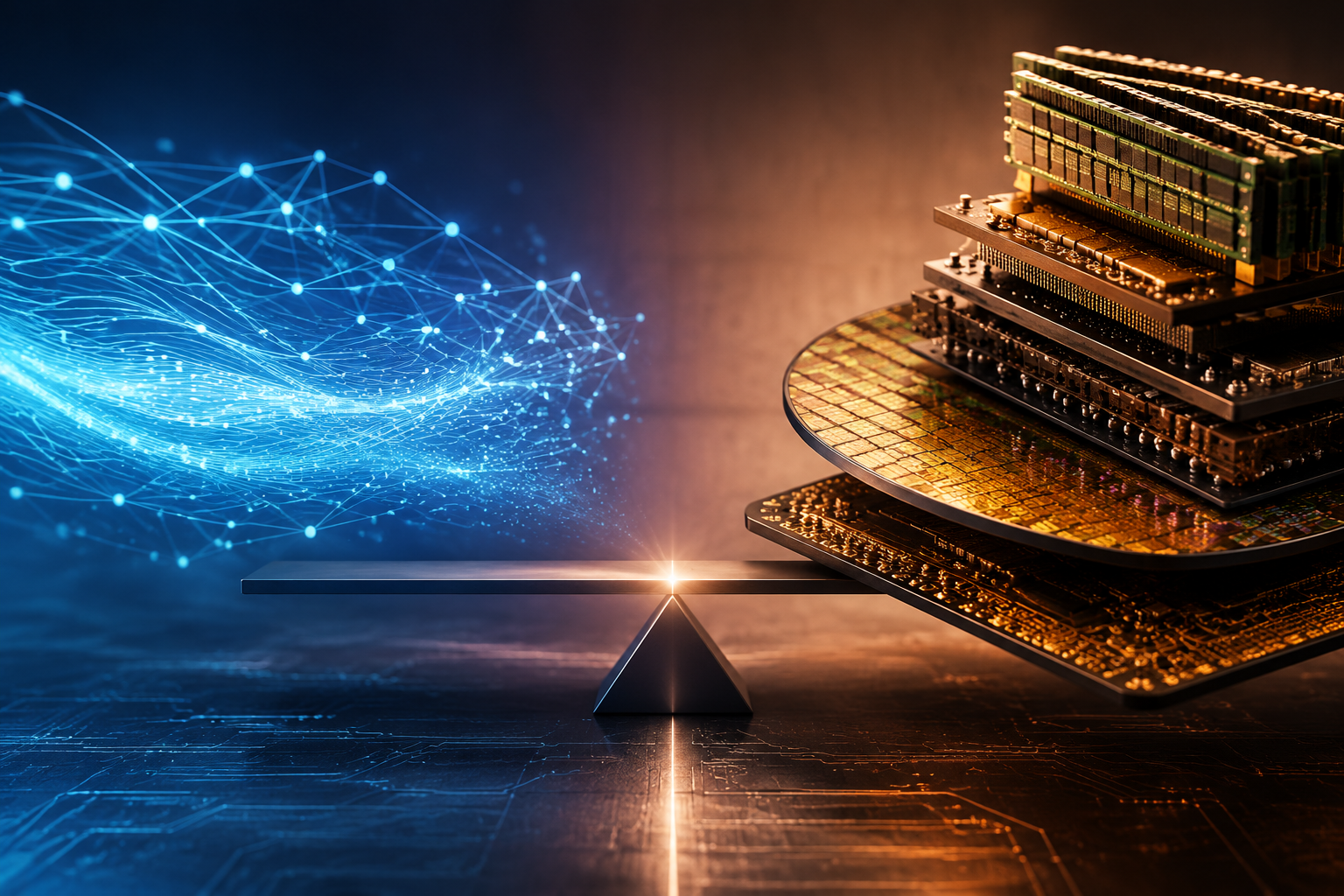
K3 Changed The Price Of Intelligence, Not The Need For Silicon
Kimi K3 is a real technical step. Moonshot released the 2.8T-parameter open-weight model in July 2026 at WAIC, says it improved scaling efficiency 2.5x versus K2, and reported frontier results including a win over Claude Fable 5 on Frontend Code Arena and a top score on the Artificial Analysis quality index [2][3]. Its posted pricing, $3 per million input tokens and $15 per million output tokens, lands well below the $10-$15 and $40-$60 ranges common to U.S. frontier models [2][3]. The part that still needs outside confirmation is the full-weights release, now expected on July 27.
That matters because cheaper inference pushes demand around instead of erasing it. If one model delivers more useful tokens per dollar, buyers do not stop buying compute; they put more weight on inference, on memory bandwidth, and on the tiers of GPU that keep serving live traffic. Training may cool relative to serving, but the stack does not shrink. It rebalances.

The Bottlenecks Did Not Get Cheaper
The physical side still looks like the physical side. TSMC raised 2026 capital spending to $64B, about 14% higher, and Micron has warned that HBM shortages extend beyond 2026 [4][5]. CoWoS packaging remains tight, and multi-year fab lead times still define the queue. If anything, a model that makes inference cheaper can increase pressure on the parts of the chain that already run hot, because the bottleneck shifts from a few frontier training runs to much broader serving demand.
For the earlier market mechanics, see AI Chip Supply Chain Bottlenecks Are Reshaping Stock Market Risk.
Faster Design Can Add Load
The 48-hour chip-design demonstration is the more interesting second-order signal. If AI can help a team go from concept to a working 4mm2, 100MHz chip in two days, the effect is not fewer fabs; it is more design attempts reaching the manufacturing queue sooner [6]. That is still a proof of concept, not a universal workflow, but it points in one direction: faster design cycles can raise the pace at which hardware teams ask for masks, packaging slots, and memory allocations.
So the clean read is narrow. K3 is impressive enough to change buying behavior and scary enough to shake semiconductor stocks, but it is not a chip-demand extinction event. It is a composition shift toward inference silicon and HBM while the same physical bottlenecks stay in place. Until the full weights arrive on July 27, that is the most defensible conclusion.
References
- Coverage of the July 2026 semiconductor selloff tied to Moonshot AI's Kimi K3 - Business Insider, Yahoo Finance, Fortune, Investing.com, Quartz - July 2026 - Business Insider
- Kimi K3 technical blog and release notes - Moonshot AI - July 2026 - Moonshot AI
- Independent coverage of Kimi K3 benchmark performance and pricing - VentureBeat, Tom's Hardware, Artificial Analysis - July 2026 - VentureBeat
- TSMC raises 2026 capital spending - Reuters - 2026 - Reuters
- Micron warning that HBM shortages extend beyond 2026 - Reuters - 2026 - Reuters
- Moonshot chip-design demonstration showing a 48-hour workflow - VentureBeat, Tom's Hardware - July 2026 - Tom's Hardware
Comments
Join the discussion with an anonymous comment.