
The useful question after the June 2026 chip selloff is not whether investors overreacted. They did, at least partly. Broadcom’s cautious Q3 AI revenue guide — $16 billion against a $17.2 billion consensus — helped trigger a one-session rout that reportedly erased about $1.4 trillion in semiconductor market value, with Broadcom down 14%, AMD down 10.86%, Intel down 11.28%, and Nvidia losing more than $300 billion in market capitalization before the group recovered within days.[1][2]
The harder question is which part of that move was attached to a physical constraint and which part was equity-market reflex. A supply chain does not clear, break, and repair itself on a three-day trading calendar. But guidance can change quickly when a bottleneck becomes visible to investors, especially in AI chips, where demand, packaging capacity, memory allocation, power availability, and export rules now meet inside the same revenue model.
That is why semiconductor supply chain disruption is too broad as a single risk label for AI chip stocks. HBM scarcity does not hit a stock the same way helium inflation does. A CoWoS slot shortage does not behave like a grid interconnection delay. Export controls can strand inventory at one company while leaving another company’s pricing power intact. The type of constraint matters more than the number of alarming headlines.

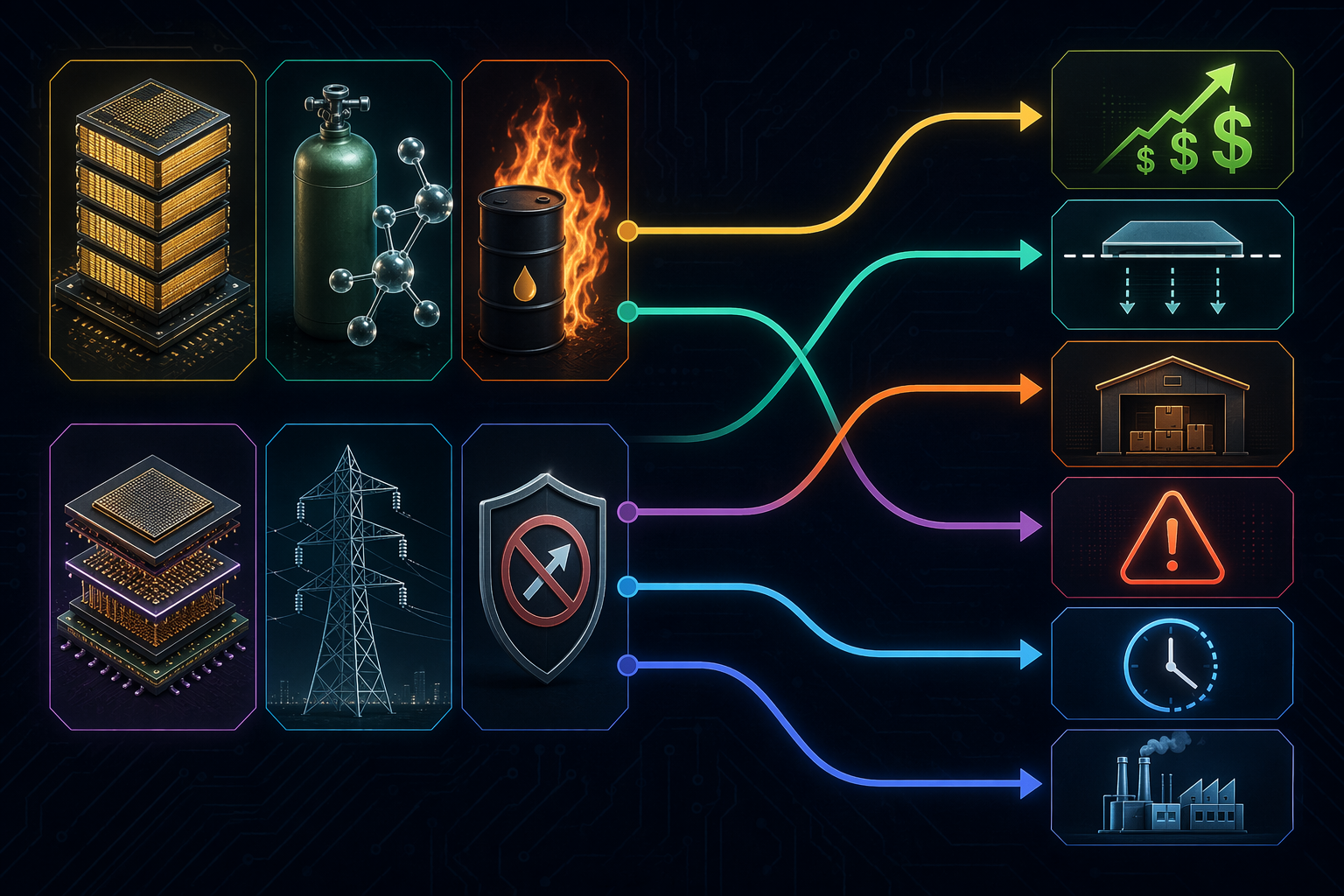
The Six Disruption Vectors Do Not Travel Through Valuation the Same Way
The cleaner way to read 2026 chip volatility is to map the physical constraint to the financial consequence before looking at the stock chart. The same AI infrastructure boom can expand margins for one supplier, cap revenue for another, delay capex recognition for a third, and compress margins for downstream OEMs.
| Disruption vector | Operational constraint | Primary valuation pathway | Stocks most exposed |
|---|---|---|---|
| HBM allocation and memory scarcity | Limited high-bandwidth memory supply for AI accelerators | Margin expansion for memory makers; cost pass-through for buyers | Micron, SK Hynix, Samsung; downstream OEMs |
| Helium and critical gas stress | Higher input costs for chip manufacturing gases and chemicals | Cost pressure and margin risk | Foundries and manufacturers with gas-intensive processes |
| Energy shocks | Fuel and power-cost exposure around Asian semiconductor production | Valuation compression when energy security becomes a production risk | Samsung, SK Hynix, regional suppliers |
| CoWoS advanced packaging bottleneck | Limited packaging slots for AI accelerators | Revenue cap and guidance risk | Nvidia, AMD, Broadcom, TSMC-linked supply chains |
| Power grid constraints | Data center power and interconnection delays | Capex delay and slower downstream AI infrastructure absorption | Hyperscalers, AI server suppliers, chip vendors tied to deployment timing |
| Export controls and critical minerals | Restricted market access or constrained mineral supply | Stranded inventory, product redesign, company-specific revenue risk | Nvidia, China-exposed suppliers, critical-mineral-dependent manufacturers |
This map is not a trading model. It is a discipline for separating a supply shock from a sentiment shock. The June selloff mattered because it showed both at once: investors punished AI chip names as if a revenue ceiling had just appeared, but the rapid recovery showed that the market had moved faster than the confirmed supply chain evidence.
HBM Scarcity Is the Shortage That Became Pricing Power
HBM is the part of the 2026 disruption story that most clearly breaks the old shortage script. A shortage usually reads as missed shipments, angry customers, and margin pressure. In high-bandwidth memory, scarcity has also turned into bargaining power for the companies that can supply the stack.
Reuters reported that the AI frenzy was driving a memory-chip supply crisis, with SK Hynix sold out through 2027.[3] That is not merely a demand anecdote. If a supplier’s qualified capacity is already spoken for, the negotiation shifts from “can you discount?” to “who gets allocation?”
The equity effect is visible in the numbers cited around memory. Micron was reported up 141% year to date, DRAM prices were up 58–63% quarter over quarter in Q2 2026, and memory makers were generating gross margins in the 60–70% range.[4] Those figures describe a very different financial exposure from an AI accelerator designer waiting for packaging capacity or a consumer electronics company absorbing higher memory costs.
That is why memory stocks can rally on a bottleneck that makes other companies nervous. Micron, SK Hynix, and Samsung are not automatically insulated from execution risk, but HBM scarcity gives them a direct route to margin expansion. For Nvidia, AMD, Broadcom, and downstream OEMs, the same scarcity can cap shipment timing, raise bill-of-material cost, or force allocation decisions that customers experience as lead-time risk.
The distinction matters in planning calls as much as in portfolio reviews. A buyer may describe the problem as “memory shortage.” A market note may describe it as “AI demand strength.” Both can be true while pointing to opposite stock outcomes. The company selling the constrained input can gain pricing power; the company assembling a finished system can lose flexibility.
Packaging Capacity and Power Availability Put a Ceiling on AI Revenue
CoWoS is the bottleneck investors keep rediscovering because it sits close to revenue recognition. Demand for AI accelerators can be strong, purchase orders can be real, and component supply can still fail to become finished, shippable systems if advanced packaging slots are fully allocated.
Omdia figures cited by Manufacturing Dive put TSMC’s CoWoS capacity at 75,000–80,000 wafers per month, scaling toward 120,000–130,000 by late 2026, while still fully booked.[5] Moody’s also identified semiconductor supply chains as a major bottleneck for 2026, with advanced packaging among the constraints shaping AI chip supply.[6]
For valuation, the issue is not whether more capacity is coming. It is whether the added capacity arrives inside the quarter implied by guidance. If a chip designer can sell every accelerator it can get packaged, the stock is judged less on end-market demand and more on conversion: how many qualified wafers, substrates, HBM stacks, and CoWoS slots turn into accepted shipments on time.
That is the practical overlap with Broadcom’s June guidance shock. A cautious AI guide can be read as a demand signal, a timing signal, or a capacity signal. Those are not interchangeable. Demand weakness would question the AI spending cycle. A timing or packaging constraint would cap near-term revenue without necessarily undermining the multi-quarter backlog. The selloff treated the distinction roughly; the recovery suggested investors had to reprice that roughness.
Power availability creates a second ceiling, farther downstream but just as relevant to chip stocks when AI infrastructure spending is valued as if deployment were frictionless. Manufacturing Dive and Omdia cited 2026 hyperscaler capex of $660–$750 billion, with each new facility demanding 100–500 megawatts and 30–50% of planned data center capacity slipping to 2028.[5] Kavout also cited a 2,100 GW U.S. interconnection queue, larger than total U.S. grid capacity, in its discussion of the semiconductor selloff.[2]
This is not the same bottleneck as CoWoS. Packaging limits how many AI chips can become finished products. Grid constraints limit how quickly those products can be installed, powered, and monetized by the customers buying them. When both constraints appear at the same time, the market has to decide whether it is looking at delayed revenue, permanently lower demand, or simply a longer deployment curve.
For complementary detail on this capacity layer, ChainSignal’s coverage of TSMC’s Q2 earnings and AI chip bottlenecks is the closer read on how CoWoS and downstream infrastructure constraints meet inside the shipment outlook.
Helium, Energy, and Export Controls Create Narrower but Sharper Stock Risks
The remaining disruption vectors deserve less space than HBM or CoWoS, not because they are unimportant, but because their valuation pathways are narrower. They usually do not re-rate the whole AI complex by themselves. They hit cost lines, regional exposure, inventory classification, or customer eligibility.
Helium and Process Gases Move Through Input Costs
Helium is a good example of a constraint that can sound dramatic while remaining hard to translate into a broad stock move. Omdia’s data cited by Manufacturing Dive said Qatar strikes removed about 20% of global LNG, while CNBC reported helium spot prices doubled and TSMC flagged chemical cost increases.[5][7]
That evidence supports a cost-pressure conclusion, not a universal production-collapse conclusion. For a foundry or manufacturer, higher gas and chemical costs can pressure margins or customer pricing. For a fabless AI chip designer, the effect is more indirect unless it shows up in wafer pricing, supplier allocation, or delivery timing.
Energy Shocks Hit Regional Manufacturing Confidence
Energy shocks move differently. Sourceability, citing Carnegie Endowment analysis, reported that South Korea imports about 70% of its crude through the Strait of Hormuz and that Samsung and SK Hynix stock valuations fell more than 20% at the onset of the Iran conflict.[8]
That is a regional supply-security signal, not proof that memory capacity disappeared. The market was marking down exposure to fuel flows, operating costs, and escalation risk. In a calmer tape, those might sit in a risk register. In a market already primed to punish AI supply constraints, they become valuation variables.
Export Controls and Critical Minerals Are Company-Specific
Export controls are the easiest disruption to misread at index level. The most important effect is often not “semiconductors down.” It is stranded inventory, blocked customers, altered product mix, or redesign cost at the company with the controlled product or constrained input.
Sourceability cited tungsten prices up 557% year over year, with China controlling 79% of production, and also cited Nvidia’s $5.5 billion stranded inventory charge tied to export-control exposure.[8] Those numbers belong in different parts of the model: tungsten is a critical-mineral cost and availability issue; Nvidia’s charge is a market-access and inventory-realization issue.
For supply chain leaders, the operational question is which supplier, product, or customer lane is exposed. For investors, the valuation question is whether the exposure changes total addressable revenue, near-term gross margin, working capital, or just quarterly noise. Export-control headlines often move the group first and get allocated to specific balance sheets later.
Why Memory Stocks Can Win While AI Chip Designers Sell Off
The apparent contradiction in 2026 is that the AI supply chain can be both tight and bullish. The contradiction disappears once the position in the constraint is identified.
- A memory maker with scarce HBM capacity can convert shortage into pricing power.
- A fabless AI chip designer can face revenue caps if packaging, HBM, or export rules restrict what can ship.
- A foundry can benefit from demand while absorbing input-cost and capacity-expansion pressure.
- A hyperscaler can announce large capex while waiting on grid interconnection and power availability.
- A consumer OEM can suffer margin compression if memory costs pass through faster than device pricing.
This is why a single supply chain headline can reward Micron while punishing Broadcom, AMD, Nvidia, or a downstream hardware company. The market is not just pricing demand. It is pricing who owns the scarce asset, who rents it, who waits for it, and who has to explain the delay to customers.
The June selloff compressed those distinctions into one trade. Broadcom’s guidance caution created a read-through to AI revenue timing, and the group sold off. Then the market recovered within days, which is exactly what should make operators suspicious of any explanation that claims supply chain fundamentals alone caused the entire move.[1][2]
Supply constraints can be real and still be over-discounted. They can also be visible for months operationally before they are taken seriously in equity prices. The timing mismatch is now part of the risk.
For a closer read on how market reaction itself becomes a supply chain signal, see ChainSignal’s AI chip supply chain bottlenecks and stock market risk.
The Framework Works Best When It Stays Humble
There are three places where this framework can become too neat.
First, memory cycles have a habit of punishing anyone who extrapolates scarcity forever. Fortune cited Harvard Business School’s Willy Shih warning that memory upcycles have historically turned when new capacity arrives at the same time, with 2027–2028 the relevant window for added supply.[4] That does not cancel the HBM pricing-power story in 2026. It limits how far that story should be carried without watching capacity additions, qualification schedules, and customer commitments.
Second, some of the most quoted market figures in this debate come from financial analysis platforms rather than primary market-data terminals. The roughly $1.4 trillion June selloff estimate comes from Intellectia.ai, while Kavout is used for selloff analysis and grid-related market framing.[1][2] Those sources can be useful for directional interpretation, but precision matters if the figure is going into an investment memo, board deck, or risk register.
Third, geopolitical and flow-of-funds signals move quickly. The Iran-conflict supply chain data reflects May–June 2026 conditions.[8] CryptoBriefing reported a record $5.4 billion single-day SOXX inflow in July 2026, a signal that may show renewed confidence but can also look contrarian if enthusiasm clusters near a crowded trade.[9]
The working conclusion is narrower than the market commentary usually allows. HBM scarcity can lift memory valuations. CoWoS and power-grid bottlenecks can cap AI revenue expectations. Helium, energy, and critical minerals can pressure costs or regional confidence. Export controls can strand inventory and reshape product eligibility. Sentiment can still exaggerate every one of those mechanisms in either direction.
References
- AI Chip Stocks Volatility June 2026: $1.4T Crash & Recovery Analysis, Intellectia.ai.
- What Triggered the Recent Semiconductor Sell-Off, Kavout.
- The AI frenzy is driving a memory chip supply crisis, Reuters, 2025-12-03.
- Wall Street thinks memory is AI's golden ticket, Fortune, 2026-05-11.
- The great data center delay, Manufacturing Dive/Omdia, 2026-04.
- Semiconductors in 2026: Why supply chains are a major bottleneck, Moody's.
- How the Iran war is exposing weak spots in the AI supply chain, CNBC, 2026-05-19.
- Geopolitics are reshaping semiconductor supply chain risk in 2026, Sourceability.
- Record $5.4B single-day SOXX inflow, CryptoBriefing, 2026-07.
Comments
Join the discussion with an anonymous comment.