
The old tariff playbook is showing its limits because it was built for disruption that could be buffered, not for cost rules that keep changing inside the product. Companies can add inventory, qualify a second supplier, or move some work closer to demand, but those moves do not answer the harder question: which SKUs, components, supplier tiers, customs codes, regions, and margin bands are actually exposed when tariff policy shifts again?
That is why the practical case for AI in supply chain disruption and geopolitical risk starts in a fairly unglamorous place: tariff math. In McKinsey’s Supply Chain Risk Pulse, 82% of surveyed companies said they were affected by tariffs, with 20% to 40% of supply chain activity impacted, yet only 45% of tariff costs were passed through to customers.[1] The rest has to be absorbed, negotiated, redesigned, hedged, or explained in the next margin review.
The response so far still looks familiar. The same survey found that 45% of companies were increasing inventory, 39% were dual sourcing, and 33% were nearshoring, while only 7% had introduced measures specific to tariffs.[1] Those tactics are not wrong. They are just blunt. Inventory protects availability before it protects profitability. Dual sourcing helps only if the alternate source has the right cost, capacity, compliance status, and component ancestry. Nearshoring can reduce some exposure while creating another set of labor, tooling, supplier-development, and logistics constraints.
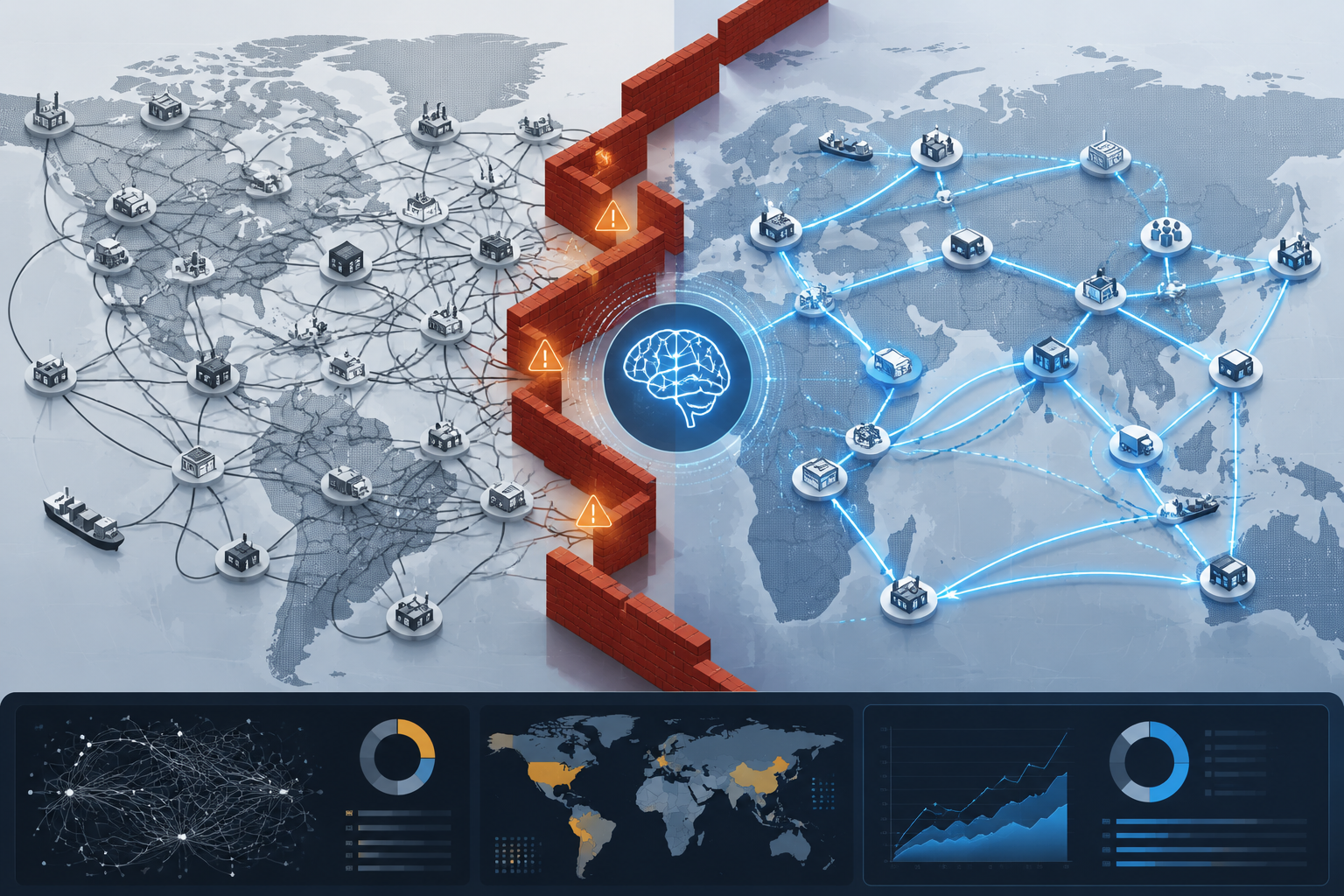
The pressure is not confined to one survey. DP World’s November 2025 study of 152 senior executives reported a median revenue loss from disruption of 5%, with 79% re-evaluating nearshoring, 78% expecting geopolitical risks to intensify, and only 25% saying they felt very prepared for trade policy changes.[2] McKinsey’s sample of 100 companies and DP World’s sample of 152 are not large enough to support grand certainty about every sector. They are enough, together, to confirm the planning problem: companies are spending more management time on geopolitical exposure while still lacking the machinery to translate that exposure into SKU-level decisions.
Tariffs Have Moved Inside the Planning Model
A tariff is often discussed as if it sits at the border. Operationally, it sits in the bill of materials, the supplier master, the trade-compliance file, the product margin bridge, and the sourcing calendar. A finished good may look domestic enough at Tier 1 while still carrying tariff exposure through a subcomponent, a resin, a semiconductor, a processed mineral, or a packaging input two tiers down.
That depth matters because the exposure is not evenly distributed. McKinsey found consumer goods had the highest share of tariff-affected activities at 43%, while chemicals had the lowest among the industries cited at 23%.[1] Those figures do not say consumer goods companies are always worse managed, or chemicals companies are safe. They show why a generic tariff response is lazy. Product mix, supplier depth, input substitutability, and margin structure decide how painful a tariff move becomes.
The visibility gap is the part procurement teams feel first. McKinsey reported a 22-percentage-point increase in companies with Tier 2 visibility driven by tariff compliance, but only 42% had visibility beyond Tier 1.[1] That is progress with a ceiling. A planner can know the Tier 1 supplier is in a lower-tariff location and still miss the embedded exposure that arrives through a critical component sourced elsewhere.
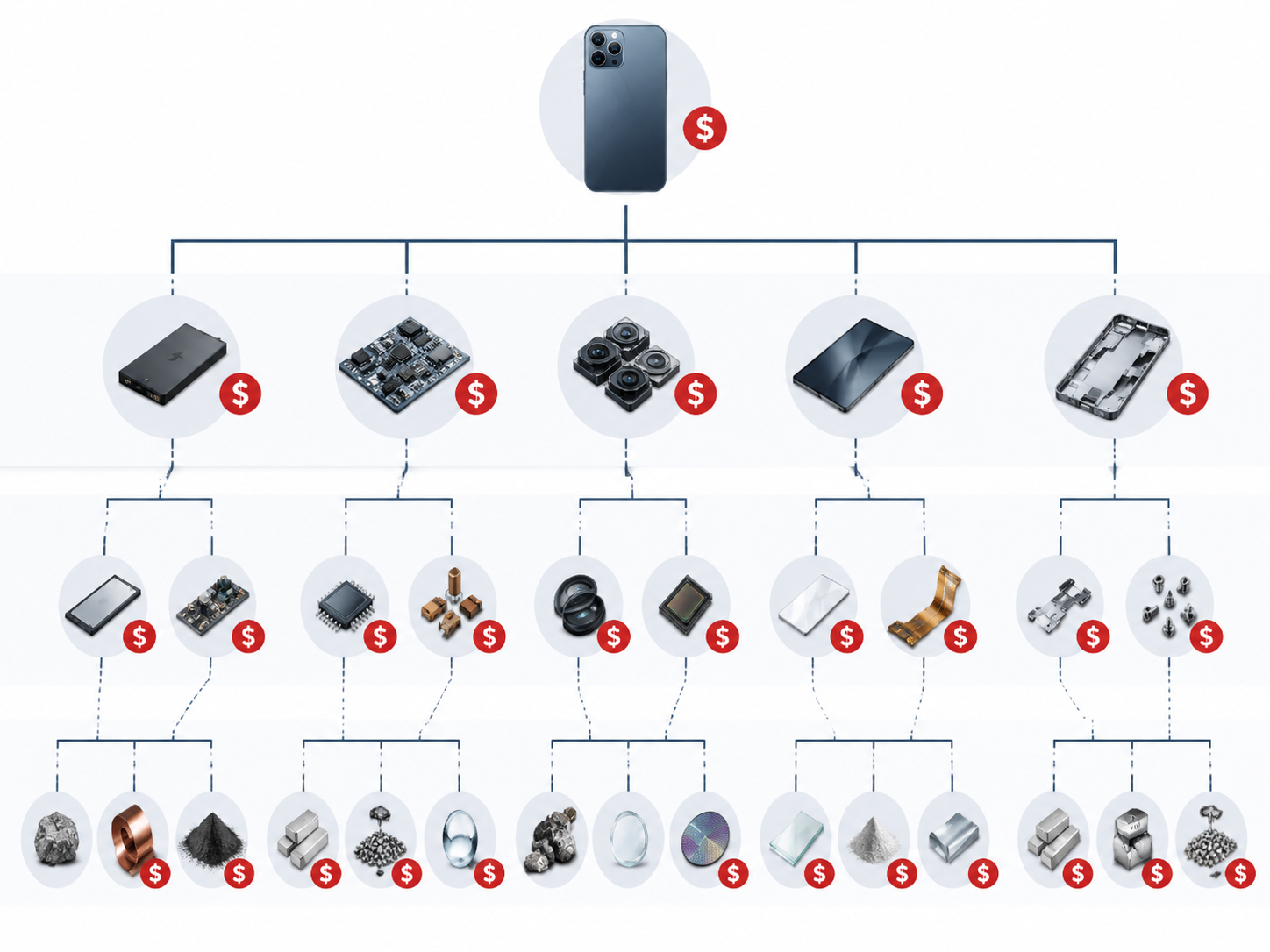
This is where AI earns attention, provided the word is kept close to the work. The useful system is not a dashboard that says a country is risky. It is a model that connects part numbers to bills of materials, bills of materials to supplier tiers, supplier tiers to trade classifications, trade classifications to tariff schedules, and all of that to landed cost, lead time, capacity, quality, and margin.
What AI Has to Model Before It Can Help
The first serious use case is multi-tier tariff exposure modeling. Traditional spreadsheet analysis can handle the obvious cases: direct imports from a country facing a new duty, a high-volume supplier with known customs codes, a finished good with a stable bill of materials. The problem is that tariff exposure is rarely that clean. A single SKU may depend on dozens of components, each with different supplier options, origin rules, classification risks, and substitution constraints.
An AI-supported model can ingest supplier declarations, purchase-order history, product structures, trade-compliance records, and logistics cost assumptions to build a more complete exposure map. It can flag where a tariff increase affects a direct import, where it enters through a sub-tier supplier, and where the company simply lacks enough information to make a confident call. That last category is not a failure of the model. It is often the most valuable output, because it tells procurement where to ask for documentation before a sourcing decision becomes a finance surprise.
| Planning Question | Static Playbook Answer | AI-Enabled Tariff Response |
|---|---|---|
| Which products are exposed? | Review direct imports and high-spend suppliers | Map exposure across bills of materials, supplier tiers, trade classifications, and origins |
| Which supplier option is best? | Compare quoted price and known logistics cost | Compare risk-adjusted total landed cost, including tariffs, capacity, lead time, compliance risk, and margin impact |
| What if policy changes again? | Run manual scenarios for a few major regions | Simulate tariff, export-control, and local-content changes across supplier-region combinations |
| Where should humans intervene? | Escalate after costs move | Escalate when the model finds missing data, classification uncertainty, supplier concentration, or margin breach risk |
The model also has to respect the difference between price and landed cost. A supplier quote can look attractive until the tariff code, freight lane, inventory buffer, broker fees, duty drawback assumptions, and service risk are included. For a CFO, the important number is not whether the alternate source is cheaper at the purchase-order line. It is whether the company can protect contribution margin after the full chain of costs and constraints is applied.
This is also why supplier-tier data cannot remain a compliance side project. If only 42% of companies have visibility beyond Tier 1, most tariff-response models are starting with holes in the map.[1] AI can help reconcile documents, infer relationships, detect anomalies, and prioritize supplier outreach, but it cannot invent reliable origin data where no one has collected it. The operating question becomes whether procurement, trade compliance, finance, and planning are willing to maintain the data together.
Dynamic Sourcing Is Where the Spreadsheet Starts to Lose
Once exposure is mapped, the next question is not simply where to move production. It is which supplier-region combination works for which SKU, at which volume, under which tariff assumption, with which implementation lead time. That is a different decision than a board-slide arrow from one country to another.
McKinsey found that 43% of companies were planning to shift their supply chain footprint to the United States, a 25-percentage-point jump from the prior year, while 38% were planning to reduce their China presence.[1] Those numbers show intent, not feasibility. Moving the footprint still requires supplier qualification, tooling transfer, regulatory checks, capacity reservation, engineering validation, and often customer approval. The sourcing decision may be strategic, but the failure modes are painfully operational.
AI helps most when it turns that strategic intent into a ranked set of constrained options. A dynamic sourcing model can compare incumbent and alternate suppliers against tariff scenarios, available capacity, lead-time volatility, quality history, logistics routes, compliance status, working-capital impact, and expected margin. It can show that a nearshore option improves tariff exposure but worsens capacity risk, or that a lower-duty supplier is unattractive once freight and qualification timing are included.
The practical output should not be a single recommended country. It should be a decision file: which SKUs can move quickly, which require dual qualification, which need commercial renegotiation, which should stay put because the switching cost is greater than the tariff exposure, and which require executive approval because every option damages margin. That is the level at which procurement and finance can have a useful argument.
There is early evidence that AI-supported trade mitigation can reduce exposure, but it should be handled carefully. One academic study reported that organizations using AI-driven trade mitigation strategies experienced a 34% reduction in exposure to tariff-related disruptions.[4] That is a directional signal, not a plug-and-play business-case benchmark. The result does not mean every company can buy a tool and remove a third of its tariff risk. It means the method is plausible enough to deserve disciplined deployment.
Policy Simulation Has Become a Planning Requirement
Tariff volatility is now part of a wider policy environment that includes export controls, local-content requirements, sanctions risk, industrial policy, and strategic trade regulation. Everstream Analytics assigned “Geopolitical Fragmentation and Strategic Use of Trade Regulations” a 97% threat level for 2026, noting that export controls, local content requirements, and tariffs are increasingly weaponized in sectors including semiconductors, critical minerals, and pharmaceuticals.[3]
That framing matters because policy simulation is different from disruption monitoring. A weather event closes a port; a policy change can alter the economics of an entire supplier network while the freight still moves on time. The shipment arrives, the invoice posts, and the damage appears in landed cost, cash flow, or customer pricing.
A useful simulation layer lets the company test policy moves before they become actual purchase-order economics. What happens if a tariff rate rises on a component family? What if a local-content rule makes the current assembly location less attractive? What if an export-control change forces a redesign around a subcomponent? What if two changes happen close together and the first mitigation option creates exposure to the second?
The model does not need to predict politics perfectly to be useful. It needs to help the business rehearse plausible cost paths, identify fragile assumptions, and prepare decision rules. If a margin threshold is breached, who reviews the sourcing option? If the tariff classification is uncertain, who validates it? If the preferred supplier region becomes constrained, which qualified alternative receives volume first? Simulation is valuable when it shortens the time between policy signal and operating decision.
The Execution Gap Is Bigger Than the Modeling Gap
The uncomfortable number is not about AI performance. It is about deployment. McKinsey found that only 19% of companies were deploying AI at scale, while 75% were planning or piloting.[1] That gap explains why so much tariff work still lands in manual analysis even when the organization already believes AI has a role.

A pilot can prove that a model finds exposure. Production deployment has to decide who owns the data, how often it refreshes, which systems feed it, which tariff updates trigger reruns, who approves recommendations, and how exceptions are handled. It also has to survive the normal mess of supplier records: duplicate names, incomplete origin data, inconsistent part numbers, stale certificates, and commercial terms that live outside the main planning system.
This is where the emotional and political difficulty of sourcing change enters, even if the model is technically right. A recommended supplier may be financially attractive and still be hard to adopt because the incumbent relationship is deep, the engineering team is cautious, the qualification window is long, or the customer contract limits changes. AI can rank options. It cannot make a supplier trustworthy, persuade a plant manager to accept transition risk, or interpret a borderline regulatory question without expert review.
The operating cadence is therefore as important as the algorithm. A serious tariff-response capability needs recurring exposure reviews, not one-off projects after a policy announcement. It needs finance to validate margin logic, trade compliance to validate classification assumptions, procurement to validate supplier feasibility, and planning to test capacity and timing. The model should produce recommendations, confidence levels, and exception queues; humans should decide which risks are acceptable and which require escalation.
Volatility also weakens models that lean too heavily on historical patterns. Xeneta has warned that AI models can degrade in volatile environments when the past stops resembling the conditions a company is trying to manage. That warning is especially relevant for tariffs because policy shocks may have little clean precedent. A model trained on yesterday’s flows can be precise about a world that no longer exists.
The answer is not to avoid AI. It is to govern it as a decision system rather than treat it as an oracle. Inputs need freshness checks. Recommendations need explainability. Scenario assumptions need owners. Exceptions need review paths. When the model says a sourcing shift lowers landed cost, the business still needs to know whether the result depends on a fragile tariff assumption, an unverified supplier declaration, or a capacity promise that has not been contracted.
What a Real Tariff-Response Capability Looks Like
The companies that move beyond pilots will not necessarily be the ones with the flashiest AI interface. They will be the ones that connect five pieces of work that are often managed separately: supplier-tier visibility, bill-of-materials mapping, trade-policy monitoring, risk-adjusted landed-cost optimization, and human governance.
- Supplier-tier data: Maintain origin, ownership, capacity, and dependency information beyond Tier 1 where tariff exposure can be embedded.
- Product-level cost logic: Link tariff assumptions to bills of materials, customs classifications, logistics costs, inventory buffers, and margin thresholds.
- Dynamic sourcing optimization: Compare supplier-region options using total landed cost and operational feasibility, not quoted price alone.
- Policy simulation: Test plausible tariff, export-control, and local-content scenarios before they become active constraints.
- Governed decision cadence: Put procurement, finance, planning, and trade compliance around the same recurring review process.
This is a narrower claim than the usual AI enthusiasm, and it is stronger because of that. AI does not make tariffs predictable. It does not remove the politics of supplier change. It does not replace the judgment needed to interpret regulations or manage strategic relationships. What it can do is process the dull, comprehensive, cross-functional analysis that tariff volatility now requires at a speed and depth manual processes cannot sustain.
Tariff volatility has become too granular and too fast-moving for static playbooks. AI changes outcomes only when it leaves the pilot environment and becomes part of recurring sourcing and planning decisions, with the data, review rights, and governance needed to keep the model honest when policy moves again.
References
- Supply Chain Risk Survey, McKinsey & Company, Dec. 2025, https://www.mckinsey.com/capabilities/operations/our-insights/supply-chain-risk-survey
- DP World Study Finds Supply Chains Underprepared for Geopolitical Risks, DP World, Nov. 2025, https://www.dpworld.com/en/news/usa/dpw-study-finds-supply-chains-underprepared-for-geopolitical-risks
- Are You Prepared for the Supply Chain Disruptions of 2026?, Everstream Analytics, https://www.everstream.ai/articles/are-you-prepared-for-the-supply-chain-disruptions-of-2026/
- ScienceDirect paper link in research draft, ScienceDirect paper link in research draft
Comments
Join the discussion with an anonymous comment.