
The practical moment for AI air quality forecasting in supply chain logistics is not a dashboard changing from yellow to orange. It is a dispatcher looking at two legal routes, one delivery window, three available trucks, and a forecast that says the usual corridor is likely to sit under unhealthy air for the next several hours. If that forecast stays in a sustainability report, nothing operational has happened. If it enters the routing platform with enough resolution and confidence to change the plan, air quality becomes a constraint alongside miles, drive time, dock appointment, toll cost, vehicle type, and customer priority.
That is the shift worth paying attention to in 2026. A fleet routing platform can ingest AI-driven air quality and weather forecasts, flag a high-pollution zone before trucks enter it, test alternate route costs, assign an electric vehicle where exposure or local restrictions matter most, or stage inventory ahead of a forecasted disruption. Visual Crossing describes this kind of use case directly: logistics platforms can use weather and air quality APIs to route around high-AQI zones in real time and allocate electric trucks to higher-risk areas while reserving fossil-fuel vehicles for lower-risk zones.[1]
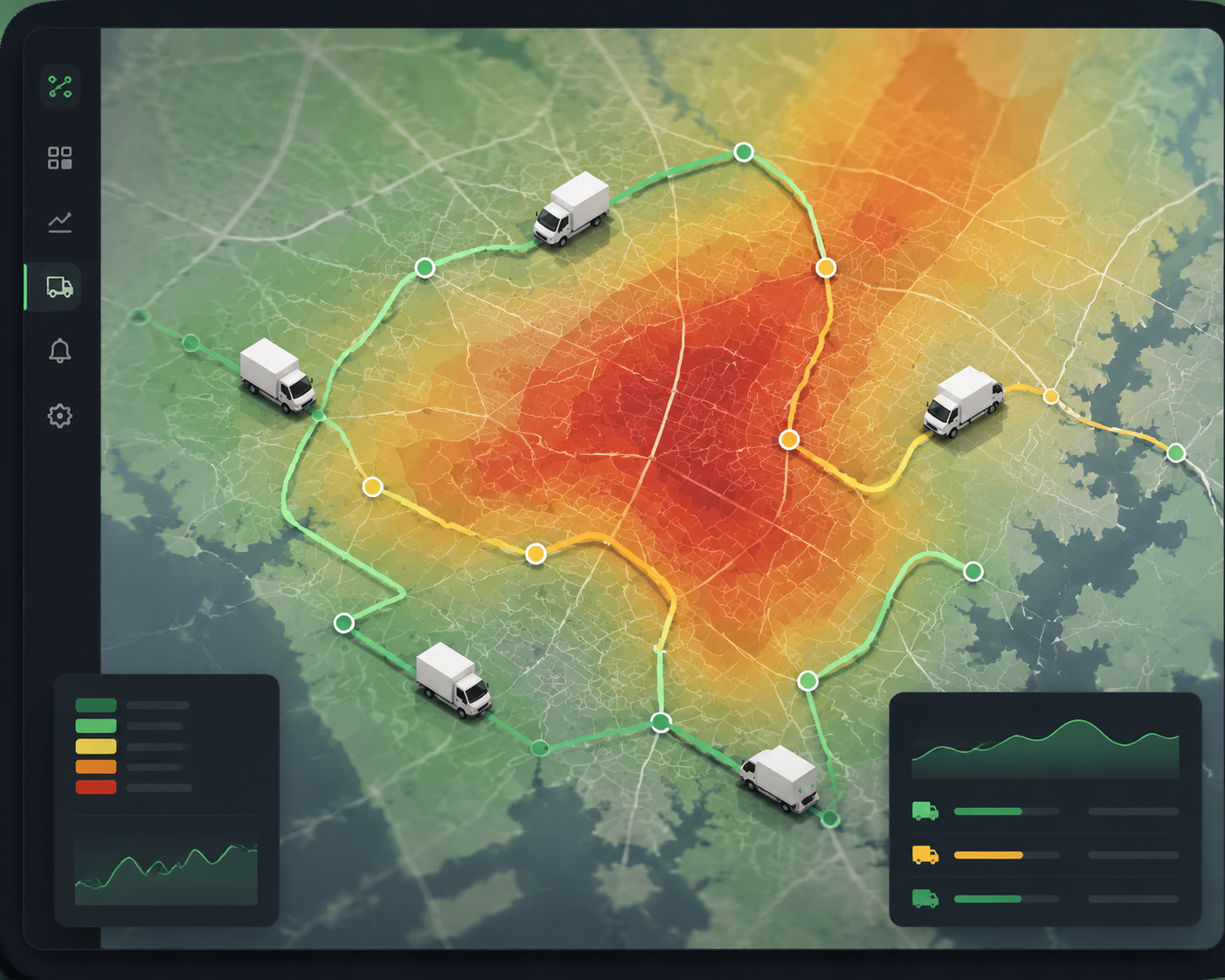
The environmental reason to care is real, but it should not be allowed to blur the operational question. In the United States, transportation is responsible for over 50% of total nitrous oxide emissions, 30% of volatile organic compound emissions, and 20% of particulate matter emissions, according to EPA SmartWay.[2] Those figures make fleet routing a meaningful target. They do not, by themselves, prove that any particular forecast will save fuel, reduce exposure, or protect service levels on a Tuesday morning.
The Forecast Has to Enter the Dispatch Workflow
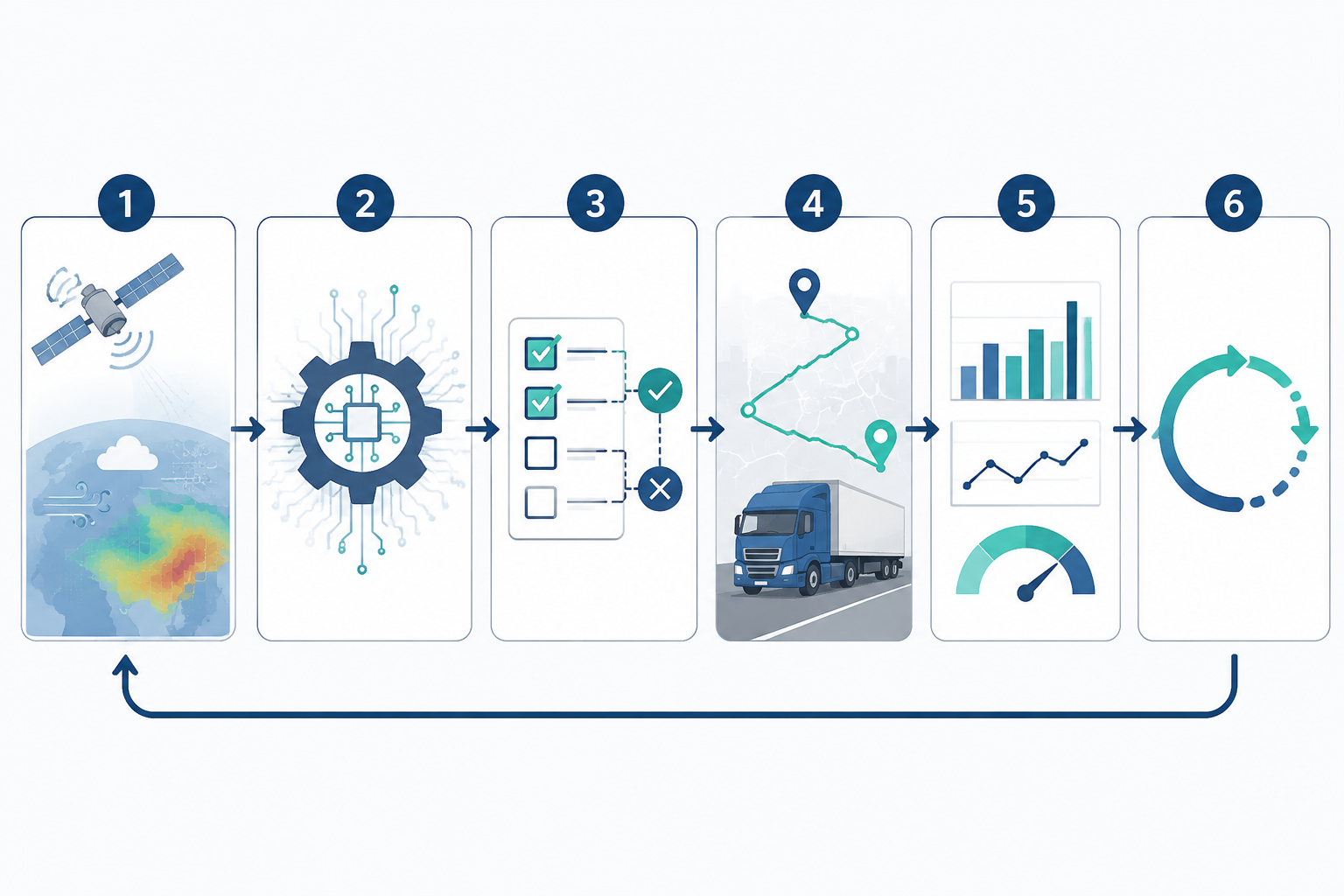
A forecast becomes useful only when it lands where decisions are already being made. For most fleets, that means the transportation management system, route optimization engine, dispatch console, telematics layer, or a control-tower tool that planners actually trust. A separate air quality portal may be useful for analysis, but it rarely survives peak dispatch pressure unless someone has already translated it into rules.
The clean version of the workflow looks simple. The field version is less forgiving.
| Workflow point | What has to happen operationally | What can go wrong |
|---|---|---|
| Forecast ingestion | Air quality, weather, and time-window forecasts arrive through an API at a usable refresh rate. | Coverage is too coarse for the lane, or the update arrives after dispatch has already locked the plan. |
| Routing integration | The TMS or optimization engine treats forecasted air quality as a constraint or penalty, not a note. | The platform cannot combine AQI, road restrictions, hours-of-service, vehicle range, and customer windows in one run. |
| Decision rule | The fleet defines when a forecast is strong enough to trigger a route, vehicle, or inventory action. | A planner is left to interpret a probabilistic warning without an agreed threshold. |
| Execution | Dispatch changes the route, assigns a different vehicle, stages inventory, or escalates a service-risk exception. | Drivers receive late or conflicting instructions, or the new route creates fuel, labor, or service penalties no one priced. |
| Measurement | The team compares the forecast, the decision, and the outcome against miles, delays, emissions exposure, and service impact. | The project claims avoided emissions or fuel savings without separating forecast value from normal routing improvements. |
This is also where buyers should separate a capable data feed from a usable operating model. A routing engine that can call an air quality API is not the same thing as a dispatch process that knows what to do when the forecast is uncertain, the customer has a hard appointment, and the alternate route adds miles through a congested arterial.
Where Air Quality Changes Fleet Decisions
The strongest early uses are not abstract emissions optimization. They are specific routing and asset-allocation decisions where the forecast can be turned into a rule.
- Avoiding forecasted high-AQI zones when the alternate route protects service and does not create a larger operating penalty.
- Assigning electric vehicles to sensitive or higher-risk urban areas when range, charging, payload, and stop density still work.
- Holding conventional vehicles for lower-risk corridors when electric assets are scarce and need to be protected for zones where they matter most.
- Pre-positioning inventory before forecasted air quality or weather-linked disruption affects inbound or outbound transportation.
- Adding an exception review when the forecast conflicts with committed delivery windows or driver workload limits.
The vehicle-assignment case is especially easy to understand because it forces a planner to rank constraints. An electric truck may be the preferred asset for a dense residential zone under poor forecasted air quality, but that assignment is still bounded by route length, charging access, cube, payload, dwell time, and the next route on that vehicle. Air quality can improve the assignment logic; it does not erase the rest of fleet planning.
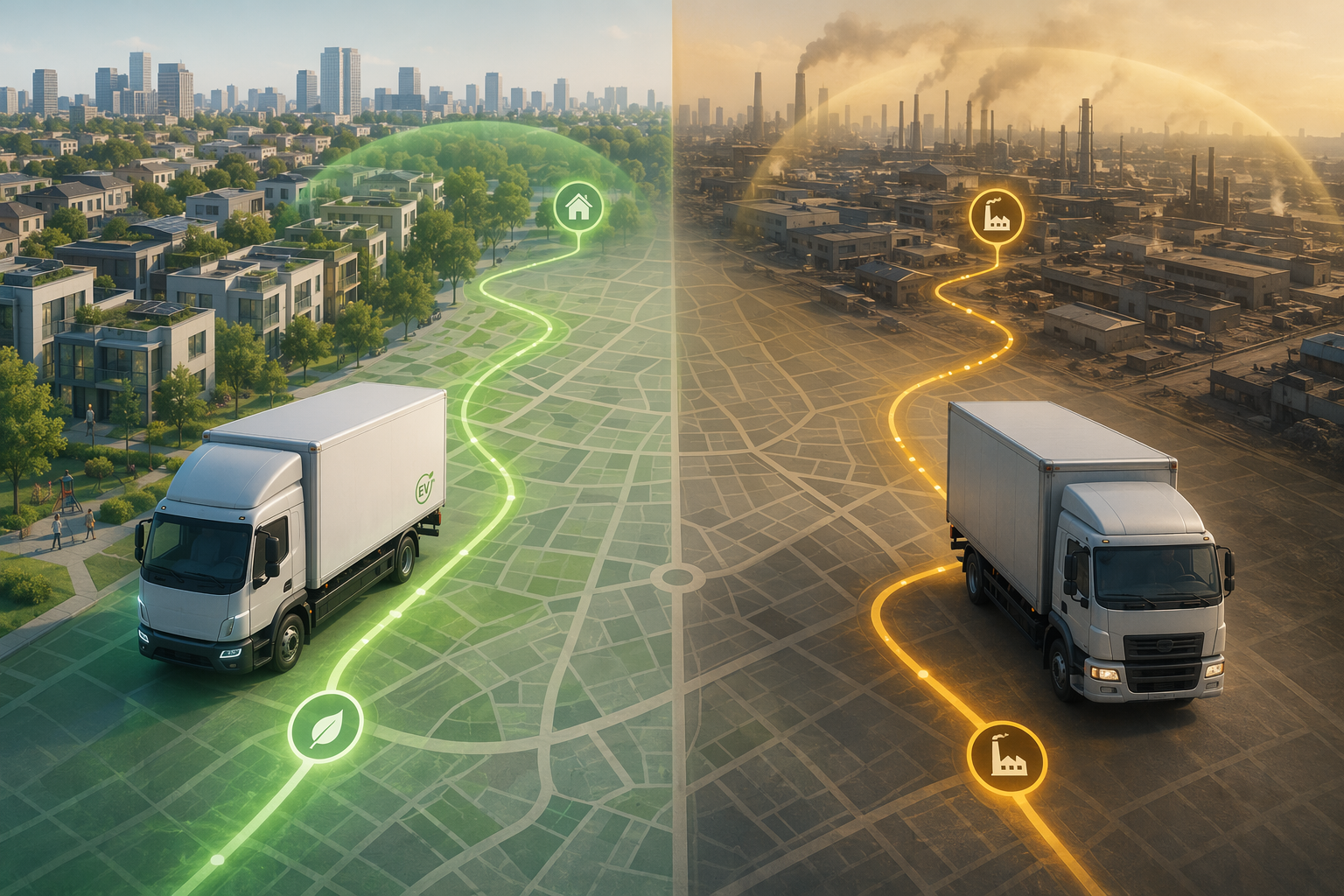
This is why constraint coverage matters when evaluating route optimization APIs. If the optimizer can only minimize distance and estimated drive time, air quality becomes a decorative overlay. If it can weigh air quality, vehicle class, service commitments, emissions objectives, driver rules, and customer priority together, then the forecast can compete honestly with the pressures dispatch already manages. Buyers comparing this layer may want to pair the air-quality use case with a broader review of route optimization API constraint coverage before shortlisting vendors.
Vendor Evidence Supports the Use Case, With Caveats
Tomorrow.io’s FleetIQ material is one of the more concrete vendor examples because it ties environmental and weather intelligence to transportation outcomes. The company reports 25% fewer shipping delays caused by weather and a 35% reduction in wasted miles by integrating air quality data alongside more than 30 weather parameters into routing decisions.[3] Those are useful figures for a business case, but they are vendor-reported. They should be treated as deployment claims to test against a fleet’s own lanes, not as universal ROI assumptions.
Visual Crossing sits closer to the API-enrichment layer. Its published logistics examples focus on weather and air quality data feeding platforms that can reroute around high-AQI zones and support vehicle allocation choices.[1] That is a practical fit for teams that already have a routing engine but need better environmental inputs. The unanswered buyer question is whether the existing TMS can consume those inputs at the right cadence, preserve the forecast metadata, and expose the recommendation clearly enough that dispatch will use it.
ClimateAi’s FICE is a different part of the workflow. It quantifies the timing, duration, and magnitude of weather-related demand spikes at 1 km resolution, which can support inventory pre-positioning before air quality events disrupt transportation.[4] That is less about turn-by-turn routing and more about staging stock before the transportation network becomes harder to operate. For supply chain teams, that distinction matters. A forecast that is too early or too broad for dispatch may still be valuable for inventory positioning, carrier capacity planning, or postponing noncritical moves.
The research-progress layer is separate again. Johns Hopkins Applied Physics Laboratory and NOAA report a deep-learning emulator that produces accurate 10-day air quality forecasts using only 21 hours of input data, described as seven timesteps, reducing the compute cost of high-resolution forecasting.[5] That points in an important direction: lower compute requirements can make finer forecasting more deployable. It does not mean every fleet can now run real-time air quality optimization inside its own routing stack without integration work, validation, and operating rules.
Granularity Is Where Many Pilots Get Exposed
Air quality forecasts are only as useful as their fit to the decision. A citywide forecast can support a general risk posture. It cannot reliably tell a dispatcher whether to send a truck down one arterial instead of another unless the forecast resolution, road network, timing, and confidence level match the routing problem.
Urban areas with denser sensor coverage are usually better candidates for high-resolution operational decisions. Non-urban corridors, rural warehouse zones, and long-haul lanes may have thinner coverage and lower confidence. That does not make the forecast useless; it changes the kind of decision it can support. A lower-resolution forecast may be good enough to stage inventory or warn planners, while still being too coarse to justify rerouting a driver away from a committed appointment.
The purchasing question should therefore be lane-specific. Ask vendors to show forecast performance in the actual service areas, industrial corridors, ports, cross-docks, and customer zones where the fleet operates. A beautiful metro demo does not answer whether the model works on the road between a regional DC and a rural customer cluster.
A Probabilistic Forecast Needs a Dispatch Rule
The uncomfortable part of AI air quality forecasting is that it is probabilistic. A 60% confidence warning and a 90% confidence warning should not trigger the same response. Yet many operational pilots treat the forecast as a binary alert: avoid or proceed. That is not how dispatch risk works.
A workable rule ties confidence to consequence. If the forecast is high confidence and the alternate route preserves the delivery window, the optimizer can automatically recommend a reroute. If confidence is moderate and the route change adds material drive time, the system can require planner approval. If confidence is low, the forecast may remain informational unless the shipment is headed into a sensitive zone or a customer with strict exposure requirements.
The same logic applies to vehicle assignment. A fleet may decide that a high-confidence poor-air forecast in a residential or school-adjacent delivery area should prioritize electric vehicles when all normal constraints are satisfied. A lower-confidence forecast may simply increase the penalty score for conventional vehicles rather than force a swap. That avoids turning every uncertain alert into a manual exception.
This is also where accountability belongs. Someone has to define who owns the wrong call: the vendor, the routing team, dispatch, sustainability, or the business unit that set the emissions target. If a reroute protects air quality exposure but misses a delivery window, the exception cannot be discovered for the first time in a customer escalation.
Measurement Has to Separate Forecast Value From Normal Optimization
Fleets already optimize miles, stops, utilization, and service levels. Adding air quality data creates a measurement problem: any improvement after deployment may come from better routing discipline, cleaner master data, revised dispatch rules, weather avoidance, or the air quality forecast itself. A credible business case should not throw all of that into one savings bucket.
At minimum, the operating review should compare planned route, forecast condition, decision taken, actual route, service result, mileage, idle time, vehicle type, and emissions-related proxy measures. The team should also record overrides. If dispatch repeatedly rejects the recommendation, that is not just a training problem; it may mean the model is missing constraints that matter on the floor.
Fuel-cost savings deserve the same discipline. A route that avoids a high-AQI zone may add miles in one case and reduce stop-and-go exposure in another. The cost impact depends on congestion, vehicle type, road grade, idling, driver time, and whether the alternate route protects downstream commitments. Teams evaluating adjacent fleet-efficiency claims can compare this use case with other approaches in AI fuel-cost reduction for logistics rather than assuming every environmental routing signal creates immediate fuel savings.
What Buyers Should Test Before Treating Savings as Bankable
A useful pilot does not need to prove every sustainability benefit at once. It needs to prove that the forecast can change the right decisions without breaking the operation. The pilot lane should include real customer windows, real vehicle constraints, normal exception handling, and the planners who will live with the tool after procurement signs off.
- Source attribution: identify whether each forecast, delay metric, emissions factor, and ROI claim comes from a vendor, public agency, internal telemetry, or independent validation.
- Forecast resolution: test the model in actual lanes, not only in dense urban areas where coverage is likely to be stronger.
- Integration path: verify that the TMS, optimizer, telematics system, and dispatch console can exchange forecast data, vehicle status, and route recommendations without manual rekeying.
- Decision thresholds: define what happens at different confidence levels before the first live exception.
- Outcome measurement: separate avoided miles, reduced delays, service exceptions, vehicle assignment changes, and emissions-related outcomes instead of reporting one blended success metric.
Organizational readiness matters here. A company may want AI-enabled logistics but still lack the operating process to absorb it. That gap shows up quickly when a forecast asks dispatch to change a familiar route, a planner wants to protect a customer appointment, and sustainability wants an emissions win. Teams still building that muscle may find the broader adoption problem familiar in the logistics AI strategy gap.
AI air quality forecasting is deployable and strategically useful for logistics teams evaluating route optimization tools in 2026. The stronger vendors and research efforts are moving the field beyond static compliance reporting and toward operational decisions. The buying standard should be equally practical: test forecast resolution in the lanes that matter, verify integration maturity with the systems dispatch already uses, and define decision rules for uncertain forecasts before treating emissions and fuel savings as bankable ROI.
References
- Air Quality and Logistics, Visual Crossing.
- SmartWay, U.S. Environmental Protection Agency.
- Logistics Solutions, Tomorrow.io.
- ClimateAi FICE, ClimateAi via TraxTech.
- Deep-learning emulator for 10-day air quality forecasts, Johns Hopkins Applied Physics Laboratory and NOAA.
Comments
Join the discussion with an anonymous comment.