
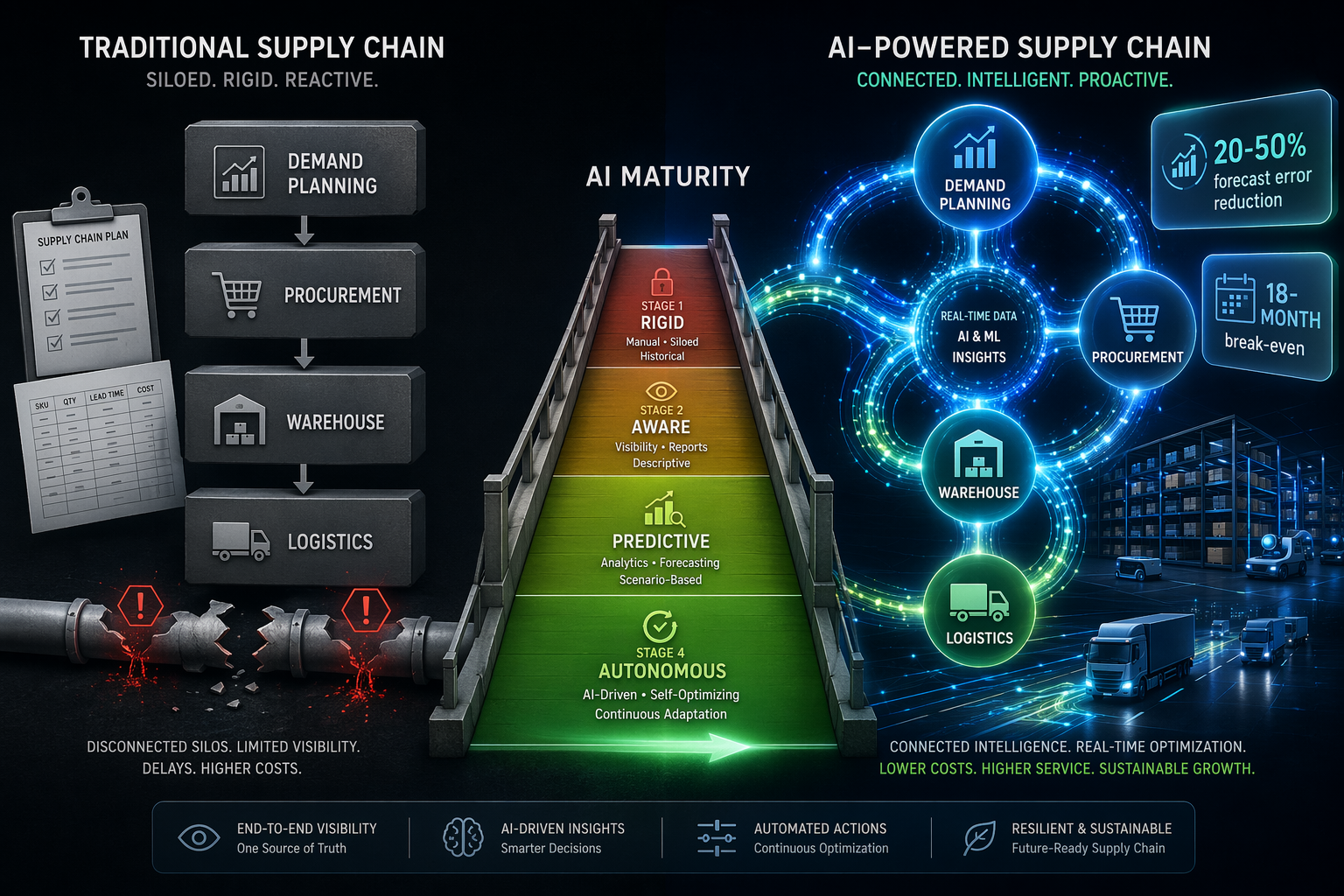
The AI-in-Supply-Chain State of Play: Hype Meets Measurable Reality
The numbers that frame every supply chain leader’s AI conversation are staggering. The global AI-in-supply-chain market was valued at $9.94 billion in 2025 and is projected to reach $236 billion by 2035 — a compound annual growth rate of 37.3%, according to Precedence Research. Meanwhile, 94% of supply chain organizations say they plan to deploy AI or generative AI for decision support within two years, per ABI Research. The intent is clear. The execution gap, however, remains wide.
PwC’s 2026 Digital Trends in Operations Survey, drawing from 767 operations and supply chain leaders, found that 89% say their technology investments have not fully delivered expected results, with integration complexity cited as the primary obstacle. A separate Gartner survey reports that only 23% of organizations have a formal AI strategy in place. These are not signals of failure — they are signals of immaturity. The companies that are closing the gap between hype and measurable outcome share a common playbook: they start with a bounded operational problem, ensure data readiness before deployment, and measure outcomes against specific KPIs from day one.
This article aggregates 10 attributable, cross-industry deployments — from Amazon’s demand forecasting engine to Frito-Lay’s predictive maintenance program — each with specific metrics, source citations, and implementation lessons. For supply chain directors and VPs building an internal business case, this is not a collection of vendor narratives. It is an evidence base.
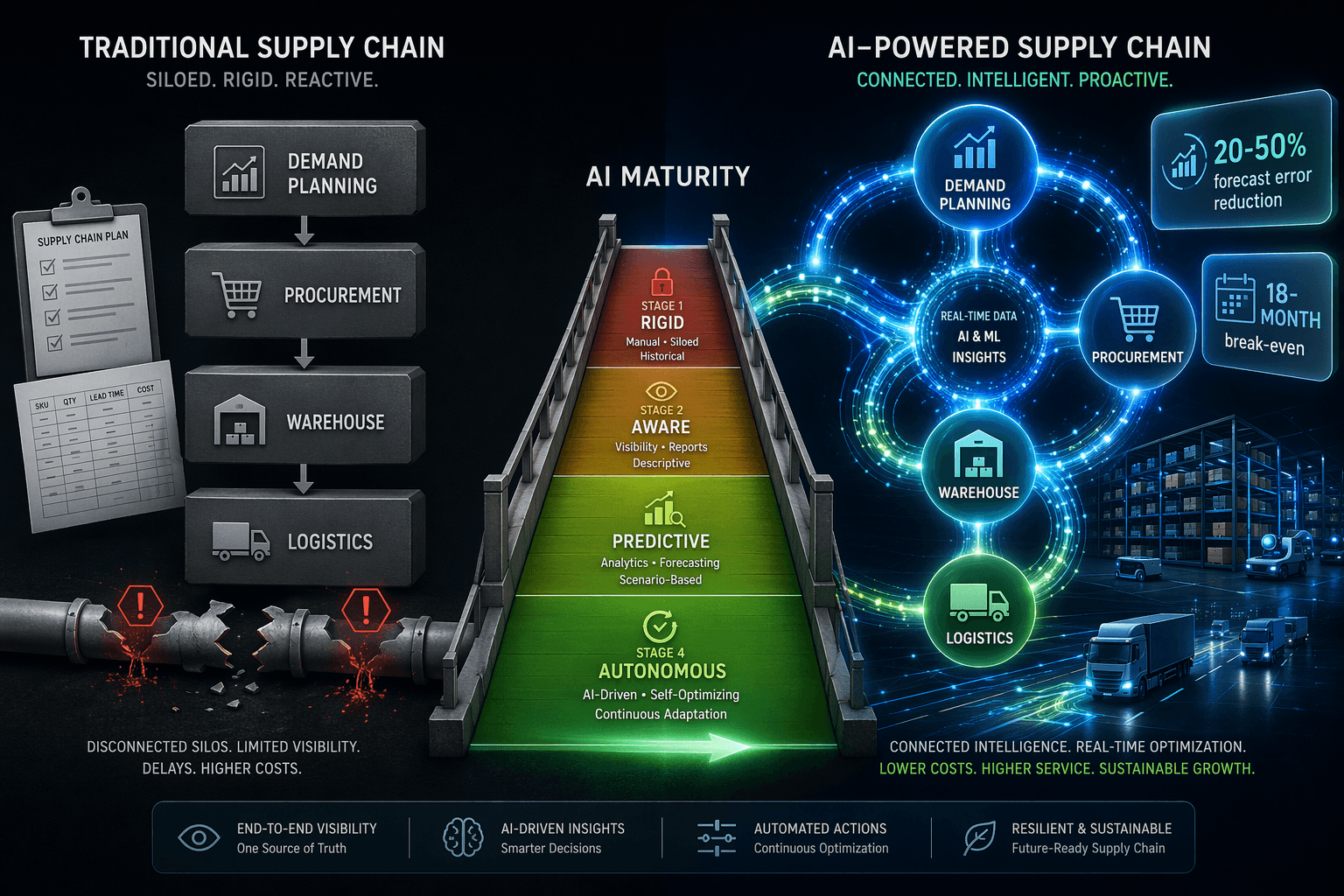
10 Real-World AI Deployments Across the Supply Chain
The following table summarizes each deployment. Detailed analysis of each case follows below.
| Company | Function | AI Technique | Key Outcome | Source Type |
|---|---|---|---|---|
| Amazon | Demand Forecasting | ML-driven forecasting across 400M+ products | Inventory optimization at scale (specific % not disclosed) | Forbes / McKinsey |
| Walmart | Route Optimization | AI-powered routing algorithms | Eliminated 30M driver miles; saved 94M lbs CO2 | Walmart Corporate |
| GXO Logistics | Warehouse Inventory Counting | AI-powered computer vision scanning | Scans 10,000 pallets/hour | GXO Press Release |
| JD Logistics | Warehouse Optimization | AI-driven warehouse layout & robotics | 300% efficiency boost; storage from 10K to 35K units | JD Corporate Blog |
| Frito-Lay (PepsiCo) | Predictive Maintenance | ML-based equipment failure prediction | Zero unexpected breakdowns in year one | PepsiCo Story |
| Lineage Logistics | Cold-Chain Operations | AI for temperature & energy optimization | 20% operational efficiency improvement | Forbes / Lineage |
| Metro Shipping | Customs Clearance | ML for document processing & classification | 40% turnaround improvement; 99% data accuracy | WNS Case Study |
| Rastelli Foods | Inventory Visibility | ML demand forecasting & inventory optimization | $3.5M saved in first year; 85% forecast accuracy | RELEX Case Study |
| Maersk | Supplier Negotiations | GenAI-powered chat interface | Automated supplier communication & negotiation | Industry Reports |
| Blount Fine Foods | Demand Planning | ML-based demand forecasting | 50% reduction in forecast errors; 35% less waste | RELEX Case Study |
1. Amazon: ML-Driven Demand Forecasting at Planetary Scale
Amazon applies machine learning to demand forecasting across more than 400 million products, using historical sales, search trends, pricing data, and external signals like weather and seasonality. The system feeds into inventory placement, replenishment, and capacity planning decisions across its global fulfillment network. While Amazon does not publish a single forecast-error reduction figure for the entire system, analysts at Forbes and McKinsey cite this as the benchmark for AI-driven demand sensing at scale. The key lesson: the system works because it is trained on high-frequency, granular transaction data — not aggregated monthly snapshots.
2. Walmart: Route Optimization That Cuts Miles and Emissions
Walmart’s AI-powered route optimization system has eliminated 30 million driver miles and saved 94 million pounds of CO2 emissions, according to Walmart’s corporate reporting. The system optimizes delivery routes across Walmart’s private fleet by factoring in traffic patterns, delivery windows, vehicle capacity, and fuel efficiency in real time. For a deeper look at how Walmart scaled AI across its international markets, see our dedicated case study: Walmart's Global AI Inventory Rollout.
3. GXO Logistics: Computer Vision for Inventory Counting
GXO, one of the world’s largest contract logistics providers, deployed an AI-powered inventory counting system that uses computer vision to scan pallets as they move through the warehouse. The system achieves a throughput of 10,000 pallets per hour, according to a GXO press release. This replaces manual cycle counting, which is slow, labor-intensive, and error-prone. The lesson: computer vision is not limited to defect detection — it is a practical, immediately deployable tool for warehouse inventory accuracy.
4. JD Logistics: AI-Driven Warehouse Transformation
JD Logistics applied AI to redesign warehouse layout and optimize robotic picking paths. The result, per JD’s corporate blog: operational efficiency improved 300%, and storage capacity expanded from 10,000 to 35,000 units in the same footprint. This is not incremental improvement — it is a step-change in throughput density. The deployment demonstrates that AI-driven warehouse optimization can deliver capacity expansion without new construction, a critical advantage in high-rent urban logistics zones.
5. Frito-Lay: Predictive Maintenance That Eliminated Downtime
Frito-Lay, a division of PepsiCo, deployed machine learning models to predict equipment failures in its manufacturing plants. The system analyzes sensor data from fryers, ovens, conveyors, and packaging machines to flag anomalies before they cause breakdowns. According to PepsiCo’s published story, the program achieved zero unexpected equipment breakdowns in its first year of operation. This aligns with McKinsey’s broader finding that predictive maintenance can reduce unplanned downtime by 30–50% and lower maintenance costs by 10–40%. Frito-Lay’s result is at the top end of that range, achieved through a focused, single-plant pilot that was later scaled.
6. Lineage Logistics: Cold-Chain AI for Energy and Throughput
Lineage Logistics, the world’s largest temperature-controlled warehouse operator, uses AI to optimize refrigeration energy consumption, pallet placement, and labor allocation across its network. The system, developed in partnership with an AI startup, analyzes temperature zones, door openings, and product flow patterns to reduce energy use while maintaining food safety. Forbes and Lineage report a 20% improvement in operational efficiency. The cold-chain environment is particularly data-rich — sensors are already in place for compliance — making it a natural fit for AI optimization.
7. Metro Shipping: ML for Customs Clearance
Metro Shipping, a UK-based freight forwarder, deployed machine learning to automate customs documentation classification and data extraction. The system processes shipping documents, identifies commodity codes, and flags discrepancies. According to a WNS case study, the deployment achieved a 40% improvement in turnaround time and 99% data accuracy. Customs clearance is a high-volume, rules-intensive process where manual errors cause costly delays. ML is particularly effective here because the classification task — matching product descriptions to harmonized system codes — is pattern-recognition work that models handle well.
8. Rastelli Foods: Inventory Visibility Saves $3.5M in Year One
Rastelli Foods, a family-owned protein processor, implemented AI-driven inventory optimization and demand forecasting using the RELEX platform. The system consolidated demand signals from retail, food service, and e-commerce channels into a single forecast. According to RELEX’s published case study, Rastelli saved $3.5 million in the first year and achieved 85% forecast accuracy — up from a baseline where manual forecasting frequently missed demand spikes. The lesson: even mid-market companies with limited data science teams can capture significant value from AI if they adopt a purpose-built platform rather than building from scratch.
9. Maersk: GenAI for Supplier Negotiations
Maersk, the global shipping and logistics conglomerate, deployed a generative AI-powered chat interface to automate supplier negotiations. The system handles routine communication, contract term comparisons, and rate negotiations with carriers and service providers. While Maersk has not published specific ROI figures, the deployment signals a broader trend: generative AI is moving into procurement workflows as a conversational layer on top of structured data. This case is included to show breadth — procurement AI is covered in depth in our dedicated article, AI in Procurement: 10 Real-World Examples with Measurable Outcomes.
10. Blount Fine Foods: ML Demand Planning Cuts Waste by 35%
Blount Fine Foods, a Massachusetts-based soup and side-dish manufacturer, deployed machine learning demand planning through the RELEX platform. The system ingests point-of-sale data, promotion calendars, and historical shipment data to generate weekly forecasts at the SKU-location level. According to RELEX’s published case study, Blount achieved a 50% reduction in forecasting errors and 35% less waste, while sustaining 20%+ compound annual growth. The waste reduction is particularly significant in fresh food, where overproduction directly erodes margin. Blount’s experience mirrors the broader pattern: AI demand planning delivers its highest ROI in short-shelf-life categories where forecast error translates immediately into spoilage.
Cross-Cutting Patterns: What the Winners Do Differently
Across these 10 deployments, four patterns distinguish the successful implementations from the 85% of AI initiatives that BCG estimates deliver close to zero measurable value.
- They start with a bounded operational problem, not a general AI strategy. Amazon did not launch an “AI initiative” — it solved a specific forecasting problem at SKU level. Frito-Lay did not deploy “AI for manufacturing” — it targeted unexpected equipment breakdowns. The scope constraint forces clarity on data requirements, success metrics, and organizational ownership.
- They ensure data readiness before deployment. PwC’s 2026 survey found that 87% of operations leaders say poor data quality has impacted the value they get from digital initiatives. The successful deployments in this roundup all had access to clean, high-frequency operational data — sensor data for Frito-Lay, transaction data for Amazon, pallet-movement data for GXO. Companies that skip the data readiness step fail before the model is trained.
- They invest in organizational change management. Deloitte’s 2026 research found that 84% of organizations have not redesigned jobs around AI. The deployments that delivered — Blount Fine Foods, Rastelli Foods, Lineage — all involved frontline workers in the design process, retraining planners and operators rather than replacing them.
- They measure outcomes against specific KPIs from day one. Every deployment in this roundup has a quantifiable metric: pallets per hour, forecast accuracy, driver miles eliminated, breakdowns avoided. Vague objectives like “improve efficiency” or “leverage AI” produce vague results. The discipline of defining the metric before writing the first line of code is the single strongest predictor of measurable ROI.
For a deeper analysis of how demand forecasting accuracy gains translate into ROI across different industries, see our evidence-base article: AI Demand Planning: The Evidence Base — What Accuracy Gains, ROI Timelines, and Adoption Data Actually Say.
Implementation Timelines and ROI Windows: What to Expect
One of the most persistent sources of friction between supply chain leaders and their finance counterparts is the ROI timeline. Deloitte’s 2025 survey of AI investment found that while 85% of organizations increased AI investment, only 6% saw ROI in under a year. The majority achieve satisfactory ROI within 2–4 years. This is not slow — it is realistic for enterprise-grade deployments that require data integration, model tuning, and organizational adoption.
McKinsey’s benchmarks provide a useful range for what is achievable: AI-enabled distribution delivers 5–20% logistics cost reduction, 20–30% inventory reduction, and 5–15% procurement spend reduction. The table below maps deployment complexity to typical timeline and ROI window, based on the patterns observed across the 10 case studies.
| Deployment Complexity | Example Case | Typical Timeline to Pilot | Typical Timeline to ROI | ROI Range |
|---|---|---|---|---|
| Low (single-function, clean data) | GXO inventory counting | 3–6 months | 6–12 months | 10–20% throughput gain |
| Medium (cross-functional, moderate data integration) | Rastelli Foods inventory visibility | 6–12 months | 12–24 months | $3.5M annual savings |
| High (multi-site, complex data integration) | Walmart route optimization | 12–18 months | 18–36 months | 30M miles eliminated |
| Very High (full network transformation) | JD Logistics warehouse redesign | 18–24 months | 24–48 months | 300% efficiency gain |
Comments
Join the discussion with an anonymous comment.