
Why the Implementation Window Is Now
The conversation around AI in warehouse management has shifted from "if" to "how." The global AI in warehousing market reached an estimated $12.69 billion in 2025 and is projected to grow at a compound annual rate of 23.1% to $83.42 billion by 2034, according to Fortune Business Insights. Those figures reflect real capital deployment, not speculative interest.
The most telling data point comes from a December 2025 study by Mecalux and MIT, which surveyed over 2,000 warehouse and supply chain leaders across 21 countries. More than 90% of respondents reported that their warehouses now use some form of AI or advanced automation, and roughly 60% operate at advanced maturity levels. The typical payback period has compressed to two to three years — significantly faster than earlier waves of automation investment. Organizations now dedicate between 11% and 30% of their warehouse technology budgets to AI initiatives, and 87% plan to increase that allocation.
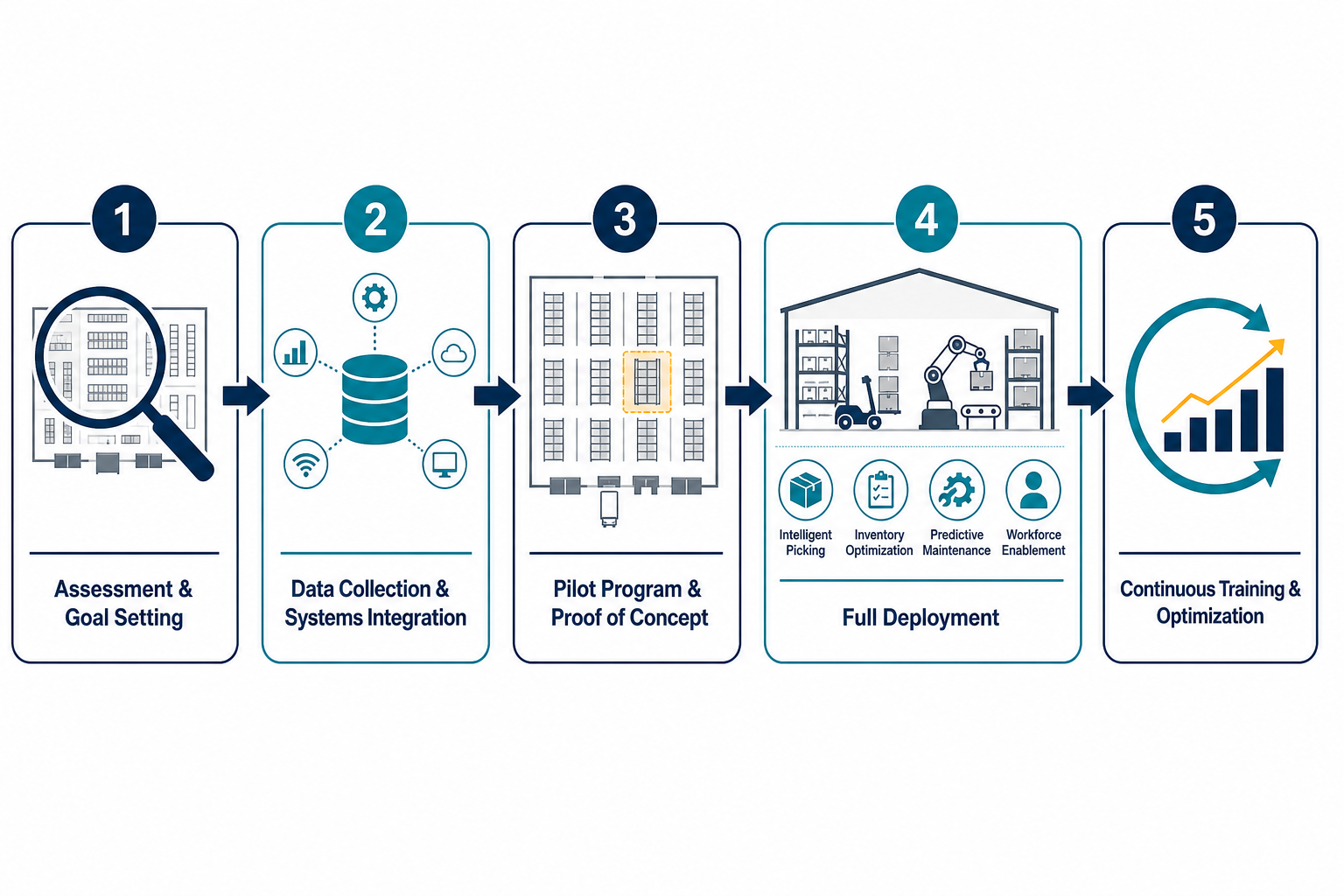
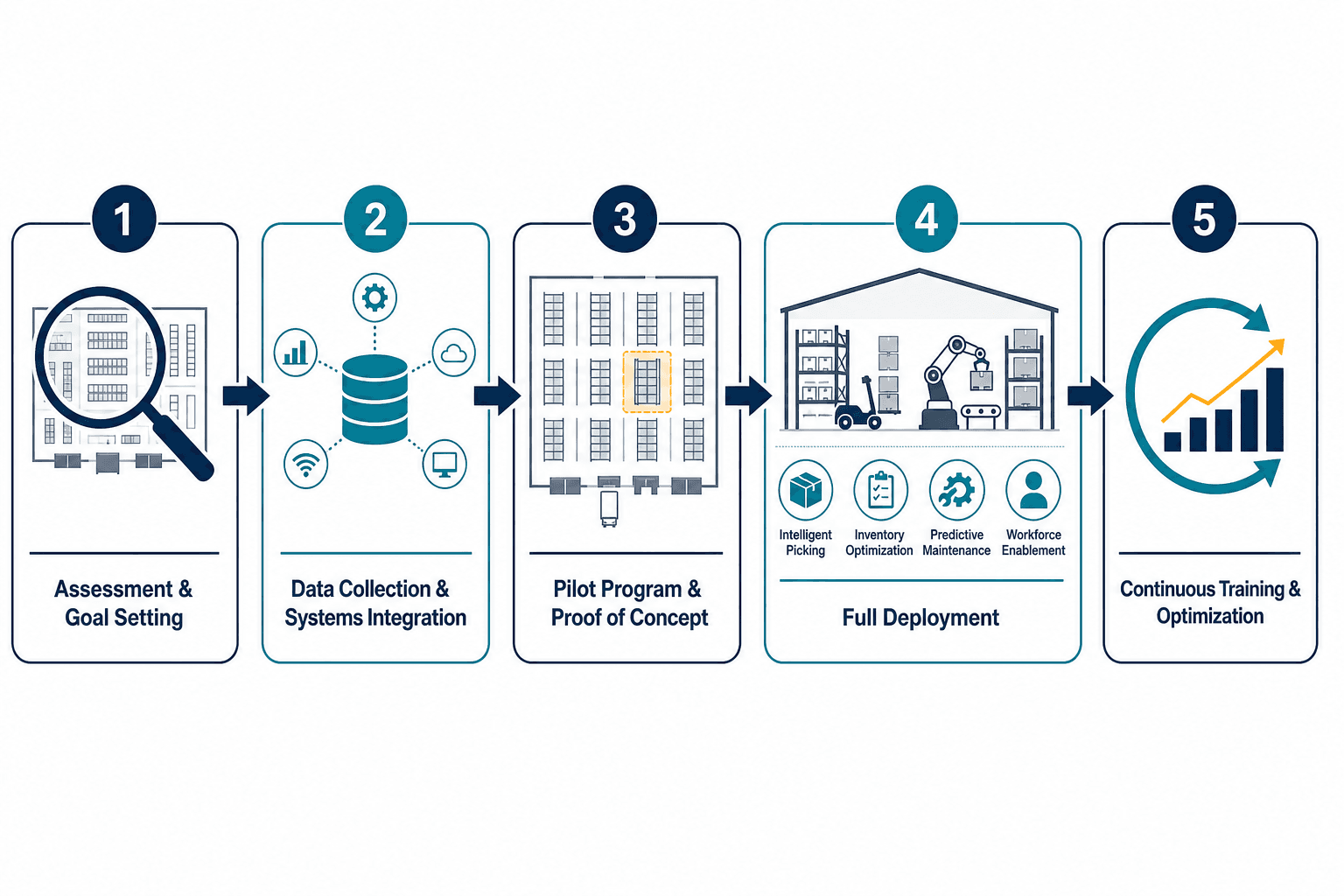
The thesis of this guide is straightforward: big-bang deployments fail more often than they succeed. The organizations that realize the fastest payback treat AI adoption as a phased process — assessment, data integration, pilot, full deployment, and continuous optimization — rather than a single technology procurement event. The following five-step roadmap is designed for VP and Director-level supply chain leaders who need a defensible, repeatable approach to deploying AI across warehouse operations.
Step 1: Assessment & Goal Setting
Before evaluating any technology, establish a clear baseline of current operations. The most common failure in AI warehouse projects is scope creep — attempting to solve every operational problem simultaneously. A focused assessment prevents this by identifying the specific pain points where AI can deliver measurable impact within a defined timeframe.
Begin by auditing three dimensions of your current warehouse operations:
- Operational performance: Gather 12 to 24 months of data on picking accuracy, inventory accuracy, order cycle time, labor productivity per shift, unplanned downtime, and throughput per square foot. Manual picking error rates can reach up to 4%, while automated systems achieve 99.96% to 99.99% accuracy — the gap represents a direct cost.
- Data readiness: Assess the quality, completeness, and accessibility of data across your WMS, ERP, IoT sensors, and any other operational systems. Poor data quality is consistently cited as the top barrier to AI adoption in warehousing. If your inventory records show more than 5% variance between system and physical counts, address that before deploying AI.
- Organizational readiness: Evaluate current technical expertise on staff, IT bandwidth for integration work, and workforce sentiment toward automation. The Mecalux-MIT study found that lack of technical expertise is a primary barrier — and that organizations investing in workforce training see higher satisfaction and retention post-deployment.
With the audit complete, set quantifiable KPIs aligned to specific business objectives. Avoid vague goals like "improve efficiency." Instead, define targets such as:
| Objective | Example KPI | Typical AI Impact Range |
|---|---|---|
| Reduce picking errors | Pick accuracy rate | From ~96% manual to 99.96%+ with AI-assisted picking |
| Lower inventory carrying costs | Inventory accuracy % / stockout rate | Up to 35% reduction in inventory costs (industry-reported) |
| Decrease unplanned downtime | Equipment uptime % | 30–50% reduction in unplanned downtime (Fortune Business Insights) |
| Increase throughput | Orders picked per labor hour | 30–50% increase in picking speed (Fortune Business Insights) |
| Improve labor productivity | Units processed per shift | Varies by use case; 20–30% typical in early deployments |
Document the current baseline for each KPI. Without a pre-deployment benchmark, you cannot calculate ROI or justify further investment to executive stakeholders. This assessment phase typically takes four to eight weeks for a single-site warehouse operation.
Step 2: Data Collection & Systems Integration
AI models are only as reliable as the data they consume. The second phase focuses on building a unified data foundation by breaking down silos between your Warehouse Management System (WMS), Enterprise Resource Planning (ERP) system, IoT sensors, labor management systems, and any other operational data sources.
Integration complexity with legacy WMS and ERP systems is one of the most frequently cited barriers to AI adoption. Many warehouses operate on WMS platforms that were not designed to stream real-time data to external analytics engines. Addressing this requires a deliberate integration architecture:
- Map all data sources: Identify every system that generates or stores operational data — WMS, ERP, IoT sensors, barcode scanners, RFID readers, labor tracking tools, and maintenance logs.
- Establish data pipelines: Implement middleware or an integration layer (APIs, ETL tools, or a data lake) that can ingest, clean, and standardize data from disparate sources into a single repository. Real-time or near-real-time ingestion is critical for use cases like dynamic pick-path optimization and predictive maintenance.
- Validate data quality: Run automated checks for completeness, accuracy, consistency, and timeliness. Common issues include missing timestamps, duplicate records, mismatched SKU identifiers between WMS and ERP, and sensor calibration drift.
- Establish data governance: Define who owns each data domain, how frequently data is refreshed, and what the escalation process is for data quality incidents. This is often overlooked but becomes critical when AI models begin making operational decisions.
For readers evaluating specific WMS platforms and their AI integration capabilities, the AI Warehouse Management Systems: Vendor Landscape Snapshot Q2 2026 provides a structured comparison of integration ecosystems, deployment models, and target company sizes. For a deeper dive into data readiness specifically for inventory AI use cases, the Data Readiness Assessment for AI Inventory Optimization guide covers the audit process in greater detail.
Step 3: Pilot Program & Proof of Concept
The pilot phase is where theoretical planning meets operational reality. The objective is not to prove that AI works in general — the market data already supports that — but to demonstrate that it works in your specific operational context, with your data, your workforce, and your constraints.
Select a pilot scope that is high-impact but low-risk. Common starting points include:
- Demand forecasting for a single product category or SKU cluster with stable historical data
- Pick-path optimization in one aisle or zone, comparing AI-generated routes against current manual routing
- Predictive maintenance for a single high-value equipment type (e.g., one conveyor system or automated sorter)
- Inventory slotting optimization for a defined storage area, measuring travel time reduction
Run the pilot for a minimum of 8 to 12 weeks to capture enough operational cycles for statistically meaningful comparison against the baseline. During this period:
- Measure against the baseline KPIs established in Step 1, not against vendor-provided benchmarks. Vendor-reported outcomes may come from different operational contexts and should not be treated as guaranteed results.
- Collect qualitative feedback from frontline workers and supervisors. The Prologis deployment analysis emphasizes that end-user empathy and change management often determine whether a rollout succeeds. Workers need to see that AI solves problems they experience daily — not that it monitors or replaces them.
- Document integration friction points. Note which data sources required manual cleaning, which system integrations caused latency, and where workforce training gaps emerged.
At the end of the pilot, conduct a formal go/no-go review with three criteria: Did the pilot meet the predefined KPI targets? Can the integration and data quality issues be resolved at scale? Does the workforce feedback support expansion? If the answer to any of these is no, extend the pilot or pivot to a different use case before committing to full deployment.
Step 4: Full Deployment Across Warehouse Operations
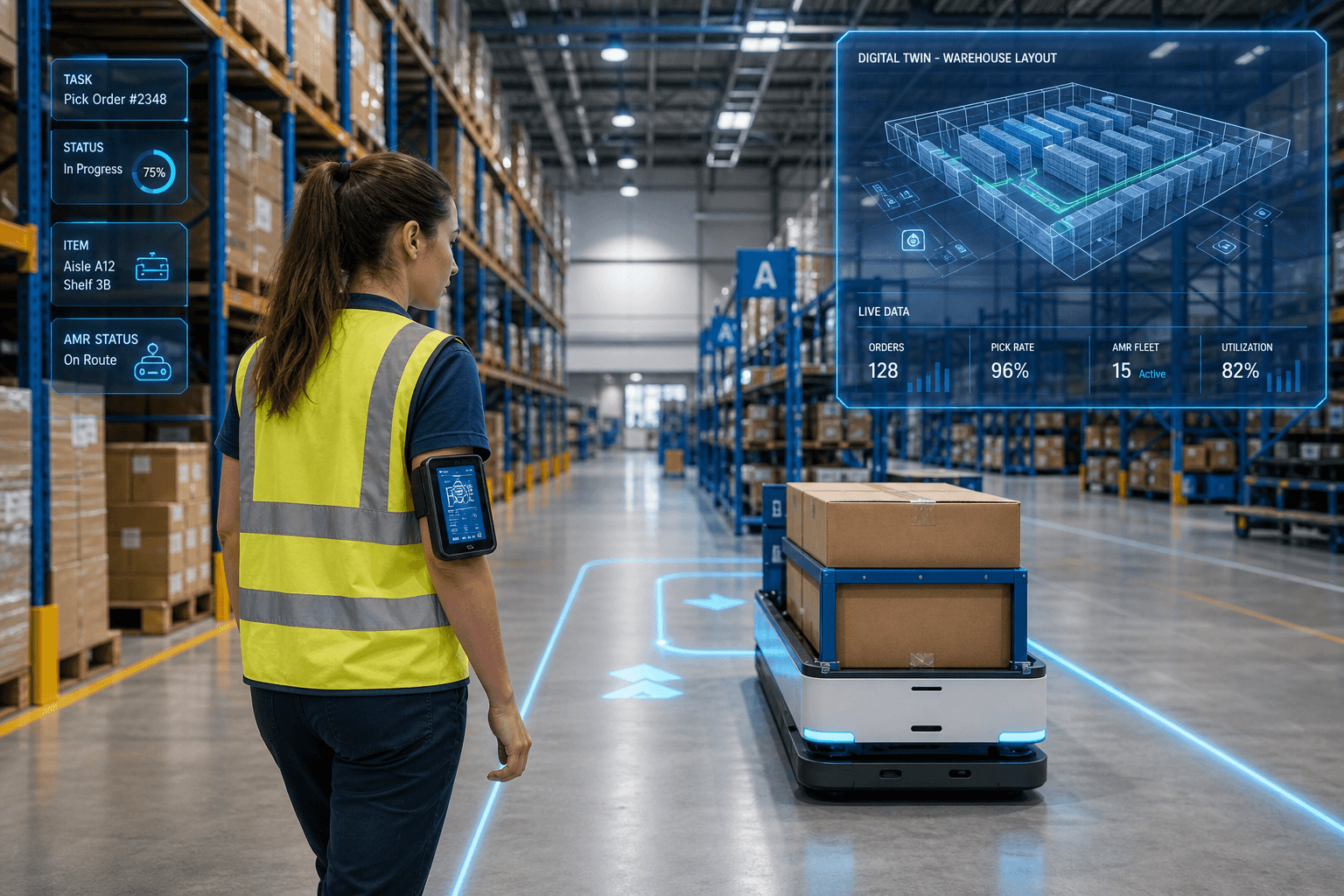
Once the pilot validates the approach, full deployment proceeds in waves — not all at once. The most successful implementations roll out AI capabilities sequentially across four core operational domains: inventory management, picking and sorting, predictive maintenance, and workforce optimization.
Each domain has distinct data requirements, integration patterns, and ROI drivers. The following table summarizes what to expect at each stage:
| Domain | Primary AI Technique | Key Data Inputs | Documented Impact |
|---|---|---|---|
| Inventory management | Machine learning forecasting, demand sensing | Historical sales, lead times, seasonality, promotions | Up to 35% reduction in inventory costs; improved service levels by over 60% (industry-reported) |
| Picking & sorting | Computer vision, reinforcement learning for path optimization | Order profiles, SKU dimensions, slot locations, real-time congestion | 99.96–99.99% accuracy vs. up to 4% manual error; 30–50% picking speed increase |
| Predictive maintenance | Anomaly detection, time-series forecasting | Equipment sensor data, maintenance logs, vibration/temperature readings | 30–50% reduction in unplanned downtime; 17–20% equipment lifespan extension (Fortune Business Insights) |
| Workforce optimization | Labor modeling, shift scheduling algorithms | Order volume forecasts, worker skill profiles, attendance patterns | 20–30% labor productivity improvement in early deployments |
A note on robotics integration: Autonomous mobile robots (AMRs) and automated picking systems are increasingly common components of AI-driven warehouses. DHL Supply Chain, in partnership with Locus Robotics, surpassed 500 million picks using AMRs across 35 global sites as of June 2024, with the most recent 100 million picks completed in just 154 days. The Amazon Robotics case study provides a real-world reference for how AI-powered picking and inventory storage automation scales, though Amazon's approach — massive capital investment, custom-built infrastructure — is not a prescriptive template for most organizations. Mid-market warehouses typically achieve strong ROI with a phased robotics rollout starting with a single AMR fleet in one zone.
During full deployment, maintain parallel operation of existing manual or legacy processes for critical workflows. A phased cutover — one zone or one shift at a time — allows the operations team to validate AI outputs against real-world conditions before fully committing.
Step 5: Continuous Training & Optimization
AI systems degrade over time without active maintenance. Model drift — where the statistical relationships learned during training no longer reflect current operational conditions — is a well-documented phenomenon in supply chain AI. A model trained on pre-pandemic demand patterns, for example, will produce unreliable forecasts if not retrained on post-disruption data.
Continuous optimization requires three parallel workstreams:
- Model retraining cycles: Establish a regular cadence for retraining AI models — typically monthly for demand forecasting models and quarterly for pick-path optimization models, though the frequency depends on how quickly your operational patterns change. Automate the retraining pipeline where possible to reduce manual overhead.
- Workforce upskilling: The Mecalux-MIT study found that over 75% of surveyed organizations saw a rise in employee satisfaction after implementing AI, and more than half reported increased workforce size. These outcomes are not automatic — they correlate with investment in training programs that help workers understand how to interpret AI recommendations, override them when necessary, and focus on higher-value tasks that AI cannot perform.
- KPI monitoring and governance: Implement dashboards that track both operational KPIs (accuracy, throughput, downtime) and model performance metrics (prediction error rates, data drift indicators). Assign clear ownership for monitoring these metrics and escalating anomalies.
Organizations that treat AI deployment as a one-time project rather than an ongoing operational capability consistently underperform on ROI. The difference between a 2-year payback and a 4-year payback is often determined by how well the organization maintains and improves its AI systems after go-live.
Key Success Factors: Budget, Sponsorship & Change Management
Three organizational factors consistently separate successful AI warehouse deployments from stalled or failed ones: realistic budgeting, active executive sponsorship, and structured change management.
Budgeting Realistically
Implementation costs vary significantly by warehouse size, scope, and whether robotics hardware is included. The following ranges are based on industry-reported data from Codiant and other implementation sources:
| Cost Category | Small Warehouse (Software + Sensors) | Mid-to-Large Warehouse (With Robotics) |
|---|---|---|
| Hardware (robots, sensors, cameras, IoT) | $20,000 – $50,000 | $100,000 – $500,000+ |
| Software (AI platforms, WMS, cloud subscriptions) | $10,000 – $50,000 annually | $50,000 – $200,000 annually |
| Integration & customization | $15,000 – $50,000 | $50,000 – $250,000 |
| Training | $5,000 – $15,000 | $15,000 – $50,000 |
| Maintenance & support | $10,000 – $30,000 annually | $30,000 – $100,000 annually |
| Total first-year investment | $50,000 – $150,000 | $250,000 – $1,000,000+ |
Comments
Join the discussion with an anonymous comment.