
The August Egg Company recall did not become hard because eggs are mysterious. It became hard because ordinary egg distribution is already complicated before Salmonella enters the building. In August 2025, the company recalled about 1.7 million dozen eggs after an outbreak investigation tied illnesses to shell eggs distributed across multiple states, sold through major retailers, and packed under more than a dozen brand names.[1][2]
That is the practical problem in handling egg recall risk across the supply chain and with consumers: the recall has to work for the label on the carton, the lot in the cooler, the warehouse transfer record, the retailer shelf set, the loyalty-card buyer, the consumer who threw away the carton, and the investigator asking for proof. A notice that is technically accurate but unclear at the kitchen counter still leaves exposure in the market.
The FDA reported that whole genome sequencing linked environmental samples from the August Egg Company facility to the outbreak strain. The investigation included 134 illnesses in 10 states, 38 hospitalizations, and one death, with case counts subject to update as investigations close.[1] Those are not just epidemiology figures. They are the operating conditions under which quality, legal, sales, retail, and customer-care teams start asking different versions of the same question: exactly which eggs have to come back?
A recall gets expensive when the scope is uncertain
The cleanest recall is not the one with the best press release. It is the one where the affected product can be isolated quickly, the company can prove why the boundary is credible, and the next shipment does not keep feeding the problem. Egg recalls punish weak boundaries because shell eggs move through private-label and multi-brand channels that can separate the consumer-facing brand from the producing facility.
In the August Egg Company case, eggs appeared under many brand names and moved through retailers including Walmart, Safeway, and Ralphs, according to available outbreak and trade reporting.[1][2] For a consumer, that means the brand they remember may not sound like the company named in the recall. For a retailer, it means the affected cartons may be mixed into planograms, warehouse slots, online order history, and store-level signage. For the producer, it means every hour spent reconciling labels, lots, and destinations is another hour before the message gets sharper.
A general food-industry benchmark often cited by logistics and food-safety technology firms puts the average direct cost of a recall at about $10 million, with a smaller share of companies facing total costs above $100 million.[3] That figure should not be read as an egg-specific forecast. It is still useful because it frames why recall precision is not a paperwork preference. Every unnecessary store withdrawal, freight move, disposal order, call-center spike, and replacement claim burns money while the public-facing story is still forming.
Prevention systems should make weak signals visible before they become a recall
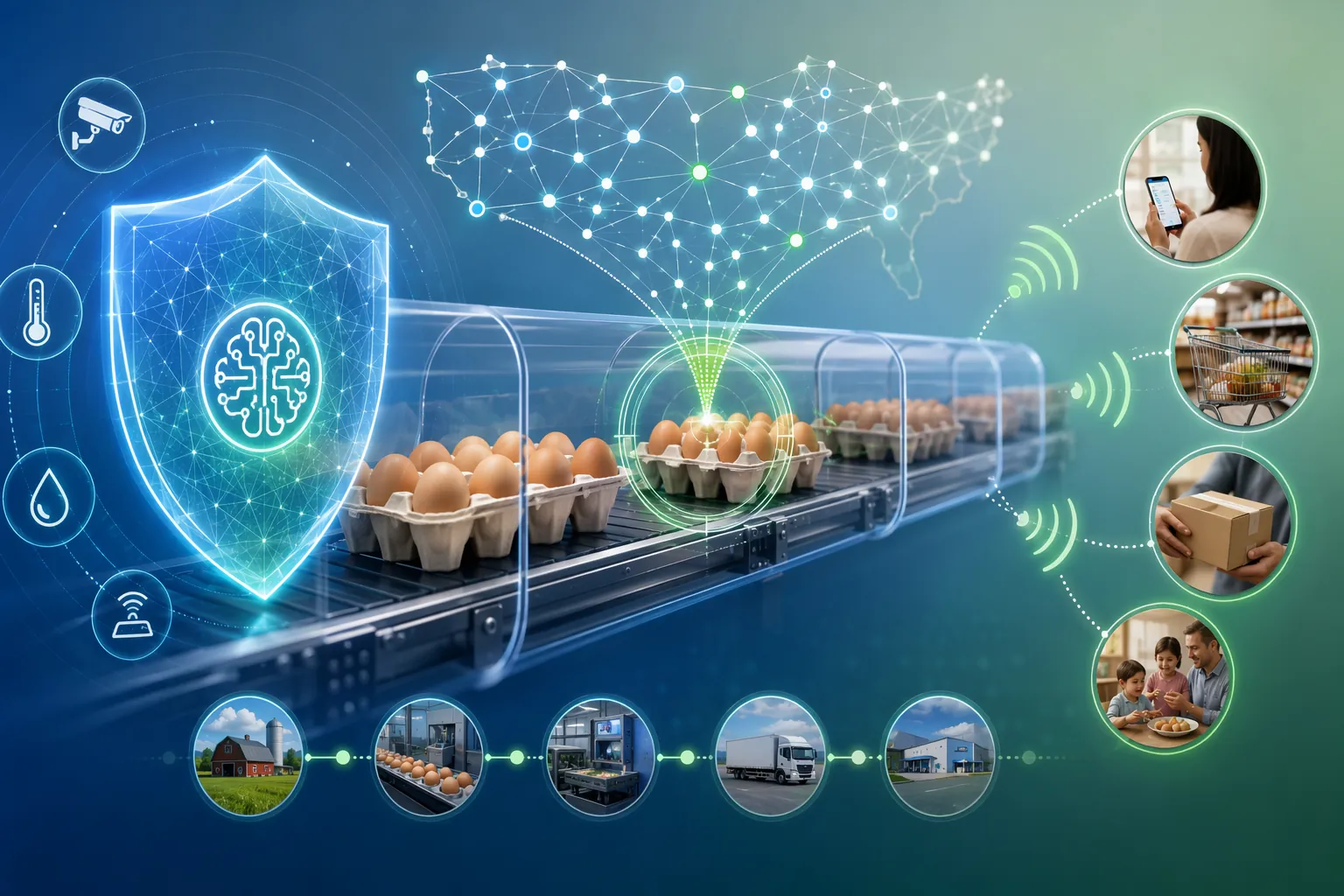
Prevention is where AI earns attention, but it should not be sold as a promise that contamination disappears. The better use is less glamorous: pulling together environmental monitoring results, sanitation deviations, flock or house history, temperature excursions, maintenance events, supplier changes, and complaint trends so that quality teams see risk building before it becomes a confirmed outbreak.
AI food-safety tools are being described around predictive risk scoring, anomaly detection, supplier risk monitoring, and faster traceability analytics.[4] In an egg operation, that matters only if the model changes someone’s next action. A higher-risk house might trigger intensified environmental swabbing. A recurring cold-chain excursion might stop a shipment pending review. A sanitation deviation might require a hold-and-release decision instead of a note in a corrective-action file.
Cold-chain IoT has the same limitation. Temperature data is useful when it is connected to lot status, distribution decisions, and exception review. A dashboard showing a red line after product has shipped is only an autopsy unless the alert reaches someone authorized to hold, divert, or investigate the affected lot.
The August Egg Company outbreak shows why environmental monitoring cannot live off to the side as a plant-level file. The FDA’s use of whole genome sequencing to connect environmental samples with the outbreak strain is exactly the kind of evidence that turns facility findings into supply chain action.[1] If those findings are not already linked to production dates, lot identities, pack configurations, customer shipments, and downstream inventory, the response starts with detective work when it should start with execution.
The response system has to narrow the recall before the market widens it
Once a credible hazard is identified, the first operational question is not whether the company has traceability. Most companies can trace something eventually. The question is whether the company can identify the affected lot, show where it went, stop more exposure, and give regulators usable records within the required window while stores and consumers are already reacting.
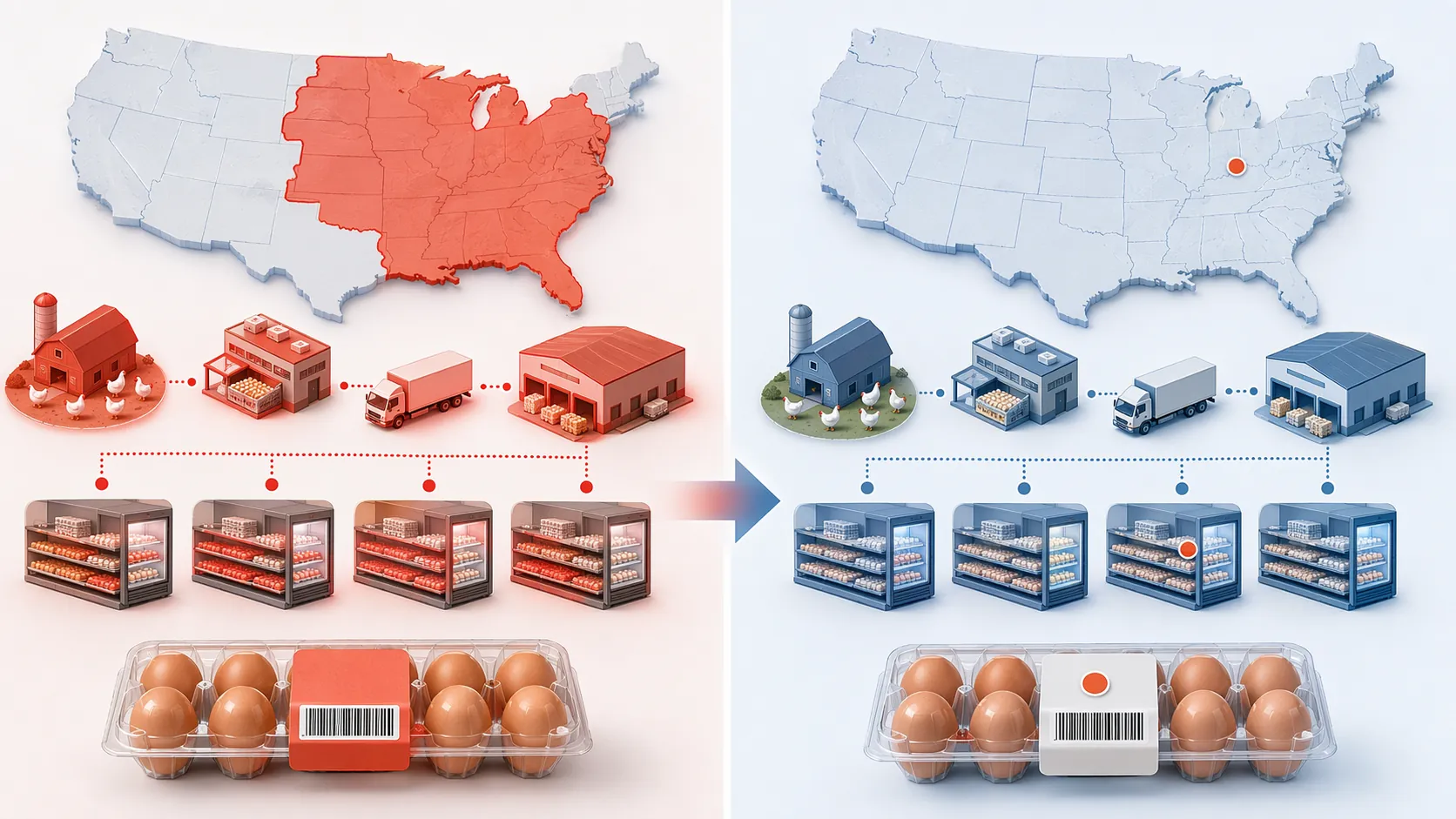
Modern traceability vendors and trade research describe recall-scope reductions in the range of 50% to 95% compared with broad traditional withdrawals.[5][6] That range is worth taking seriously, but not as a guaranteed outcome. The available materials do not provide enough methodology detail to treat it as a universal result across egg operations, outbreak types, or retailer systems. It is better used as a directional benchmark: better lot records can make the difference between pulling a defined set of cartons and clearing shelves across whole regions.
The mechanics are straightforward and unforgiving. A recall-resilient egg supply chain needs lot identity that survives repacking, private labeling, warehouse transfers, retail distribution, and e-commerce fulfillment. If a carton label, pallet record, bill of lading, distributor file, and retailer item setup cannot be reconciled quickly, the company will either under-recall and risk continued exposure or over-recall and create avoidable damage.
| Recall task | What weak records create | What lot-level readiness changes |
|---|---|---|
| Identify affected product | Teams search production logs, label files, and shipment spreadsheets separately. | Lot, pack date, facility, brand, and customer records are linked before the event. |
| Set recall scope | The safest answer becomes a broad withdrawal because the boundary cannot be defended. | The company can explain why included lots are included and why excluded lots are not. |
| Notify retailers | Retailers receive long lists that require manual interpretation at store level. | Notices map affected lots to specific SKUs, distribution centers, stores, and shelf actions. |
| Support consumers | Call centers ask consumers to find unclear codes or discard more product than necessary. | Consumer instructions can reference the exact label, date, lot, and refund path. |
FSMA 204 raises the stakes because shell eggs are on the Food Traceability List, and the rule requires covered entities to provide electronic sortable traceability records to FDA within 24 hours of a request.[7] FDA has announced an extension of the compliance date for shell eggs to July 20, 2028, and its June 15, 2026 public meeting on lot-level traceability challenges signaled that implementation details remain a live regulatory issue.[7][8]
The date matters because it creates an investment window, not a reason to wait. FoodReady has characterized fewer than 40% of affected food companies as currently able to meet FSMA 204’s 24-hour electronic traceability record requirement, though the available material does not allow independent verification of the survey method behind that figure.[5] Treat it as a warning light, not a precise market census.
Mock recalls are where that warning light becomes visible. BRCGS certification requires a full traceability exercise to be completed within four hours.[9] Paper records and disconnected spreadsheets may pass ordinary audits when everyone has time to prepare. They tend to fail at 11 p.m., when the person with the key spreadsheet is offline, the distributor file uses different item descriptions, and legal wants the scope frozen before customer service has the consumer script.
Automated workflows are useful only if they match recall authority
Automation should remove waiting, not judgment. A strong recall workflow can open the incident record, lock affected lots, generate retailer-specific notifications, assign regulatory documentation, trigger warehouse holds, and feed customer-care scripts from the same source data. It should also show who approved each scope decision and what evidence supported it.
That is different from turning a traceability platform into a digital filing cabinet. If quality cannot place a hold without sales escalation, if retail customers receive generic PDFs instead of actionable item and lot data, or if consumer affairs has to rewrite instructions manually, the technology has not changed the recall. It has only made the archive cleaner.
For an egg producer or retailer, the practical buildout should connect five records before the next incident: facility and environmental results, production and pack data, lot and pallet movements, customer and retailer shipment records, and consumer-facing item information. Those records do not need to live in one monolithic system. They do need shared identifiers and tested handoffs.
Consumer recovery starts while the recall is still operational
Egg recalls do not end when the last pallet leaves the store. They continue in refrigerators, trash cans, refund lines, search results, loyalty apps, social feeds, and call-center notes. A consumer who cannot tell whether their carton is included may act conservatively and discard safe product, or worse, assume the warning does not apply because the company name in the notice is unfamiliar.
Consumer trust numbers explain why this work cannot be treated as a communications afterthought. GS1 US research cited by SupplySide F&B Journal found that 59% of consumers would be hesitant to buy the same brand again after a recall, and 93% of U.S. adults are concerned about recall frequency.[10] Those figures measure attitudes, not guaranteed buying behavior, but attitudes shape what happens the next time a shopper pauses at the egg case.
Private-label distribution makes that harder. If the recalled eggs were sold under a retailer brand, a regional label, and several producer-controlled names, the consumer does not care how the ownership structure works. They need to know whether the carton in their refrigerator is affected, what code to check, whether to throw it away or return it, how to get a refund, and what to do if someone ate the eggs and is ill.
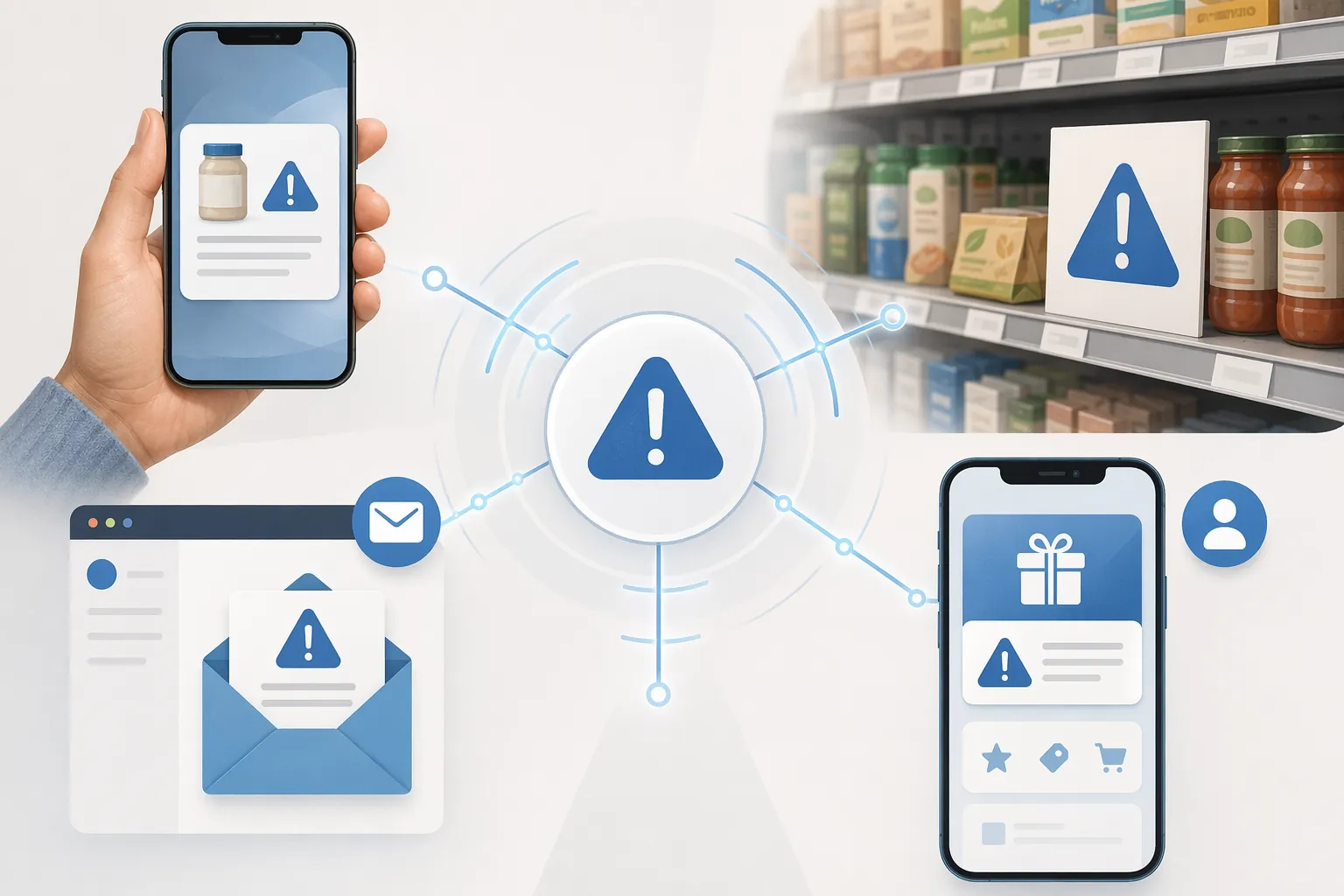
Effective recall communication guidance from Edelman and Recall Info Link emphasizes speed, clarity, empathy, consistency across channels, and direct instructions for affected consumers.[11][12] In grocery execution, that translates into shelf signs where the product was sold, website and app notices that match the FDA notice, retailer customer-service scripts, loyalty-program outreach where purchase data is available, email and SMS alerts where consumers have opted in, and plain-language refund or replacement instructions.
- Name every affected consumer-facing brand and package configuration instead of relying only on the producer name.
- Show consumers where to find the lot, date, or plant code on the carton.
- Separate “do not eat” instructions from refund instructions so the safety action is not buried.
- Give retailers store-level removal instructions that match their item files and shelf labels.
- Update notices when the recall scope changes, and make old instructions visibly obsolete.
The loyalty-card piece deserves careful handling. Purchase-history outreach can be one of the fastest ways to reach likely buyers, especially when products moved through multiple labels. It also depends on retailer data access, consumer consent rules, and message governance. If the producer and retailer have not agreed in advance who sends the alert, what data can be used, and how refunds are handled, the channel that should be precise becomes another negotiation during the recall.
Recovery is also a records problem
After the public notice, the organization still has to prove removal, manage returned or destroyed product, reconcile credits, answer regulator follow-up, and understand what failed. If the recall involved environmental evidence, the post-incident review has to connect sanitation, sampling, corrective actions, production timing, and shipment decisions. If the recall involved multiple labels, it has to examine whether brand mapping slowed consumer notification.
This is where executive language about restoring trust can become thin. Consumers and retail partners do not experience trust as a statement. They experience it as fewer ambiguous notices, faster refunds, cleaner shelf execution, and visible correction when the company learns more. A retailer that had to over-pull an entire category because a supplier could not defend lot boundaries will remember that during the next line review.
The August Egg Company case is useful because it shows all three phases under pressure. Prevention signals matter because environmental findings can become outbreak evidence. Response systems matter because multi-brand, multi-state distribution turns weak lot control into broad disruption. Consumer recovery matters because the person holding a carton recognizes the retailer or brand on the package, not the supply chain diagram behind it.
What to build before the next egg recall
A recall-resilient egg supply chain does not start with a single software purchase. It starts with deciding which operating questions must be answerable under stress.
- Can quality link environmental monitoring results to production lots, pack dates, facilities, and customer shipments without manual reconstruction?
- Can operations isolate affected lots across warehouses, distributors, retail customers, and private-label configurations?
- Can the company generate electronic sortable traceability records within the FSMA 204 request window?
- Can a mock recall reach a defensible scope within four hours, not just eventually?
- Can consumer-facing notices explain the affected brands, codes, actions, refunds, and health guidance without requiring shoppers to understand the supply chain?
AI risk scoring, environmental monitoring, cold-chain IoT, traceability platforms, automated recall workflows, and consumer communication tools each solve only part of that list. The expensive failures usually sit between them: the sensor alert that never became a hold, the facility result that was not connected to shipment records, the lot code that did not survive private labeling, the retailer notice that did not match shelf labels, the consumer message that named a company the shopper had never seen.
By July 20, 2028, assuming the FSMA 204 shell-egg timeline holds, egg supply chain leaders still have time to build the connective tissue.[7] Resilience will not come from buying one tool or issuing faster press releases. It will come from connecting risk signals, lot-level records, recall execution, and consumer communication into one operating system before the next outbreak tests it.
References
- Outbreak Investigation of Salmonella: Eggs (June 2025), FDA.
- Nationwide egg recall over Salmonella risk, AviNews.
- Food Recall Statistics and Trends, PLS Logistics.
- AI Food Supply Chain Traceability: 16 Advances (2026), Yenra.
- Transforming Food Safety With AI-Native Traceability, FoodReady.
- SME Competitiveness Outlook 2020: COVID-19: The Great Lockdown and its Impact on Small Business, International Trade Centre.
- FSMA Final Rule on Requirements for Additional Traceability Records for Certain Foods, FDA.
- How Technology Shapes Food Recall Readiness in 2026, Food Logistics.
- BRCGS Global Standard Food Safety Issue 9, BRCGS.
- The future of food safety, SupplySide F&B Journal.
- 7 Golden Rules of Effective Recall Communications, Edelman.
- 8 Tips for Better Consumer Communication During a Product Recall, Recall Info Link.
Comments
Join the discussion with an anonymous comment.