
The August Egg Company recall was not a single-brand cleanup. It was 1.7 million dozen shell eggs, sold under more than 10 brand names, distributed across 9 states, and routed through more than 10 retail banners before anyone in operations had to start pulling product back through the system. The labels included Clover, First Street, Nulaid, O Organics, Marketside, Raley’s, Simple Truth, Sun Harvest, and Sunnyside, among others.[1] The final FDA outbreak investigation counted 134 illnesses tied to the Salmonella outbreak; earlier case counts were lower, as they often are before outbreak investigations close.[2]
That shape matters. A consumer may see different egg brands on different shelves. A logistics team sees a shared production footprint, retailer-specific withdrawal procedures, cold rooms that need segregation space, trucks that cannot be treated like ordinary returns, and planners trying to replace a daily staple while the normal source is compromised. This is where an egg recall’s supply-chain logistics impact starts to separate from the way recall costs are usually discussed.
The familiar benchmark is that a food recall costs about $10 million in direct costs, a figure commonly attributed to Food Marketing Institute and Grocery Manufacturers Association work and repeated in recall economics discussions.[3] It is useful as a warning label, but it is also several years old and blunt. It does not tell a distribution center manager where to put recalled refrigerated inventory while disposition is pending, or tell a carrier whether a backhaul can be mixed with other freight, or tell a retailer how many store-level systems must agree before an item is no longer sellable.
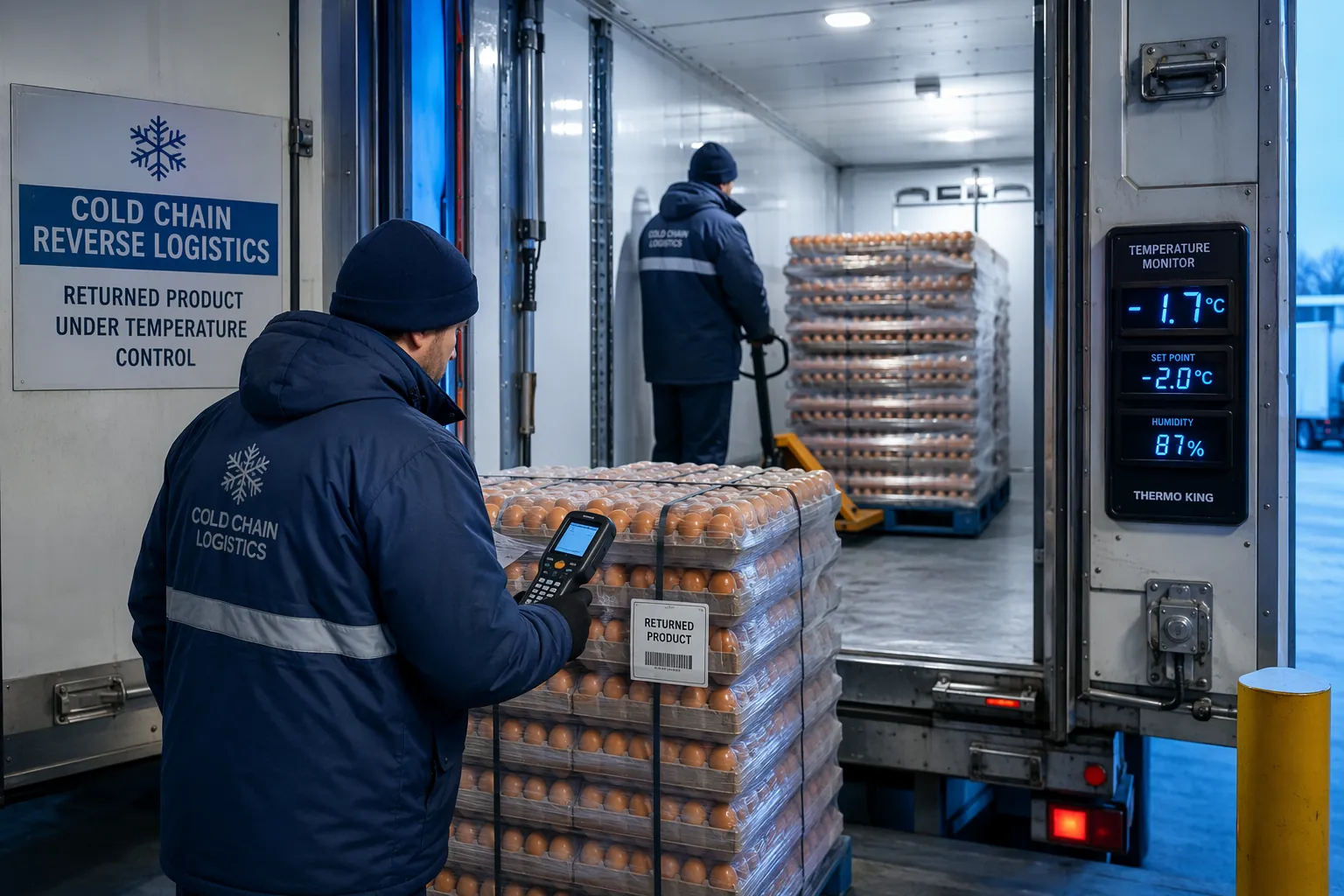
The Recall Starts as a Sorting Problem
Before a case moves, someone has to decide which cases are implicated. That sounds administrative until the product is sitting in a mixed retail network. The August Egg Company notice required customers to check brand, carton size, plant code, Julian date, and sell-by date.[1] Those identifiers are the difference between a narrow pull and a dock full of product that cannot be released.
For store operations, the first visible job is shelf withdrawal. For distribution, the heavier job is alignment: retail item files, warehouse inventory, transportation instructions, vendor recall notices, and disposal authorization all have to describe the same product perimeter. If one system recognizes a UPC while another is driven by vendor lot, or if a retailer’s private-label description masks the shared facility behind it, the recall perimeter becomes a reconciliation exercise.
Eggs leave less room for casual staging than shelf-stable packaged goods. A recalled box of crackers can often be isolated at ambient temperature while paperwork catches up. Recalled shell eggs still occupy refrigerated space, still require handling discipline, and still need a compliant path to disposal or other approved disposition. The product may have lost commercial value, but it has not stopped consuming cold-chain capacity.
Cold-Chain Reverse Logistics Is the Expensive Middle
A forward egg shipment is planned around replenishment: predictable lanes, temperature-controlled trailers, scheduled dock appointments, and inventory that should move quickly from producer to distributor to store. A recall reverses the direction without giving operations the same clean geometry. Product is now scattered across store backrooms, retail distribution centers, customer returns areas, and possibly carrier cross-docks. It has to be identified, held, moved, and disposed of while temperature control remains part of the job.
That is why transportation and processing can dominate recall spending when the reverse plan has not been tested. Global Food Safety Resource notes that without a pre-tested reverse logistics plan, companies can face more than 60% of total recall cost from transportation and processing, and that reverse logistics can account for 5% to 7% of the total bottom line when no program is in place.[4] Those are not egg-specific figures, but they describe the part of the recall budget that cold-chain products stress hardest.
The hard cost is not simply “send a truck.” Refrigerated capacity must be scheduled for product that cannot be sold. Loads may need segregation from saleable inventory. Store pickups may not match efficient route density. Consolidation points need cold space and clear status controls. A returned pallet that is waiting for destruction approval still needs to be kept where it belongs, labeled so it does not re-enter commerce, and tracked so finance, food safety, and the retailer can close the loop.
Food Chain Magazine’s coverage of the egg recall noted that recalled eggs must be retrieved under temperature-controlled conditions, a requirement that prevents the kind of simple consolidation available in many shelf-stable recalls.[5] That limitation ripples through the network. A carrier cannot always use the cheapest return movement. A warehouse cannot simply park questionable product in any overflow location. A retailer cannot rely on ordinary damaged-goods handling if the product has a food safety disposition attached to it.
Disposal is another logistics operation, not a footnote. The cases must be counted, documented, and routed to an approved endpoint. If disposal approval lags, the product occupies scarce refrigerated space. If a retailer requires store-level confirmation before credit is issued, cartons may sit longer than anyone wants. If the vendor, retailer, and disposal provider use different identifiers, the reconciliation burden survives after the physical eggs are gone.
This is the part of recall cost that a generic average hides. Press releases are cheap compared with refrigerated reverse movement, exception handling, claims support, disposal documentation, and the labor needed to keep unsafe product physically separated from sellable inventory.
One Plant Code Can Become Many Retail Recalls
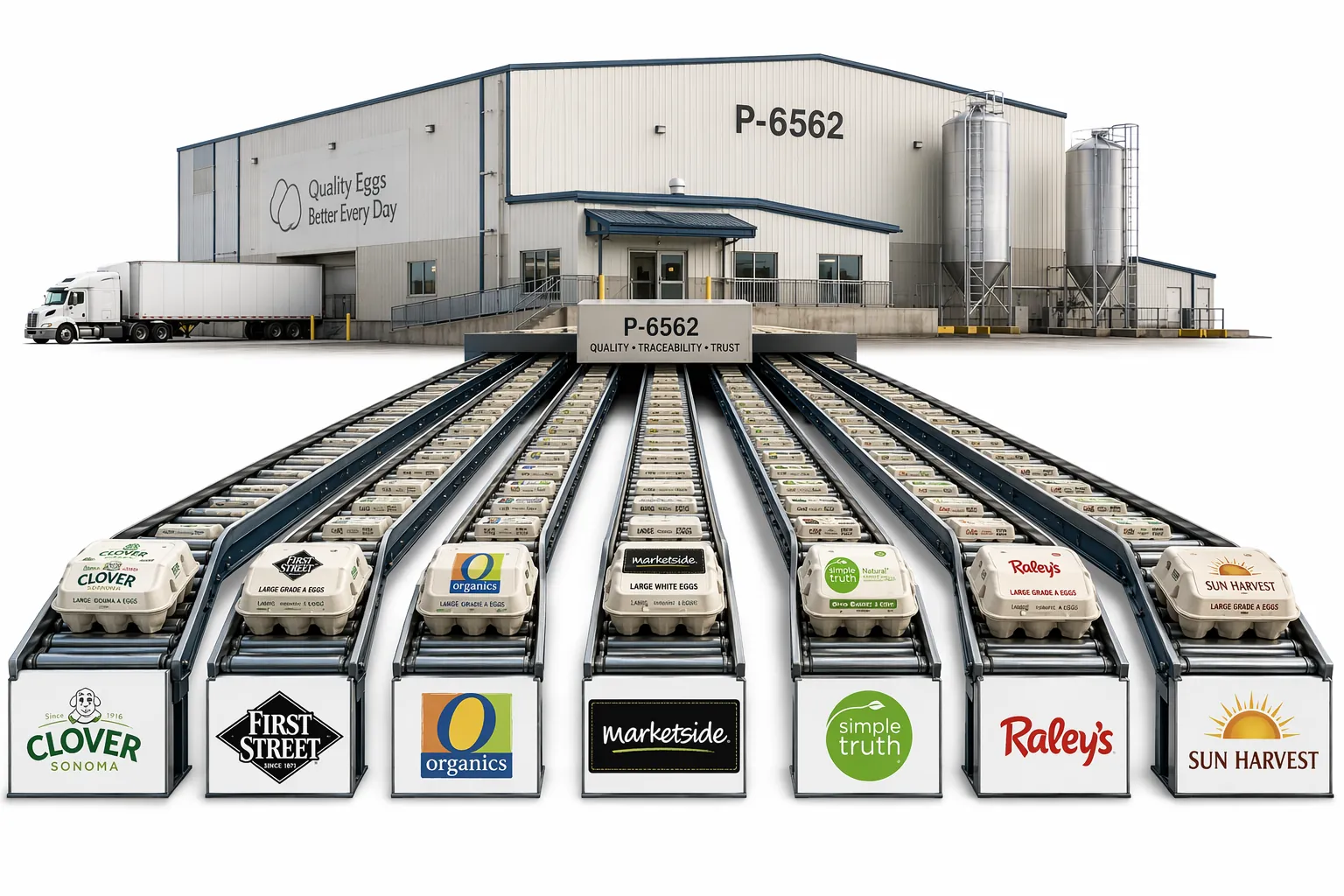
The August recall’s brand list was long because the operational source was shared. FreshByte’s analysis noted that August Egg Company eggs shared plant codes P-6562 and CA-5330, meaning brands produced at those facilities were pulled into the recall perimeter.[6] That is the part a shopper rarely sees and the part a logistics team cannot ignore.
A multi-brand recall is not just a bigger consumer notice. It multiplies the number of parties that need instructions in their own operating language. A mass merchant, a regional grocer, a club channel, and a natural foods banner may all need to remove the same implicated production, but they will not necessarily use the same recall portal, credit process, return authorization rule, or store execution cadence.
| What Looks Simple | What Operations Must Resolve |
|---|---|
| One recalled producer | Multiple private-label and branded item records tied back to plant codes |
| One public recall notice | Retailer-by-retailer pull instructions, credits, confirmations, and exception reports |
| One product category | Different carton sizes, date ranges, plant codes, and shelf locations |
| One affected network | Separate store, DC, carrier, vendor, and disposal handoffs |
The plant-code problem also changes how inventory teams search. If the recall is treated as a brand event, product can be missed under another label. If it is treated as a facility-and-date event, retailers have to pull across assortment lines that may normally be managed by different buyers, category teams, or replenishment rules. The cleaner the shelf presentation, the easier it is to underestimate the shared production logic behind it.
There is also a timing problem. Retailers do not all freeze inventory at the same second. Some stores may pull quickly but lag in confirmation. Some distribution centers may have already shipped product after the suspect lots entered the network. Some recalled cases may be in transit. The recall is not contained when a notice is posted; it is contained when implicated product is found, blocked, removed, and documented across every node that touched it.
Eggs Do Not Replenish Like Manufactured Inventory
Once the pull is underway, the next problem is the empty space it leaves. In many packaged-goods categories, planners can shift production, change pack configurations, or draw down alternate finished-goods inventory. Eggs are constrained by biology. USDA Economic Research Service research published through ScienceDirect notes that replacing depopulated laying flocks can take 5 to 12 months.[7]
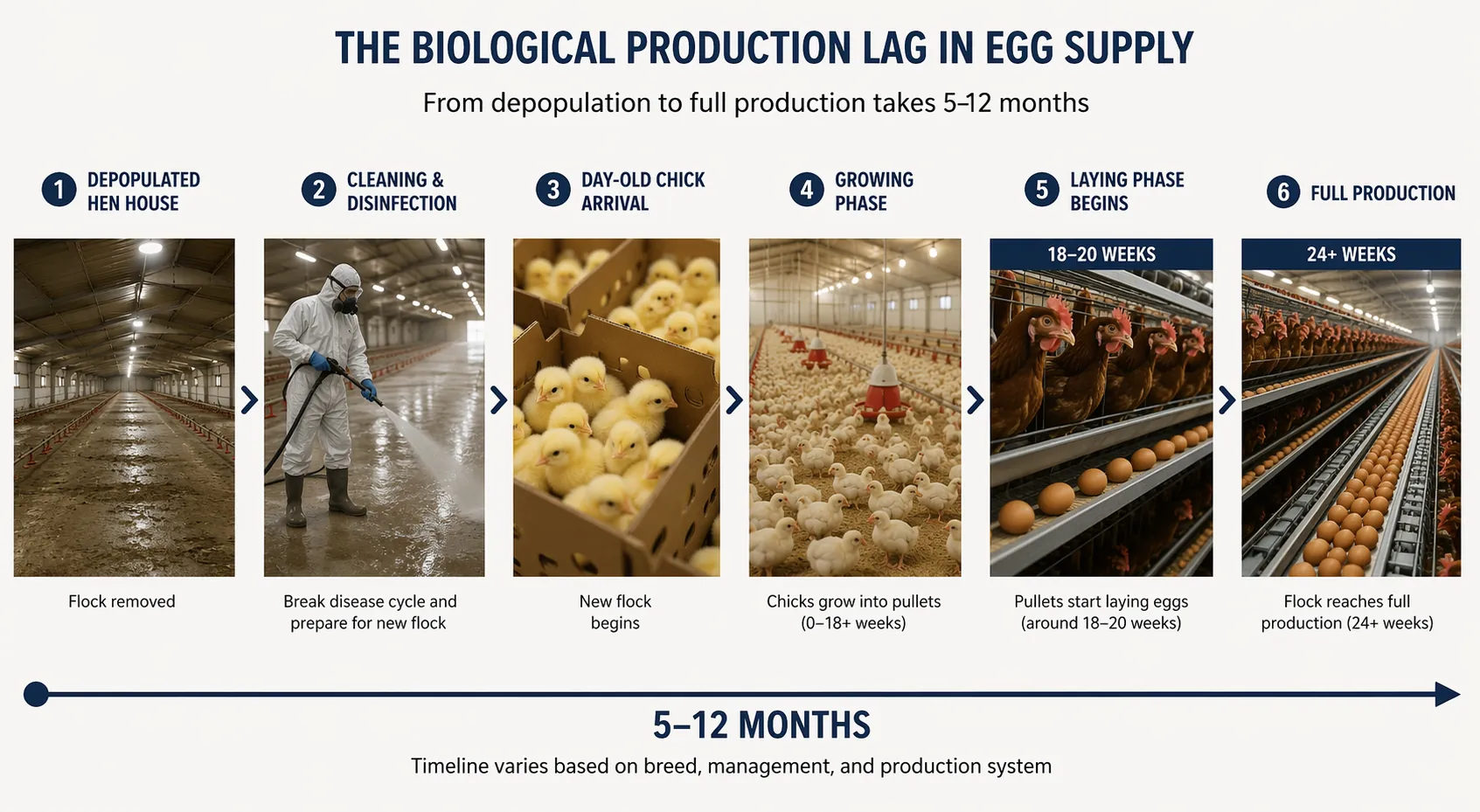
The August Egg Company recall was a Salmonella recall, not a depopulation case in the way avian influenza response can be. The 5-to-12-month figure should not be read as a direct recovery clock for that specific recall. It is still important because it explains why egg supply networks are less elastic than many buyers would like. When a production source becomes unavailable or constrained, the replacement cannot simply be switched on.
That lag turns a recall from a retrieval project into a replenishment problem. Retailers need substitute supply. Distributors may reach farther from the affected market. Freight lanes may lengthen. Cold-chain appointments may become less predictable. Category managers may accept different brands, pack sizes, or pricing conditions to keep shelves from looking stripped. None of those adjustments appear in the first recall notice, but they sit on the same operations desk.
The difficulty is not only volume. Eggs are a high-velocity staple with steady consumer expectations. A short fill-rate disruption becomes visible quickly, and retailers have limited patience for explanations that begin at the farm. If replacement supply comes from farther facilities, the logistics team absorbs the distance in transportation cost, appointment complexity, and tighter margin for temperature excursions.
Compliance Adds Guardrails, Not Capacity
Regulatory compliance is necessary, but it does not make refrigerated space appear or align retailer systems by itself. Food safety teams need traceability records, recall effectiveness checks, and evidence that product did not remain available for sale. Store teams need executable instructions. Carriers need handling requirements. Finance needs proof for credits and claims. Disposal partners need authorization. Those workflows overlap, but they do not move on the same clock.
Industry consolidation can make the perimeter wider when shared facilities serve many labels, but the logistics issue is more specific than consolidation as a slogan. The operational pressure comes from dependency: many downstream retail processes depend on the same upstream plant codes, and each downstream process still has to complete its own withdrawal, return, disposal, and replacement tasks.
Where Process and Technology Actually Help
The useful technology question is not whether a recall response sounds modern. It is whether a tool removes a handoff, shortens a hold, or prevents a bad case from moving one node farther. In egg recalls, the practical targets are narrow and concrete.
- Lot and plant-code matching should connect brand, UPC, carton date, facility code, customer shipment, and retailer location before the recall notice becomes a spreadsheet chase.
- Return authorization should tell stores and distribution centers whether product is to be held, returned, destroyed, photographed, counted, or segregated without waiting for one-off email clarification.
- Cold-chain monitoring should identify recalled product that remains in controlled conditions and flag exceptions during reverse movement.
- Disposal documentation should close the loop between physical disposition, retailer credit, vendor claims, and food safety records.
- Replacement sourcing should model distance, temperature-control capacity, supplier constraints, and shelf impact instead of treating the recall as complete once product is pulled.
Those are the places where recall return logistics automation can matter: not as a press-release feature, but as a way to keep product status, location, temperature requirements, and disposition instructions from fragmenting across systems. The same standard applies to AI-driven food recall risk management and predictive cold-chain monitoring: they earn their keep only if they reduce the time product spends unidentified, uncontrolled, or waiting for a decision.
Reverse logistics orchestration is sometimes discussed in higher-value categories, including parts and durable goods. Food recalls are less forgiving because the returned item usually has no recovery value and still carries handling constraints. Lessons from reverse logistics value recovery and recall logistics orchestration still apply, but the measure is different: safe containment, fewer exceptions, faster confirmation, and less refrigerated capacity tied up in limbo.
The Cost Is a Chain of Constrained Operations
An egg recall is not one cost event. It is a sequence: identify implicated lots, translate plant-code scope across many brands, coordinate retailer protocols, remove product from sale, retrieve or destroy it under temperature-control expectations, document disposition, process credits and claims, and rebuild supply while production cannot instantly respond.
The August Egg Company recall made that sequence visible because the recall perimeter cut across brands, states, and retail banners.[1] The final outbreak count explains why the public health action mattered.[2] The logistics burden explains why the operational bill cannot be understood from a generic average alone.
For eggs, the expensive part starts after the announcement: cold cases moving backward, plant codes being reconciled against retail labels, refrigerated space being consumed by product nobody can sell, and replenishment planners looking for substitute supply in a market where biology sets the pace.
References
- August Egg Company Recalls Shell Eggs Because of Possible Health Risk, FDA.
- Outbreak Investigation of Salmonella: Eggs, June 2025, FDA, June 2025.
- The Economics of Food Recall Systems, Kraken Sense.
- Reverse Logistics, Global Food Safety Resource.
- FDA Urges Consumers to Toss Millions of Eggs as Salmonella Contamination Risks Rise, Food Chain Magazine.
- Massive Egg Salmonella Recall Highlights Traceability Challenges, FreshByte Software.
- ScienceDirect / USDA ERS study on replacing depopulated laying flocks, ScienceDirect / USDA ERS.
Comments
Join the discussion with an anonymous comment.