
The uncomfortable question behind Trump's AI research-funding cuts is not whether Washington can write an ambitious AI strategy. It can. In July 2025, the Trump administration's AI Action Plan called for American "AI dominance," even as reporting and policy analysis described deep disruption to the federal research system that trains much of the country's advanced AI workforce.[1][2] For supply chain technology buyers, that contradiction is not just a science-policy dispute. It is a vendor-risk signal.
The procurement version of the question is narrower and more useful: if planning, visibility, inventory optimization, and automation vendors depend on advanced AI talent, what happens when the public research pipeline that produces a large share of that talent becomes less stable?
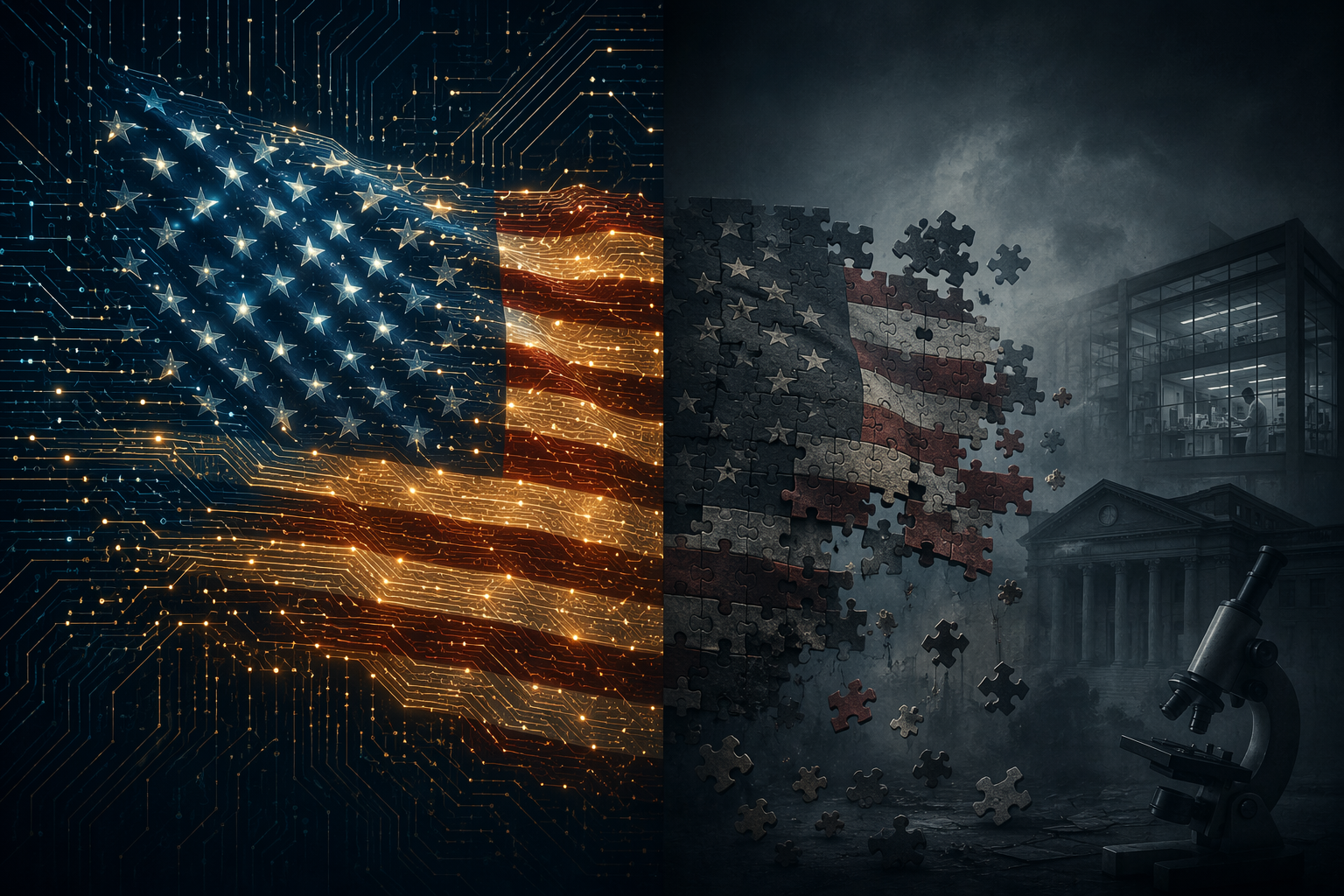
The answer does not require melodrama. The cuts do not mean a supply chain AI platform will stop working next quarter, or that every promised roadmap item is suddenly fiction. But the evidence is strong enough to treat federal research-funding instability as a medium-term innovation risk. The relevant horizon is not the next demo cycle. It is the three to five years in which today's graduate admissions decisions, lab closures, grant freezes, and career exits become tomorrow's hiring market.
The Funding Disruption Is Large Enough To Matter
The Brennan Center's March 2026 accounting describes more than $3 billion in previously approved research grants from the National Institutes of Health and the National Science Foundation being cut or frozen during 2025, including more than $700 million in frozen NSF grants affecting AI research.[2] The same analysis reports more than 2,500 NIH grants initially terminated, $2.3 billion in frozen NIH grants, and a proposed FY2027 budget that would cut NSF by 55% and NIH by 13%.[2]
The NSF figure is especially relevant to AI buyers because NSF is not a marginal player in the U.S. AI talent system. ZDNET reported that NSF invests more than $700 million annually in AI research, and quoted Gregory Allen of the Center for Strategic and International Studies saying that "almost every employee with an advanced degree at every American AI firm has been a part of NSF-funded research."[3]
That quote matters because it connects a budget line to a labor market. Supply chain software buyers are used to asking whether a vendor has enough implementation consultants, cloud engineers, data scientists, or customer-success staff. They are less accustomed to asking whether the upstream institutions that train the vendor's future research staff are still intact. Yet AI roadmap claims depend on that second question more than most procurement checklists acknowledge.
The administration's own posture makes the gap harder to ignore. The Guardian described the tension between the AI Action Plan's dominance language and cuts to the scientific research base that would be needed to support that ambition.[1] ZDNET also reported NSF staffing losses, including 170 staff departures, alongside AI-related funding and personnel cuts.[3] A government can favor AI rhetorically while weakening the institutions that supply AI researchers. Buyers should not treat those two signals as if they cancel each other out.
How Research Cuts Reach A Supply Chain AI Roadmap
There is no public study showing that a specific dollar amount of NSF disruption has delayed a specific release from Blue Yonder, Kinaxis, o9, or any other supply chain AI vendor. That absence matters. The case here is not a direct product-failure claim; it is a traceable pipeline-risk claim.
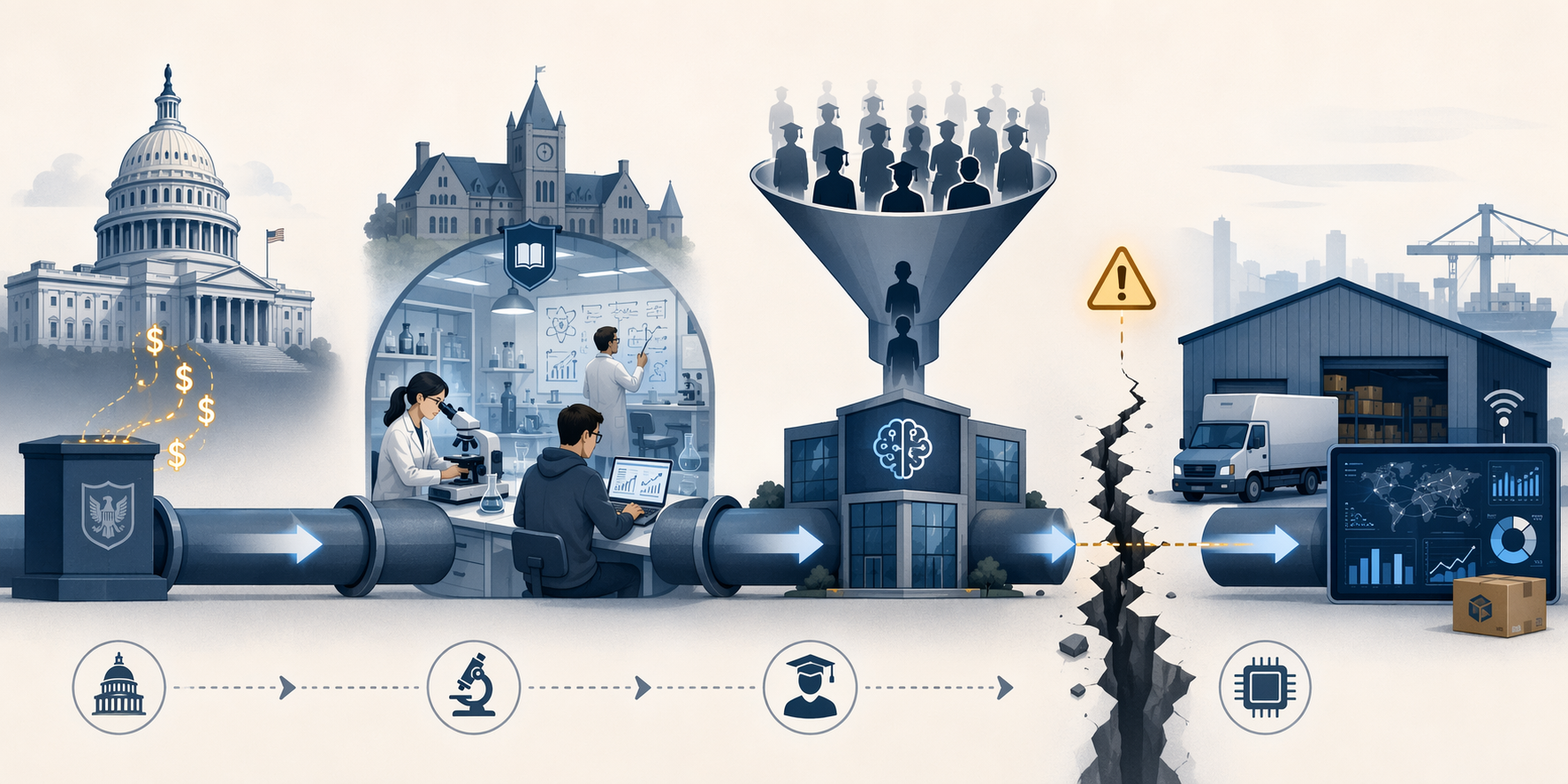
The mechanism is straightforward. Federal grants support research labs. Research labs fund graduate students, postdoctoral researchers, datasets, compute access, and faculty time. Those labs produce methods, papers, open-source tools, and people trained to work on hard modeling problems. AI firms then hire from that pool or build on work that came out of it. Supply chain AI vendors compete in the same broader market for machine-learning researchers, optimization specialists, data engineers, and applied scientists.
A supply chain planning model is not usually marketed as a descendant of an NSF grant. The sales deck talks about forecast accuracy, inventory turns, exception management, autonomous planning, or digital twins. But the difficult work underneath those claims often looks familiar to academic AI and operations-research labs: probabilistic forecasting, reinforcement learning, combinatorial optimization, graph methods, causal inference, simulation, anomaly detection, and human-in-the-loop decision design.
When the academic system absorbs a shock, the effect is delayed. A frozen grant may first mean a lab does not hire a new PhD student, does not renew a postdoc, scales back a research project, or drops a collaboration. The software buyer does not feel that immediately. The product manager may not feel it immediately either. The signal appears later, when a vendor tries to hire a specialized researcher for a planning engine, replace a departing principal scientist, or staff a promised AI roadmap with people who have done more than package a model behind a dashboard.
That is why the time horizon matters. A thin PhD cohort in 2025 or 2026 does not break a 2026 release. It can, however, reduce the number of experienced candidates available for applied AI roles several years later. A lab that closes one research direction this year does not immediately weaken every vendor's optimizer. It can narrow the set of methods and trained people available when vendors need to move from generic AI features to domain-specific automation.
The Pipeline Signals Are Already Visible
The most concrete early signal is graduate admissions. The Brennan Center cited reporting that MIT and Duke cut PhD admissions by 20% in biology programs in 2025, and also cited a Boston Globe survey in which two-thirds of research scientists near Boston said they were advising students to avoid academic careers.[2] Those are not supply chain AI statistics, and they should not be stretched into one. They are evidence that research institutions and scientists are already changing behavior under funding pressure.
That behavioral shift is often more important than the headline number. A frozen grant is a budget event. A smaller admissions class is an institutional response. Senior scientists warning students away from academic careers is a pipeline-confidence response. Once that confidence erodes, recovery is not as simple as restoring a line item. Students choose other programs, other countries, or private-sector jobs. Postdocs leave. Faculty stop proposing projects that depend on uncertain support.
The talent market is also international. The Brennan Center and Guardian reported that 85 U.S. scientists moved to China in the past year, while the European Union launched a EUR500 million package to attract U.S.-based researchers.[2][1] Those figures do not prove a mass exodus from American AI. They do show that competing research systems are treating U.S. instability as an opportunity.
For procurement leaders, the practical point is not nationalism. It is availability. If the strongest candidates have more reasons to leave U.S. academia, avoid academic research altogether, or accept roles outside the vendor categories serving supply chain, then vendor claims about aggressive AI hiring deserve closer examination.
Private AI Funding Helps, But It Does Not Replace The Public System
The strongest counterargument is that private AI investment is enormous. If the federal government cuts grants, large technology companies, AI labs, and venture-backed vendors can fund training, recruit directly, sponsor university work, or build internal research teams. That argument is partly right. Corporate money can preserve some research capacity and create attractive career paths.
The scale comparison is still awkward. ZDNET cited OpenAI's $50 million NextGenAI initiative as an example of private-sector support.[3] That is meaningful money for selected institutions and projects. It is also much smaller than the more than $3 billion in cut or frozen NIH and NSF grants identified by the Brennan Center, and smaller than the more than $700 million in frozen NSF grants affecting AI research alone.[2]
There is also a role difference. Corporate programs tend to serve corporate priorities. Federal research funding supports a wider training base, including early-stage work whose commercial use is not obvious at proposal time. Supply chain AI has benefited from that kind of long-cycle research culture, even when the final product arrives years later with a procurement-friendly name and no visible connection to the original lab.
A buyer does not need to dismiss private-sector substitution to ask whether it is enough. The right question is whether a vendor has access to durable talent formation, not just whether the AI sector has capital somewhere in the system.
Vendor Exposure Will Not Be Even
The funding shock should not be applied mechanically to every supply chain AI vendor. A large platform vendor with established R&D teams, international recruiting channels, internal training programs, and a mature customer base is not in the same position as a startup whose technical credibility depends on hiring recent PhDs from U.S. labs.
Large vendors may be better able to absorb a thinner U.S. academic pipeline. They can recruit globally, acquire smaller teams, retrain engineers, maintain internal research groups, and distribute roadmap work across regions. They may also have enough installed-base revenue to keep research programs alive through a difficult hiring market.
Startups and narrow AI specialists face a different test. If their differentiation depends on a small number of researchers, access to university collaborators, or a model architecture still close to academic research, then talent disruption has more leverage. A delayed hire can delay a product line. A senior researcher leaving can turn a roadmap from a technical plan into a recruiting problem. A grant-funded university partner losing capacity can weaken the vendor's experimentation loop.
The most exposed vendors are not necessarily the smallest by revenue. They are the ones whose AI claims outrun their research bench. A vendor can have strong sales momentum, polished demos, and impressive pilot language while still depending on a fragile technical team for the next generation of capabilities.
| Vendor Situation | Likely Exposure | What To Test In Diligence |
|---|---|---|
| Established platform vendor with global R&D teams | Lower, though not zero | Depth of applied AI staff, retention of senior technical leaders, and evidence that roadmap work is already staffed |
| AI-native startup hiring mainly from U.S. universities | Higher | Hiring pipeline, university dependencies, cash runway for research roles, and backup plans if specialized hires slip |
| Vendor relying on partnerships for advanced modeling | Variable | Contractual control over research work, continuity of partner labs, and whether IP sits inside or outside the vendor |
| Vendor marketing AI features built mostly on third-party models | Different exposure | Ability to adapt foundation models to supply chain data, maintain domain expertise, and avoid roadmap dependence on external model releases |
What This Means For Supply Chain AI Procurement
AI procurement already asks for security reviews, integration architecture, implementation capacity, model governance, reference customers, and commercial terms. For multi-year platform decisions, it should also ask whether the vendor can keep building the AI capabilities it is selling into the contract.
The first diligence area is R&D depth. Buyers should ask how many people are working on core AI and optimization, how many are senior enough to lead original development, and which roadmap items are already staffed. A roadmap item that depends on future hiring is not necessarily weak, but it carries a different risk profile from one assigned to an existing team.
The second area is talent retention. A vendor that says AI is central to its differentiation should be able to discuss turnover among senior researchers, hiring cycle times for specialized roles, and whether compensation or career paths are keeping technical staff from moving to larger AI companies. The question is not whether the vendor can hire one impressive chief scientist. It is whether the bench behind that person can survive the contract term.
The third area is dependence on academic partnerships. University collaboration can be a strength, especially in domains where supply chain problems require deep modeling rather than cosmetic AI features. But buyers should know whether a vendor's promised improvements depend on a lab, grant, or research group that may be affected by funding instability.
The fourth area is roadmap evidence. Procurement teams should separate capabilities already in production from capabilities shown in prototype, described as "coming soon," or tied to a generalized AI strategy. If a vendor is selling autonomous planning, probabilistic decision support, or advanced exception management as a future state, the buyer should ask who is building it, what milestones have been met, and what happens if hiring slows.
- Which AI roadmap commitments are staffed today, and which depend on future hiring?
- How many senior researchers or applied scientists are assigned to planning, forecasting, optimization, or visibility products?
- What percentage of the AI team was hired from universities or research labs in the last several years?
- Which university partnerships, if any, support current or future product capabilities?
- What is the vendor's fallback plan if specialized AI hiring takes longer than expected?
- How are renewal terms, service levels, or roadmap commitments affected if promised AI features slip?
These questions should not be treated as a political screen. They are supplier-capability questions. A procurement team does not need to predict federal budget outcomes to recognize that research-funding instability can change the labor market from which vendors hire.
A Medium-Term Risk, Not A Product Obituary
The strongest version of the risk is modest but important. Federal AI research cuts do not prove that supply chain AI vendors will miss their roadmaps. They do not prove that private AI investment cannot offset some of the damage. They do not affect all vendors equally. Policy could also reverse through a future administration, congressional action, or agency-level restoration.
Still, the current 2025-2026 evidence points in one direction: large research-funding disruption, specific AI grant freezes, staff losses at NSF, graduate admissions pressure, scientists warning students away from academic careers, and rival research systems trying to attract U.S.-based talent.[2][3][1] That is enough to make the AI talent pipeline part of vendor diligence.
Supply chain leaders signing multi-year AI platform deals are not buying only today's interface. They are buying a vendor's ability to keep improving models, maintain specialized teams, and turn research into usable planning and execution tools. When the upstream talent system weakens, that ability deserves closer inspection.
References
- Trump cuts to science research threaten his own AI action plan, The Guardian
- The Cost of the Trump Administration's Attacks on Research Funding, Brennan Center, March 2026
- Trump axes AI staff and research funding, and scientists are worried, ZDNET
Comments
Join the discussion with an anonymous comment.