
AI weather intelligence in supply chain and logistics planning is useful only when the weather signal reaches a decision someone can actually change. A storm probability by itself does not move inventory, reserve carrier capacity, cut a purchase order, or adjust a demand plan. The supply chain use case begins when probabilistic weather data is joined with enterprise and logistics data tightly enough to answer a narrower question: what should change before the weather becomes an exception ticket?
That distinction matters because weather is already a material operating variable. NOAA counted 28 billion-dollar weather and climate disasters in the United States in 2024, with losses of $92.9 billion; 2022 losses were $165 billion.[1] Those figures do not say which companies should buy an AI product. They do explain why planners are being asked to make earlier calls with imperfect information.

What AI Weather Intelligence Does in Supply Chain Planning
In supply chain operations, AI weather intelligence is a decision layer that combines meteorological signals with demand, inventory, transportation, and supplier-network data. It can support demand forecasting, logistics routing, inventory pre-positioning, and supplier risk monitoring. The mechanism is not “the forecast is better, therefore the plan is better.” The useful mechanism is more concrete: a model estimates weather probability, translates likely timing and geography into business exposure, then pushes a recommendation or alert into the planning workflow.
A retailer may use the signal to increase demand expectations for bottled water, generators, ice cream, or roofing materials in specific regions. A transportation team may use it to reroute loads before a lane becomes unreliable. A manufacturer may use it to pull forward production for a weather-sensitive product. A procurement team may use it to check whether suppliers, ports, or upstream nodes sit inside a storm path.
The operating value comes from compressing the time between detection and action. If a planner sees a storm after capacity has tightened and inventory is still in the wrong distribution center, the forecast has arrived too late for practical planning. If the same signal enters a demand plan, allocation rule, route tender, or supplier review early enough, it can change the cost and service outcome.
| Supply chain function | Weather-intelligence action | Decision that changes |
|---|---|---|
| Demand forecasting | Weather signals are added to demand sensing and forecast models | Regional volume expectations, production schedules, replenishment quantities |
| Logistics routing | Storm, flood, heat, wind, or snow probabilities are matched to lanes and delivery windows | Route selection, appointment timing, carrier allocation, cutoff decisions |
| Inventory optimization | Weather exposure is compared with stock position and service requirements | Pre-positioning, allocation, safety stock, emergency replenishment |
| Supplier risk monitoring | Weather paths are mapped against supplier sites and multi-tier networks | Expedite decisions, alternate sourcing, pre-cutoff purchase orders |
Where the ROI Evidence Is Strongest—and Where It Needs Framing
The headline performance ranges are attractive, but they need careful handling. McKinsey’s Supply Chain 4.0 research stream is widely cited through secondary sources for the claim that AI weather forecasting can reduce supply chain forecast errors by 20–50% and cut lost sales by up to 65%.[2] Those figures are useful as directional evidence that weather-aware forecasting can matter. They should not be treated as a clean benchmark unless the original methodology, sample, and supply chain contexts are verified.
The Weather Company and IBM’s 2024 Weather Means Business report makes a broader enterprise case: companies using weather intelligence report 5–10% revenue increases and substantial operating cost reductions, and 90% of executives say weather affects their operations.[3] That supports adoption interest, not a universal ROI guarantee. A grocery network, a parcel carrier, a construction-materials producer, and a pharmaceutical manufacturer do not experience the same weather-to-decision chain.
For a planner evaluating the use case, the better question is not whether AI weather intelligence has a single average ROI. It is whether the organization has enough weather-sensitive volume, enough decision lead time, and enough control over execution to convert probability into action. A model can see a demand spike coming; the value appears only if inventory, labor, carrier capacity, and order cutoffs can still be moved.
The Hurricane Ian Case Shows the Inventory Move
ClimateAi’s Hurricane Ian case is one of the cleaner examples because the operating move is visible. A roofing materials producer used ClimateAi forecasts to pre-position Florida-code-compliant inventory before the hurricane, generating $15 million in incremental sales that the vendor says would otherwise have been lost.[4] The figure is vendor-reported and tied to a single anonymous company, so it should not be read as independently audited proof. Still, the case shows the kind of traceability that matters: weather signal, localized demand expectation, compliant inventory placement, recovered sales.
The detail about Florida-code-compliant product is important. If the model had only forecast “storm demand,” the recommendation would have been too blunt. The supply chain decision required knowing which inventory was saleable in that jurisdiction, where it was sitting, where it needed to be, and how much time remained before transportation or warehouse constraints hardened.
That is the operational difference between a weather dashboard and a planning tool. A dashboard can warn that demand may rise. A planning tool can identify the inventory subset, the geography, the transfer window, and the revenue at risk. The human decision still matters: pre-positioning too much product can strand inventory after the event, while waiting for certainty can erase the opportunity.
ClimateAi’s broader FICE model, described in coverage by TraxTech, combines credit-card activity across more than 100 sectors with weather data to quantify the timing, duration, and magnitude of weather-related demand shifts.[5] That kind of signal is more useful to demand teams when it can be connected to SKU hierarchies, channel behavior, regional replenishment rules, and substitution patterns. A heat wave may lift one category, suppress another, and pull demand forward rather than create permanent incremental volume.
Unilever’s Ice Cream Result Is a Demand-Sensing Example, Not a Universal Template
Unilever’s ice cream deployment gives the demand-planning side of the use case more shape. In January 2025, Unilever reported that AI incorporating weather inputs improved forecast accuracy by 10% in Sweden, helped achieve world-class service levels, and saved up to 10% on high-value raw materials through AI-optimized production scheduling.[6]
This is a strong example precisely because ice cream is weather-sensitive. Temperature, seasonality, promotion, retail availability, and short-term regional behavior can move demand quickly enough that conventional planning cycles struggle. Weather-aware AI can help production and replenishment teams avoid the familiar mismatch: too little product when a warm spell lifts demand, or too much high-value material committed when weather softens sales.
The caveat is just as useful as the result. A 10% forecast-accuracy improvement in Swedish ice cream does not imply the same effect for industrial components, durable goods, or categories where weather is a weak demand driver. What transfers is the pattern: use weather as an external causal signal when the category has a plausible operating link, then connect the forecast change to production scheduling, raw-material use, and service-level outcomes.
How the Workflow Usually Fits Together
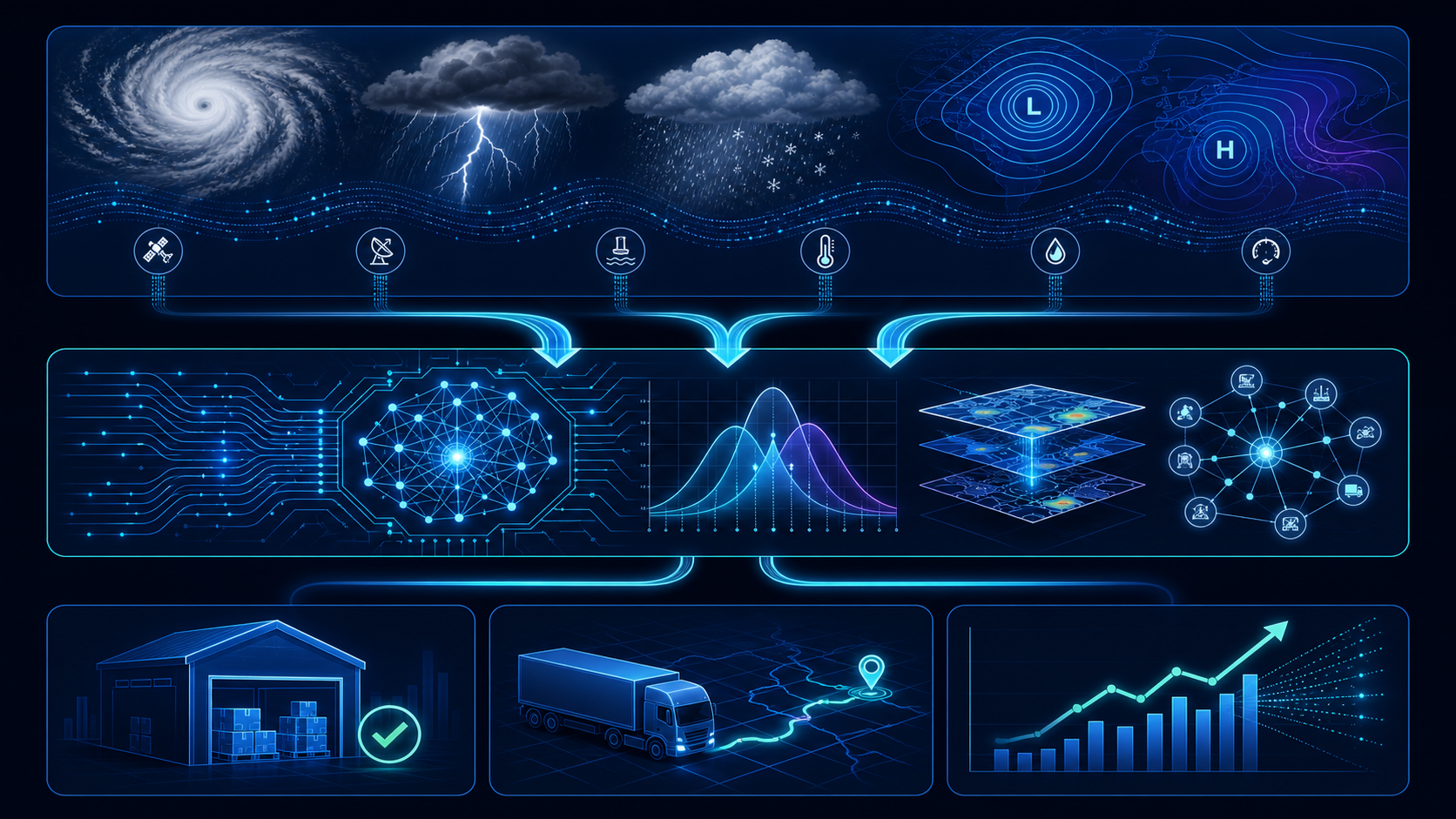
A workable deployment usually has four moving parts. First, weather data enters through APIs or specialized feeds, with probabilities for event type, timing, intensity, and location. Second, the company overlays its own exposure: customer demand, open orders, inventory location, supplier sites, transportation lanes, warehouse capacity, and service commitments. Third, the AI layer evaluates which exceptions are likely to matter operationally. Fourth, planners, logistics managers, or procurement teams decide whether to act.
That last step is where many projects become more organizational than technical. A deterministic alert says, in effect, “a storm is coming.” A probabilistic planning process asks what to do when there is a meaningful chance of disruption but not enough certainty to make the decision comfortable. Pre-positioning inventory, expediting supplier orders, or rerouting freight all carry costs if the event misses the exposed node.
Supply Chain Management Review described AI-driven predictive orchestration in 2026 as combining weather, port congestion, and social media signals so companies can detect disruptions before physical impact.[7] That is directionally where this use case is going: weather is rarely the only signal. A storm path matters more when it intersects with a congested port, a constrained supplier, a product launch, a labor bottleneck, or a seasonal demand peak.
Supplier Risk Is the Same Pattern on a Different Map
Weather intelligence for supplier risk is less about consumer demand and more about exposure mapping. Interos reports that its Catastrophic Risk Model enabled Cooper University Health Care to identify three suppliers in Hurricane Idalia’s path and place orders before cutoff.[8] Again, the case is vendor-provided. Its usefulness lies in the operating sequence: identify exposed suppliers, understand dependency, act before the order window closes.
Multi-tier supplier mapping changes the value of the weather signal. A procurement team that only sees tier-one supplier headquarters may miss the plant, subcontractor, port, or logistics node that actually sits in the risk zone. A supplier-risk model becomes more credible when it can map weather exposure to parts, sites, purchase orders, inventory buffers, and approved alternates.
Monitoring More Events Is Not the Same as Suffering More Damage
Resilinc’s EventWatchAI data gives a useful view of alert volume. In 2024, the company reported that extreme weather alerts to supply chains increased 119% year over year; flood alerts rose 214%, forest fire alerts rose 88%, and overall disruptions rose 38%.[9] Those are alert counts, not direct measures of severity or financial loss. Some of the increase may reflect broader monitoring coverage or better detection.
For operators, that distinction matters because more alerts can create their own workload. If every weather event becomes a high-priority exception, planners stop trusting the system or spend the day triaging noise. A useful AI layer should reduce avoidable remedial work, not simply make the control tower louder. The practical test is whether alerts are ranked by exposure, decision window, and consequence.
Logistics Optimization Needs Freight-Specific Proof
The logistics case is intuitively strong: weather affects routes, dwell time, driver safety, delivery reliability, port operations, and appointment windows. The evidence base, however, should be read with context. A 2025 University of Tokyo arXiv study by Kikuchi simulated 10,000 Tokyo taxi operations and found that weather-aware AI systems increased revenue 107.3%, compared with 14% for route-optimization-only AI; the study also reported a 1.4-month payback and discussed an $8.9 billion weather-AI market opportunity.[10]
That is not a freight benchmark. Taxi dispatch in Tokyo is not long-haul trucking, less-than-truckload planning, drayage, parcel delivery, or ocean logistics. The study is still useful because it isolates the incremental value of weather awareness over route optimization alone. In freight terms, the comparable question is whether a weather-aware routing model performs better than a routing model that only optimizes distance, cost, or transit time under normal conditions.
The freight version also needs constraints a taxi simulation may not carry: hours-of-service limits, appointment penalties, equipment type, temperature control, hazmat restrictions, carrier availability, customer delivery windows, and contractual service commitments. Without those constraints, the model may suggest a route that looks optimal on a map and fails in dispatch.
Vendor Landscape: Capabilities to Compare, Not Just Logos
The vendors in this space do not all solve the same planning problem. ClimateAi is best represented here by demand-shift modeling and the Hurricane Ian pre-positioning case. The Weather Company and IBM represent enterprise weather intelligence and executive-level adoption evidence. Resilinc is useful for disruption monitoring and alert-volume data. Interos emphasizes catastrophic risk modeling and supplier-network exposure. Everstream Analytics describes a platform that applies more than 20 billion daily data points to supply chain networks.[11]
A shortlist should start from the decision that needs to change. If the problem is SKU-level regional demand, a supplier-risk platform may not be the first fit. If the problem is multi-tier exposure during hurricanes, a demand-sensing tool may leave too much of the network unmapped. If the problem is transportation reliability, the evaluation should focus on lane-level constraints, integration with TMS workflows, and the quality of exception prioritization.
| Evaluation question | Why it matters |
|---|---|
| Can the system map weather probability to specific SKUs, lanes, sites, suppliers, or orders? | Generic regional alerts rarely create executable planning actions. |
| Does it integrate with ERP, TMS, WMS, demand-planning, and supplier-risk data? | Weather intelligence needs enterprise context before it can rank consequences. |
| Does it support probabilistic thresholds rather than only deterministic alerts? | Most useful decisions happen before certainty is available. |
| Can planners override, annotate, and review recommendations? | Novel events and business tradeoffs still require accountable human judgment. |
| How is ROI measured? | Forecast accuracy, revenue recovery, avoided expedites, reduced waste, and service levels are different outcomes. |
Prerequisites That Decide Whether the Use Case Works
The most important prerequisite is data integration. Weather APIs alone are not enough. The model needs current inventory positions, open orders, forecast baselines, supplier locations, transportation lanes, warehouse constraints, and customer service rules. If those feeds are stale or inconsistent, the AI can become confidently wrong: it may recommend moving inventory that is not actually available, expediting through a lane that has no carrier capacity, or prioritizing a supplier that is not the true bottleneck.
The second prerequisite is a probabilistic operating model. Teams need thresholds for action before they know exactly what will happen. That may mean pre-positioning only when the exposure value exceeds a cost threshold, rerouting only when the probability-weighted service risk is high enough, or asking procurement to review suppliers only when the event intersects with low inventory and long replenishment lead times.
The third prerequisite is human-in-the-loop governance. AI can handle routine pattern recognition and exception ranking, but humans need to own unusual tradeoffs: whether to protect a strategic customer first, whether to accept higher freight cost to preserve hospital supply, whether to hold scarce inventory for a region with more severe projected impact, or whether a model trained on historical data is under-reading a novel event.
The Failure Modes Are Operational
The first failure mode is treating forecast accuracy as the whole business case. A model can improve forecast accuracy and still fail to create measurable value if the organization cannot change production, inventory, or transportation decisions quickly enough. The lag between forecast update and execution matters as much as the model score.
The second failure mode is weak master data. Supplier locations, alternate sites, SKU eligibility, transportation constraints, and customer priority rules are often messier than the weather feed. Weather intelligence exposes those gaps because it asks the system to make a time-sensitive recommendation across functions that may not share clean definitions.
The third failure mode is overconfidence in historical patterns. AI systems trained on the past may struggle with black-swan scenarios, compound events, or operational conditions outside the training data. A hurricane that shifts late, a flood that closes a supplier’s supplier, or a heat event that changes both demand and labor productivity may require judgment beyond model output.
These risks narrow the adoption judgment. AI weather intelligence is most credible when the organization can trace the path from weather probability to exposed node to recommended action to measured outcome. It is least credible when it is bought as a general resilience layer without changing how planners, logistics teams, and procurement leads make decisions under uncertainty.
When AI Weather Intelligence Creates Measurable Value
The use case is strongest where three conditions are present. Weather must materially affect demand, supply, transportation, or service. The company must have enough lead time and operational control to act before the event becomes unavoidable. The system must integrate weather data with ERP, TMS, WMS, demand-planning, and supplier-risk data closely enough to identify the decision at stake.
Under those conditions, the value can appear as recovered sales, fewer stockouts, lower waste, better service levels, reduced expedites, safer routing, or earlier supplier intervention. The evidence base contains promising cases and meaningful caveats: vendor-reported revenue recovery, vertical-specific forecast improvements, alert-volume data that needs interpretation, and simulations that should not be mistaken for freight results.
The practical adoption standard is not whether the AI can predict weather better than a public forecast. It is whether planners can use its probabilities to make earlier, traceable decisions while keeping humans accountable for novel scenarios the model may not understand.
References
- U.S. Billion-Dollar Weather and Climate Disasters, NOAA National Centers for Environmental Information, 2024, link
- Supply Chain 4.0 research stream, McKinsey & Company, link
- Weather Means Business 2024 report, The Weather Company / IBM, 2024, link
- ClimateAi Hurricane Ian case study, ClimateAi, 2023, link
- ClimateAi FICE model article, TraxTech, link
- Unilever Ice Cream AI forecasting corporate news, Unilever, January 2025, link
- AI-driven predictive orchestration article, Supply Chain Management Review, January 2026, link
- Catastrophic Risk Model Cooper University Health Care case, Interos, link
- EventWatchAI 2024 disruption monitoring data, Resilinc, 2024, link
- Weather-aware AI systems simulation of Tokyo taxi operations, University of Tokyo / arXiv, 2025, link
- Everstream Analytics platform data point description, Everstream Analytics, link
Comments
Join the discussion with an anonymous comment.