
The hard part of planning for AI model liability risk in a supply chain lawsuit is not predicting the first complaint. It is reading the vendor paper before the tool is embedded in routing, replenishment, allocation, or supplier-selection workflows. By then, the demo has usually gone well. The business owner wants the savings. Legal is asked to move quickly. Procurement is told the contract is “standard.”
That is where the risk is often transferred. AI vendors are asking to influence operational decisions that used to sit with planners, buyers, freight specialists, or analysts, while many contracts still treat the product like an ordinary software subscription. One analysis cited by AI Standard of Care reports that 88% of AI vendors cap liability, often at no more than one month’s subscription fees, and only 17% provide warranties for regulatory compliance.[1]
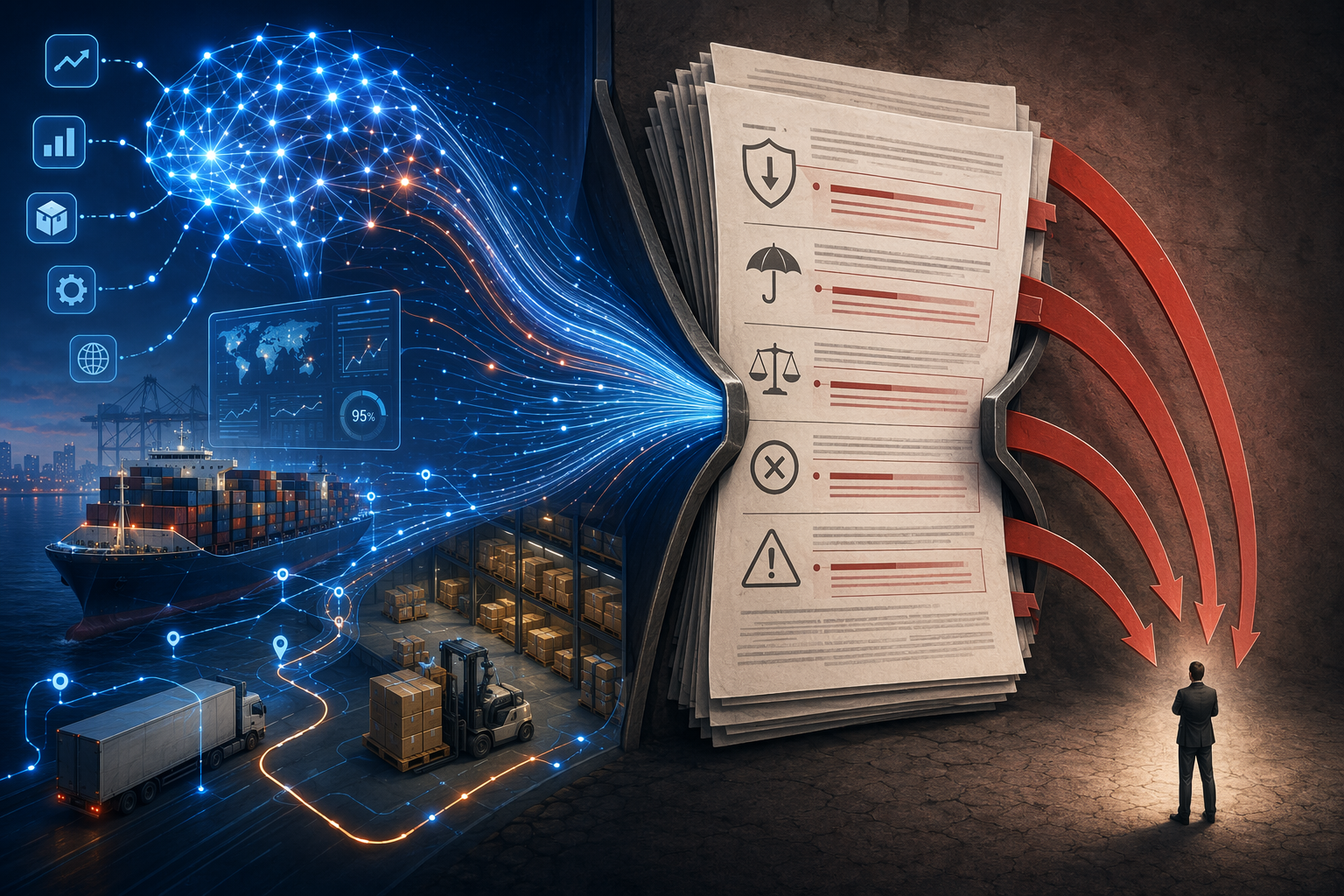
Those two numbers explain the current squeeze. The vendor may provide the model, the interface, the training environment, the optimization logic, and the sales assurance that the system improves decision quality. But if the system contributes to a costly routing error, an unsuitable supplier recommendation, a flawed inventory allocation, or a regulatory problem, the contract may leave the deployer with the real-world loss and only a token recovery claim against the vendor.
The Question Is Usually Decided Before the Failure
When an AI tool causes harm in a supply chain setting, the immediate business answer is usually simple: the deploying organization faces the customer, the regulator, the carrier, the supplier, the insurer, and the internal loss review. The vendor may be involved later, but the company using the tool is the visible actor that issued the purchase order, selected the carrier, allocated the inventory, accepted the recommendation, or sent the customer-facing output.
That practical exposure does not mean the vendor had no role. It means the contract has to be read as an allocation instrument, not as administrative paperwork. In many AI vendor agreements, four clauses do most of the work: the liability cap, the consequential-damages exclusion, the warranty disclaimer, and the indemnity section.

A one-month subscription-fee cap is not a meaningful remedy for a high-impact operational system. If an AI-enabled replenishment tool contributes to the wrong inventory being placed in the wrong region, the subscription fee is not the measure of the harm. The harm may sit in expedited freight, excess stock, lost sales, chargebacks, customer credits, plant downtime, spoilage, or a replacement sourcing process. Yet a nominal cap can turn that entire dispute into a low-recovery software claim.
The consequential-damages exclusion is often even more important. Many supply chain losses are not the invoice price of the software. They are downstream commercial consequences. A damaged shipment after an AI-recommended reroute, a late component caused by an autonomous allocation decision, or a poor supplier recommendation that disrupts production may all be framed as consequential, indirect, special, or lost-profit damages. If those categories are waived, the buyer may be barred from recovering the kinds of losses the system is most likely to create.
Warranty language can narrow the path further. AI Standard of Care describes standard vendor contracts that require customers to indemnify vendors for discriminatory or harmful outcomes while disclaiming warranties for algorithmic accuracy.[1] In a supply chain contract, that combination matters. The vendor avoids promising that the model’s outputs are accurate, compliant, fit for a regulated use, or suitable for autonomous decisioning, while the customer may still agree to defend the vendor if a third party challenges how the tool was used.
Customer indemnity is easy to accept when it covers the customer’s own data, misuse, or violation of law. It is harder to justify when it effectively requires the deployer to defend outcomes shaped by the vendor’s model design, training choices, performance claims, update process, or insufficient testing support. Risk should follow control. If the buyer cannot inspect the model, cannot validate critical assumptions, cannot control updates, and cannot obtain usable performance evidence, it should not quietly become the insurer of the whole system.
Why the Vendor Paper Is Starting to Look Less Settled
The standard contract position is under pressure from more than one direction. The pressure does not mean every supply chain AI dispute will produce vendor liability. It does mean procurement teams have more room to resist boilerplate than they may be told during negotiation.
Mobley v. Workday is the most useful cautionary example, but it needs to be used carefully. The case is not a supply chain case. It concerns employment discrimination claims involving an AI vendor’s screening functions. In July 2024, the Northern District of California allowed claims to proceed on an agency theory where the AI vendor allegedly performed functions traditionally handled by employers; a class was certified in June 2025.[2]
The analogy matters because supply chain AI vendors increasingly sell tools that perform functions companies historically assigned to employees, consultants, freight specialists, category managers, or planning teams. Vendor selection, inventory allocation, autonomous replenishment, transportation routing, and exception handling are not passive database functions. They influence who receives business, where goods move, which customers are served first, and which risks are accepted.
That does not make Mobley direct authority for a logistics or procurement dispute. It does make one-sided “we are only a tool” language less persuasive when the commercial pitch says the tool screens, selects, allocates, recommends, optimizes, or acts with limited human intervention. Procurement teams do not need to overstate the case. They can say something narrower and stronger: courts and commentators are scrutinizing AI vendors that perform delegated decision functions, so the contract should not assume the vendor has no meaningful responsibility.
Product-liability developments add a second source of pressure. The EU Product Liability Directive, Directive 2024/2853, treats software and AI as products subject to strict liability, with a transposition deadline of December 9, 2026; analyses note that liability for software defects under the directive cannot simply be contracted away.[3] K&L Gates has also described early U.S. cases, including Garcia v. Character Technologies and Raine v. OpenAI, as examples of plaintiffs using product-liability theories against deployed AI systems, with design-defect allegations reaching through the AI supply chain.[4]
The EU AI Liability Directive is no longer the framework to watch in the same way; it was withdrawn in February 2025.[3] The EU AI Act, with an effective date of August 2, 2026, remains part of the regulatory backdrop, but the procurement point is more immediate than a survey of AI regulation.[3] Vendor accountability is not frozen at the liability cap printed in the form agreement.
Causation Will Be Messy, So the Contract Has to Be Cleaner
AI failures in supply chains rarely follow a neat line from one bad output to one clean loss. A recommendation may depend on customer data, supplier master data, model training, integration settings, human override practices, exception thresholds, carrier feeds, and update timing. Taylor Wessing’s analysis of AI liability emphasizes that causation often involves multiple actors rather than a single straight path.[3]
That is exactly why vague contract language is dangerous. If the agreement says the customer is responsible for all decisions made using the system, the vendor disclaims algorithmic accuracy, consequential damages are waived, and indemnity runs mainly from customer to vendor, the causation complexity is not shared. It becomes a practical defense for the vendor and a practical burden for the deployer.
A June 2026 Thomson Reuters/Hogan Lovells analysis reached a similar practical point under English law in a professional-services setting: the firm deploying the AI tool carries most practical risk because it produces the final output and faces the client.[5] Supply chain organizations occupy a comparable position. The customer does not sue the routing algorithm. The supplier does not negotiate with the model. The regulator does not start by interviewing the optimization engine. The deployer is the operating face of the decision.
Independent testing also matters because vendor disclaimers do not eliminate the deployer’s evidence problem. AI Standard of Care cites FTC v. Rite Aid for the proposition that deployers relying on vendor claims or disclaimers without independent testing may face evidentiary exposure.[1] In practical terms, a buyer that cannot show pre-deployment validation, monitoring, exception review, and escalation controls may have difficulty explaining why it trusted the system when harm appears.
Agentic Supply Chain Tools Raise the Stakes
The contract problem becomes sharper as AI tools move from analytics to action. Foley & Lardner reported in May 2026 that Walmart uses AI for autonomous inventory replenishment and that Flexport’s AI agents manage about 40% of freight forwarding.[6] Those examples are not proof that the tools are unsafe. They show why liability terms built for low-impact software access are increasingly mismatched to operational autonomy.
A procurement team evaluating an autonomous replenishment, freight-forwarding, or supplier-selection platform should assume that a future dispute will involve more than “the software was down.” It may involve who approved the model’s decision authority, which recommendations were reviewed by humans, how exception thresholds were set, whether the vendor changed the model, whether audit logs are available, and whether the buyer had enough information to test the system before scaling.
Cyber risk belongs in the same file, not as a separate afterthought. AI Standard of Care cites World Economic Forum material stating that AI-managed supply chains experienced 47% more cyberattack attempts in 2024 than traditional systems.[1] If an AI platform connects demand signals, supplier data, routing instructions, warehouse execution, and customer commitments, a security failure can become an operational failure quickly. The insurance and indemnity language should reflect that combined exposure.
What Procurement Should Push Back On
Renegotiation does not require treating every vendor as reckless or every cap as illegitimate. Software companies resist open-ended exposure for understandable reasons: they do not control every customer workflow, every dataset, every integration, or every human override. The better position is proportionality. The party best able to prevent, monitor, insure, or explain a failure should carry an appropriate share of the risk.
| Contract term | Why it matters in supply chain AI | Negotiation target |
|---|---|---|
| Liability cap | A one-month subscription-fee cap may be trivial compared with inventory, freight, production, or customer losses. | Use a higher cap tied to operational exposure, transaction volume, affected spend, or a negotiated multiple of annual fees. |
| Consequential-damages waiver | Many AI-related supply chain losses appear as downstream commercial consequences. | Carve out specific AI-caused operational losses, confidentiality breaches, data misuse, IP claims, security incidents, regulatory fines where enforceable, and indemnity obligations. |
| Compliance warranty | Only a minority of vendors provide regulatory-compliance warranties, even when tools support regulated decisions.[1] | Require warranties that the vendor’s system, documentation, updates, and support will comply with identified laws and agreed use cases. |
| Algorithmic accuracy disclaimer | A broad disclaimer may erase the practical value of performance claims made during sales. | Tie disclaimers to disclosed limitations and require measurable performance commitments, testing support, and notice of material model changes. |
| Indemnity | Customer-only indemnity can leave the deployer defending outcomes shaped by vendor design or updates. | Make indemnity mutual and assign responsibility by cause: vendor model defect, vendor IP, vendor security failure, customer misuse, customer data defect, or unauthorized use. |
| Audit and testing rights | The deployer needs evidence before and after deployment, especially when outputs affect third parties. | Require validation access, audit logs, model-change notice, incident cooperation, and the right to suspend or narrow autonomous functions. |
| Insurance | A vendor asking the customer to absorb operational risk should show financial capacity. | Require cyber, technology errors and omissions, professional liability, and AI-specific coverage where available and appropriate. |
The liability cap is usually the first fight because it defines whether the vendor has meaningful economic exposure. For a narrow pilot with no autonomous action and no production impact, a modest cap may be defensible. For a tool that allocates scarce inventory, ranks suppliers, triggers replenishment, or selects freight routes, a cap based on one month of fees does not match the risk transferred to the buyer.
Caps do not have to be unlimited to be useful. They can be layered. Ordinary service issues might sit under a lower cap. Security incidents, confidentiality breaches, IP infringement, regulatory violations, gross negligence, willful misconduct, and agreed high-risk AI functions can sit under a higher cap or be excluded from the cap where commercially justified. The point is to stop treating every AI failure as if it were a missed support ticket.
Compliance warranties deserve more attention than they usually receive. If a vendor sells a supplier-screening, trade-compliance, workforce-allocation, or routing tool into a regulated process, it should be prepared to say something about compliance for the agreed use case. A warranty does not have to promise that the buyer can never violate the law. It can warrant that the vendor’s system, as delivered and documented, complies with specified requirements, that the vendor will not make undocumented changes that undermine compliance, and that it will cooperate in audits or investigations tied to system behavior.
Audit rights should be operational, not decorative. A clause that gives the customer the right to request “reasonable information” after an incident may not help when the business needs to reconstruct why inventory moved, why a carrier was selected, or why a supplier was downgraded. Buyers should ask for audit logs, output records, material model-change notices, testing documentation, incident cooperation, and enough access to validate the tool against their own risk thresholds.
For teams building their internal review process, the contract should connect to vendor evaluation and governance rather than sit in a separate legal folder. A supply chain buyer can use a domain-specific process to evaluate AI vendors before contracting, then maintain decision controls through AI governance for supply chain decisions. Contract review and operating controls should reinforce each other.
The Clauses That Should Not Survive Unchanged
Certain formulations deserve immediate resistance in a supply chain AI agreement. A clause saying the vendor has no responsibility for any output generated by the system is too broad if the vendor controls the model and sells the output as decision support. A clause saying the customer is solely responsible for all decisions made using the platform is incomplete if the platform acts autonomously or heavily constrains the user’s options. A clause disclaiming all accuracy while the sales materials promise optimization should be reconciled before signature, not after an incident.
The same applies to unilateral model changes. If the vendor can update the model, alter weighting, change data sources, or modify decision logic without notice, the buyer’s validation record can become stale without anyone in procurement, legal, or operations realizing it. For AI tools embedded in material supply chain decisions, change control is a liability term. It decides whether the buyer can keep proving that the system it tested is the system it used.
Documentation should also be negotiated as evidence. Procurement teams often ask for implementation timelines and service levels, then accept thin model documentation. That leaves operations with little to show if the tool later makes a disputed recommendation. Useful documentation explains intended use, prohibited use, known limitations, performance assumptions, data requirements, monitoring expectations, escalation paths, and human-review points.
Contract-risk review can be assisted by tooling, but it still needs legal and operational judgment. AI-assisted extraction can help identify caps, indemnities, warranty gaps, and unusual disclaimers across vendor paper; the harder work is deciding which terms are unacceptable for the actual workflow. For procurement teams comparing multiple platforms, that review belongs alongside the functional assessment of AI procurement platforms and the operational implications of agentic AI in procurement and logistics.
A Practical Signing-Table Test
Before signing, the procurement team should be able to answer a few plain questions without relying on the sales deck. If the AI system contributes to a harmful supply chain decision, does the liability cap match the operational exposure? Are the most likely losses excluded as consequential damages? Does the vendor warrant compliance for the agreed use case, or only promise generic platform performance? Does indemnity run both ways? Can the buyer audit, test, and reconstruct system behavior? Does the vendor carry insurance that fits the risk it is asking the customer to absorb?
The deployer still carries most practical risk today. It produces the final operational output, faces the customer or regulator, and usually has to manage the immediate disruption. But the contract is not fixed terrain. The growth of agency-theory arguments, product-liability framing, autonomous supply chain tools, and regulatory scrutiny gives buyers a sound basis to push for more balanced terms before the system becomes part of daily operations.
A vendor that wants influence over supply chain decisions should be prepared to share responsibility for failures it is best positioned to prevent, monitor, insure, or explain. That is not anti-vendor. It is the minimum discipline required when software stops merely reporting on operations and starts shaping them.
References
- Supply Chain, AI Standard of Care
- AI Vendor Liability Squeeze: Courts Expand Accountability While Contracts Shift Risk, Jones Walker
- AI liability: who is accountable when artificial intelligence malfunctions?, Taylor Wessing, January 2025
- AI Product Liability: The Next Wave of Litigation, K&L Gates, March 27, 2026
- Using AI to ask difficult questions about AI liability, Thomson Reuters, June 1, 2026
- Agentic AI Liability in Autonomous Supply Chain Decisions: Identifying and Preventing Legal Risks, Foley & Lardner, May 2026
Comments
Join the discussion with an anonymous comment.