
The hard part of using AI for supply chain disruption planning against infrastructure attacks is not recognizing that infrastructure is exposed. Most supply chain teams already know that ports, pipelines, power nodes, data centers, and logistics platforms can fail. The harder problem is speed: the attack moves faster than the planning cycle, and the first executive question usually arrives before the exposure model has caught up.
Everstream Analytics says cyber-attacks on logistics infrastructure increased 965% between 2021 and 2025, including a 61% surge in 2025 alone.[1] That is a vendor-published figure, so it should not be treated as a neutral census of every attack in the world. But it is directionally consistent with what operators feel: the disruption signal is getting louder, earlier, and more entangled with physical flow.
The readiness side is more troubling. In Dataiku’s February 2026 supply chain AI trends survey, 78% of supply chain leaders said they expect disruptions to intensify, while only 25% said they feel prepared.[2] That gap is where planning breaks down. It is the space between a warning banner on a dashboard and a defensible decision about which orders move, which lanes close, which suppliers need escalation, and which customers receive constrained inventory.
The infrastructure base underneath those decisions is already stretched. McKinsey’s estimate, cited by Everstream, puts the global infrastructure investment gap through 2040 at $106 trillion, with logistics and transport alone requiring $36 trillion.[1] That does not prove that any single port outage, power event, pipeline disruption, or data center incident will cascade through a specific network. It does mean many supply chains are planning on top of systems that have less spare resilience than their service commitments imply.
What AI Has to Change in the Planning Cycle
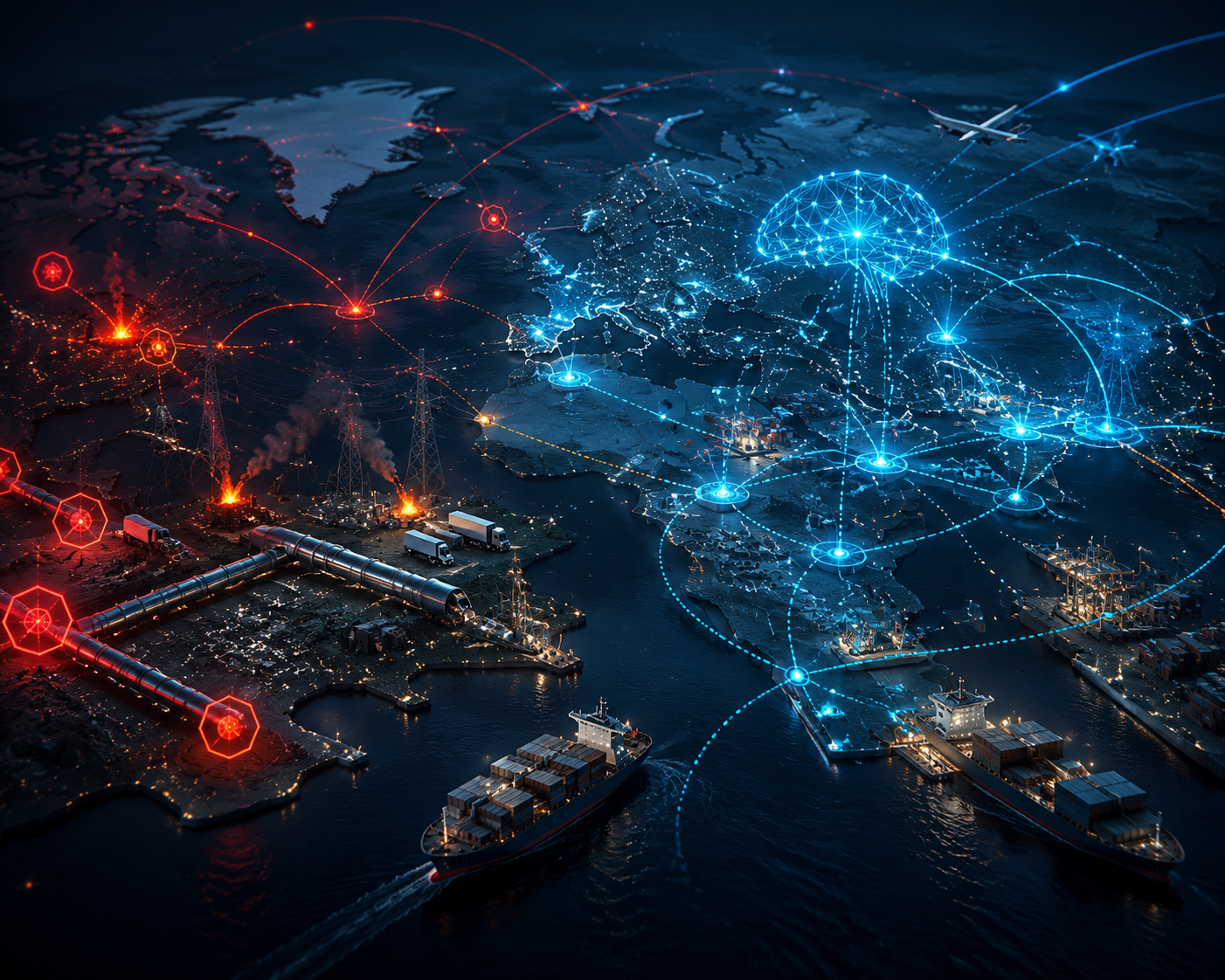
AI is useful here only if it changes the operating sequence. A conventional disruption response often starts when a shipment is late, a supplier misses a commit, a carrier cancels capacity, or a site manager reports that production will slip. By then, the planning team is already working from consequences.
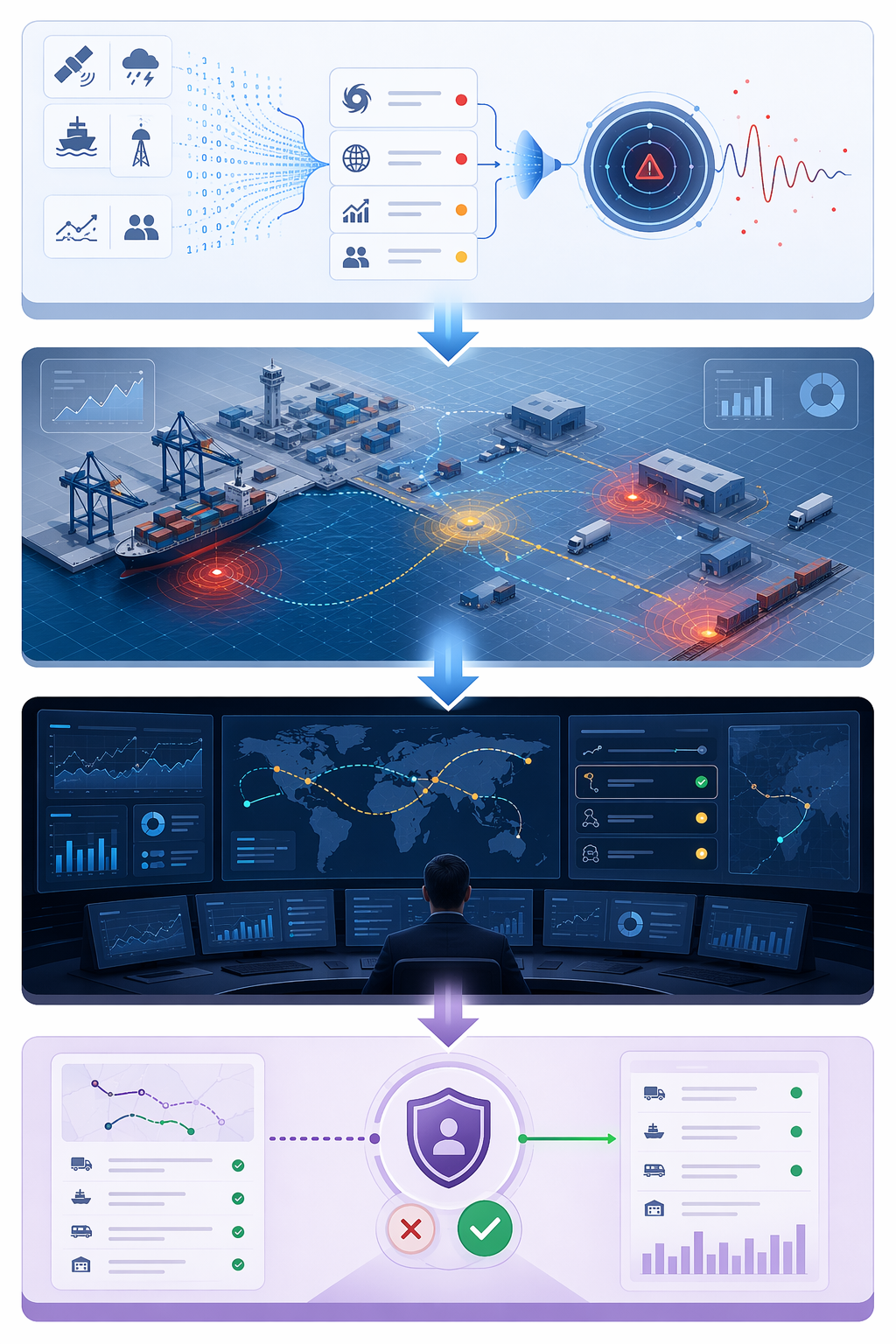
For infrastructure attacks, the better sequence is earlier and more explicit: sense weak signals, model the network impact, recommend constrained actions, execute what is approved, and keep a record of why the decision was made. The distinction matters because a cyber event at a logistics platform, a power issue near a port, or a data center outage supporting order visibility may not first appear as a clean “supply chain disruption.” It may appear as missing scans, inconsistent ETAs, duplicate system alerts, frozen booking flows, or a sudden loss of confidence in capacity data.
| Planning layer | What it changes | What leaders should evaluate |
|---|---|---|
| Early warning | Moves detection upstream of missed orders and delayed shipments | Source diversity, anomaly logic, false-positive handling, escalation rules |
| Digital twin stress-testing | Turns a warning into quantified exposure across lanes, sites, inventory, and service | Scenario library, constraint modeling, refresh cadence, assumptions |
| Cognitive control tower | Converts scenarios into next-best actions for routing, allocation, and supplier response | Recommendation quality, execution integration, audit trail, override design |
| Human-in-the-loop governance | Defines who can approve, stop, reverse, or limit automated action | Approval thresholds, model monitoring, security controls, accountability |
That is the practical frame. Not “AI for resilience” in the abstract, and not a promise that automation will make infrastructure risk manageable by itself. The test is whether the system shortens the distance between signal, scenario, decision, and execution without hiding who is accountable for the result.
Early Warning Before the Disruption Looks Like a Shipment Problem
In a clean planning environment, teams would know that a critical infrastructure attack is relevant before the ERP, TMS, WMS, or supplier portal begins producing bad answers. In real operations, signals arrive unevenly. A port operator may issue a limited notice. A carrier may stop accepting bookings on a lane. A pipeline incident may affect fuel availability before it affects pickup performance. A data center disruption may make inventory visibility unreliable before inventory is actually unavailable.
AI-powered early warning systems help when they do more than aggregate news. The useful version combines risk feeds, logistics milestones, weather and physical infrastructure alerts where relevant, supplier status, cyber incident indicators, carrier behavior, and internal transaction anomalies. The model is not trying to “know” the whole attack. It is trying to identify that the pattern around a node no longer matches normal operating behavior.
That distinction is important. If a regional logistics platform is compromised, the first planning variable may be confidence in ETA data, not confirmed capacity loss. If a power node fails near a port, the first variable may be container dwell or crane availability, not production supply. If a data center supporting order orchestration is impaired, the first variable may be which orders are visible enough to promise. A good early warning layer tags those variables so planners can move from “something happened” to “these parts of the plan are now suspect.”
False positives still matter. A system that alerts on every anomaly will recreate the worst version of an incident room: too many screens, too many unranked warnings, and no basis for action. Evaluation should focus on whether alerts are tied to planning consequences: affected nodes, dependent lanes, constrained inventory, customer commitments, supplier promises, and decision deadlines.
This is also where third-party exposure becomes part of the planning problem. Xeneta reported in February 2026 that 35.5% of data breaches originate from third-party compromises, and that 46% of UK organizations experienced at least two supply chain cyber incidents in the prior year.[3] Those figures are not specific to infrastructure attacks alone, but they reinforce why early warning cannot stop at owned facilities. The planning perimeter includes vendors, platforms, carriers, and technology dependencies that may not sit inside the formal supply chain map.
The Digital Twin Is Where a Warning Becomes a Decision
The most common failure after early warning is a familiar one: everyone agrees that a node is at risk, but nobody can agree quickly enough on the size of the exposure. Procurement sees supplier risk. Logistics sees lane risk. Sales sees customer promise risk. Finance sees margin and expedite risk. IT may still be determining whether the data is trustworthy. The digital twin earns its place only if it gives those teams a shared operating picture before the meeting becomes a debate over whose spreadsheet is current.
For infrastructure-attack planning, a digital twin should model how failure at a physical or digital node changes feasible flow. That can include port throughput reduction, route closures, fuel or pipeline constraints, site power loss, warehouse labor displacement, loss of booking functionality, degraded supplier communication, or unreliable order visibility. The model does not need to be perfect to be useful. It needs to show which assumptions drive the decision.
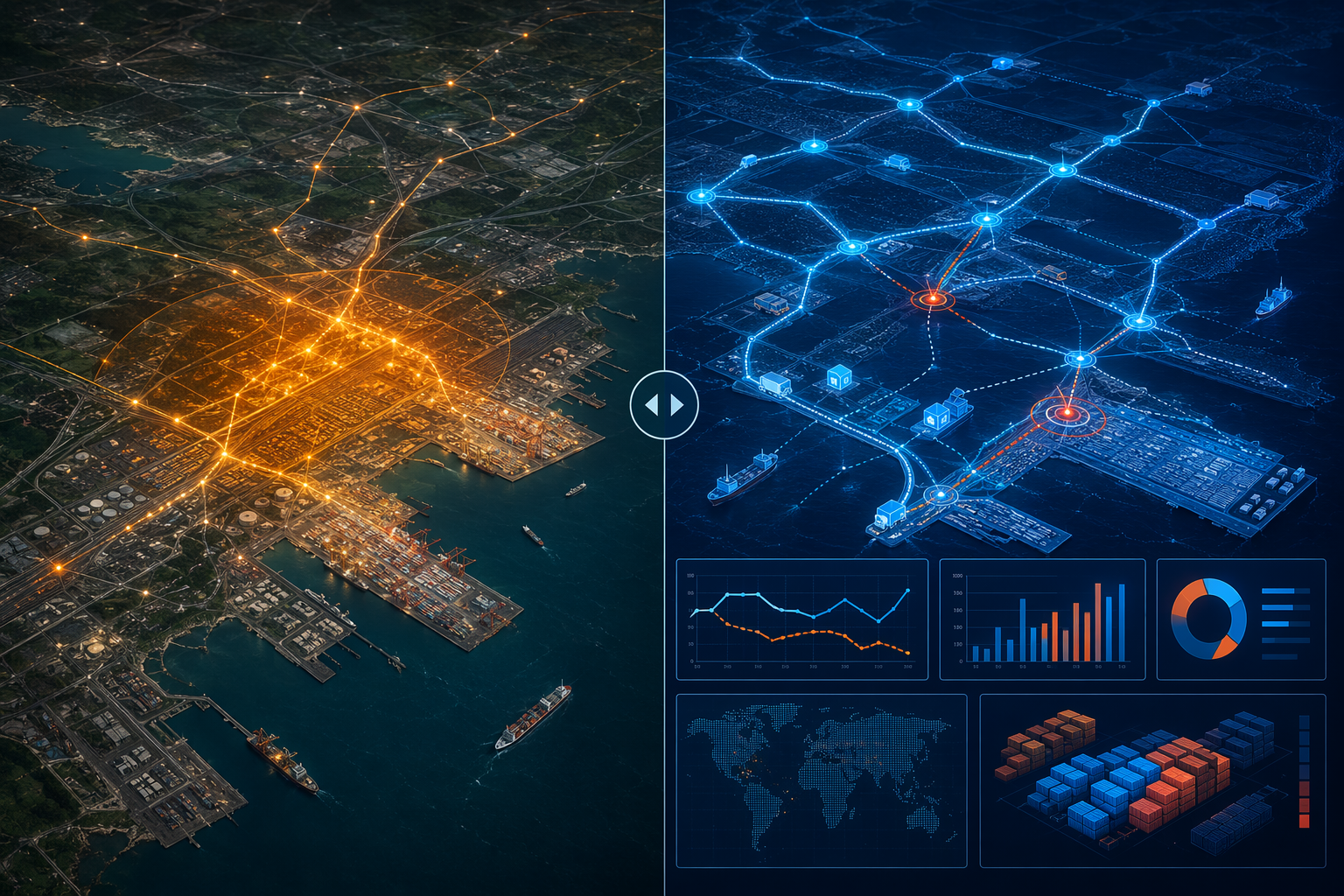
A practical stress test starts with a constrained question. If a port node loses throughput for a defined period, which inbound materials miss production windows? If a data center outage makes order status unreliable, which customer allocation decisions should pause until confirmation? If a logistics platform cannot be trusted, which carriers can accept manual tendering and which lanes become invisible? If power disruption reduces warehouse capacity, which orders must be sequenced first because delay creates the largest downstream penalty?
The better models also show second-order consequences. A reroute may protect one plant while consuming scarce drayage capacity needed by another. A supplier allocation choice may preserve near-term production while creating a contractual failure elsewhere. An emergency mode in one warehouse may clear priority orders but break cold-chain, hazardous, or regulated handling assumptions. Infrastructure attacks are rarely tidy single-node failures; they disturb the rules that planners use to trust the network.
This is where generic scenario libraries are not enough. A digital twin for this work needs the company’s own constraints: approved alternates, qualified suppliers, lane capacities, site dependencies, inventory policies, minimum order quantities, customer service rules, and finance thresholds. Otherwise the model produces theoretical resilience instead of executable options.
The value case for AI-enabled supply chain management is real but should be read carefully. The World Economic Forum reported in January 2025 that early adopters reduced logistics costs by 15% and improved inventory levels by 35%.[4] Those are broad AI-enabled supply chain outcomes, not proof that a company will achieve the same gains during an infrastructure attack. For disruption planning, the more defensible claim is narrower: better simulation can reduce blind decisions, expose bad assumptions earlier, and help teams choose between imperfect options with a clearer view of trade-offs.
Control Towers Need to Move From Visibility to Action
Many control towers were sold as visibility layers. Visibility is helpful, but during an infrastructure attack it is not the same as response. A dashboard that confirms late containers, unavailable lanes, or missing carrier updates still leaves a planner to build the option set manually. That may be acceptable in a slow-moving shortage. It is weak protection when the affected node is part of a digital or physical infrastructure network.
The more useful cognitive control tower does three things in sequence. It ingests the early warning signal, runs the scenario or retrieves an already rehearsed one, and recommends a next-best action that respects known constraints. ABI Research describes cognitive control towers as enabling next-best-action recommendations and route stress-testing, and its 2026 work found that 65% of supply chain professionals consider AI or GenAI capabilities important or very important for technology purchase decisions.[5]
That does not mean the tool should be allowed to rewrite the plan without boundaries. A next-best-action recommendation might suggest moving volume from one port to another, switching from ocean to air for a narrow order class, reallocating constrained inventory to higher-penalty customers, pulling forward a supplier shipment, or freezing lower-priority orders until data quality is restored. Each action has a different risk profile. Some are reversible. Some are expensive. Some change customer commitments. Some create compliance exposure.
This is why integration quality matters more than interface polish. If the control tower recommends rerouting but cannot trigger a tender, update allocation rules, notify procurement, or flag finance for expedite approval, the planner still becomes the middleware. If it can execute but cannot show which constraint or assumption drove the action, the organization has simply moved the blind spot into software.
Internal maturity also matters. A company that is still reconciling shipment status across duplicate spreadsheets should not start by authorizing broad autonomous execution. It may need a narrower first move: automated exposure mapping, recommended reroutes, exception prioritization, or scenario comparison. For a deeper taxonomy of control tower models, see ChainSignal’s internal guide to control tower ROI and the companion explainer on supply chain control tower AI.
Agentic AI Is the Trajectory, Not a Blanket Permission Slip
Gartner predicted in March 2026 that 60% of supply chain disruptions will be resolved without human intervention by 2031, and also reported that 55% of supply chain leaders expect agentic AI to be the most influential driver of future performance.[6] That forecast deserves attention because it points to a real direction of travel: systems that do not just notify and recommend, but initiate bounded actions across planning and execution workflows.
It should not be mistaken for a description of the typical 2026 operating state. In most organizations, the credible near-term use of agentic AI is narrower: monitor specific disruption classes, retrieve applicable playbooks, run approved simulations, draft action options, prepare communications, trigger low-risk workflow steps, and escalate higher-risk decisions to named approvers. That is still valuable. It removes minutes and hours from the cycle without pretending that every supply chain consequence can be delegated.
The approval boundary should be designed by consequence, not by enthusiasm for automation. An AI agent might be allowed to request updated carrier capacity, generate alternate lane comparisons, or hold a noncritical replenishment recommendation for review. It may need explicit approval before changing customer allocation, selecting an unplanned supplier, authorizing premium freight, or changing production sequencing. The point is not to keep a human in every click. The point is to keep accountability attached to the decisions that can materially harm service, cost, safety, or compliance.
A useful evaluation question is simple: if the AI recommendation is wrong at 2:00 a.m., who can see it, stop it, explain it, and recover from it? If the answer depends on a superuser remembering how the model was configured six months ago, the organization is not ready for autonomous disruption resolution.
The Governance Layer Is Part of the Planning Architecture
The moment AI starts shaping disruption response, it also becomes part of the risk surface. CSET Georgetown’s October 2024 workshop report identifies three vulnerability classes for AI and critical infrastructure: attacks using AI, attacks targeting AI systems, and AI design or implementation failures.[7] Those categories map uncomfortably well to supply chain planning.
An attacker could use AI to scale reconnaissance or social engineering against suppliers and logistics partners. An attacker could target the AI planning layer itself by corrupting inputs, manipulating model behavior, or exploiting integrations. Or the organization could create its own failure through a poorly tested model that recommends infeasible routes, over-trusts stale inventory, or suppresses a signal because past training data did not include the current failure mode.
DHS and CISA’s critical infrastructure AI guidance, summarized by IBM in April 2024, groups AI risk into three categories and incorporates the NIST AI Risk Management Framework functions: Govern, Map, Measure, and Manage.[8] For supply chain leaders, those functions should not stay in a policy document. They translate into operating questions.
- Govern: who owns the AI disruption-planning policy, approval thresholds, exceptions, and audit trail?
- Map: which planning decisions, infrastructure dependencies, data feeds, suppliers, and execution systems does the AI touch?
- Measure: how are model accuracy, recommendation quality, false positives, false negatives, and data quality monitored during normal operations and exercises?
- Manage: what happens when the model is degraded, attacked, contradicted by operators, or no longer aligned with current constraints?
The AI supply chain itself also needs attention. NSA guidance issued in March 2026, as described by NeuralTrust and other secondary sources, warned about AI supply chain risks including hidden backdoors, manipulation, and evasion threats.[9] Because the primary guidance was not directly available in the research set, the safest use of that point is limited: supply chain teams should treat AI vendors, models, training data, plug-ins, and integrations as part of the dependency map rather than as a neutral overlay.
Governance also has to be rehearsed. A tabletop exercise that only asks whether people know the escalation tree is not enough. Teams need to test whether the early warning layer flags the right dependency, whether the digital twin produces an executable scenario, whether the control tower recommendation respects real constraints, and whether human approvers understand the consequence of accepting, rejecting, or modifying the action.
A Readiness Test for Infrastructure-Attack Planning
The most useful readiness test is not whether the organization has bought an AI platform. It is whether a planner can answer a specific infrastructure-attack scenario with a time-stamped, auditable decision path.
- Signal: can the system detect that a port, pipeline, power node, data center, logistics platform, or critical vendor is behaving abnormally before the impact appears only as late orders?
- Exposure: can the team see which products, sites, lanes, suppliers, customers, and inventory positions depend on the affected infrastructure?
- Scenario: can the digital twin stress-test constrained alternatives without relying on assumptions that nobody has validated?
- Action: can the control tower recommend options that procurement, logistics, warehouse, customer service, IT, and finance can actually execute?
- Authority: are approval rights clear for reversible actions, expensive actions, customer-impacting actions, and safety- or compliance-sensitive actions?
- Recovery: if the recommendation is wrong or the AI layer is compromised, can the organization stop, roll back, and explain what happened?
This is where budget discussions should become more disciplined. Funding only the sensing layer creates smarter alerts without decisions. Funding only a digital twin creates elegant simulations that may not reach execution. Funding only a control tower risks automating bad assumptions. Funding governance after the fact leaves teams debating accountability while the network is already moving.
AI is not a single defensive product against infrastructure attacks. It is a planning architecture. It works when sensing, simulation, control tower execution, and accountable human oversight are designed together. Most organizations are not there yet, which is exactly why the preparedness gap matters more than the threat chart.
References
- Are You Prepared for the Supply Chain Disruptions of 2026?, Everstream Analytics
- Supply chain AI trends 2026, Dataiku, February 2026
- The Biggest Supply Chain Risks of 2026, Xeneta, February 2026
- AI will protect global supply chains from the next major shock, World Economic Forum, January 2025
- Supply Chain Disruptions 2026: How to Build Resilience with AI and Automation, ABI Research, 2026
- Gartner Predicts 60% of Supply Chain Disruptions Will Be Resolved Without Human Intervention by 2031, Gartner, March 2026
- Securing Critical Infrastructure in the Age of AI, CSET Georgetown, October 2024
- Inside the DHS's AI security guidelines for critical infrastructure, IBM, April 2024
- AI-Driven Supply Chain Attacks, NeuralTrust
Comments
Join the discussion with an anonymous comment.