
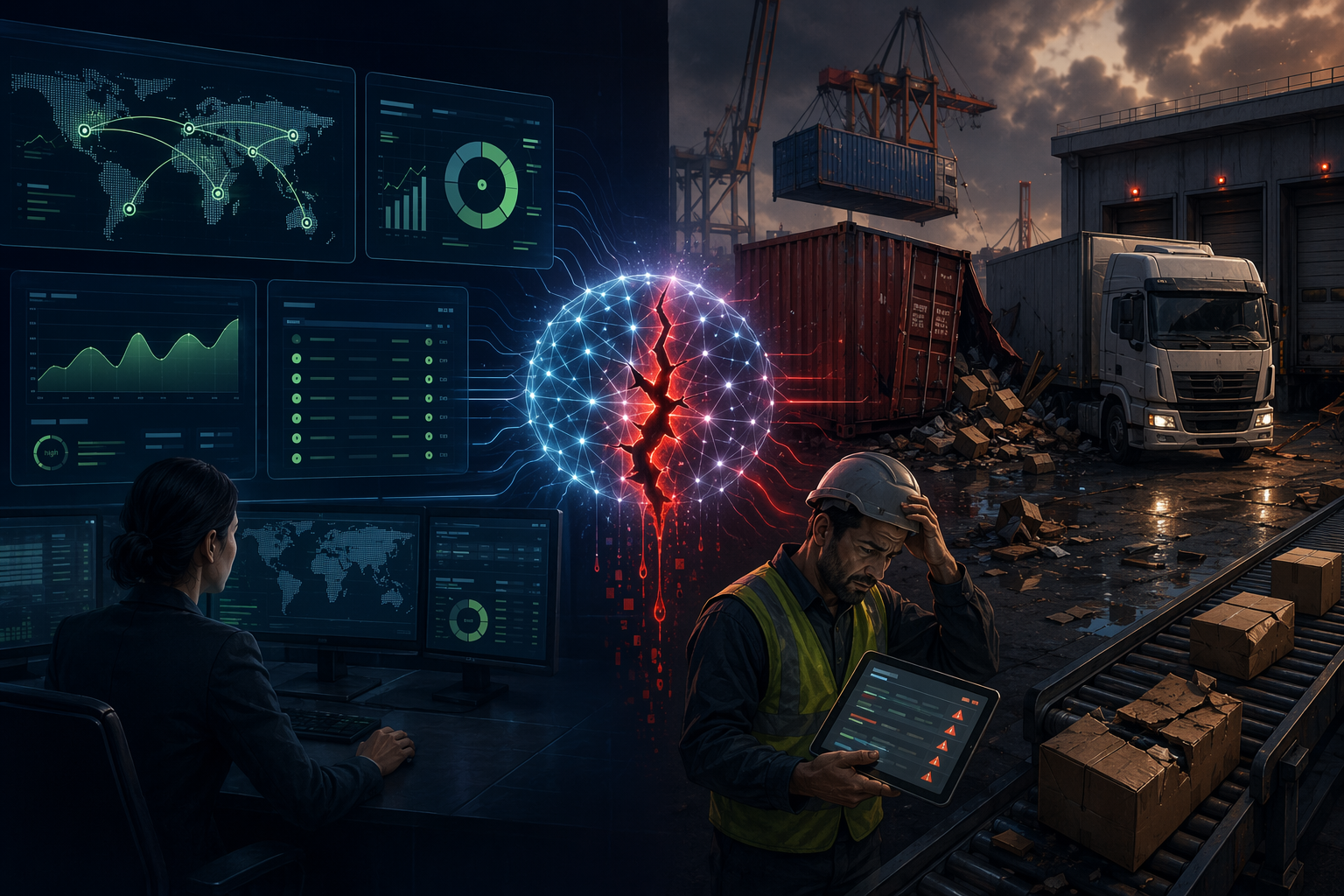
The first visible sign of an AI model breach in a supply chain may not be a ransom note, a locked screen, or a public leak. It may be a replenishment plan that still looks mathematically clean while moving inventory to the wrong place. It may be a supplier-risk score that quietly clears a vendor no buyer would have approved after a manual review. It may be a logistics dashboard showing normal integrations while warehouse counts, routing instructions, and shipment status have already drifted apart.
That is the practical problem supply chain leaders need to assess. The breach does not only expose information. It can corrupt the decision layer that tells planners what to buy, procurement teams whom to trust, and logistics teams where product should move next. If the model keeps producing confident outputs, the organization may continue operating as if the system is healthy while the work downstream becomes more expensive, slower, and harder to unwind.
The cost benchmark is already uncomfortable, even before isolating AI-model-only events. IBM’s 2025 Cost of a Data Breach Report puts supply chain compromises at an average cost of $4.91 million and a 267-day identification-and-containment lifecycle, the longest lifecycle among breach vectors in the report.[1] IBM also reports that 30% of incidents involving AI models and applications stem from supply chain compromise.[1] Those are not clean proof that every breached supply chain AI model costs $4.91 million. They are a warning that the surrounding breach category is already expensive, slow, and increasingly entangled with AI systems.
Verizon’s 2025 Data Breach Investigations Report adds the third-party pressure point: third-party involvement in breaches doubled from 15% to 30% in one year, the largest single-year shift in the report’s history.[2] For supply chain leaders, that matters because the systems using AI for forecasts, vendor qualification, transport planning, document intake, and exception handling are rarely cleanly internal. They sit on SaaS platforms, model APIs, open-source components, vendor data feeds, and implementation partners.
What Breaks First Is Usually a Decision
A conventional breach investigation often starts with access: which account, which system, which data store. In a breached supply chain AI workflow, the more urgent operating question is narrower: which decisions did the compromised system influence while everyone still trusted it?
A forecast model does not need to delete data to cause damage. It can overweight the wrong signal. A procurement model does not need to create a fake purchase order by itself. It can lower the friction for a bad supplier to pass screening. A logistics AI tool does not need to own every warehouse process. It can poison inventory status or routing recommendations enough that operators spend days reconciling what the system says against what is physically on the dock.
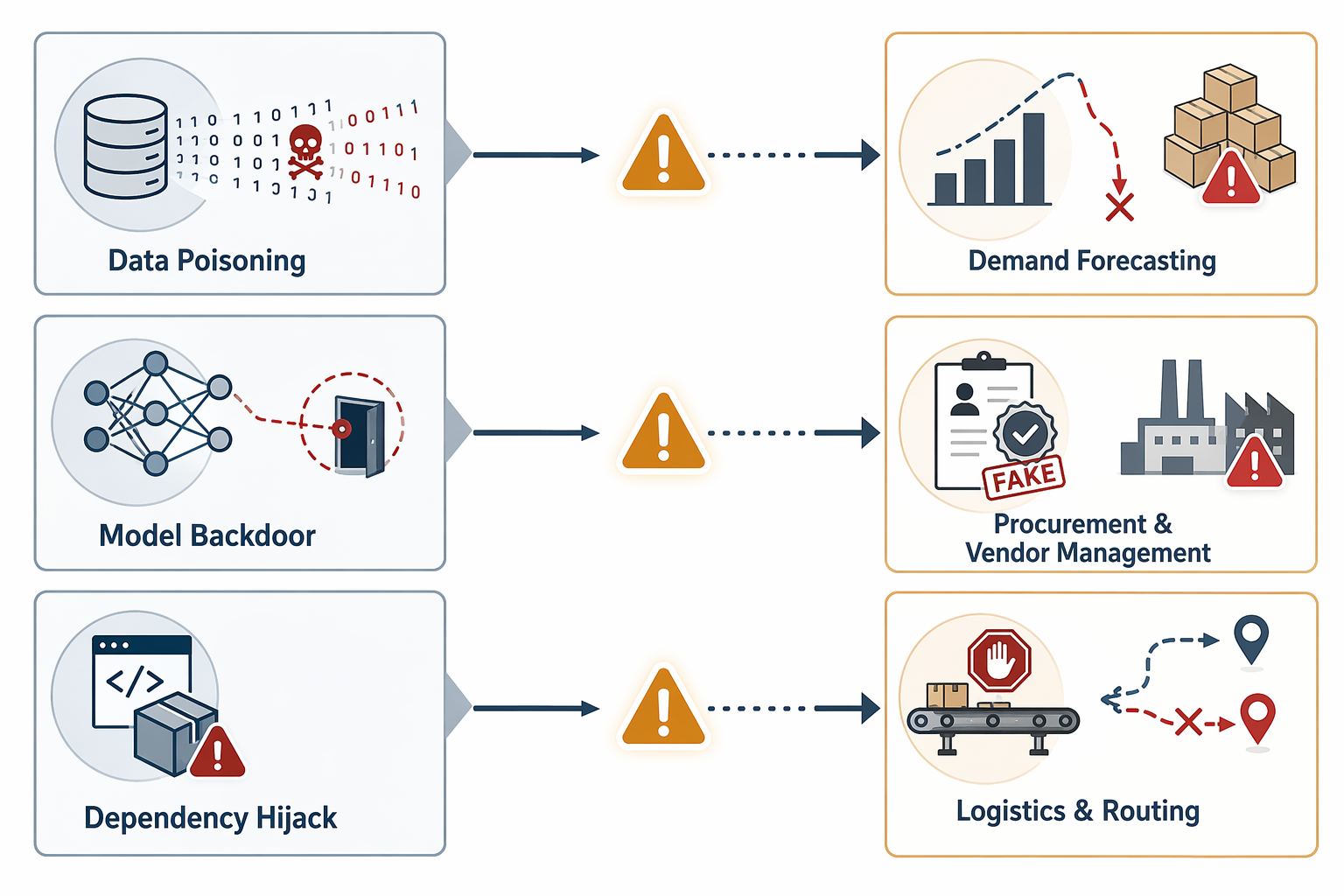
| Breach manifestation | Supply chain function exposed | Operational failure mode | Evidence boundary |
|---|---|---|---|
| Data poisoning | Demand forecasting and replenishment | Forecasts drift, inventory positioning becomes unreliable, planners chase exceptions after the planning run has already shaped orders | Controlled research shows very small training-data manipulation can succeed; it is not a production benchmark |
| Model backdoor | Procurement and vendor management | Supplier approvals, cost-risk signals, or vendor-risk scoring can be distorted without looking like a system outage | Public evidence supports model backdooring as an active risk; documented procurement-specific breach frequency is still limited |
| Dependency hijack or compromised SaaS | Logistics, warehouse, and fulfillment systems | Shipments halt, inventory data corrupts, fulfillment delays compound across customers or regions | The clearest cascade account comes from NeuralTrust and should be attributed to that source |
This is why “data was exposed” is too small a frame. The exposed data may be serious. But in an AI-enabled supply chain, the damaged asset may also be the judgment engine embedded in daily work: the forecast, approval, routing, prioritization, matching, or exception recommendation that people have learned to trust.
Demand Forecasting: Small Poisoning, Large Planning Noise
Demand planning is an easy place to underestimate breach impact because the failure can look like normal volatility. Forecasts are already probabilistic. Promotions, weather, customer behavior, channel shifts, and supplier constraints all create noise. A poisoned model can hide inside that noise long enough for the planning cycle to convert bad signals into purchase orders, allocation decisions, and inventory transfers.
The most useful evidence here is not that every production demand model can be corrupted with a trivial change. The useful evidence is that microscopic training-data manipulation is technically plausible. CMU Software Engineering Institute, citing Carlini et al.’s USENIX Security 2021 work, notes that an attacker needed to alter only 0.1% of training data to achieve a successful data poisoning attack in a controlled academic setting.[3] That figure should not be treated as a universal attack threshold. It does explain why chain-of-custody for training data is not a paperwork concern once forecasts influence physical inventory.
In a planning workflow, the delay between corruption and consequence is part of the damage. A bad forecast can pass through demand review, supply planning, procurement release, supplier confirmation, and warehouse scheduling before anyone sees the mismatch physically. By then, the correction is not a model retrain alone. Teams may need to freeze part of the plan, compare model output against historical baselines, review manual overrides, expedite constrained items, and explain to commercial teams why the system that looked stable produced the wrong operating answer.
That is also where AI forecasting gains become fragile. Leaders adopt these tools because better forecasts can improve planning discipline; a poisoned model attacks the same dependency. For a separate discussion of the accuracy expectations companies bring into these deployments, see AI demand forecasting accuracy benchmarks. The breach risk is not that forecasting becomes useless. It is that the organization may keep using the forecast after its input history, training set, or model behavior has stopped representing the business.
Procurement: The Approval Is the Payload
Procurement AI risk is often discussed as vendor due diligence, but the sharper breach scenario is decision integrity. A compromised model used in supplier onboarding, spend analytics, contract review, or vendor-risk scoring does not have to steal the supplier master to create operating damage. It can make the wrong supplier look acceptable, bury a cost anomaly, or soften the risk score attached to a third party that should trigger additional review.
This is where the third-party breach trend becomes operational. If breach involvement through third parties is rising, procurement is not only a stakeholder in cyber due diligence; it is a function whose own AI-assisted decisions can become part of the attack path.[2] The evidence does not support claiming that fraudulent supplier approvals through poisoned procurement models are already a widely documented public pattern. It does support treating the scenario as credible when procurement workflows rely on external data, vendor portals, model APIs, and automated scoring.
The failure mode is awkward because normal controls may appear to work. The supplier has a profile. Required fields are complete. The model’s explanation sounds businesslike. The score clears the threshold. No one may notice until a shipment fails, an invoice exception appears, a quality issue surfaces, or an internal reviewer asks why a known risk signal was discounted.
Supplier approval is also hard to repair after the fact. If a bad vendor entered the network through a compromised scoring process, the recovery path may include revalidating supplier records, checking contracts and purchase orders influenced by the model, reviewing payment instructions, retesting onboarding controls, and deciding which approvals need human reauthorization. That is slower than revoking an account because the damage is mixed into ordinary procurement work.
AI vendor due diligence therefore needs to reach beyond security questionnaires and uptime language. The buyer needs to know what model version made a recommendation, which external data influenced it, what changed before and after a vendor was approved, and how quickly the organization can reconstruct those decisions if the model is later found to be compromised. For the procurement side of AI vendor exposure, see AI vendor capex risks and supply chain adoption.
Logistics: When a Compromised Platform Becomes a Physical Bottleneck
Logistics is where the breach stops sounding abstract. Trucks wait. Orders miss windows. Warehouse teams reconcile counts by hand. Customer service starts giving answers before operations has finished proving which records are true.
The clearest published cascade comes from NeuralTrust’s account of an early 2025 poisoned logistics SaaS platform. NeuralTrust says the compromise disrupted operations for more than 500 global retailers, halted shipments, corrupted inventory data, delayed order fulfillment for weeks, and exposed customer payment details and vendor credentials.[4] The same account describes the pattern as “SolarWinds-like cascading impact” attributed to CISA.[4] Because affected-company statements or primary CISA incident materials are not available here, the incident should be treated as NeuralTrust’s published account rather than independently verified public case evidence.
Even with that attribution guardrail, the pattern is exactly the one supply chain teams should test against. A shared platform sits between retailers, warehouses, carriers, and vendor records. It does not need to own the whole enterprise to create a systemwide scramble. If it corrupts inventory data, downstream processes inherit false availability. If it halts shipments, exceptions pile up faster than teams can manually prioritize them. If credentials are exposed, the containment plan has to cover partners and vendors as well as internal users.
This is where traditional incident response can feel misaligned with operations. Security may contain the compromised platform, rotate credentials, and block known malicious access. Operations still has to answer different questions: which orders were released from bad inventory records, which loads were stopped or misrouted, which customers were promised product that was never available, and which warehouse balances can be trusted now.
The operational recovery work is not secondary. It is the recovery. Until inventory records, routing instructions, order status, and partner credentials are reconciled, the business is not back to normal just because the compromised system is offline or patched.
How the Breach Enters the Stack
Supply chain AI compromise rarely needs a dramatic front door. It can enter through training data, a third-party model, an open-source dependency, a SaaS workflow, a model package, or an AI agent connected to procurement and logistics tools. OWASP’s Generative AI Security Project now treats supply chain risk as a dedicated category, LLM03, covering poisoned training data, compromised third-party models, and vulnerable open-source dependencies.[5] That classification matters because it places AI supply chain compromise inside the normal risk vocabulary, not outside it as a novelty.
The open-source dependency channel is already noisy. Sonatype’s 2026 State of the Software Supply Chain Report reports more than 454,600 malicious packages in 2025 across ecosystems including npm, PyPI, Maven, NuGet, and Hugging Face, a 75% year-over-year increase.[6] Not all of those packages target supply chain planning tools, and not every malicious package is an AI model breach. But AI-enabled supply chain platforms depend on the same software supply chain, and their model integrations add another place where a poisoned or malicious component can influence operational decisions.
Model-weight backdooring is not theoretical either. JFrog Security Research reported more than 100 malicious Hugging Face models in 2024 that established reverse shells on load, according to cited secondary sources.[7] That finding does not prove a logistics or procurement platform was breached through those exact models. It shows that a model artifact can behave like executable attack infrastructure, which is the point many operating teams miss when they treat model files as passive analytics assets.
For supply chain leaders, the technical distinctions matter only to the extent that they change controls. Data poisoning pushes attention toward provenance and chain-of-custody for training and feedback data. Backdoored models push attention toward model source, scanning, sandboxing, and version approval. Dependency hijack pushes attention toward software composition, package governance, and vendor integration review. AI agents connected to procurement or logistics tools raise a containment problem: if an agent can take actions, not just recommend them, a compromised instruction path can move from bad advice to bad execution. For more on containment in supply chain AI contexts, see what the OpenAI containment failure means for supply chain AI security.
A useful internal review should therefore ask where models or AI components sit in the actual workflow, not just where they sit in the architecture diagram. The question is not “Do we use AI?” It is “Which operational decisions would become suspect if this model, dependency, or SaaS integration were compromised for several weeks?”
Why Detection Takes So Long
IBM’s 267-day lifecycle for supply chain compromises is especially troubling because AI model breaches can preserve the appearance of normal operation.[1] A system that crashes gets attention. A model that continues producing plausible recommendations may only generate friction: more expedites, more planner overrides, more supplier exceptions, more warehouse adjustments, more carrier escalations.
Those are weak security signals but strong operational signals. Demand planners may see forecast bias before security sees an intrusion. Procurement managers may see odd supplier approvals before a SIEM alert connects the pattern. Warehouse operators may know the inventory feed is wrong before anyone identifies the SaaS compromise. If incident response waits only for technical indicators, the business can spend weeks treating breach symptoms as process failures.
This is why the investigation plan needs operational telemetry beside security telemetry. Forecast error by product family, override rates, vendor-risk score distribution, sudden changes in supplier approval velocity, inventory adjustment spikes, routing exception volume, and unexplained fulfillment delays can all help identify whether the model’s outputs still match the business. None of these metrics proves a breach by itself. Together, they can shorten the time between “operations feels wrong” and “the decision system may be compromised.”
The investigation also has to preserve decision history. If the organization cannot reconstruct which model version produced which recommendation from which data at which time, it cannot easily determine what needs to be reversed. That is the gap between system recovery and operational recovery. The former asks whether access has been contained. The latter asks which decisions are still contaminated.
For teams already using AI to accelerate breach investigation, the useful benchmark is not only faster technical triage. It is whether investigation speed carries through to planning, procurement, and logistics remediation. ChainSignal’s related piece on how AI cuts supply chain IT breach investigation from weeks to hours covers the detection lifecycle angle in more detail.
The Cost Is in the Rework
The $4.91 million average cost figure for supply chain compromises is not an AI-model-only loss estimate.[1] Treating it that way would overstate the evidence. Still, the number is useful because it frames the kind of cost structure supply chain compromise creates: investigation, containment, partner coordination, operational disruption, customer response, and remediation across interconnected systems.
AI model breaches add a particular kind of rework. A stolen database can be scoped around records. A compromised model forces the company to scope decisions. Which forecasts were influenced? Which purchase orders followed those forecasts? Which supplier approvals relied on the bad score? Which shipments were routed from corrupted inventory data? Which downstream systems accepted the output as truth?
That decision audit consumes the same people needed to keep the supply chain running. Planners stop planning and start validating. Buyers stop negotiating and start rechecking approvals. Logistics teams stop optimizing and start reconciling shipment reality against system records. IT and security may own containment, but operations bears much of the labor cost because operations has to make the business safe to run again.
The NeuralTrust MedTech account shows a more severe version of decision corruption, though it sits outside ordinary retail or industrial planning. NeuralTrust says a manufacturer’s AI model for verifying firmware updates was poisoned, inserting hidden backdoors into insulin pumps and pacemakers that could be remotely activated and forcing a recall of multiple thousands of devices.[4] As with the logistics SaaS account, independent affected-company or regulator documentation is not available here. The case is still useful as a boundary marker: when AI verification systems are compromised, the output can become a physical safety and recall problem, not just an IT problem.
Most supply chain AI deployments will not face that exact device scenario. But the underlying repair burden is familiar. Once a trusted decision process is suspect, teams must decide how far back to review, which transactions to freeze, which partners to notify, and which work can safely continue while the model is being isolated or rebuilt.
Assess the Breach by Decision Integrity
A supply chain AI breach assessment should start with the operating decisions the model touches. The useful questions are direct:
- Which planning, procurement, logistics, quality, or fulfillment decisions used the model output?
- Which data sources, vendor feeds, model versions, and dependencies influenced those outputs?
- What changed in forecast error, override rates, supplier approvals, inventory adjustments, or shipment exceptions during the suspected window?
- Which decisions can be reconstructed from logs, and which require manual sampling or partner confirmation?
- What must be corrected before the process is safe to automate again?
This lens changes the definition of containment. It is not enough to remove the malicious package, rotate credentials, or take the vendor integration offline. The company has to identify the period during which decisions may have been corrupted and then repair the operational consequences. In demand planning, that may mean reverting to a prior model, comparing against baseline forecasts, and reviewing replenishment decisions made during the exposure window. In procurement, it may mean revalidating approvals and vendor-risk exceptions. In logistics, it may mean reconciling warehouse counts, shipment status, routing plans, and partner credentials before normal automation resumes.
That is why AI model breaches are slower and more expensive in supply chain settings than a narrow systems-restored metric suggests. They compromise the layer that converts data into action. Until the business proves those actions are trustworthy again, the breach is still affecting the supply chain.
References
- Cost of a Data Breach Report, IBM, 2025.
- 2025 Data Breach Investigations Report, Verizon, 2025.
- Data Poisoning in AI Models: The Case for Chain-of-Custody Controls, Carnegie Mellon University Software Engineering Institute.
- AI-Driven Supply Chain Attacks, NeuralTrust, September 2025.
- LLM03: Supply Chain, OWASP Gen AI Security Project.
- State of the Software Supply Chain, Sonatype, 2026.
- AI Supply Chain Risks: Lessons from Recent Scares, Questa AI.
Comments
Join the discussion with an anonymous comment.