
The Bifurcation of the AI Logistics Vendor Market
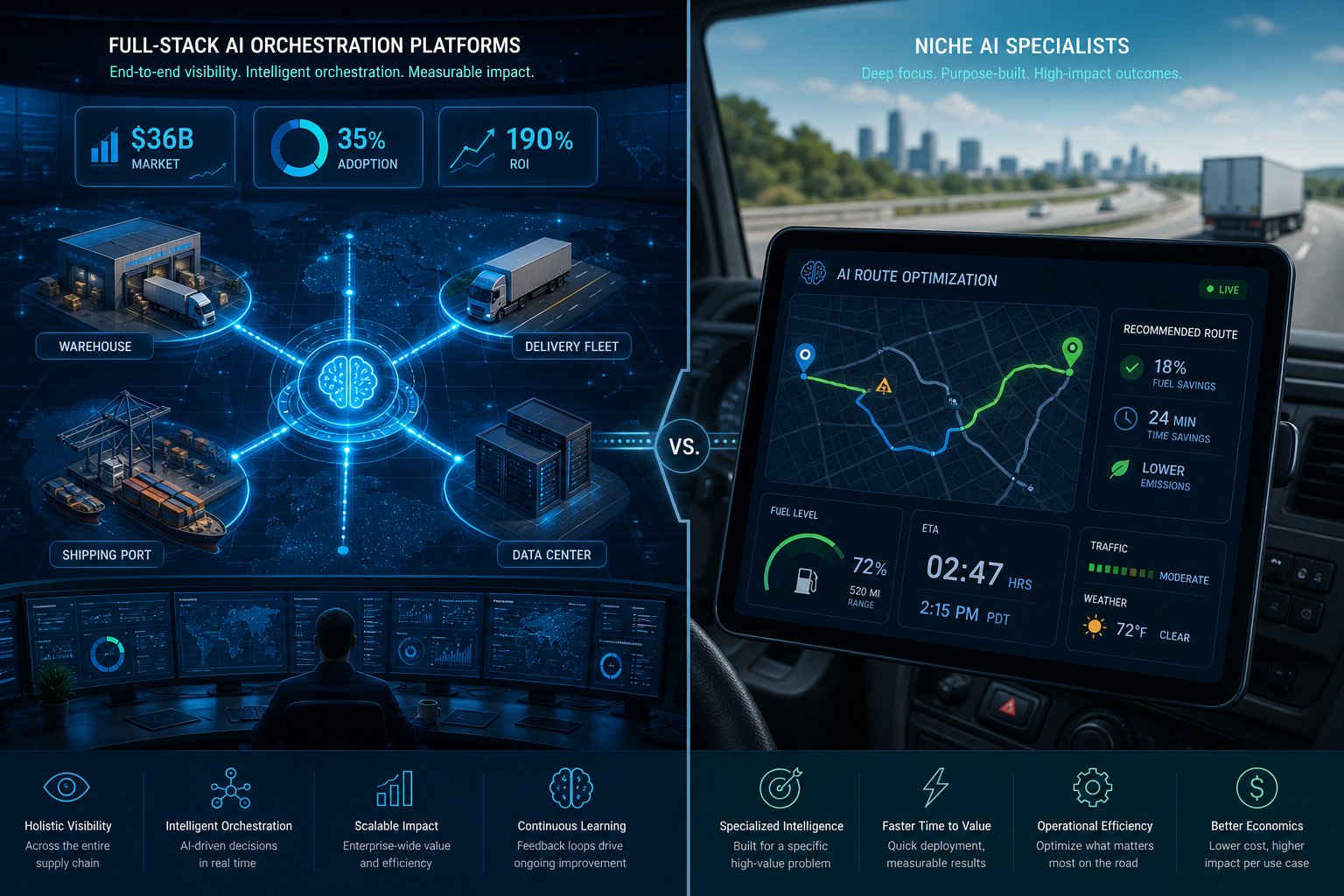
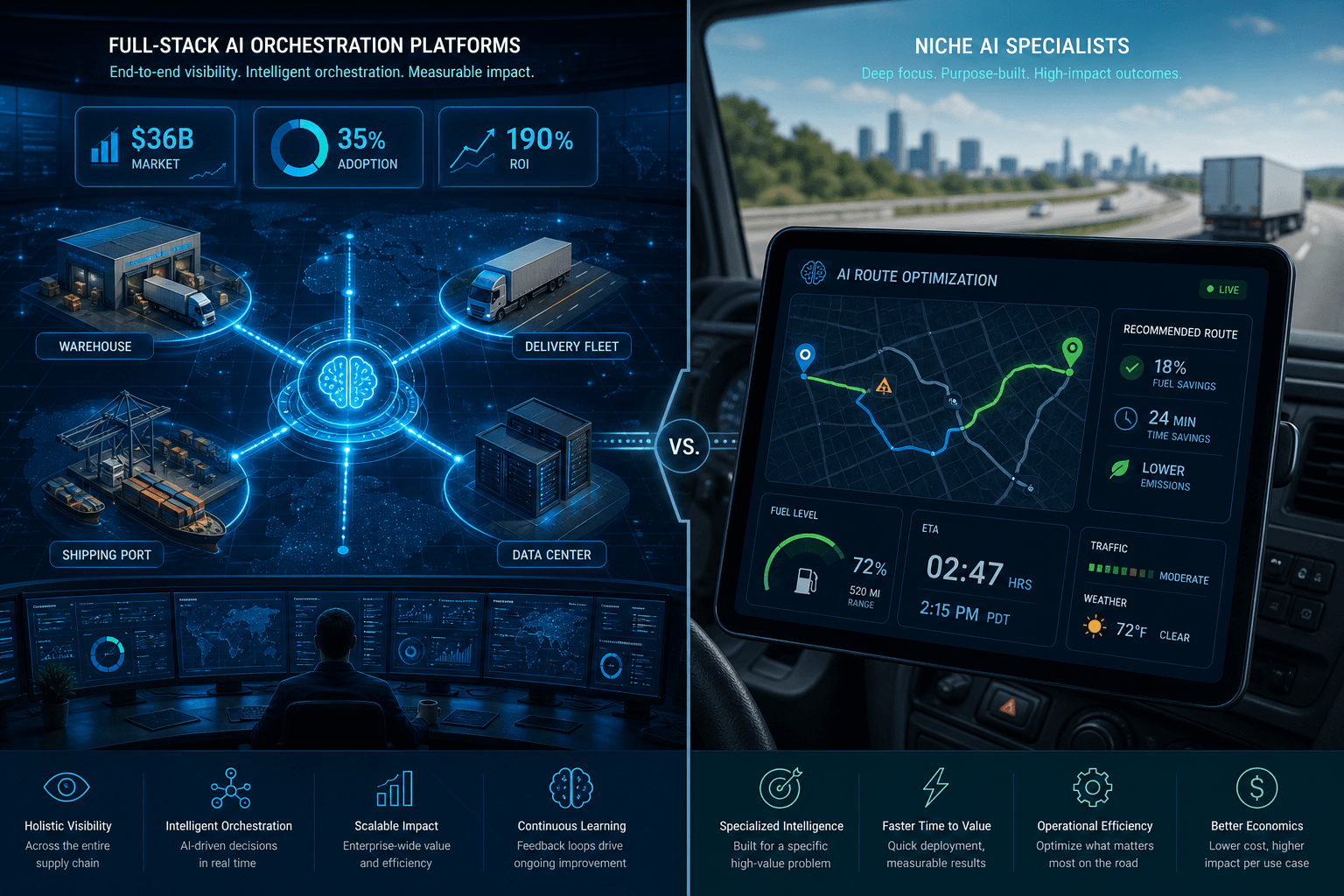
The AI logistics market is no longer a monolith. As of mid-2026, the vendor landscape has split into two fundamentally different models: full-stack orchestration platforms that aim to unify transport, warehouse, and planning under a single AI layer, and niche specialists that deliver deep functional value in a single domain such as routing, fleet analytics, or customs classification. For supply chain leaders conducting active vendor shortlists, understanding which model fits their organization is now the critical first decision — before evaluating any individual product.
The market context makes this bifurcation urgent to address. According to a January 2026 BCG and Alpega survey of more than 180 logistics service provider (LSP) and shipper leaders across Europe, North America, Asia, and the Middle East, over 40% of shippers now consider an LSP's AI capabilities when selecting logistics partners. Yet fewer than 10% view it as mandatory, and only about one in ten LSPs report measurable financial impact from AI. The same survey found that 40% of LSPs have deployed AI beyond pilots, but just 13% report measurable value. Unclear ROI and internal capability gaps — not technology cost — are the top barriers.
Market sizing underscores the scale of the opportunity — and the confusion. Straits Research projects the global AI in logistics market at USD 36.08 billion in 2026, growing to USD 742.03 billion by 2034 at a CAGR of 45.93%. DataM Intelligence, using a different methodology, estimates USD 21.7 billion in 2025 growing to USD 435.6 billion by 2033. The discrepancy reflects genuine disagreement about what counts as "AI in logistics" — a definitional problem that mirrors the vendor bifurcation itself.
The Inbound Logistics 2026 Top 100 list provides a practical validation of the bifurcation. Of the 100 companies selected by the publication's editors, approximately 40+ offer AI-specific capabilities, spanning from full-platform players like Blue Yonder and Oracle SCM to narrow-point solutions like AutoScheduler.AI and Optimal Dynamics. This is not an exhaustive count, but it confirms that the market has already sorted itself into two tiers.
Regional maturity differences add another layer. The BCG survey found that LSPs in Asia-Pacific lead in AI maturity, with 31% embedding AI across core operations, compared to 14% in North America and just 6% in Europe. A buyer in Singapore evaluating an orchestrator platform faces a different readiness landscape than a buyer in Frankfurt considering a routing specialist. The right vendor model depends not only on company size and pain point but also on the regional ecosystem's AI maturity.
Full-Stack Orchestrators: Unified AI Across Transport, Warehouse, and Planning
Full-stack orchestrators aim to replace fragmented point solutions with a single AI layer spanning demand planning, warehouse management, transportation management, and inventory optimization. These platforms are designed for organizations with broad integration needs, multiple functional pain points, and the organizational maturity to manage a multi-year deployment. The orchestrator group includes Deposco, Blue Yonder, Oracle SCM Cloud, SAP IBP, o9 Solutions, and nuVizz.
Deposco
Deposco positions itself as a unified cloud-native platform combining WMS, OMS, planning, and AI intelligence. It claims 90-day implementations and 150+ pre-built integrations, which is unusually fast for an orchestrator. The target buyer is mid-market to upper-mid-market companies that want orchestration capabilities without the 12- to 18-month deployment timelines typical of enterprise-tier platforms. Deposco's architecture is natively unified rather than assembled through acquisitions, which reduces integration complexity at the cost of some functional depth in specialized domains.
Blue Yonder
Blue Yonder (formerly JDA) offers the broadest functional coverage among orchestrators, spanning demand planning, warehouse management, transportation management, and retail planning. Its architecture is acquisition-based, incorporating technologies from multiple purchased companies over the past decade. This gives Blue Yonder deep capabilities in individual domains but requires detailed planning for data integration across modules. The platform is best suited for large enterprises with dedicated IT teams and existing investments in the Blue Yonder ecosystem. Deployment timelines typically range from 6 to 18 months depending on module scope.
Oracle SCM Cloud and SAP IBP
Both Oracle SCM Cloud and SAP IBP are best suited for organizations already embedded in their respective ERP ecosystems. Oracle SCM Cloud evolved through acquisitions and offers strong AI capabilities in demand planning, order management, and transportation. SAP IBP, built on SAP HANA, provides deep planning functionality but is most effective when the organization's transactional data already lives in SAP. For companies outside these ecosystems, the integration overhead can be prohibitive. Both platforms target enterprise buyers and require 12- to 18-month deployment timelines.
o9 Solutions
o9 Solutions differentiates itself through a graph-based digital twin architecture that models the entire supply chain as a connected network rather than a series of siloed functions. This approach is particularly powerful for demand planning and inventory optimization in complex, multi-echelon environments. o9's platform is cloud-native and planning-focused, with less emphasis on warehouse execution or transportation management than Blue Yonder or Oracle. The target buyer is the enterprise planning team that needs integrated demand, supply, and inventory visibility without replacing existing WMS or TMS systems.
nuVizz
nuVizz positions itself as an end-to-end AI logistics platform with a focus on last-mile delivery, route optimization, and real-time visibility. It targets mid-market to enterprise shippers and 3PLs, particularly those with complex last-mile operations. nuVizz operates across North America, Europe, and Asia. Its deployment model is cloud SaaS, and it emphasizes faster time-to-value compared to larger orchestrators, though independent case data is limited.
| Orchestrator | Core Strength | Target Buyer | Deployment Timeline |
|---|---|---|---|
| Deposco | Unified cloud-native WMS/OMS/Planning | Mid-market to upper-mid-market | ~90 days (claimed) |
| Blue Yonder | Broadest functional coverage | Large enterprise | 6–18 months |
| Oracle SCM Cloud | Deep ERP integration | Oracle ecosystem enterprise | 12–18 months |
| SAP IBP | HANA-based planning | SAP ecosystem enterprise | 12–18 months |
| o9 Solutions | Graph-based digital twin planning | Enterprise planning teams | 6–12 months |
| nuVizz | Last-mile and route AI | Mid-market to enterprise 3PLs | 3–6 months |
Niche Specialists: Deep Functional Value in a Single Domain
Niche specialists focus on one functional domain — visibility, trucking AI, warehouse AI, fleet analytics, last-mile delivery, value chain intelligence, or workforce AI — and deliver depth that orchestrators cannot match without significant customization. These vendors are ideal for mid-market operators with a clear, bounded pain point and a preference for faster deployment and lower upfront investment. The specialist group includes FourKites, Optimal Dynamics, Locus, Logiwa, Fleetmanager, Radaro, Altana, Pallet, and Shipwell.
FourKites (Visibility)
FourKites provides real-time supply chain visibility across transportation modes, tracking more than 3 million shipments per day across 6,000+ data points. Its AI layer focuses on predictive ETAs, dynamic rerouting, and anomaly detection. FourKites is a visibility-first platform; it does not manage warehouse operations or demand planning. The target buyer is the logistics operations team that needs to reduce uncertainty in inbound and outbound freight without replacing existing TMS or WMS systems.
Optimal Dynamics (Trucking AI)
Optimal Dynamics offers a decision engine for long-haul freight, using AI to optimize carrier selection, lane assignment, and pricing. Its core differentiator is the application of reinforcement learning to trucking decisions that have traditionally relied on static rules or human dispatchers. The platform is designed for carriers and brokers, not shippers managing multimodal logistics. Deployment is typically 2 to 4 months.
Locus (Enterprise Routing and Dispatch)
Locus provides enterprise-grade AI routing and dispatch optimization, primarily for last-mile and field service operations. Its platform handles dynamic rerouting, driver assignment, and real-time ETA updates. Locus targets large fleets (500+ vehicles) and has documented deployments with major 3PLs and retailers. The platform integrates with existing TMS and WMS systems rather than replacing them.
Logiwa (Warehouse AI)
Logiwa offers AI-powered warehouse and inventory management, focusing on high-volume, multi-channel fulfillment operations. Its AI layer optimizes slotting, pick paths, and inventory allocation. Logiwa is a cloud-native WMS with AI embedded rather than an add-on, making it suitable for mid-market to upper-mid-market operators that need warehouse intelligence without the cost and complexity of enterprise WMS platforms. It operates primarily in the US and Europe.
Fleetmanager (Predictive Fleet Analytics)
Fleetmanager provides predictive fleet analytics, using AI to forecast maintenance needs, optimize vehicle utilization, and reduce fuel consumption. It targets fleet operators with 50 to 500 vehicles, a segment often overlooked by enterprise orchestrators. The platform operates across Europe, Asia, and North America. Deployment is typically 1 to 3 months.
Radaro (Last-Mile Visibility)
Radaro specializes in last-mile delivery visibility and customer communication, providing real-time tracking, ETA predictions, and delivery confirmation. It integrates with existing TMS and WMS platforms rather than replacing them. Radaro operates in Australia, Europe, and North America, and targets mid-market 3PLs and retailers.
Altana (Value Chain Intelligence)
Altana provides a value chain management system that uses AI to map, monitor, and manage global supply chain networks. Its platform ingests data from customs filings, shipping manifests, and corporate registrations to create a dynamic map of supplier, logistics, and customer relationships. Altana is not a routing or warehouse optimization tool; it is a visibility and risk intelligence platform for supply chain networks. The target buyer is the procurement or supply chain risk team at large enterprises with complex global sourcing operations.
Pallet (Workforce AI)
Pallet applies AI to warehouse workforce management, optimizing labor allocation, shift scheduling, and task assignment based on real-time order volumes and worker performance data. It integrates with existing WMS platforms and targets mid-market to enterprise warehouses. Pallet addresses a specific operational pain point — labor productivity — that orchestrators typically handle only at the surface level.
Shipwell (TMS + AI)
Shipwell combines a cloud-based TMS with AI-driven rate optimization, carrier selection, and shipment tracking. It targets mid-market shippers that need more intelligence than a basic TMS provides but are not ready for a full orchestrator platform. Shipwell's AI layer focuses on reducing freight spend and improving carrier performance visibility.
| Specialist | Domain | Target Buyer | Deployment Timeline |
|---|---|---|---|
| FourKites | Real-time visibility, predictive ETAs | Logistics ops teams | 2–4 months |
| Optimal Dynamics | Long-haul trucking AI | Carriers and brokers | 2–4 months |
| Locus | Enterprise routing and dispatch | Large fleets (500+ vehicles) | 3–6 months |
| Logiwa | Warehouse AI (WMS) | Mid-market fulfillment ops | 2–4 months |
| Fleetmanager | Predictive fleet analytics | Fleet operators (50–500 vehicles) | 1–3 months |
| Radaro | Last-mile visibility | Mid-market 3PLs and retailers | 1–3 months |
| Altana | Value chain intelligence | Enterprise procurement/risk teams | 3–6 months |
| Pallet | Warehouse workforce AI | Mid-market to enterprise warehouses | 2–4 months |
| Shipwell | TMS + AI rate optimization | Mid-market shippers | 2–4 months |
Head-to-Head: Orchestrator vs. Specialist Across 8 Buyer Dimensions
The following comparison table maps the two vendor models across eight dimensions that matter most during active shortlisting. These dimensions are drawn from the BCG survey's finding that unclear ROI and internal capability gaps — not technology cost — are the primary barriers to AI adoption. Each dimension is scored relative to the other model, not on an absolute scale.
| Dimension | Full-Stack Orchestrator | Niche Specialist |
|---|---|---|
| Deployment speed | 6–18 months typical; 90 days claimed by some | 1–4 months typical |
| Data integration depth | Requires integration across ERP, WMS, TMS, planning systems | Integrates with existing systems; lighter data requirements |
| Functional breadth | Covers transport, warehouse, planning, inventory | Deep in one domain; limited or no coverage in others |
| TCO for mid-market | High; license fees 20–30% of total TCO per some estimates | Moderate; lower upfront investment and faster payback |
| TCO for enterprise | Moderate relative to value; high absolute cost | Low relative to value; may require multiple specialists |
| AI maturity level required | Stage 3–4 (embedding AI across operations) | Stage 1–2 (pilot or limited deployment) |
| Change management requirements | High; impacts multiple functions and processes | Moderate; scoped to a single function |
| Customer case study availability | Abundant for large enterprises; limited for mid-market | Abundant within specific domain; limited cross-function |
| Regional strength | Global coverage; varies by vendor | Often strong in specific regions (e.g., Radaro in Australia) |
Decision Framework: 7 Questions to Determine Your Fit
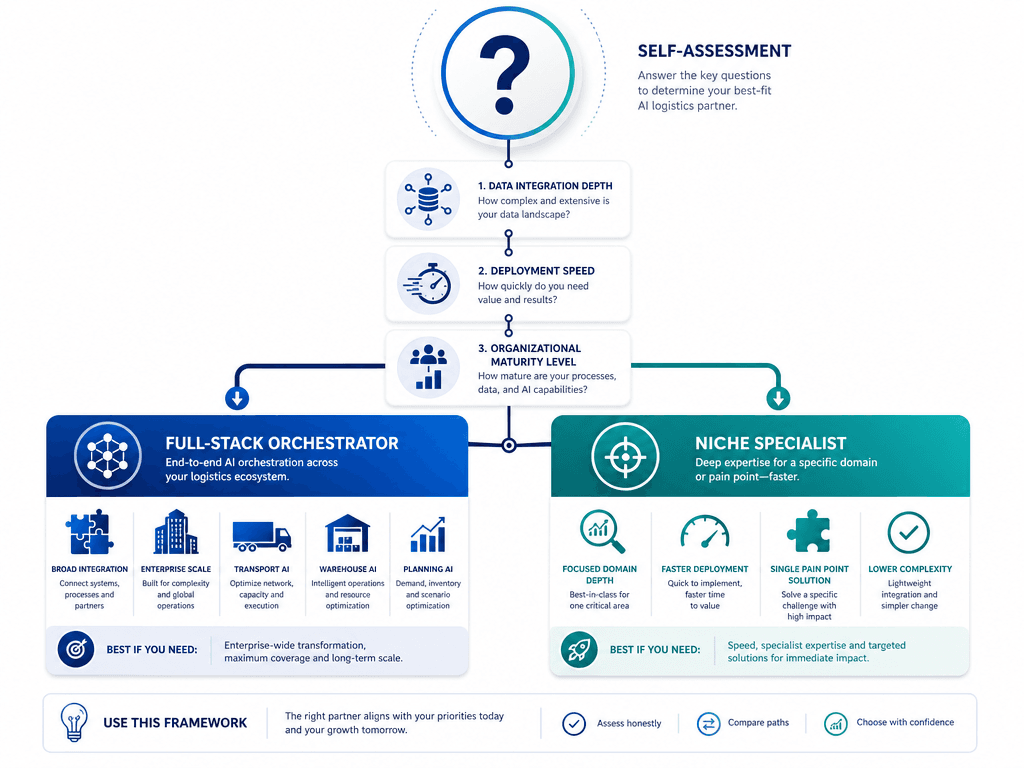
The following self-assessment is designed to map your organization's profile to the appropriate vendor model. Each question includes guidance on how the answer points toward an orchestrator or a specialist.
- What is your organization's AI maturity level? If your team has deployed AI in at least two supply chain functions and has a dedicated data science or analytics group, you are likely at Stage 3–4 and can handle an orchestrator. If you are still experimenting with a single pilot, start with a specialist.
- Is your primary pain point single-function or multi-functional? If your most urgent problem is limited to one domain — for example, poor route efficiency or warehouse labor productivity — a specialist will deliver faster ROI. If you have pain points across transport, warehouse, and planning simultaneously, an orchestrator may be more cost-effective in the long run.
- What is your tolerance for integration complexity? If your existing systems are already integrated (e.g., a single ERP instance across functions) and you have IT resources to manage a multi-system deployment, an orchestrator is feasible. If your systems are fragmented and your IT team is lean, a specialist that integrates with existing tools is lower risk.
- How quickly do you need to see measurable results? If you need a pilot producing ROI within 3 months to justify further investment, choose a specialist. If your organization can sustain a 12- to 18-month deployment cycle with phased value delivery, an orchestrator is viable.
- What is your budget and TCO expectation? If your budget is under $500K annually for AI software, most orchestrators will be out of range. Specialists typically offer lower entry points. If your budget is $1M+ and you need coverage across multiple functions, an orchestrator's TCO may be lower than stitching together multiple specialists.
- What is your regional operational footprint? If you operate primarily in Asia-Pacific, where LSP AI maturity is highest (31% embedding AI across core operations per BCG), you may find more advanced specialist options and a more receptive internal environment for orchestrator deployment. If you operate in Europe, where only 6% of LSPs have embedded AI, a specialist may face less organizational resistance.
- What is your internal change management capacity? If you have a dedicated digital transformation team and executive sponsorship for a multi-year initiative, an orchestrator is within reach. If AI adoption is driven by a single functional leader without cross-functional authority, a specialist that stays within that leader's domain is more likely to succeed.
Case Examples: Orchestrator and Specialist in Practice
Real-world deployments illustrate how each model delivers value in different contexts. The following cases are drawn from secondary citations of DHL, Kuehne+Nagel, and InPost reports. Buyers should verify these figures against original sources before using them in business cases.
DHL: Full-Stack Orchestration at Global Scale
DHL's AI-optimized routing across its European parcel network — covering 2.3 million daily stops across 14 countries — is a flagship example of full-stack orchestration by a global integrator. The deployment achieved a 14% reduction in distance traveled, EUR 180 million in annual fuel savings, and a reduction of 127,000 tonnes of CO2. DHL operates at Stage 3–4 AI maturity, with dedicated data science teams and the organizational capacity to manage a multi-year, multi-function AI transformation. This case is relevant for enterprise buyers with similar scale and maturity.
Kuehne+Nagel: Specialist AI in Customs Classification
Kuehne+Nagel deployed AI for customs classification across 2.1 million declarations annually in 43 countries. The specialist application — focused on a single, high-stakes domain — achieved a 61% reduction in classification errors and a 72% reduction in document processing time. This case demonstrates that deep functional AI in a bounded domain can deliver measurable, auditable value without requiring a full-stack transformation. It is relevant for mid-market to enterprise buyers with a clear pain point in customs, trade compliance, or other specialized functions.
InPost: Mid-Market Specialist in Parcel Locker AI
InPost, the Polish parcel locker operator, deployed AI-driven delivery prediction across 22,000+ parcel lockers. The specialist application achieved 94% ETA accuracy and a 41% reduction in locker overflow events. This case is relevant for mid-market operators that need to solve a specific operational problem — in this case, parcel locker capacity management — without investing in a broad AI platform.
The Convergence Trend: Specialists Adding Breadth, Orchestrators Adding Depth
The bifurcation described in this article is not static. Several specialists are expanding into adjacent functions: FourKites has added predictive ETAs and dynamic rerouting beyond its core visibility offering; Locus has added warehouse orchestration capabilities alongside its routing and dispatch platform. Meanwhile, orchestrators are deepening domain-specific AI modules: Blue Yonder has invested in routing AI for last-mile delivery, and o9 Solutions has enhanced its graph-based digital twin for inventory optimization.
This convergence means that today's specialist may become tomorrow's orchestrator, and today's orchestrator may develop best-in-class modules in specific domains. Buyers should evaluate not only current fit but also the vendor's roadmap and ability to grow with the organization. A specialist with a clear expansion plan and a track record of successful adjacent-function deployments may be a lower-risk long-term bet than an orchestrator that requires a multi-year transformation upfront.
For buyers who want to evaluate individual vendor AI architecture more deeply — distinguishing genuinely AI-first platforms from legacy systems with AI add-ons — ChainSignal's AI-Native vs. AI-Enhanced article provides a complementary framework focused on architectural trustworthiness. For a deeper exploration of route optimization and TMS AI use cases, see the AI in TMS guide. And for warehouse AI ROI benchmarks and business case construction, the warehouse AI implementation guide provides practitioner-oriented cost modeling and payback period analysis.
Comments
Join the discussion with an anonymous comment.