
Washington is trying to make the AI defense supply chain between the US and Israel more formal, more programmable, and more useful to both defense establishments. The compute layer is not moving at the same speed. Israel remains in Tier 2 under US AI chip export rules, alongside countries such as Mexico and Singapore, which means advanced AI processor access still requires case-by-case Commerce Department approval.[1] That is not a paperwork detail when autonomous systems, cyber tools, targeting-support software, and defense production analytics all depend on the same scarce accelerator base.
The contradiction is already visible inside Israel’s own defense planning. The head of the Defense Ministry’s AI branch warned that Israel is “increasingly losing its security independence,” a phrase that lands differently when read as supply chain language rather than diplomatic complaint.[1] Security independence, in this context, is not simply the ability to write code or field prototypes. It is the ability to obtain processors, licenses, cloud capacity, export approvals, integration pathways, and production support quickly enough for wartime systems to matter.

That is the useful starting point for the current US-Israel defense technology shift. The story is not just that two allies want deeper cooperation. It is that three separate systems are beginning to interlock: proposed congressional language for formal defense technology cooperation, an allied AI supply chain security framework, and a rapid rerouting of Israeli defense procurement toward startups. Together, they can widen the pipeline of dual-use systems. They can also expose the uncomfortable fact that a wider pipeline still narrows at compute access.
The Cooperation Channel Is Being Written Into Procurement Language
Section 219 of the FY27 House National Defense Authorization Act, formerly Section 224, would establish a US-Israel Defense Technology Cooperation Initiative covering artificial intelligence, autonomous systems, cyberwarfare, and defense industrial production.[2] The careful verb is “would.” As of mid-2026, this is proposed NDAA language, not a settled operating architecture.
That distinction matters. Proponents frame the provision as a way to institutionalize allied innovation and accelerate defense technology sharing; AIPAC’s memo presents the initiative in that cooperative register.[3] Critics, including coverage in The Intercept, describe it as an unusually deep integration with a foreign power.[2] Both readings are politically charged, but the supply chain question is narrower: if language like this survives the legislative process, which firms get access to programs, which offices approve work, and which technologies become eligible for joint development rather than ad hoc coordination?
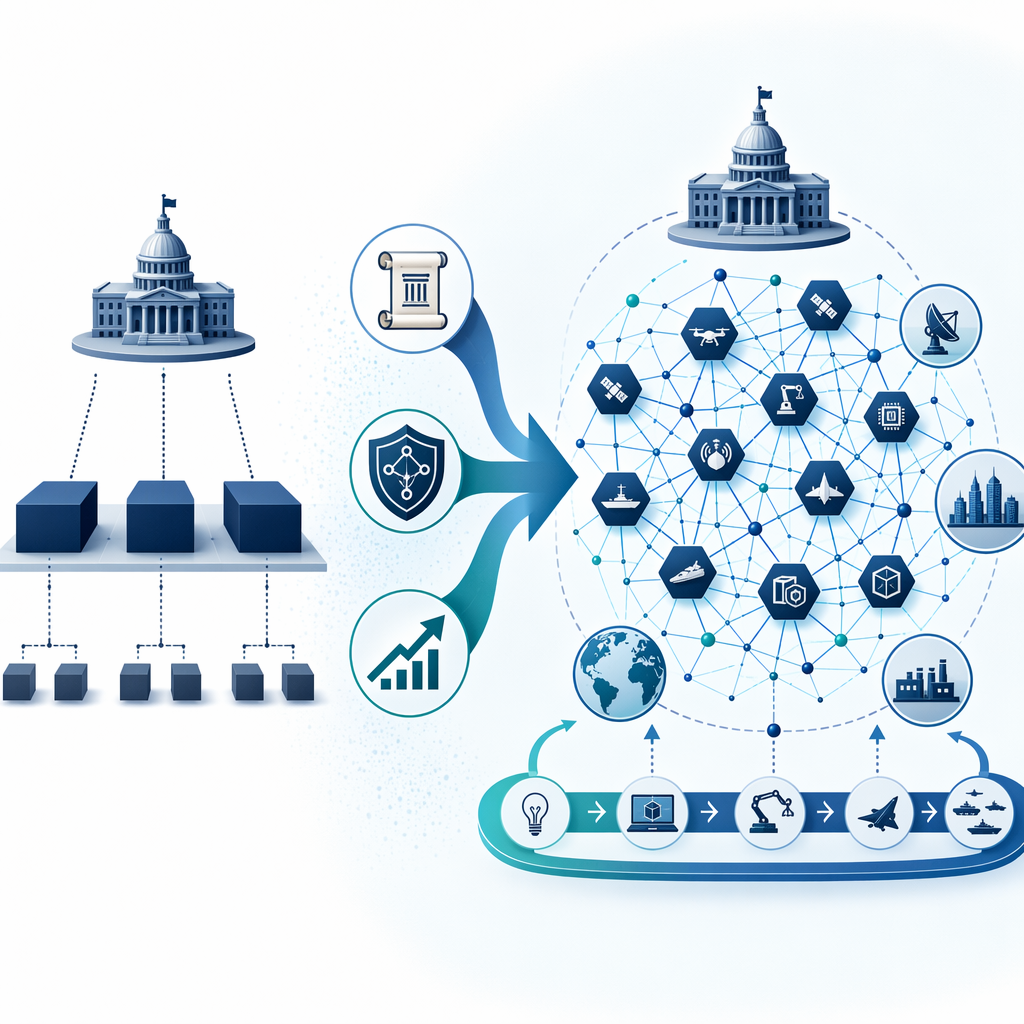
The old model was easier to draw. A small set of large defense primes held the most durable relationships, government-to-government support moved through familiar channels, and new technology entered through acquisition gates that favored incumbents with compliance staff, classified program experience, and production depth. Section 219 points toward a different plumbing arrangement. It does not by itself create operational capacity, but it could create a named channel through which AI, autonomy, cyber, and industrial-production capabilities are identified, funded, reviewed, and transferred.
| Force | Supply Chain Role | Main Constraint |
|---|---|---|
| Proposed Section 219 | Creates a formal cooperation channel for AI, autonomy, cyberwarfare, and defense industrial production | Still depends on final legislative language, implementation rules, and program-level execution |
| Pax Silica | Places Israel inside a broader allied stack for AI supply chain security | Does not erase export-control tiers or national approval processes |
| Startup procurement surge | Supplies firms, prototypes, and dual-use products that can flow through allied channels | Requires compute, approvals, and defense buying processes that can keep pace |
This is where articles that stay at the level of alliance language miss the practical change. A cooperation initiative becomes consequential only when it changes the path from prototype to fielded system. That path includes budget lines, security reviews, data-sharing permissions, test environments, export classifications, contracting vehicles, and maintenance obligations. A legislative channel can shorten some of those steps. It can also create a queue if the downstream approval and compute infrastructure is not expanded with it.
Pax Silica Turns the Bilateral Story Into an Allied Stack
Israel’s December 2025 entry into the US-led Pax Silica initiative makes the same shift look less bilateral and more industrial. The initiative includes eight nations: Israel, Japan, South Korea, Singapore, the Netherlands, the United Kingdom, the United Arab Emirates, and Australia.[4][5] Its scope is not limited to software cooperation. It covers semiconductors, critical minerals, energy, and logistics, the physical and commercial layers that determine whether AI systems can be built, powered, shipped, secured, and sustained.[4][5]
That framing is important because defense AI is not a self-contained procurement category. A model trained for battlefield sensing still depends on accelerator supply. A cyber-defense platform still depends on trusted cloud regions, secure chips, and update channels. An autonomous system still depends on sensors, embedded compute, batteries, navigation components, and production capacity. Pax Silica places Israel inside an allied-market conversation about those dependencies rather than treating AI cooperation as a matter of research memoranda alone.
The initiative also changes the commercial audience. A dual-use company selling into allied defense markets is no longer looking only at one ministry, one prime, or one export license. It is trying to understand whether its product fits an emerging allied stack: processors and minerals in one layer, energy and logistics in another, defense customers and security approvals above them. That can create larger addressable markets, but it also multiplies gatekeepers.
The Startup Surge Is Where the Plumbing Actually Changes
Policy channels matter because there are now many more firms positioned to use them. Israeli defense-tech startups raised $3 billion in the first half of 2026, tripling the $1 billion raised in all of 2025 and representing roughly 30% of Israel’s $8.4 billion total high-tech investment.[6] Those figures should not be mistaken for proof that every funded company will deliver a fielded defense capability. Venture capital measures investor conviction and market appetite, not operational effectiveness.
The procurement figure is more revealing. More than 800 startups now have direct Israeli Ministry of Defense procurement orders, and the ministry plans to allocate at least 10% of its 2026 R&D budget to startups rather than the three traditional primes: Israel Aerospace Industries, Elbit, and Rafael.[6] That is a change in who gets purchase orders, not merely who gets conference attention.
The named financing milestones show how quickly the defense-adjacent capital stack has thickened. Heven raised $100 million to become Israel’s first defense-tech unicorn; Kela raised $100 million from investors including Sequoia, Lux Capital, and the CIA’s IQT venture arm; and Ondas acquired Sentrycs for $225 million.[6] Each milestone is different: a growth round, a venture-backed defense software bet, and an acquisition. Together they show capital moving into the layer between commercial technology and defense procurement.
Since October 2023, more than 130 startups have reportedly been integrated into Israel’s war effort, with about half working in autonomy and AI and about a quarter in sensors and detectors.[6] That wartime integration does not establish a normal peacetime acquisition model. It does, however, give program managers and founders a shared operating memory: emergency demand, direct feedback, fast iteration, and the difficulty of turning urgent prototypes into durable procurement programs.
This is the part of the US-Israel AI defense supply chain that looks most different from the older prime-contractor pattern. The primes are not disappearing; they still hold integration, production, classified-program, and sustainment advantages. But the Ministry of Defense is deliberately routing more budget and orders toward smaller firms. Once that happens, a US cooperation initiative is no longer just a government-to-government bridge. It becomes a potential sorting mechanism for hundreds of dual-use vendors seeking allied defense customers.
From Prime Contractor Chain to Co-Development Pipeline
The emerging structure is best understood as a pipeline with three connected sections. Proposed Section 219 would define a formal cooperation route. Pax Silica gives that route a wider allied supply chain context. The Israeli startup surge supplies the firms and prototypes that can move through it.
That does not mean the pipeline is frictionless. A founder with an autonomy product may need Israeli defense validation, US export-control analysis, cloud or chip access, a US partner, cybersecurity review, and a procurement vehicle before the product becomes relevant to an allied defense customer. A US prime or systems integrator may see the same startup as a source of speed, a compliance burden, or a future competitor. A ministry buyer may want the capability immediately but still lack the long-term sustainment model to support it.
This is why the shift should not be reduced to “more cooperation” or “more startups.” The more precise change is in routing. Instead of waiting for innovation to enter through a handful of incumbents, the Israeli Ministry of Defense is placing direct orders with a much broader supplier base. Instead of leaving technology cooperation to episodic bilateral arrangements, Section 219 would name specific domains for formal collaboration. Instead of treating AI supply chains as national technology projects, Pax Silica frames them as allied industrial systems.
For commercial supply chain strategists, that routing change is the signal. Defense demand is becoming more legible to dual-use firms, while dual-use firms are becoming more visible to defense buyers. The firms that understand both sides of the channel — product velocity on one side, export controls and procurement discipline on the other — will have a different market position from firms that assume a venture round is enough to cross into defense.
The Compute Layer Can Still Decide the Pace
The compute bottleneck cuts across every promising part of this structure. Advanced AI processors are not simply inputs purchased at the end of a development cycle. They shape what models can be trained, how quickly systems can be tested, whether classified or sensitive workloads can remain under trusted control, and how much autonomy a defense establishment has when demand spikes.
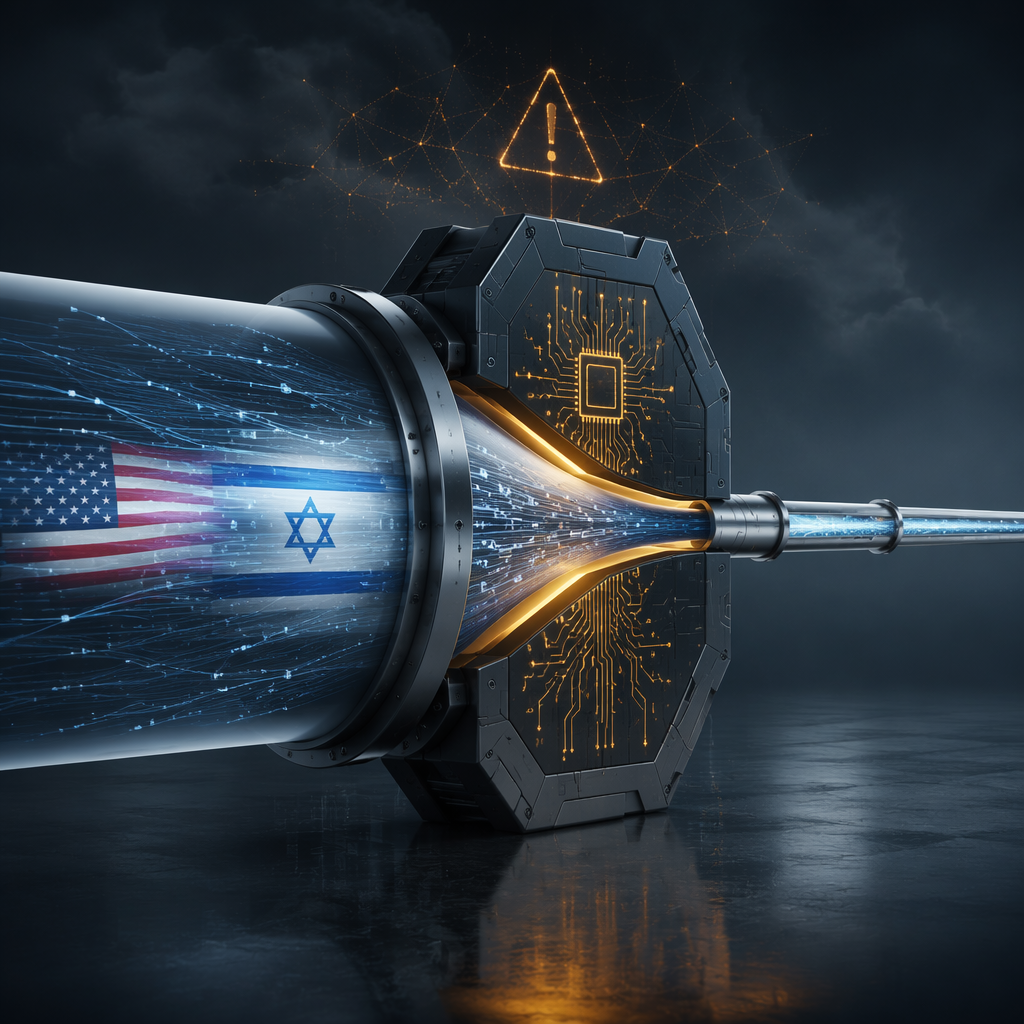
Israel’s Tier 2 classification under US AI chip export rules therefore sits underneath the entire co-development story. Case-by-case approval can work for discrete transactions. It is less comfortable as the foundation for a fast-moving defense AI ecosystem in which hundreds of startups, ministry units, integrators, and allied customers may need access to advanced processors on program timelines rather than diplomatic timelines.[1]
The vulnerability is not limited to model training. AI-enabled cyber systems need secure development and deployment environments. Autonomous platforms need simulation and testing capacity. Sensor-fusion systems need inference performance at the edge and retraining capacity in the rear. Defense industrial production tools need compute for scheduling, inspection, anomaly detection, and digital engineering. A chip constraint can appear first as a cloud planning problem, then as a testing delay, then as a procurement risk, and finally as a strategic dependency.
This is also where export classification becomes more than a legal specialty. An export-control lawyer may be the person who determines whether a system can move from an Israeli prototype environment into a US-linked program. A cloud planner may be the person who discovers that the approved compute region is not the one the engineers designed around. A program manager may be the person who has to explain why policy cooperation produced a signed framework before it produced usable capacity.
The Biden-era chip-control architecture and the Trump administration’s approach to Israel’s Tier 2 status introduce regulatory uncertainty rather than a settled forecast.[1] The narrower conclusion is enough: as long as Israel’s access to advanced AI processors is handled through a more restrictive approval tier, compute remains a limiting infrastructure beneath any promise of accelerated AI defense cooperation.
What Allied Firms Should Watch
The practical map is not complicated, but it is easy to misread if attention stays on announcements. The first place to watch is final NDAA language and implementation guidance. Section 219’s impact depends on whether it becomes law, how its eligible technology areas are defined, and whether the relevant offices receive processes that can move faster than the ordinary interagency pace.
The second place is Israeli Ministry of Defense purchasing behavior. The signal is not another high valuation by itself. It is whether direct orders to startups continue, whether the 2026 R&D allocation shift is executed, and whether successful wartime prototypes are converted into repeatable programs with support, security, and upgrade paths.
The third place is compute allocation. If chip approvals, cloud access, and processor supply remain uncertain, the startup pipeline can expand faster than the infrastructure needed to train, test, and deploy its products. That mismatch is especially important for companies building systems in autonomy, cyber, sensor fusion, and defense production analytics — the same domains that sit near the center of the proposed cooperation channel.
The opportunity is a deeper dual-use innovation pipeline for allied markets: more firms connected to defense buyers, more routes for US-Israel co-development, and a broader allied supply chain frame for AI infrastructure. The risk is that compute access, export classifications, and approval processes become the real limiting infrastructure beneath the partnership. That is where the US-Israel defense AI supply chain is being rebuilt, and that is where it may jam.
References
- Calcalist/Ctech report on Israel’s Tier 2 AI chip classification, Calcalist/Ctech.
- The Intercept report on Section 219 of the FY27 House NDAA, The Intercept, June 2026.
- AIPAC memo on the US-Israel Defense Technology Cooperation Initiative, AIPAC.
- Times of Israel report on Israel joining the Pax Silica initiative, Times of Israel.
- Israel National News report on the Pax Silica initiative, Israel National News.
- Jerusalem Post report on Israeli defense-tech startup funding and procurement, Jerusalem Post.
Comments
Join the discussion with an anonymous comment.