
The operational problem is almost unfair: send paid hunters into the Everglades to find Burmese pythons across roughly 1.5 million acres, knowing the animals are so hard to see that detection probability has been estimated at only 1-3%.[1] That is the useful entry point for discussing an AI python hunting app forecast. The interesting question is not whether software can magically find snakes. It is how to place scarce human effort when the signal is rare, the territory is huge, and the best outcome may depend on a few people who know what they are doing.
That distinction matters because low detectability and forecast accuracy are not the same metric. The 1-3% figure describes how difficult it is to detect pythons in the field. The University of Florida and South Florida Water Management District work reported an approximately 80% prediction accuracy for removal success under surveyed conditions, based on a model of when and where removal was more likely given actual survey effort.[2] Treating those as interchangeable would be the same planning error as confusing poor demand observability with a bad demand forecast.

The Data Asset Behind the Forecast
The load-bearing material is not a demo screen. It is a field dataset: 4,092 surveys, 16,336 survey hours, and 67 paid Python Elimination Program contractors, with each trip tied to date, time, location, weather, survey method, and capture outcome.[2] That is the shape of a serious resource allocation problem. Not clean enough to behave like a lab experiment, but structured enough to stop dispatching purely by habit.
The UF/SFWMD study used generalized additive mixed models, or GAMMs, to estimate probability of removal and removal per unit effort. The models tested predictors including time of day, Julian date, air temperature, barometric pressure change, survey method, spatial location, and contractor identity.[2] In supply chain terms, that is historical event data plus covariates, modeled against an operational outcome, then converted into deployment rules.
The highest-value finding is practical rather than exotic. Removal success was associated with the 8 p.m. to 2 a.m. window, the wet season from May through October, air temperature above 25 degrees C, a barometric pressure decline of at least 2.0 mmHg, aquatic vehicles, and spatial location.[2] None of those variables means much in isolation. Together, they define a narrower search window in which a paid hour is more likely to produce a removal.
What Transfers to Supply Chain Planning
The python program is not a supply chain case study. It does not have service-level agreements, promotion calendars, purchase orders, or warehouse capacity constraints. The transfer is methodological: scarce resources are assigned across space and time under noisy observability, uneven historical coverage, environmental confounding, and operator variance.
| Python forecasting element | Supply chain analogue | Operational decision it supports |
|---|---|---|
| Survey history with time, location, weather, method, and outcome | Orders, shipments, service tickets, stockouts, returns, sensor alerts, and external covariates | Where the historical signal is strong enough to guide deployment |
| Probability of removal and removal per unit effort | Demand probability, failure probability, conversion probability, or expected units per labor hour | Which lane, store, site, or customer cluster deserves scarce capacity |
| Wet-season, night-window, temperature, and pressure predictors | Seasonality, weather, events, price moves, promotions, traffic, or local operating conditions | When the same resource is more likely to produce a useful outcome |
| Aquatic vehicle and contractor effects | Equipment type, technician skill, planner judgment, carrier performance, or warehouse team capability | Who or what should be assigned when conditions are favorable |
| Spatial mismatch between capture density and survey effort | Inventory, labor, or field coverage misaligned with observed demand or exception density | Where legacy allocation rules should be challenged |
A demand sensing model works in much the same pattern. It does not simply ask whether last month's demand was high. It asks whether demand increased under a specific combination of location, customer behavior, season, event timing, weather, price, channel activity, and fulfillment constraint. ChainSignal's prior discussion of AI demand forecasting in CPG and retail covers the same basic planning tension: the forecast is only useful when it changes where inventory, production, or labor goes.
Field service routing is an even closer operational match. A utility, equipment manufacturer, or cold-chain operator may have thousands of assets spread across a region, with rare failures and incomplete inspection records. Historical work orders alone can overweight the places crews already visit. A probability model that blends asset age, temperature, site type, usage patterns, and recent alerts can tell dispatchers where a crew-hour is more likely to prevent a costly event. That is not identical to python removal, but the allocation logic is familiar.
Inventory placement has the same trap at a different scale. If the network sends stock to the nodes that were historically replenished most often, it may reinforce old coverage patterns. A better model asks where demand density, delivery promise, return risk, seasonality, and substitution behavior justify stock before the exception appears. The spatial allocation lesson connects directly to AI inventory allocation for ecommerce stockouts: the system is valuable only if it moves constrained inventory toward expected opportunity rather than toward historical comfort.
The Rule Is Simple Only After the Modeling Is Done
The operating rule that comes out of the python work is easy to say: prioritize surveys during the 8 p.m. to 2 a.m. wet-season window, especially when air temperature exceeds 25 degrees C and barometric pressure is falling, with attention to method and location.[2] The simplicity is earned. It comes after collecting enough trip-level data to separate a promising condition from an anecdote.
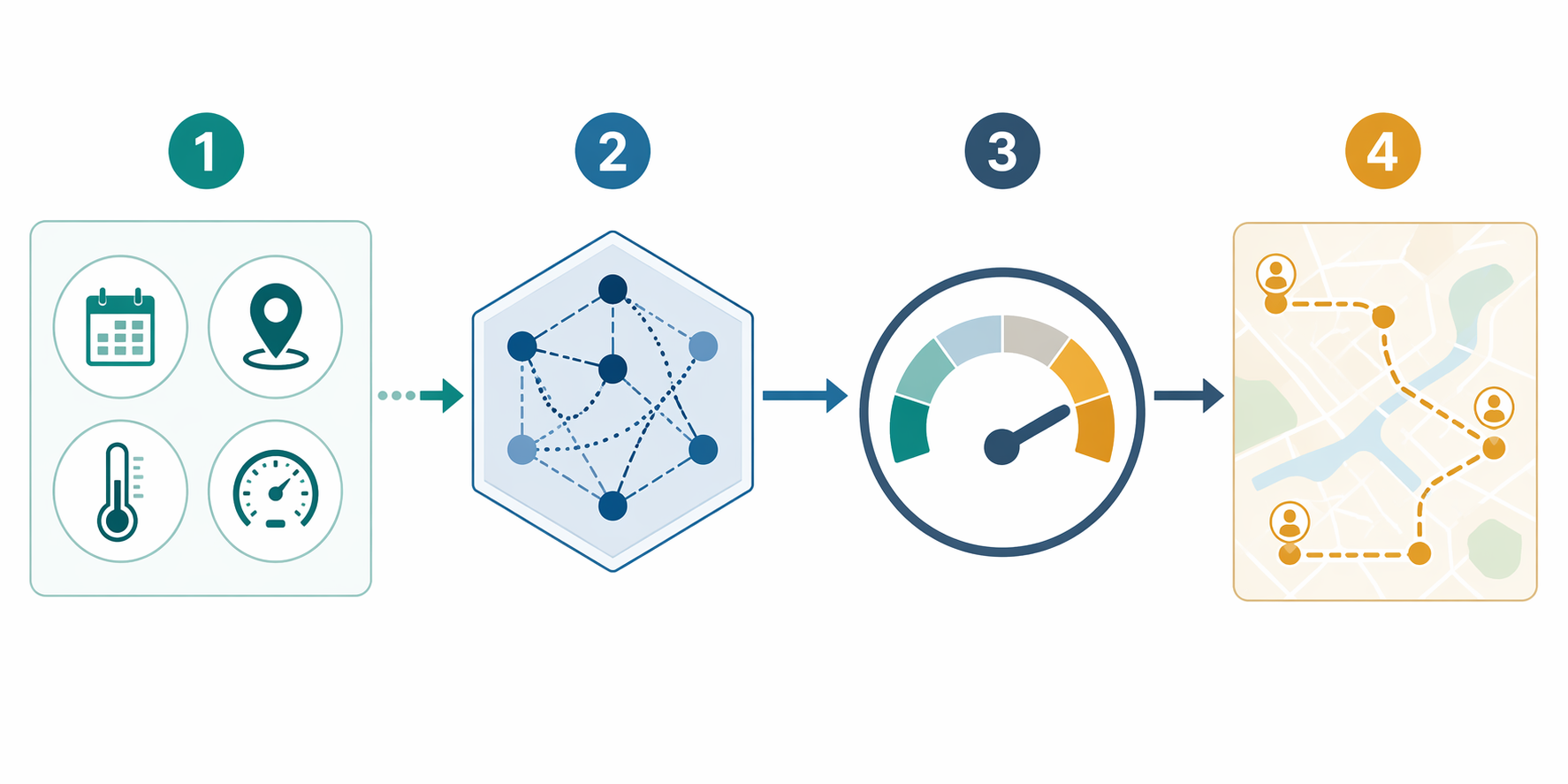
Supply chain teams should recognize the sequence. First, define the event that matters: removal, service success, stockout avoidance, delivery recovery, conversion, or units moved per labor hour. Second, assemble historical events with the conditions surrounding them. Third, model the outcome probability rather than just the average volume. Fourth, turn the probability surface into a dispatch, replenishment, or staffing rule.
The model family matters less than the discipline of the workflow. GAMMs are useful here because they can handle nonlinear relationships without pretending that every predictor moves the outcome in a straight line. Many supply chain AI systems use other classification, regression, or optimization techniques; the broader math landscape is covered in ChainSignal's overview of core AI techniques for supply chain. What matters operationally is whether the model expresses a usable difference between Tuesday afternoon and Saturday night, between one zone and another, between one crew and another, or between one replenishment node and another.
The Annoying Part: Effort Did Not Naturally Follow Opportunity
One of the most useful findings is also one of the least flattering. The study identified two high-capture-density zones that received disproportionately low survey effort: Big Cypress Preserve along Tamiami Trail and Stormwater Treatment Area 3/4.[2] In plain operations language, the labor was not fully aligned with the observed opportunity.
That happens constantly in planning systems. Warehouses keep receiving inventory because they have historically handled volume. Sales territories get coverage because a manager knows the accounts. Service teams return to the same clusters because the routes are familiar. A dashboard may show exception density elsewhere, but the dispatch board still reflects habit, access, local confidence, and the friction of changing assignments.
The python finding is valuable because it avoids a soft version of the AI story. The model did not merely make hunters more efficient inside existing patterns. It exposed a coverage mismatch. For supply chain leaders, that is often the first serious test of an AI allocation tool: whether it confirms the current plan with nicer graphics, or whether it can show where the plan is spending constrained effort in the wrong place.
The More Uncomfortable Part: Contractor Identity Mattered
The clean automation narrative gets another complication. Contractor identity was reported as the single most influential predictor of removal efficiency; removing it from the model reduced R-squared by 13.1%.[1] That is not a minor footnote. It says individual skill, local knowledge, persistence, or method discipline affected outcomes enough that a model ignoring the operator would be materially worse.
Supply chain organizations see the same thing, though they often file it under tribal knowledge until someone leaves. One planner knows which customer demand spikes are real. One dispatcher knows which technician can handle a messy rural route. One warehouse lead knows which exception queue will break the shift if it is left until 4 p.m. If the model treats every operator as interchangeable, it may look fairer and cleaner while becoming less accurate.
The better lesson is not to automate around skilled people. It is to make their judgment more deployable. A forecasting model can identify when conditions justify sending the strongest operator, when a less experienced crew can handle the task, and where coaching or standard work would narrow the performance gap. That is different from pretending that the app, the optimizer, or the dispatch algorithm has replaced field expertise.
Where the App Fits, and Where It Does Not
The app angle is real but should stay in proportion. Reporting in July 2026 described Florida work on a new app to help find Burmese pythons for the Python Challenge, while also making clear that the forecasting app was still in development.[3] That means the finished operational value of the app is not yet demonstrated by the public reporting. The peer-reviewed analytical framework is the stronger evidence.
The program context is worth knowing, but it is not the center of the supply chain lesson. South Florida Water Management District says more than 23,500 pythons had been removed from the Everglades and surrounding areas since 2000, and describes Python Elimination Program pay as hourly compensation of $14 to $30 plus length-based incentives and bonuses.[4] Paid contractors account for a large share of removals in the program context, but pay design is not what makes this case analytically transferable.
The ecological stakes explain why the work matters outside a planning office. Florida Museum material describes severe mammal declines in the Everglades, including a 99.3% raccoon decline associated with the invasive python problem.[1] That gives the allocation decision real consequence: sending people to the wrong place at the wrong time is not just inefficient. It slows a removal effort aimed at an ecological threat.
A Practical Blueprint for Sparse, Noisy Signals
The transferable pattern is compact:
- Capture event-level history, not just aggregate outcomes.
- Attach time, location, environmental, method, and operator covariates to each event.
- Model outcome probability and productivity per unit of effort.
- Look for spatial or temporal mismatches between effort and opportunity.
- Treat operator variance as a planning variable, not an embarrassment.
- Convert the model into deployment windows, routing priorities, inventory positions, or labor assignments.
For a retailer, the equivalent may be identifying which store clusters need inventory before a weather-driven demand event. For a manufacturer, it may be which field assets deserve preventive service before failure probability rises. For a distributor, it may be where to place scarce labor when order volatility is high and historical averages are misleading. For a planner, it may be which exception deserves escalation because the context around it resembles prior costly failures.
The caution is equally important. A model trained on where people already looked can inherit coverage bias. A high predicted success rate may reflect strong operators as much as strong locations. A clean rule can decay if weather patterns, access constraints, contractor behavior, or reporting discipline change. None of that invalidates the workflow. It means the model has to stay attached to the operating system it is trying to improve.
The python hunting app forecast is therefore not useful mainly as a product story. Its value is a tested forecasting workflow for deciding where constrained resources should go when historical signals are sparse, noisy, spatially uneven, and partly dependent on skilled operators.
References
- Florida vs. the Burmese Python: How an Invasive Giant is Changing the Sunshine State — Florida Museum
- Optimizing survey conditions for Burmese python detection and removal using community science data — Scientific Reports, Jan 2025
- Florida works on new app to find Burmese pythons for Python Challenge — Naples News, July 2026
- Python Elimination Program — SFWMD
Comments
Join the discussion with an anonymous comment.