
The first effective detector in the July 2026 cetirizine recall was not a release test, a vision station, or a lot-level quality review. It was a pharmacy technician counting tablets and noticing red dots.
That detail matters because it puts the supply chain impact of the allergy medication recall in the wrong part of the workflow. By the time a technician is seeing a visible tablet abnormality at the pharmacy counter, the lot has already cleared manufacturing controls, moved through distribution, reached dispensing operations, and forced the downstream network into containment mode.
Unique Pharmaceutical Laboratories, a division of J.B. Chemicals & Pharmaceuticals Ltd., issued a voluntary nationwide recall of four lots of Cetirizine Hydrochloride Tablets USP 5 mg because of potential cross-contamination with ranitidine. The FDA safety alert describes the discovery plainly: a pharmacy technician observed red dots on tablets while manually counting them.[1]

There is no need to inflate that fact into a claim that AI would have automatically prevented contamination. Contamination prevention still belongs to facility design, cleaning validation, line clearance, material controls, deviation management, and disciplined production execution. The sharper question is narrower and more useful: where should the warning have surfaced before the product reached a pharmacy?
The signal appeared after the product had already escaped
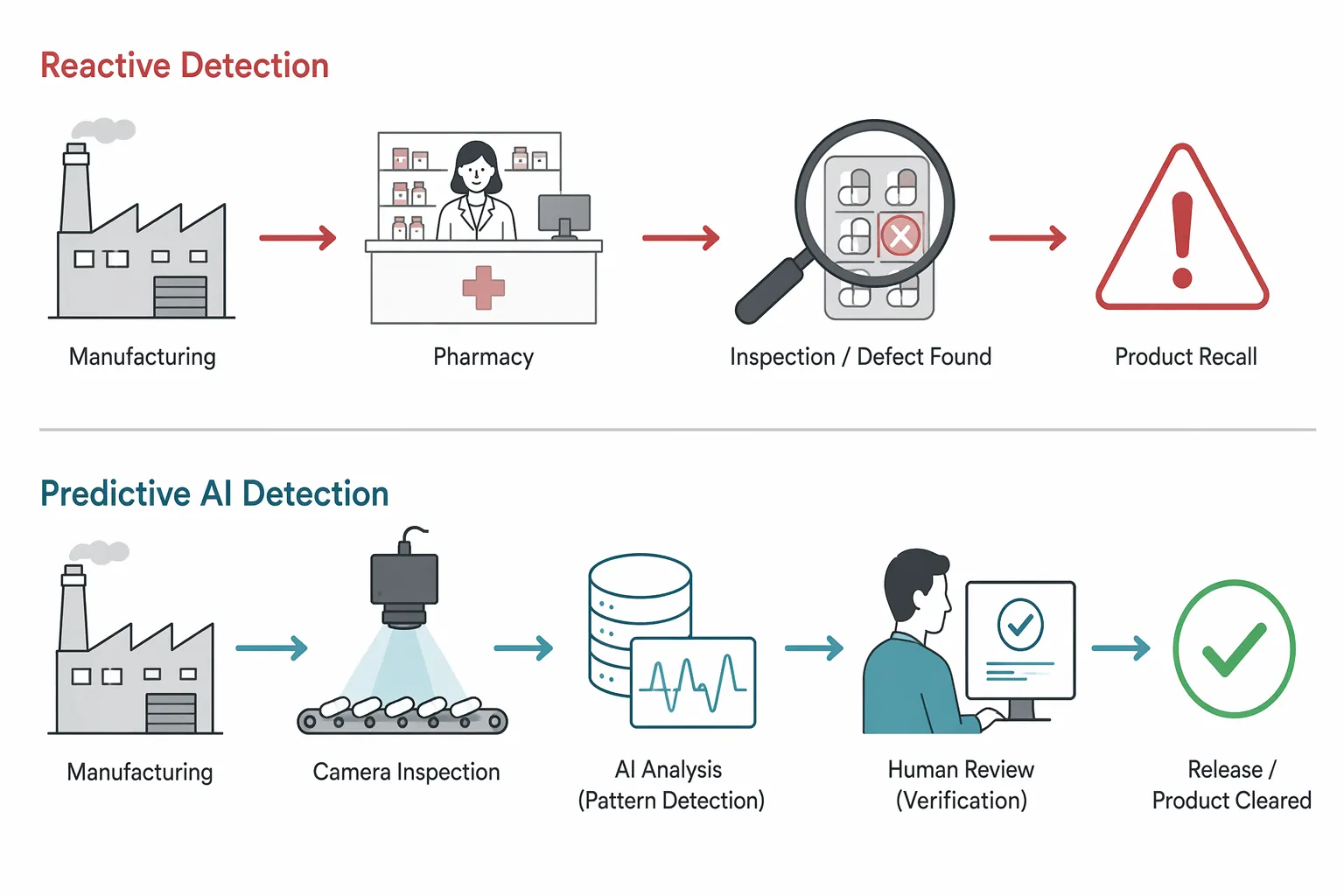
A pharmacy counter is a poor place to discover a manufacturing quality signal. The technician’s observation was valuable, and the recall process depends on people who catch what systems miss. But from a quality systems view, this is a late detector. It does not protect the batch from release. It does not prevent shipment. It does not stop inventory from being allocated across accounts. It starts a response after distribution has already occurred.
The public record does not disclose the total number of affected units, the detailed plant investigation findings, or a final root cause for the cetirizine event. The available facts support a more limited conclusion: four lots were recalled for potential ranitidine cross-contamination, and the visible clue was first reported during manual pill counting, not through an upstream automated quality signal.[1]
That distinction is the center of the case. A recall announcement can move quickly. Pharmacies can pull stock. Serialization data can help identify where product went. Those are important containment tools. They do not answer why the first visible evidence reached the last operational handoff before the patient.
Where the earlier detectors should have been
Working backward from the pharmacy counter, the missed opportunities are not mysterious. They sit in familiar places: visual inspection, batch record review, deviation trending, serialization-linked lot movement, and the quality data that sits around manufacturing but is often not analyzed as one connected signal.
| Workflow layer | What it could have shown | What it should not be asked to decide alone |
|---|---|---|
| In-line or end-of-line visual inspection | Visible tablet abnormalities such as discoloration, spots, coating defects, or foreign material patterns | Final batch disposition without quality review |
| Batch and deviation records | Process drift, repeated interventions, line clearance concerns, or cleaning-related events | Whether every abnormality represents contamination |
| Serialization-linked quality data | Lot, line, time, and movement patterns that correlate with contamination or potency deviation indicators | A regulatory conclusion without investigation |
| Distribution traceability | Where released product moved after shipment | Pre-release detection of a defect that was never flagged upstream |
The last row is often where supply chain teams spend their energy after a recall begins. Traceability is necessary, especially when product has to be contained across customers and locations. But predictive recall prevention starts earlier. It asks whether the same data environment that supports distribution visibility can also be joined to inspection and quality signals before release.
Why ordinary inspection leaves gaps
Manual visual inspection catches some defects because people are good at noticing the unexpected. It fails as a control strategy when the defect is intermittent, subtle, late-appearing, or buried inside a sampling plan. A technician seeing red dots during counting is a reminder that visibility is not the same as controlled detectability.
End-of-line testing has a similar limitation. It can confirm that selected samples meet specified tests at a defined moment. It does not necessarily integrate every upstream signal: a short equipment intervention, a cleaning documentation concern, a material movement anomaly, a minor visual trend, or a lot genealogy pattern that looks ordinary in isolation but abnormal in combination.
Cross-contamination is especially uncomfortable because the best evidence may not arrive as one clean failure. It may show up as small clues scattered across systems: a visible speck, an atypical result, an unusual hold, a repeat deviation, a line changeover detail, or a lot movement pattern that deserves a second look. If those clues remain separated, the release decision can still appear well supported on paper.
Broader recall data points in the same direction, although it should not be overread as proof of what happened in the cetirizine case. ComplianceQuest’s discussion of FDA recall trends reports that supplier or component failures account for about 26% of medical device recalls and process control errors add about 17%. In pharma, it reports that 31% of recalls involve microbial contamination and 28% involve sterility issues.[2] Those figures are not cetirizine root-cause evidence. They are context for why upstream process and contamination indicators deserve more attention than downstream recall administration.
What AI would actually examine
A credible AI claim in this setting has to name the data. For the cetirizine scenario, the relevant candidates are not generic “big data.” They are tablet images from inspection systems, batch and deviation records, laboratory and potency results where available, cleaning and line-clearance metadata, environmental or process parameters where applicable, and serialization-linked lot movement data.
Computer vision is the most direct fit for the red-dot part of the story. A camera-based inspection system can examine tablets repeatedly and consistently for visible abnormalities: spots, color variation, broken edges, coating defects, foreign particles, or other image patterns that fall outside an approved visual profile. The useful output is not “recall this lot.” It is a documented exception requiring review before release or before further distribution.
Machine learning on serialization-linked data addresses a different layer. A 2025 JICRCR study describes ML algorithms identifying initial warning indicators of contamination and potency deviations within serialization datasets, enabling detection before products reach distribution.[3] The important point is the timing. Serialization is usually discussed as a traceability tool after a product moves. The more ambitious use is to connect serialized lot identity with quality signals early enough to interrupt release or shipment.
In practical terms, that means the model is not looking at a tablet in isolation or a shipping record in isolation. It is looking for combinations that deserve escalation: an inspection pattern concentrated in a lot, an atypical result clustered by line or time window, a deviation history that aligns with product movement, or a potency indicator that does not yet fail specification but is inconsistent with normal process behavior. Those are warning indicators, not final verdicts.
The decision point matters as much as the model
The strongest place for an AI signal is before release or before shipment authorization, where quality can still hold the lot, open an investigation, expand inspection, review cleaning and line-clearance evidence, or quarantine related inventory. Once the signal appears at a pharmacy counter, the decision has changed. The work is no longer prevention. It is containment.
That is also why a human-in-the-loop architecture is not a conservative afterthought. In GxP environments, AI can flag anomalies at machine speed, but trained personnel still need to make disposition decisions, document rationale, and decide whether the evidence supports rejection, rework where permitted, additional testing, deviation escalation, or release. Sharp Services describes human oversight, data quality, regulatory verification, and integration with existing serialization repositories as prerequisites for AI deployment in the pharma supply chain.[4]
How the cetirizine workflow could have looked different
A realistic alternative workflow does not start with an AI system “knowing” that ranitidine contamination occurred. It starts with smaller alarms that are routed to the right review point.
- Inspection cameras flag a statistically unusual pattern of red or dark specks on tablets from a defined lot or run segment.
- The exception links to batch, equipment, line-clearance, cleaning, and deviation records for the same production window.
- Serialization data ties the suspect product identity to lot movement status, making it clear whether units are still under control, staged for distribution, or already shipped.
- Quality reviewers assess the signal, decide whether to hold or expand inspection, and document the investigation path.
- Distribution is blocked or limited until disposition is complete.
That workflow is less dramatic than a promise that AI prevents recalls. It is also closer to how pharmaceutical quality decisions are made. The model provides earlier attention, better clustering, and faster retrieval of related evidence. It does not replace contamination controls or release authority.
For supply chain teams, the operational difference is substantial. A pre-release hold affects inventory planning and customer service. A post-distribution recall affects wholesalers, pharmacies, reverse logistics, regulatory notification, customer communication, and replacement supply. The same defect signal has a different cost and compliance profile depending on when it is detected.
The investment case is context, not proof
There is a business case for earlier detection, but the numbers need to stay in their lane. DeepCeutix cites examples including Merck’s use of deep convolutional neural networks for tablet defect detection and Pfizer’s target of a 10% yield improvement through AI-powered quality monitoring. It also reports Pharma 4.0 early-adopter outcomes such as 50% to 60% reduction in investigation time, 55% reduction in process variability, 64% reduction in compliance incidents, and 65% to 80% fewer deviations.[5]
Those figures are useful as directional evidence that manufacturers are pursuing measurable quality gains. They should not be treated as audited industry-wide guarantees, and they do not prove that a specific cetirizine lot would have been stopped. They support a more modest investment conclusion: if a site already has inspection data, serialization repositories, and quality records, AI can make those assets more usable for earlier detection.
Recall-cost data belongs in the same category. Sparta Systems, now part of Honeywell, describes pharmaceutical recalls as commonly costing in the range of $10 million to $100 million.[6] Lumafield, citing Clarimed analysis, reports business interruption as 49% of total recall cost in a broader recall-cost breakdown.[7] Sedgwick’s Q4 2025 index reported that pharmaceutical recall volume by units surged 140.2% in 2025 versus 2024.[8] These numbers explain why prevention attracts capital. They do not substitute for validation, site-specific risk assessment, or a documented quality use case.
What procurement should ask before buying
The practical test for an AI system is not whether the demo can classify a defective tablet image. The test is whether the system can be placed into a controlled quality workflow without creating a new black box next to the old inspection gap.
- What data does the model see: images, batch records, deviation data, lab results, serialization events, or all of them?
- What anomaly does it flag: visible defect, lot-level pattern, potency deviation indicator, contamination indicator, or distribution movement conflict?
- Where does the alert appear: in inspection review, batch release, deviation management, warehouse hold, or recall response?
- Who reviews the signal, and what evidence do they see when they open it?
- What decision is the system allowed to support, and what decision remains with quality?
- How are validation, audit trail, model-change control, false positives, and false negatives handled?
A vendor that cannot answer those questions is selling detection language without a quality system. A manufacturer that cannot provide the underlying data discipline is buying an alert engine that may have nowhere meaningful to send its alerts.
The lesson from the pharmacy counter
The July 2026 cetirizine recall should not be turned into a clean story about AI saving the day. The available facts do not support that. They support a more operational lesson: a potential cross-contamination signal became visible only after recalled product had moved far enough downstream for a pharmacy technician to catch it during manual counting.
AI could have helped prevent distribution of potentially affected product only under specific conditions: inspection systems capable of capturing visible defects, serialization repositories connected to lot and quality data, models validated to flag relevant anomaly patterns, governed escalation into batch release or deviation workflows, and human reviewers responsible for final disposition. Without that integration, AI remains an after-the-fact explanation layered onto a recall that the upstream system did not stop.
References
- Unique Pharmaceutical Laboratories (A Div. of J.B. Chemicals & Pharmaceuticals Ltd.) Issues Voluntary Nationwide Recall of Cetirizine Hydrochloride Tablets USP 5 mg Due to Potential Cross Contamination With Ranitidine, FDA, July 20, 2026,
- Rising Drug Recalls: How Quality Leaders Can Reverse the Trend, ComplianceQuest,
- JICRCR study on ML algorithms and serialization datasets, JICRCR, 2025,
- Introducing AI in the Pharma Supply Chain Is a Journey, Sharp Services,
- GMP Manufacturing Crisis, DeepCeutix,
- The Rising Cost of Product Recalls: Why Prevention Matters, Sparta Systems/Honeywell,
- The Real Cost of a Product Recall and How to Prevent One, Lumafield,
- 2025 Product Recalls Increase Amid Shifting U.S. Regulatory Landscape, Risk & Insurance,
Comments
Join the discussion with an anonymous comment.