
NYC is a hard place to make airport disruption management look clean. In InsureMyTrip’s 2025 analysis of DOT Bureau of Transportation Statistics data, LaGuardia ranked second among U.S. airports for cancellations at 3.12%, Newark ranked fourth at 2.81%, and JFK ranked fifth at 2.40%. Newark also posted a 26.79% delay rate, high enough to make any recovery plan feel like it is starting mid-incident rather than from a stable baseline.[1]
That matters because the useful question is not whether the airports have bought AI. They have. The better question is where the tools touch the operating chain: aircraft turns, passenger queues, baggage screening, and disruption communication. Those are the places where five lost minutes, one late belt loader, or a checkpoint queue that grows faster than staffing can respond becomes visible to everyone downstream.
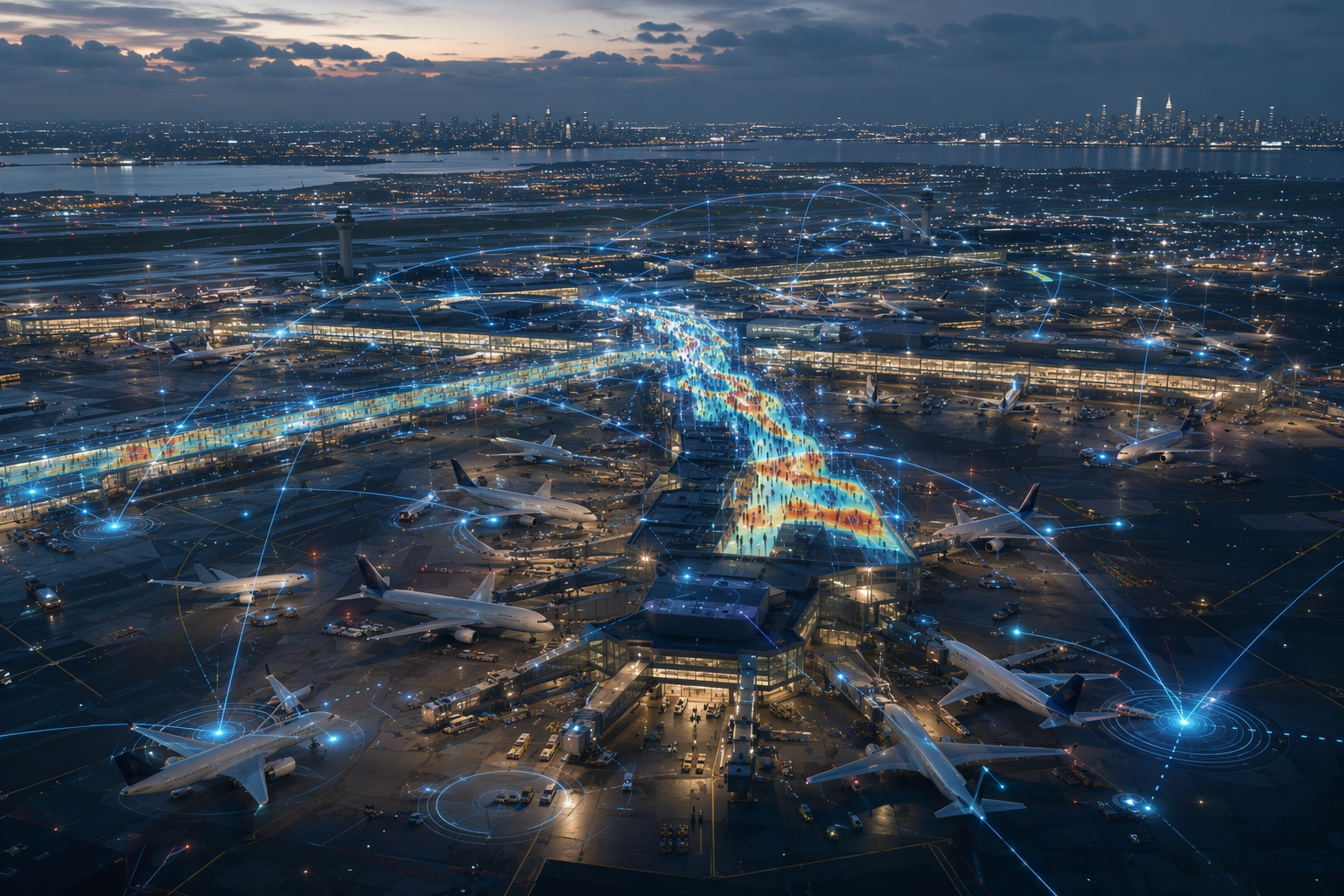
The NYC metro system also has little slack to absorb variance. Congested airspace, controller shortages, older FAA infrastructure, terminal operators with different technology stacks, and Newark flight caps through 2028 all compress the room for recovery. AI is not being introduced into a laboratory environment. It is being asked to help people make faster decisions inside a network that is already constrained before weather, maintenance, crew legality, or bags enter the picture.
The strongest NYC evidence starts at JFK Terminal 4
JFK Terminal 4 is the most useful NYC case because it shows two different AI layers working on different parts of the disruption chain. One watches the aircraft turn on the apron. The other watches passenger movement inside the terminal. Neither solves disruption by itself, but both reduce the amount of time teams spend discovering what has already gone wrong.
On the ramp side, JFK Terminal 4 uses Assaia’s ApronAI, a computer vision platform that monitors aircraft turnaround activity in real time and predicts off-block time. The product is built around the work that actually determines whether an aircraft can leave the gate: chocks, bridge movement, fueling, catering, cleaning, loading, unloading, pushback readiness, and the timing gaps between those events.[2]
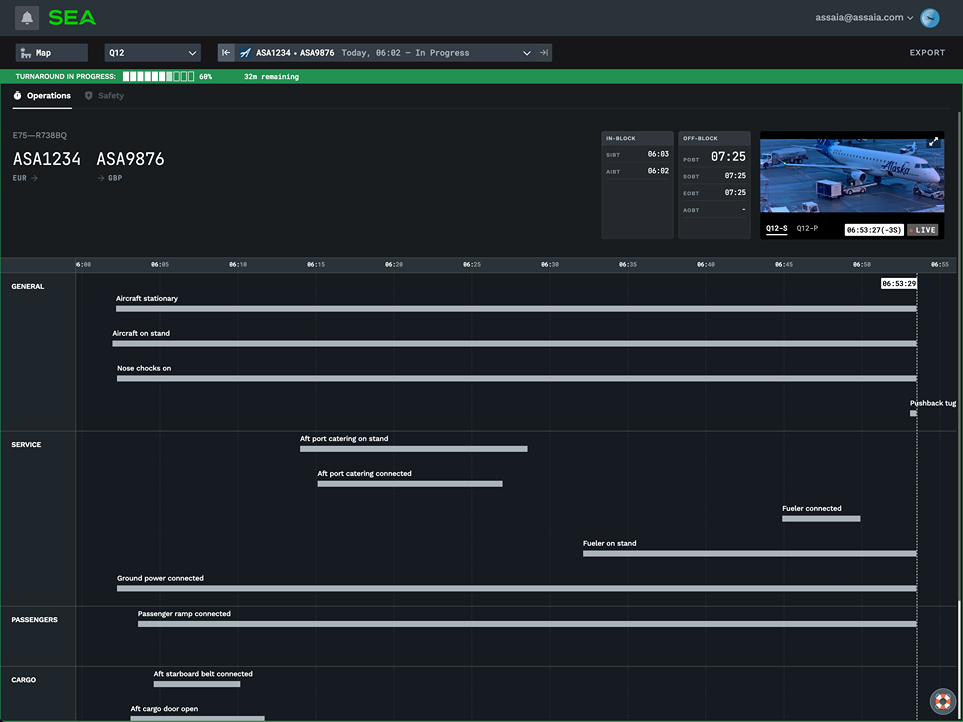
This is where AI starts to look less like a dashboard feature and more like a control-room aid. A predicted off-block time is useful because it gives station teams, gate planners, ramp coordinators, and airline operations centers a shared estimate before the official departure time becomes fantasy. A detected late task is useful because someone can still intervene while the aircraft is on stand. The value is not the computer vision label; it is the earlier exception.
Assaia publishes platform-wide performance claims of a 17% on-time performance improvement, a 5-minute ground delay reduction, and a 50% safety improvement. Those figures are vendor-published and should not be read as independently audited JFK Terminal 4 outcomes.[2] The closest comparable public benchmark in the research set is Rome Fiumicino, where the OAG/Microsoft report cites a 6% reduction in ground delay and a 4% improvement in turnaround time associated with Assaia deployment.[3]
That distinction is important. The Rome numbers make the turnaround use case credible; they do not prove the same percentages at JFK. Airport geography, airline mix, stand utilization, labor availability, and data-sharing rules all change the result. Still, the operating mechanism is easy to understand: if a late or out-of-sequence turnaround task is visible earlier, the recovery window opens earlier.
Passenger flow is the other half of the Terminal 4 picture
Inside JFK Terminal 4, Beonic’s case study describes a LiDAR and AI-based passenger-flow system that predicts queue length and staffing needs, with operational signals shared across teams. Roel Huinink, President and CEO of JFKIAT, is identified in the case study as the executive sponsor for the work.[4]
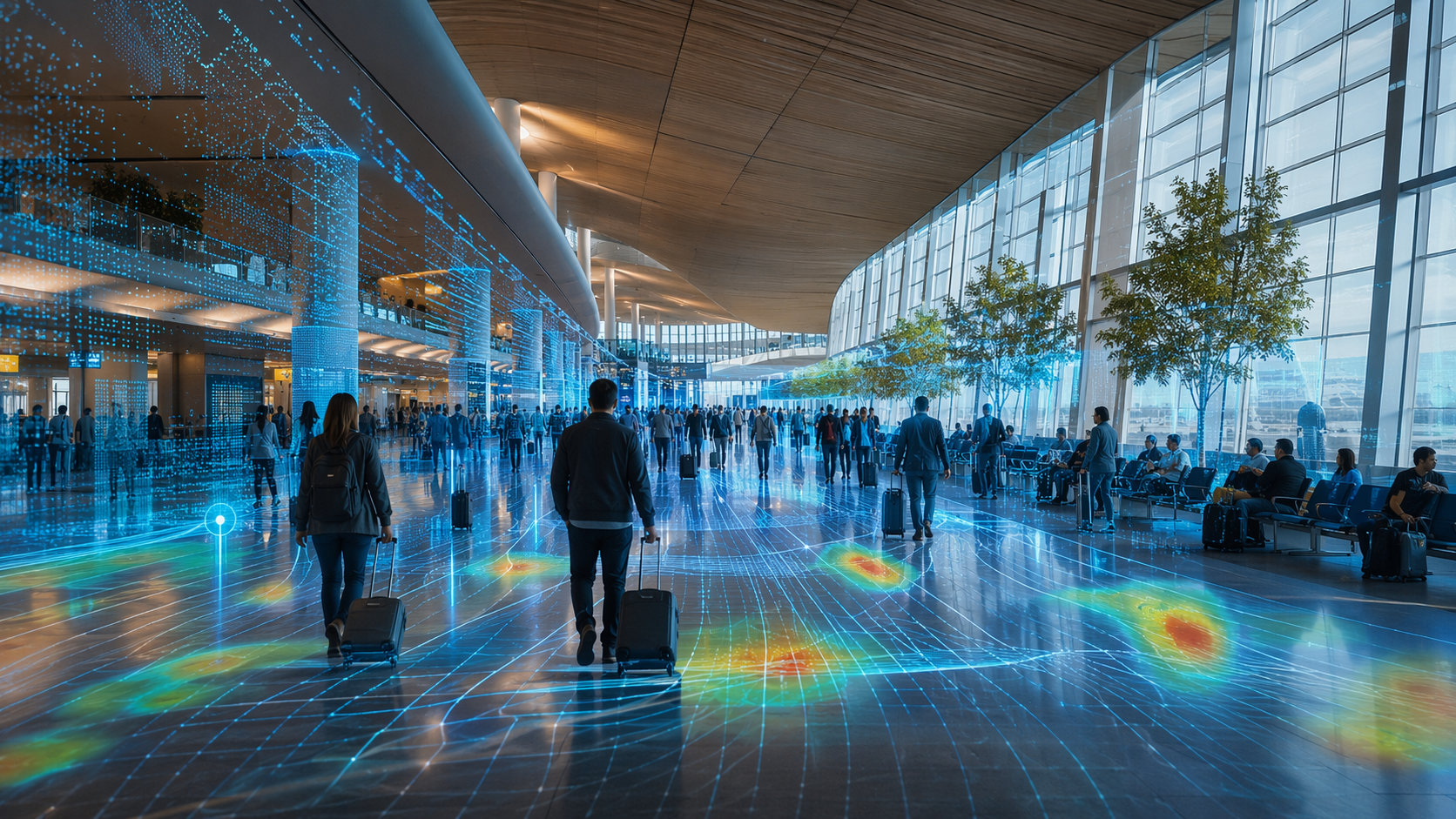
A queue sensor will not clear a thunderstorm line or add a runway slot. It can, however, prevent one disruption from spilling into another. When passenger-flow teams see a checkpoint, lobby, or processing area building faster than expected, the response can move from after-the-fact crowd control to earlier staffing and routing decisions. In a terminal environment, that can be the difference between a line that is irritating and a line that starts causing missed bags, late boarding, and rebooking pressure.
The Terminal 4 combination is the cleanest example of AI disruption management as workflow rather than product category. ApronAI watches the aircraft turn. Beonic watches the passenger stream. The airport and terminal teams can use both to narrow the time between signal and response. That is the part many AI sales narratives blur: the system is only useful if it changes who acts, when they act, and what they know before the situation becomes unrecoverable.
LaGuardia’s clearest case is baggage screening capacity
LaGuardia Terminal B appears in the NYC AI picture through a more specific, less glamorous use case: automated baggage screening. In coverage of a Vaughn College panel on artificial intelligence at NYC airports, Metro Airport News reported that Terminal B had 55 autonomous mobile inspection tables, with Suzette Noble, CEO of LaGuardia Gateway Partners, discussing AI use in the terminal context.[5]
For disruption management, baggage screening capacity matters because bags create hard downstream commitments. A passenger can be rebooked, rerouted, or held at a gate; a screened bag has to move through a physical chain with fewer improvisation options. When inspection capacity falls behind, the delay can show up as late bags, missed load plans, hold decisions, and extra coordination between airline station teams and baggage operations.
The public evidence here is deployment evidence, not audited performance evidence. The 55-table figure is concrete, and the use case is operationally relevant. What is missing from the public record is a before-and-after measure tied to Terminal B: screening throughput, bag dwell time, alarm resolution time, staffing utilization, or downstream departure impact.
Newark shows why communication tools still count, but only after operations
Newark is where the disruption baseline is hardest to ignore. A 26.79% delay rate means the airport’s AI story cannot be judged only by passenger-facing convenience.[1] If the physical operation is saturated, a chatbot does not create gate capacity, ramp labor, airspace throughput, or controller staffing.
Still, communication is part of disruption management when it changes what stranded passengers and airport staff can do. In 2026, the Port Authority launched new airport websites for JFK, LaGuardia, Newark, and Stewart with AI-powered travel assistants. The assistants are meant to support traveler information across the airport sites, placing Newark inside a metro-wide passenger communication layer rather than a single-terminal pilot.[6]
That is a lower tier of operational recovery than turnaround monitoring or screening automation, but it is not irrelevant. During irregular operations, passenger uncertainty creates work: repeated questions, wrong queues, missed service options, and pressure on airline and airport staff who are already handling exceptions. An AI assistant earns its place if it reduces that avoidable load or directs passengers to the next usable action faster. Public materials confirm the launch; they do not yet show whether the assistants reduce call volume, queue pressure, misrouted passengers, or staff workload at NYC airports.[6]
What has been proven, and what has only been deployed
The answer to whether AI is actually being deployed for airport disruption management in NYC is yes. JFK has production examples in aircraft turnaround monitoring and passenger-flow prediction. LaGuardia has a reported automated baggage screening installation. The Port Authority has put AI travel assistants across JFK, LGA, EWR, and SWF. The harder investment question is whether the public evidence is strong enough to prove measurable NYC-specific gains.
| Use case | NYC deployment evidence | Outcome evidence available publicly | How to read it |
|---|---|---|---|
| Computer vision turnaround monitoring | JFK Terminal 4 uses Assaia ApronAI | Vendor-published platform claims; comparable Rome Fiumicino figures from OAG/Microsoft | Strong use-case fit, but JFK-specific audited outcomes are not public |
| Passenger-flow prediction | JFK Terminal 4 uses Beonic LiDAR and AI passenger-flow monitoring | Case study confirms operational sharing and predictive staffing use | Good deployment evidence; public performance metrics are limited |
| Automated baggage screening | LaGuardia Terminal B reported 55 autonomous mobile inspection tables | No public before-and-after operational metric in the research set | Concrete capacity deployment; impact needs independent measurement |
| AI travel assistants | Port Authority launched assistants for JFK, LGA, EWR, and SWF websites | Launch confirmation, not outcome measurement | Useful for disruption communication if it reduces passenger and staff friction |
The evidence tiers are uneven, and that is normal for airport technology. Deployment usually becomes visible before performance data does. A vendor can show the screen. A terminal operator can describe the workflow. Independent measurement takes longer because the result is tangled with schedule design, weather, airline processes, TSA conditions, ramp staffing, and airspace constraints.
The business case is not small. Airlines for America reported a 2024 estimated delay cost of $100.76 per minute for U.S. passenger carriers.[7] Against that cost base, a credible reduction in ground delay or avoidable passenger-processing friction does not need to sound dramatic to matter. A few minutes recovered repeatedly across banks, turns, and queues can justify attention quickly. The problem is that buyers should demand the metric be tied to the actual operating scope, not to a platform average.
The useful AI categories are narrower than the airport AI label
Putting every deployment under “airport AI” hides the important differences. The tools at NYC airports do not operate on the same problem, and they should not be evaluated with the same metric.
- Computer vision for turnarounds should be judged on off-block prediction accuracy, late-task detection, ground delay, safety events, and on-time performance within the airport or terminal scope.
- Predictive passenger-flow sensing should be judged on queue forecast accuracy, staffing response time, congestion duration, missed processing targets, and whether operational teams actually use the same signals.
- Automated baggage screening should be judged on inspection throughput, alarm handling, bag dwell time, staffing efficiency, and downstream departure impact.
- AI travel assistants should be judged on containment of routine questions, reduction in misdirected passengers, staff workload relief, and whether passengers receive actionable disruption guidance.
Those categories also carry different risk profiles. A travel assistant that gives weak advice creates passenger frustration. A turnaround monitoring model that misses a repeated ramp exception can distort the recovery plan. A passenger-flow forecast that is not trusted by terminal staff becomes another unused screen. The failure mode is not always technical; often it is that the signal never reaches the person who can act on it.
Why NYC is a credible benchmark, not a clean proof
NYC is useful precisely because it is messy. A technology that only works when gates are available, queues are mild, labor is abundant, and airspace is forgiving has limited value for real disruption management. JFK, LGA, and EWR force the question into the open: can the tool help teams recover sooner when there is little spare capacity?
The public record supports a balanced answer. AI disruption management technologies are already in production across the major NYC airport system. The most operationally meaningful deployments are closest to the physical bottlenecks: aircraft turns, terminal flow, and baggage screening. Passenger-facing assistants may help during disruption, but they sit downstream from the constraints that create the disruption in the first place.
What NYC does not yet provide is a clean, independently verified scorecard. The available materials confirm deployments and, in some cases, vendor or comparable-airport outcome claims. They do not yet give audited JFK, LaGuardia, or Newark before-and-after results by use case. For supply chain executives evaluating the investment, that means the use case is real, but diligence should move quickly from “does the AI exist?” to “which bottleneck did it reduce, under whose control, and by how much?”
The next proof point for NYC airports is not another pilot announcement. It is independently verified outcome data and better integration across FAA, airlines, airport operators, terminal companies, and ground-service teams. Until those signals travel across the same disruption chain that passengers and bags already do, AI will keep improving pieces of recovery faster than the system can prove the full effect.
References
- US Airport Statistics & Flight Cancellation Data, InsureMyTrip.
- Assaia.
- AI and Trusted Data, OAG/Microsoft.
- A New Standard of Airport Innovation: JFKIAT Case Study, Beonic.
- A Very Real Conversation About the Use of Artificial Intelligence at the NYC Airports, Metro Airport News.
- Port Authority Launches New Websites for Its Commercial Airports, Port Authority of New York and New Jersey, 2026.
- U.S. Passenger Carrier Delay Costs, Airlines for America, 2024.
Comments
Join the discussion with an anonymous comment.