
Why the IBP/S&OP Distinction Now Carries Tooling Consequences
Vendors marketing AI-capable planning platforms routinely position the same product as suitable for both S&OP and IBP environments. The capability claims — ML forecasting, probabilistic scenario simulation, autonomous exception handling — are presented as framework-agnostic. They are not.
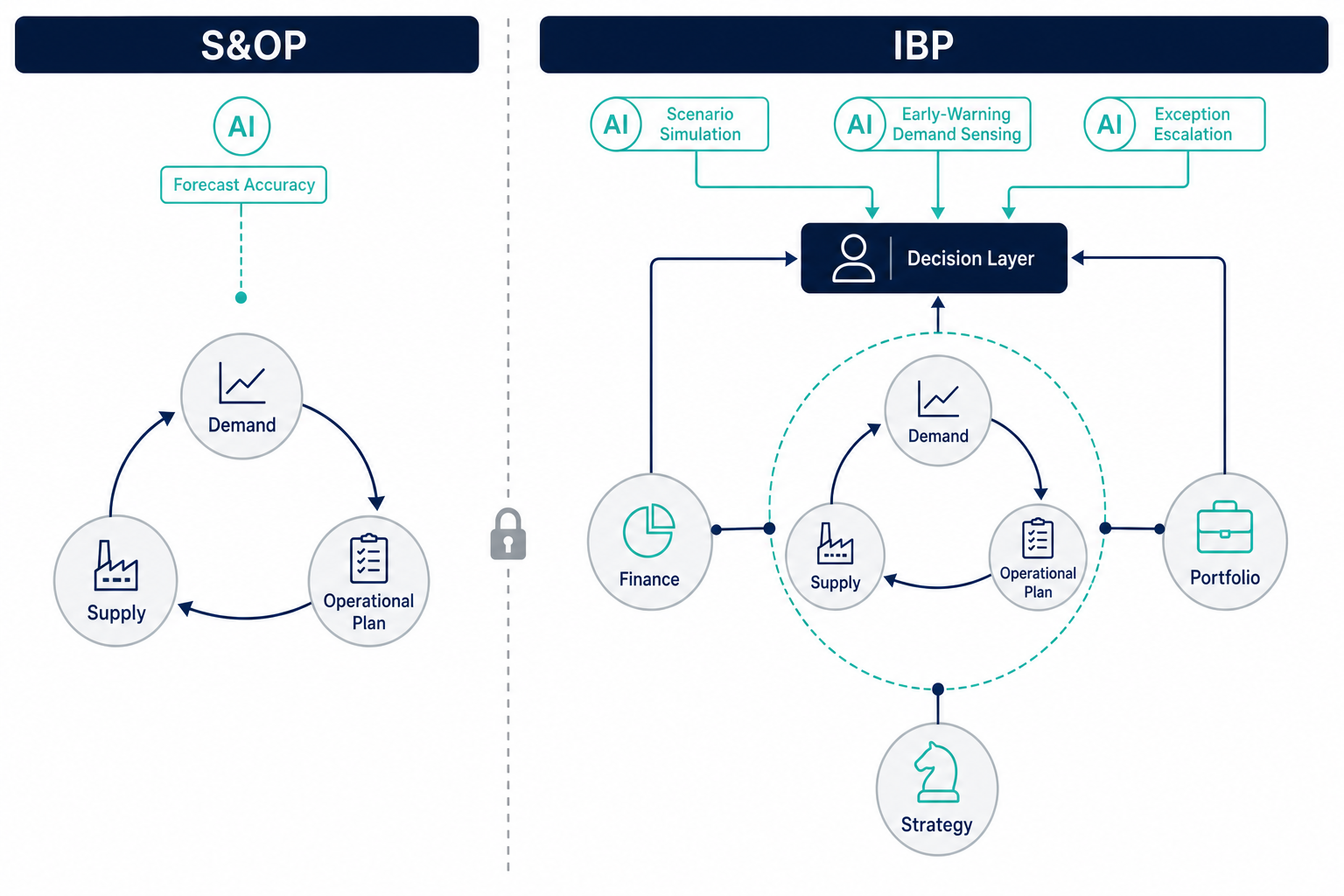
The organizational infrastructure available to act on AI outputs differs fundamentally between S&OP and IBP. A probabilistic scenario output that surfaces three demand paths with revenue and margin implications attached is decision-ready inside an IBP process where finance co-owns the plan and executive decision rights are formalized. Inside S&OP, the same output is a volume plan with no financial translation layer — it informs a conversation but cannot drive a trade-off decision at the executive level.
This is the operational cost of terminology confusion: organizations buy AI tooling calibrated to IBP process architecture and attempt to run it inside S&OP governance. The AI performs correctly. The organization cannot act on what it produces.
Structural Differences That AI Makes Consequential
The structural attributes below are not new — practitioners familiar with both frameworks recognize them. What has changed is that AI capabilities expose these differences as consequential tooling conditions, not just organizational design preferences. Each attribute below is framed around its AI mechanism implication.
| Structural Attribute | S&OP | IBP | AI Mechanism Consequence |
|---|---|---|---|
| Scope | Demand-supply balancing; operational functions | Enterprise-wide: commercial, financial, portfolio, operations | AI scenario outputs are bounded by scope — S&OP scenarios lack financial and portfolio dimensions needed for executive trade-off decisions |
| Time horizon | Typically 12–18 months | 24+ months minimum | AI demand sensing and early-warning signals deliver highest value at 24+ months, where capacity and sourcing decisions are still controllable; at 12–18 months, the same signals often arrive too late for structured response |
| Finance integration | Peripheral — finance reviews but does not co-own the plan | Central — finance is a co-owner; operational volumes are mapped to revenue, margin, and working capital | Without financial integration, AI scenario simulation produces volume plans, not decision-ready financial outputs; executives cannot approve a trade-off they cannot quantify |
| Decision rights | Implicit — escalation paths are informal or undefined | Formalized — RACI is explicit; who decides, who approves, who is informed is documented | AI exception management requires defined escalation paths to function; exceptions surfaced without resolution paths create noise, not decisions |
| Governance cadence | Periodic reviews — monthly cycle dominant | Continuous decision cycle — reviews are decision events, not status updates | AI continuous monitoring and signal feeds are underutilized in periodic-review governance; the cadence determines whether AI-generated signals can be acted on within the planning cycle |
AI Mechanism by Mechanism: What Each Technique Does Differently Inside S&OP vs. IBP
Treating AI as a single capability applied uniformly across planning frameworks misses the mechanism-level differences that determine whether AI investment delivers value. Each technique below has a distinct structural dependency.
ML Statistical Forecasting
ML-based demand forecasting improves statistical accuracy in both S&OP and IBP environments. This is the most widely deployed AI capability in planning platforms today and the least framework-dependent. The mechanism difference is not in the forecast itself — it is in what the forecast connects to downstream.
In S&OP, an improved ML forecast produces a more accurate demand signal feeding into a supply plan. The accuracy gain is real and operationally valuable. But without a financial translation layer, the improved forecast cannot directly inform revenue projections, margin trade-offs, or working capital decisions. It remains an operational input.
In IBP, the same improved ML forecast feeds into a process where finance co-owns the plan. Accuracy improvements propagate through to revenue and margin projections, creating a direct link between forecast quality and financial decision quality. The mechanism is identical; the downstream value is structurally different.
Probabilistic Scenario Simulation
Probabilistic scenario simulation is where the S&OP/IBP architectural difference is most consequential for AI value. The technique generates multiple demand and supply paths with associated probability distributions — rather than converging on a single most-likely plan.
In S&OP, simulation outputs are volume and operational: scenario A requires X units of capacity, scenario B requires Y. These are useful inputs to operational planning but do not constitute decision-ready executive outputs. There is no mechanism to attach revenue, margin, or working capital implications to each path.
In IBP, the same simulation produces scenario A with $X revenue impact, Y% margin implication, and Z weeks of working capital exposure — and scenario B with a different set of financial trade-offs. Executives can select a course of action, assign ownership, and track outcomes against a quantified commitment. The simulation is decision-ready because IBP's financial integration provides the translation layer S&OP lacks.
AI Demand Sensing and Early-Warning Signals
AI demand sensing — the use of near-real-time signals (POS data, search trends, social signals, early order patterns) to detect demand shifts before they appear in historical sales data — is covered in depth in the Demand Sensing vs. Demand Forecasting: Definitions, Differences, and AI Roles reference. The framework-level question here is where in the planning horizon these signals deliver the highest value.
AI early-warning signals that surface capacity constraints or supply risks 9 to 12 months out are most valuable inside IBP's 24+ month horizon. At that distance, procurement, supplier development, and capital allocation decisions are still controllable. The organization can respond with a structured plan.
Inside S&OP's 12–18 month horizon, the same signal arriving 9 to 12 months out leaves 3 to 6 months of planning window — often insufficient to execute meaningful supply-side responses. The signal is technically accurate; the planning architecture does not provide the time or governance to act on it.
Exception Management Automation
AI exception management identifies deviations from plan — demand spikes, supply shortfalls, inventory threshold breaches — and routes them for resolution. The mechanism is straightforward. Its structural dependency is on governance design.
In IBP, formalized decision rights and RACI clarity mean exceptions have defined resolution paths. An AI-surfaced exception routes to the correct decision owner with the authority and information to resolve it within the planning cycle. The exception becomes a decision.
In S&OP, where escalation paths are informal or undefined, the same AI-surfaced exception enters a meeting without a clear owner or resolution mechanism. It generates discussion but not necessarily a decision. AI exception management in this environment produces more visible noise, not more resolved problems.
Agentic AI: The Current Production Reality
This matters for the IBP/S&OP evaluation because much of the vendor pitch for IBP platform AI implies autonomous continuous planning. The gap between that framing and current production capability is significant. The mechanism-level analysis above applies to what is deployable today — ML forecasting, probabilistic simulation, rule-based exception routing, and demand sensing. Agentic capabilities require evaluation against the specific vendor's pilot program status, not its product roadmap.
Why AI Scenario Simulation Specifically Requires IBP-Level Financial Integration
The scenario simulation mechanism warrants deeper examination because it is the AI capability most frequently cited as justification for moving from S&OP to IBP — and the one most often misunderstood.
The value of AI-accelerated scenario simulation is not primarily in the speed of generating scenarios. It is in the speed at which teams can compare options and see impact on service, inventory, and financials quickly enough to make decisions within the planning cycle. Speed without financial translation produces faster volume comparisons — which is operationally useful but not what drives executive alignment.
What makes scenario simulation decision-ready at the executive level is the financial translation layer: each scenario must carry quantified implications for revenue, margin, inventory value, cash, and service. Without that translation, executives reviewing scenarios are comparing operational configurations, not business outcomes. They cannot select a course of action with confidence because the trade-off is not quantified.
This is precisely why AI does not dissolve the IBP/S&OP distinction — it sharpens it. AI can generate and evaluate scenarios faster than any manual process. But the output quality at the executive level is determined by whether finance is integrated into the planning architecture, not by the sophistication of the AI model. A faster volume plan is still a volume plan.
RACI clarity compounds this. In mature IBP, roles are explicitly defined: who prepares scenarios, who approves trade-offs, who must be consulted, who is informed after decisions. AI tooling makes it easier to focus meetings on decisions by providing trusted numbers and transparent assumptions — but only when the governance structure exists to receive and act on those inputs. Technology does not replace governance; it depends on it.
Non-Negotiable Prerequisites: Data, Financial Linkage, and Governance
Organizations that treat IBP as a software procurement decision consistently underdeliver on AI-enabled planning. The gap is not in the technology. It is in the foundational conditions that determine whether AI outputs are trustworthy and actionable. Four prerequisites are non-negotiable.
Master Data Quality and Harmonization
Leading organizations use 15 to 20 distinct data sets for demand planning alone. This breadth requires harmonized master data — consistent product hierarchies, customer classifications, and location structures — across systems that were not designed to share definitions. Without harmonization, AI models train on inconsistent signals and produce outputs that planners correctly distrust.
Financial-Operational Data Linkage
IBP requires a live mapping between operational volumes and their financial expressions: revenue by product line, margin by channel, inventory value by location, working capital exposure by scenario. Without this linkage, AI scenario outputs are cost-free volume plans — they describe operational configurations without quantifying their financial consequences.
Building this linkage is not a data engineering task alone. It requires agreement between finance and operations on how volumes translate to financial outcomes — which cost allocations apply, which revenue assumptions are used, which inventory valuation method is authoritative. This is organizational alignment work that precedes any AI deployment.
The working capital dimension is particularly consequential. AI-enabled IBP can reduce inventories by 15 to 30 percent according to BCG's 2023 benchmarks — but realizing that reduction requires that inventory decisions are made against working capital targets, not just service level targets. For more on how AI-driven optimization connects to inventory policy design, see the AI Safety Stock Optimization for High-SKU Retail: SCOR Plan Stage Reference reference.
Governance Redesign: Decision Rights and Single-Number Discipline
McKinsey's research shows that for two-thirds of organizations, IBP meetings function as periodic business reviews rather than integrated decision cycles. AI adds negligible value on top of this governance deficit. If the meeting is a status update rather than a decision event, AI-generated scenarios and exceptions have nowhere to go.
Governance redesign requires four specific elements before AI tooling is introduced:
- Decision rights clarity: which decisions are made at which organizational level, by which role, with what information.
- RACI documentation: who prepares scenarios, who approves trade-offs, who is consulted, who is informed — documented and enforced, not assumed.
- Escalation thresholds: explicit criteria for when an exception requires escalation versus local resolution, so AI-surfaced exceptions route correctly.
- Single-number discipline: one authoritative demand number used across finance, operations, and commercial — AI models cannot reconcile competing internal forecasts.
Planner Role Transformation
The planner role in AI-augmented IBP changes in four concrete ways. Most IBP implementations underestimate the capability investment required to make this transition real — and the failure shows up as low adoption of AI outputs, continued reliance on manual overrides, and AI models that degrade because planners do not trust or engage with them.
| Role Shift | From | To | Capability Investment Required |
|---|---|---|---|
| Model Overseer | Manual forecast creator — building and adjusting statistical models | Monitoring AI model performance, identifying drift, adjusting inputs and parameters | Statistical literacy, model evaluation skills, understanding of training data dependencies |
| Scenario Strategist | Producing one consensus forecast | Designing and interpreting multiple demand scenarios with probability weights and financial implications | Financial acumen, scenario framing skills, understanding of business levers |
| Exception Manager | Reviewing all plan deviations manually | Triaging AI-surfaced exceptions, applying judgment to edge cases, routing structured decisions | Exception classification skills, escalation judgment, understanding of decision thresholds |
| Assumption Governor | Accepting model defaults | Documenting, challenging, and updating the assumptions driving AI model behavior — promotions, launches, market shifts | Business context knowledge, assumption documentation discipline, cross-functional communication |
When S&OP + AI Is Sufficient vs. When IBP + AI Is Warranted
S&OP augmented with AI is a valid and sufficient target state for many organizations. The decision to move to IBP should be driven by genuine organizational challenges — not by vendor positioning, peer benchmarking, or the assumption that IBP is inherently superior.
| Organizational Signal | S&OP + AI Sufficient? | IBP + AI Warranted? |
|---|---|---|
| Primary challenge is demand-supply balancing and forecast accuracy | Yes — ML forecasting and exception management deliver value inside S&OP | Not required; adding IBP complexity without financial integration need adds overhead without proportional value |
| Finance and operations run on separate plans with regular reconciliation friction | No — AI cannot bridge disconnected financial and operational data architectures | Yes — IBP financial integration resolves the structural disconnect AI cannot compensate for |
| Commercial decisions (pricing, promotions, portfolio) regularly override supply plans without visibility into consequences | No — S&OP lacks the portfolio and financial integration to quantify commercial trade-offs | Yes — IBP provides the architecture to connect commercial decisions to financial and operational outcomes |
| Executive team is regularly pulled into operational gap-closing rather than strategic decisions | Signal of governance deficit — fix governance before adding AI in either framework | IBP + AI warranted only after decision rights and escalation design are resolved |
| Portfolio complexity: multiple product lines, channels, or geographies with competing resource claims | S&OP handles single-dimension balancing; portfolio trade-offs exceed its scope | Yes — IBP's enterprise scope and financial integration are designed for this complexity |
| Planning horizon challenge is 12–18 months and the primary need is operational accuracy | Yes — S&OP + AI addresses this directly | IBP adds overhead without proportional benefit if the challenge is purely operational accuracy at short horizon |
Scrutinizing Vendor AI Claims: What IBP Platform AI Actually Is in Production
The gap between vendor AI marketing language and production capability in IBP platforms is substantial as of Q2 2026. Practitioners evaluating AI-capable planning platforms need a practical filter for distinguishing what is deployable from what is on the product roadmap.
Note that the source above is vendor-produced content from Board, a planning software company. It is cited here specifically because it acknowledges the infancy of agentic AI in enterprise planning with unusual candor — and because it references Gartner's prediction that at least 15% of day-to-day work decisions will be made autonomously by AI agents by 2028, up from essentially zero today. That framing makes the current gap explicit.
A practical filter for evaluating vendor AI claims in IBP platform contexts:
- Ask whether the AI feature is in general availability or in limited release / preview. Many AI agent capabilities in planning platforms are in private pilot or preview mode as of Q2 2026 — expect ongoing refinement and do not build implementation plans around preview features.
- Distinguish ML statistical forecasting from agentic AI. Most production AI in IBP platforms today is the former — gradient boosting, ensemble methods, or similar techniques applied to demand history. This is valuable but is not autonomous planning.
- Ask what the AI model does when it encounters data it has not seen before — new product launches, demand disruptions, structural market shifts. Rule-based automation breaks at edge cases; genuine ML models degrade gracefully with human override mechanisms. The answer reveals the actual technique.
- Require reference customers who have run the specific AI capability in production — not pilot — for at least 12 months in an environment comparable in complexity to your own. Vendor-produced case studies without independent verification are insufficient.
- Evaluate the vendor's explainability tooling. If planners cannot understand why the AI produced a specific forecast or exception, adoption will fail regardless of model accuracy. Explainability is a governance requirement, not a nice-to-have.
Implementation Sequencing: Process Maturity Before AI Layer
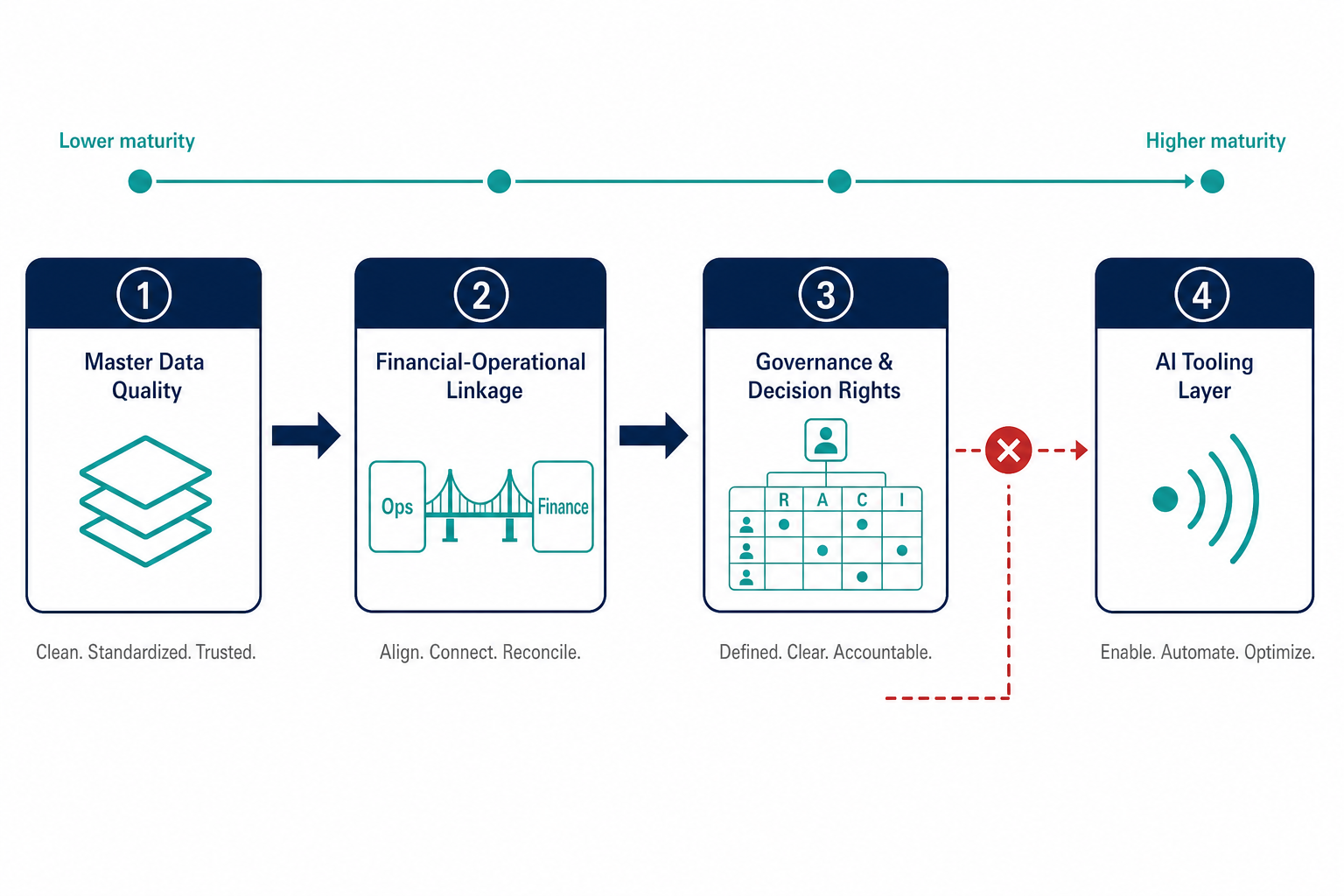
The most consistent failure pattern in AI-enabled IBP implementations is sequence inversion: organizations invest in AI tooling before resolving the foundational conditions that determine whether AI outputs are trustworthy and actionable. The result is not a failed AI deployment — the AI performs as designed. The result is a functioning AI layer producing outputs that the organization cannot trust, interpret, or act on.
BCG's 2023 research documents this pattern explicitly: many organizations that implemented AI-enabled IBP platforms reported realizing less value than expected, primarily because of poor adoption rates, misaligned processes, and lack of connectivity between IBP tools. The technology was not the failure point. The foundational conditions were.
The correct sequence:
- Fix master data. Harmonize product hierarchies, customer classifications, and location structures across source systems. Establish data governance ownership — who is accountable for data quality in each domain. This is not a one-time project; it is an ongoing operational discipline. AI models trained on unharmonized data will produce outputs that planners correctly override, and the override behavior will become entrenched.
- Establish financial-operational data linkage. Map operational volumes to revenue, margin, inventory value, and working capital. Agree on the financial translation rules between finance and operations before any AI scenario tool is deployed. Without this linkage, AI scenario simulation cannot produce the financially quantified outputs that justify IBP's governance overhead.
- Redesign governance and decision rights. Document RACI, establish escalation thresholds, enforce single-number discipline, and convert planning meetings from status reviews to decision events. McKinsey's data shows that two-thirds of IBP implementations fail to make this transition — they run periodic reviews and call them IBP. AI adds no value on top of a governance structure that cannot make decisions.
- Layer AI tooling. With master data clean, financial linkage established, and governance operational, AI tooling can deliver on its mechanism-level value: improved forecast accuracy, faster scenario comparison, earlier exception surfacing, and structured escalation routing. The AI is now operating inside a process architecture that can act on its outputs.
Mature IBP practitioners who complete this sequence realize measurable operational outcomes. McKinsey's research attributes one to two additional EBIT percentage points to mature IBP, with service levels 5 to 20 percentage points higher, freight costs and capital intensity 10 to 15 percent lower, and customer delivery penalties and missed sales 40 to 50 percent lower. These are governance and process outcomes that AI tooling accelerates — not outcomes that AI tooling creates independently of the process conditions underneath it.
Comments
Join the discussion with an anonymous comment.