
A supply chain AI project rarely fails compliance at the demo screen. It fails one handoff earlier: a supplier uploads quality records, a logistics device streams location and condition data, a planning vendor normalizes the feed, an internal analytics team changes model thresholds, and a procurement manager treats the result as a supplier-risk signal. By the time someone asks whether the EU AI Act applies, the data has already moved through several parties that may not agree on who owns the documentation, who checked the dataset, or who changed the system enough to inherit provider obligations.
That is why EU AI regulation has made supply chain data sharing more than a narrow IT integration topic. The penalty ceiling explains the urgency: EU AI Act enforcement can reach up to €35 million or 7% of total worldwide annual turnover for certain violations, while prohibited-practice rules have applied since February 2025. At the same time, the May 2026 Digital Omnibus legislative agreement has proposed extending deadlines for high-risk standalone systems to December 2027 and AI embedded in regulated products to August 2028, leaving companies in an uncomfortable planning window rather than a clean pause button.[1]
Classification is still the first gate. A demand-forecasting model, inventory optimizer, supplier-risk scoring tool, or warehouse automation system should not be casually labeled high-risk just because it uses AI. Nor should it be waved through as minimal-risk because a vendor says it keeps a human in the loop. The classification analysis belongs in the file before the data-sharing plan begins; ChainSignal’s earlier guide to high-risk classification for AI procurement and planning tools is the place to revisit that threshold question. After that gate, data, vendor roles, contracts, and connected-device access rights decide whether the compliance position can survive review.

Start With the Handoff Map, Not the Vendor Slide
A practical compliance file should begin with a map of the system and the data handoffs around it. The useful question is not only “Who sold us the AI tool?” It is “Who provided the data, who transformed it, who used it to train, validate, or test the system, who modified the system after deployment, and who relies on the output?”
For a supply chain organization, that map usually includes more than the AI vendor. It may include suppliers contributing performance data, carriers and warehouse operators producing operational records, device manufacturers or lessors controlling connected logistics equipment, ERP and planning-system vendors moving master data, and internal teams adjusting model behavior after go-live. Each party can change the factual answer to a compliance question.
| Compliance question | What to document | Why it matters |
|---|---|---|
| What is the AI system and intended use? | Tool name, model function, deployment context, business decision supported, human review point | Risk classification depends on use, not only the software category |
| Who is the provider, distributor, importer, and deployer? | Contracting entity, EU market role, operational controller, post-deployment modifier | Obligations attach to legal roles, and roles can shift |
| What data enters training, validation, testing, and operation? | Source system, supplier or device origin, transformation step, quality owner, retention rule | Article 10 turns dataset quality into a governed obligation |
| Who can access connected-device data? | Device user, Data Holder, access request process, permitted recipient, restrictions | The EU Data Act can create mandatory sharing rights before the AI team uses the data |
| What does the contract require? | Documentation, audit rights, change notice, data-quality warranties, incident cooperation | Vendor reassurance is not evidence unless the obligation is enforceable |
This map should be maintained as an operating artifact, not as a one-time procurement appendix. Supply chain systems change through connector upgrades, new supplier feeds, regional rollouts, and analytics tweaks. Those changes are exactly where AI Act role assumptions can become stale.
Run the Article 25 Role Audit Before Deployment Changes Go Live
The most dangerous sentence in many AI procurement files is “We are only the customer.” Under Article 25, a distributor, importer, deployer, or other third party that substantially modifies a high-risk AI system can be treated as the provider, taking on the provider’s obligations rather than only downstream user duties. Reed Smith’s supply-chain analysis highlights this reclassification risk for businesses along the AI supply chain.[2]
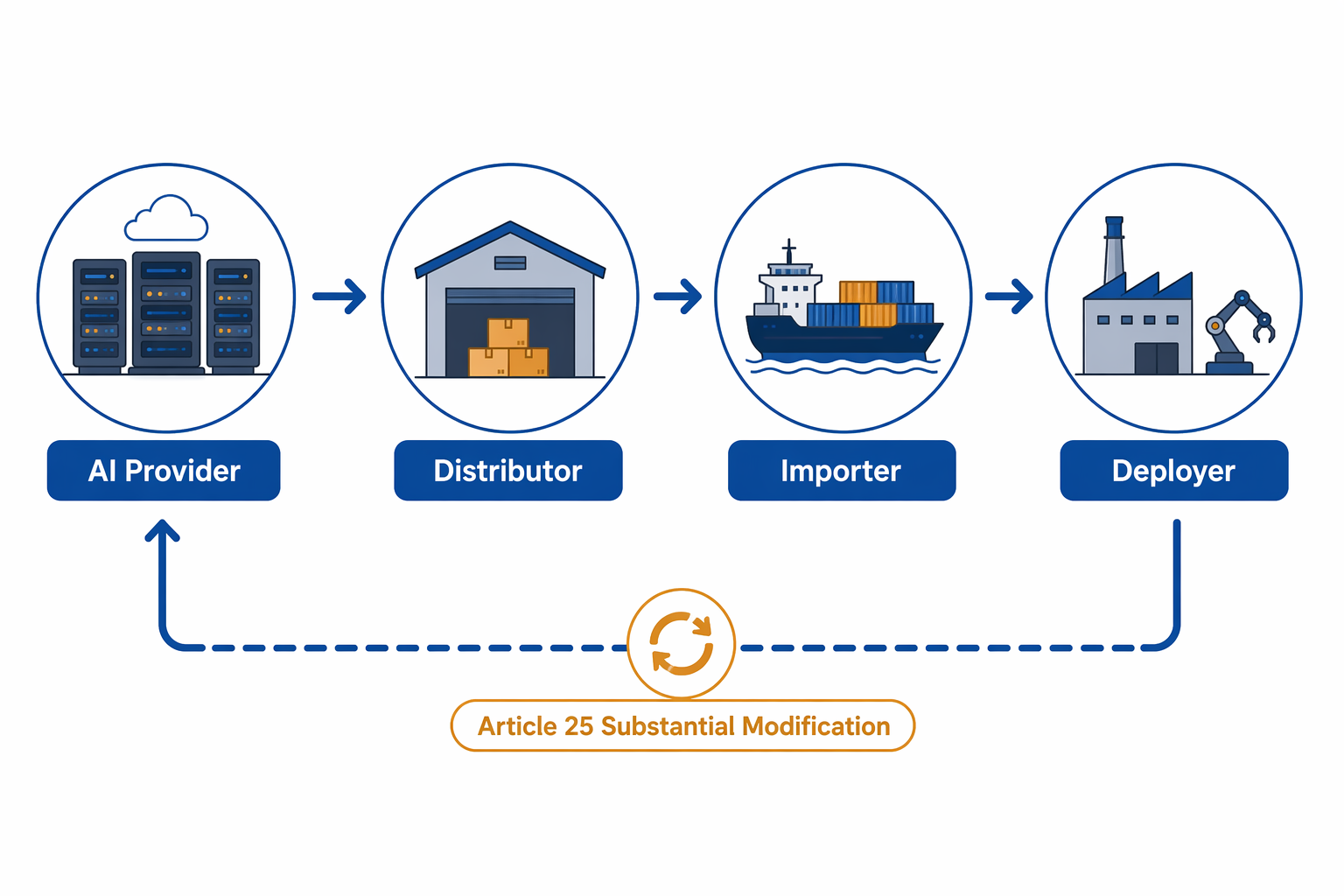
In supply chain deployments, substantial modification risk is rarely theatrical. It may appear when a company retrains or fine-tunes a vendor model on its supplier data, expands a tool from forecasting into supplier performance scoring, changes output thresholds that affect procurement decisions, integrates additional device feeds that alter model behavior, or repackages the system for affiliates and distributors. Whether a specific change crosses the legal threshold remains fact-dependent, but the audit should force the question before the change goes live.
The role audit should therefore separate ordinary configuration from changes that may affect intended purpose, performance, risk controls, or user reliance. A warehouse planner changing a dashboard filter is not the same event as an analytics team retraining a supplier-risk model on new categories of supplier incident data. A procurement director adding a new supplier attribute may not be the same as shifting the model from advisory ranking to automated exclusion from tender invitations. The file should show who approved the change, what testing occurred, what documentation changed, and whether legal reviewed the Article 25 consequence.
- Record each AI system’s legal role allocation: provider, importer, distributor, deployer, and any downstream operator.
- Require change notices from vendors before model, intended-use, data-source, or performance-control changes.
- Create an internal substantial-modification review for retraining, fine-tuning, new data categories, new use cases, and automated-decision expansion.
- Keep evidence that human oversight, testing, logging, documentation, and user instructions still match the system after modification.
- Do not accept a vendor’s role label as conclusive if internal teams materially change the system after deployment.
The point is not to freeze every operational adjustment. It is to stop treating deployment changes as purely technical tickets when they may change the company’s legal position.
Article 10 Makes Data Quality a Compliance Control
Article 10 is where supply chain data sharing becomes hard to bluff. For high-risk AI systems using data for training, validation, and testing, datasets must be relevant, sufficiently representative, and, to the best extent possible, free of errors and complete. Article 10 also requires governance practices around data collection, preparation, assumptions, availability, suitability, bias-related examination where relevant, and identification of data gaps that may affect compliance.[3]
Those words land differently in supply chain operations than they do in a policy deck. Supplier master data may be incomplete because local teams use optional fields differently. Carrier performance records may overrepresent strategic lanes and underrepresent spot freight. Quality-incident records may reflect reporting discipline as much as actual defect frequency. Connected-device data may be technically abundant but still unsuitable if timestamps, calibration status, or missing intervals are not controlled.
A defensible Article 10 plan does not promise perfect data. The statutory language itself recognizes “to the best extent possible” for freedom from errors and completeness.[3] What the plan must show is governance: the company knows where the data came from, what it is supposed to represent, what has been excluded, which errors are known, who corrected or accepted them, and how the dataset remains suitable for the intended use.
| Article 10 control | Supply chain implementation |
|---|---|
| Relevance | Tie each data field to the model’s intended supply chain decision; remove fields collected only because they are easy to obtain |
| Representativeness | Check whether regions, suppliers, product categories, lanes, seasons, and facility types used in operation are reflected in training, validation, and testing data |
| Completeness | Track missing fields, missing periods, missing suppliers, and excluded operational events; record whether gaps are corrected or accepted |
| Error management | Define who validates source data, who resolves conflicts between systems, and when a dataset is rejected from model use |
| Transformation traceability | Document normalization, aggregation, enrichment, anonymization, and feature engineering before data enters the AI system |
| Ongoing suitability | Review data drift when suppliers, transport modes, markets, devices, or business rules change |
The uncomfortable work is assigning ownership. Procurement may own supplier attributes, logistics may own carrier and lane records, quality may own nonconformance data, IT may own integration integrity, and the AI vendor may own model-side preprocessing. If no one is accountable for the point where those records become training, validation, testing, or operational input, Article 10 compliance becomes a collection of good intentions.
Contracts Need to Allocate Evidence, Not Just Liability
Many legacy supply chain technology contracts were written for uptime, cybersecurity, service credits, and confidentiality. Those clauses still matter, but they do not answer the questions an AI Act audit will ask: What documentation must the provider deliver? What data-quality obligations does the deployer carry? Who maintains logs? Who notifies whom after a model or dataset change? Who helps respond when an output is challenged?
The EU’s Model Contractual Clauses for AI procurement, discussed in IAPP’s March 2025 practical guide, give public organizations and vendors a structured starting point for allocating AI-related obligations in procurement contracts. The clauses are not a magic compliance certificate, but they are useful because they move the discussion from general vendor comfort to specific duties around documentation, transparency, data governance, risk management, and cooperation.[4]
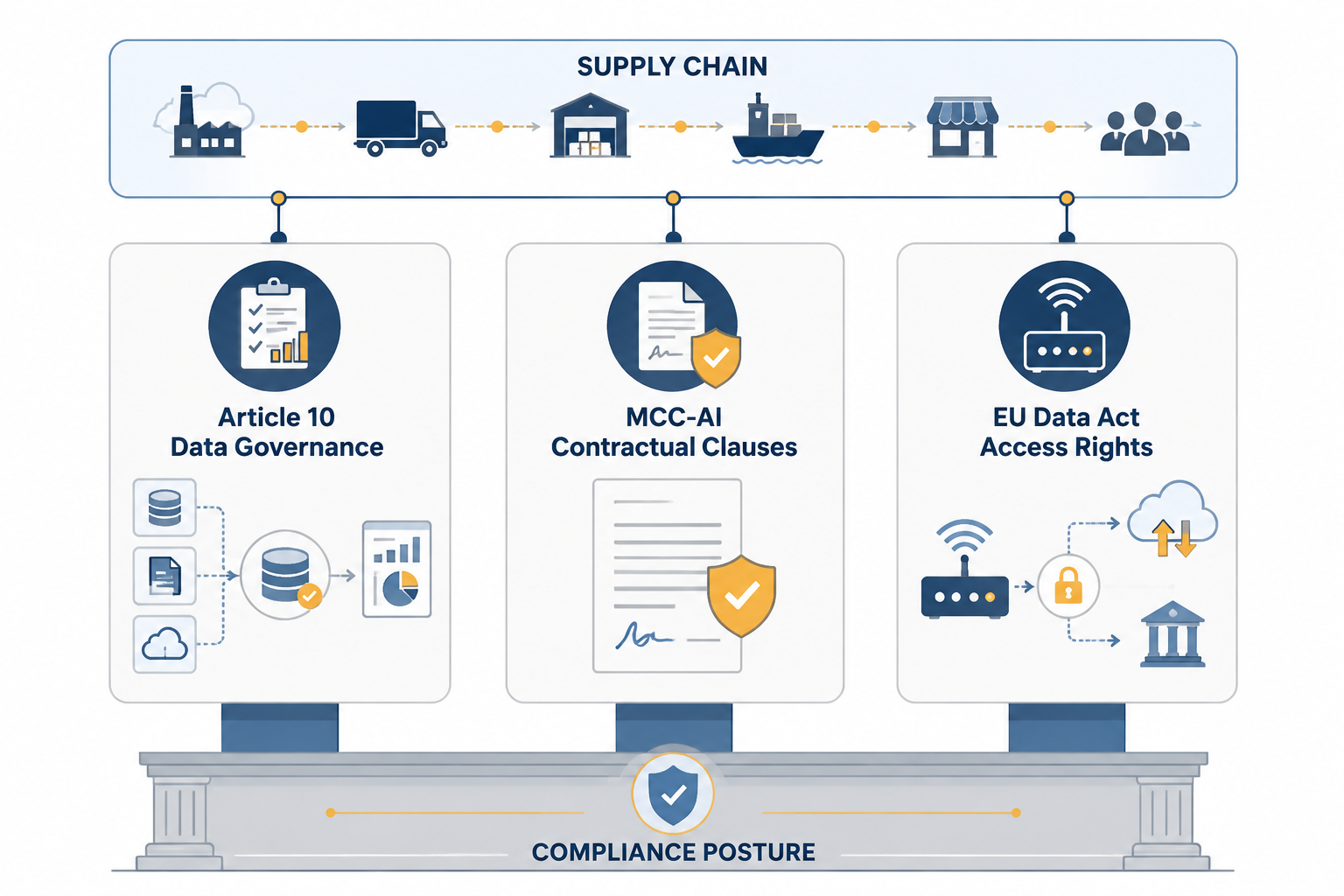
For private-sector supply chain buyers, the practical move is to translate MCC-AI-style controls into the vendor stack. The contract should say which party is responsible for dataset description, data lineage, quality checks, documentation updates, technical logging, user instructions, audit support, and change management. It should also say what happens when the buyer contributes data that the vendor uses to improve, test, or validate the system.
- Data-use boundaries: specify whether supplier, logistics, warehouse, or device data may be used for training, validation, testing, benchmarking, product improvement, or only service delivery.
- Documentation delivery: require system instructions, intended-use limits, data-governance descriptions, performance information, and audit-support materials appropriate to the buyer’s role.
- Quality cooperation: assign who checks source-data accuracy, who documents transformation, and who decides whether a dataset is fit for a high-risk AI use.
- Change control: require advance notice and approval for model updates, new data categories, intended-use changes, material performance changes, and subcontractor changes.
- Incident and challenge support: require timely cooperation if regulators, customers, workers, suppliers, or affected parties question the system’s output or data basis.
- Role protection: state that vendor assistance, configuration, and customization do not silently shift provider obligations without an Article 25 review.
The contract should not push every obligation onto the vendor if the buyer controls the relevant facts. A provider cannot make supplier master data representative if the buyer gives it only records from preferred suppliers. A deployer cannot prove appropriate use if the vendor refuses to disclose intended-use limits. The contract has to match the real handoff.
The EU Data Act Adds Another Route Into the Data
The EU Data Act changes the supply chain conversation because connected logistics assets produce operational data that may be valuable for AI systems. Trucks, containers, telematics units, warehouse equipment, and other connected products can generate data that users may have rights to access and share. Open Logistics Foundation’s August 2025 logistics analysis notes that companies leasing connected devices may themselves become Data Holders, creating mandatory sharing obligations rather than only contractual data-sharing options.[5]
That matters when a company wants to feed device data into an AI system for ETA prediction, inventory positioning, cold-chain monitoring, dock scheduling, or maintenance planning. The Data Act may help a user obtain access to data that previously sat with a device manufacturer, lessor, platform provider, or logistics partner. But access is not the same thing as AI Act readiness.
EU AI Risk’s analysis of AI Act and Data Act interaction describes the basic division: the Data Act can grant users of connected logistics devices direct access rights, while AI Act obligations still govern whether data used in high-risk AI systems satisfies quality and governance requirements under Article 10.[6] A company may have a right to receive data and still need to quarantine, clean, document, or reject it before using it for model training, validation, testing, or operation.
| Data Act question | AI Act follow-through |
|---|---|
| Are we the user of a connected product or related service? | Identify whether the data is relevant to an AI system and whether the AI use has been risk-classified |
| Are we a Data Holder with mandatory sharing duties? | Set controls so shared data is not later treated as model-ready without Article 10 checks |
| Can a third party receive the device data? | Check whether downstream AI vendors have contractual limits, documentation duties, and security controls |
| What data is technically available? | Separate raw access from suitability, representativeness, completeness, and error management |
| What restrictions apply to use and onward sharing? | Align Data Act access terms with AI vendor contracts and internal data-governance records |
The risk is a false sense of compliance from lawful access. A logistics team may properly obtain sensor data from connected equipment and still lack evidence that the data is complete across operating conditions, calibrated consistently, or representative of the lanes where the AI output will be used. A procurement team may receive supplier-related device data and still need to decide whether using it in a supplier-risk model changes the intended purpose or introduces bias and data-gap issues that require review.
A Workable Compliance Workflow
A supply chain leader does not need a perfect answer to every unresolved EU interpretive issue before improving control. The workflow should force documented decisions at the points where obligations actually attach.
- Inventory AI-enabled supply chain tools, including embedded functions in planning suites, supplier platforms, logistics systems, warehouse software, and connected-device services.
- Classify each use case and record the rationale, especially where demand forecasting, inventory optimization, or supplier scoring could plausibly be interpreted differently under forthcoming guidance.
- Map legal roles across provider, importer, distributor, deployer, Data Holder, connected-product user, data recipient, and subcontractor.
- Run an Article 25 review for post-deployment modification, fine-tuning, new data feeds, intended-use expansion, threshold changes, and redistribution to affiliates or partners.
- Build an Article 10 data file for high-risk systems, covering source, relevance, representativeness, completeness, error controls, transformation, assumptions, gaps, and ongoing suitability.
- Update vendor and supplier contracts with MCC-AI-aligned obligations for documentation, audit support, change control, data-use limits, quality cooperation, and incident response.
- Add a Data Act position for connected logistics devices, including access rights, Data Holder obligations, permitted recipients, and restrictions on onward AI use.
- Create governance checkpoints before new supplier datasets, device feeds, regions, facilities, or business decisions are added to the AI system.
The workflow is deliberately uneven. Some systems will need only a short classification memo and contract cleanup. Others will need a full role reclassification review, a fresh dataset assessment, and revised vendor obligations before deployment continues. The difference should be visible in the file.
What Good Evidence Looks Like
A compliance-ready supply chain organization can answer the regulator’s practical questions without reconstructing the project from emails. It can show the classification memo, the role map, the data-flow diagram, the Article 10 dataset assessment, the change-control log, the vendor contract, the Data Act access analysis, and the decision record for any substantial modification review.
It can also show where uncertainty remains. If a supplier-risk scoring tool sits in an unclear classification zone, the file should say why the organization reached its view, what assumptions it made, what guidance it is monitoring, and which controls it adopted anyway. If connected-device data is accessed under the Data Act but not used for model training because quality gaps remain unresolved, that restraint is evidence too.
The mistake is treating AI-enabled data exchange as business as usual because no one has yet objected. By Q3 2026, a defensible posture means documented risk classification, mapped data flows, Article 10 quality controls, MCC-AI-aligned contracts, and a clear Data Act access and sharing position before supplier, logistics, warehouse, or device data is allowed to become AI evidence.
References
- Compliance and Enforcement in Global AI Regulation: EU AI Act Risks and International Regulatory Challenges, Foley & Lardner, July 2026.
- EU’s AI Act Adds New Compliance Tasks on Businesses Along the Supply Chain, Reed Smith.
- Article 10: Data and Data Governance, Artificial Intelligence Act.
- EU Model Contractual Clauses for AI Procurement: A Practical Guide, IAPP, March 2025.
- What the EU Data Act Means for Logistics, Data Sharing and Open Source Innovation, Open Logistics Foundation, August 2025.
- EU Data Act & AI Synergy, EU AI Risk.
Comments
Join the discussion with an anonymous comment.