
The hardest question around wind-assisted propulsion is no longer whether a rotor sail, wing, or suction sail can reduce fuel consumption. It can. The harder question is whether the saving survives contact with the operating pattern that actually pays the bills: the charter, the weather window, the port call, the master’s judgment, the fuel price, the carbon exposure, and the retrofit invoice.
That is where the business case usually tightens. DNV’s summary of owner-reported WAPS retrofit performance puts fuel savings in the 4.5% to 9% range, while also noting that more than 28 vessels were equipped with WAPS by 2023 and more than 100 were projected by the end of 2025.[1] Those are useful numbers because they are not theatrical. They show that hardware alone can create measurable savings, but they also show why a finance team may hesitate. A single-digit reduction may be technically meaningful and still commercially fragile once downtime, maintenance, route variability, and carbon-accounting assumptions are added.
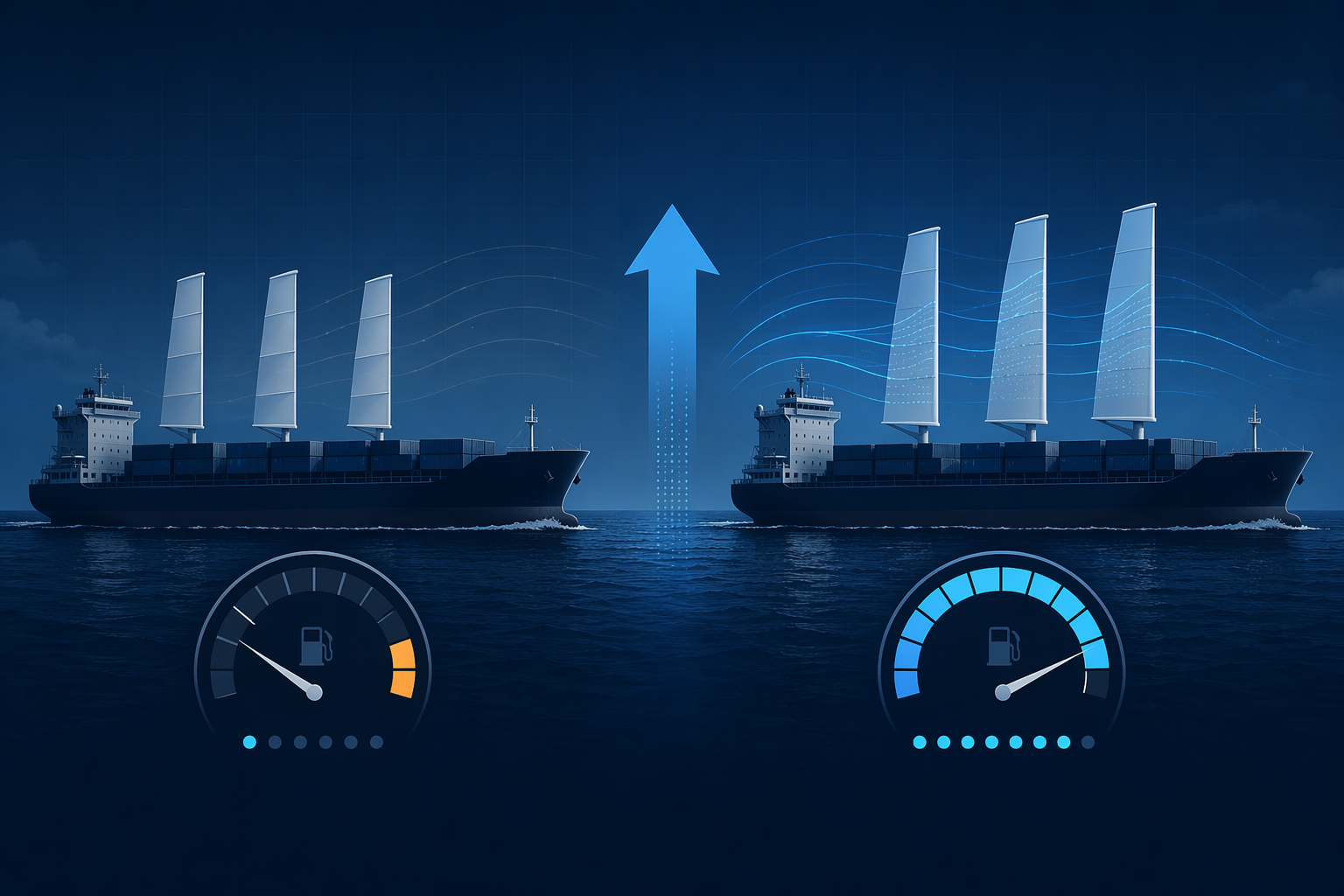
The strongest current evidence for the AI layer comes from a study by NAPA, Norsepower, and Sumitomo Heavy Industries Marine & Engineering. In that work, rotor sails alone produced 10.8% average fuel savings. When weather routing was added, the combined result rose to 17.7%, with an upper result reported at 28%.[2] The move from 10.8% to 17.7% is a 64% improvement over the hardware-only case. For fleet investment committees, that comparison matters more than another broad claim that artificial intelligence “optimizes routes.” It isolates the additional value created when the ship is not merely fitted with wind-assist equipment, but actively routed to use it.
The ROI Gap Is Between Installed Wind and Usable Wind
A WAPS retrofit gives a vessel a new physical capability. It does not, by itself, guarantee that the vessel will meet the wind angles, wind speeds, sea states, and schedule conditions that make that capability valuable. A rotor sail can generate thrust only when the voyage exposes it to usable apparent wind. A wing can reduce engine load only if the route and operating profile let it work often enough. The savings are therefore partly an engineering result and partly a decision result.
The NAPA/Norsepower/Sumitomo comparison is useful because it separates those two layers. The hardware-only result shows what the rotor sails contributed under the modeled operating assumptions. The weather-routing result shows what changed when the voyage plan was adjusted to capture more favorable wind. In practical terms, the AI and routing layer decides whether the vessel should accept a slightly different track, speed profile, or timing to increase WAPS thrust without creating unacceptable schedule or safety penalties.
| Evidence point | What it measures | Why it matters for ROI |
|---|---|---|
| DNV owner-reported retrofit range: 4.5% to 9% | Observed WAPS fuel-saving range reported from retrofit vessels | A realistic baseline for hardware-led savings before optimization claims are added |
| NAPA/Norsepower/Sumitomo rotor sails alone: 10.8% | Average fuel saving from rotor sails without weather-routing uplift | Shows that the hardware works, but also defines the comparison point |
| NAPA/Norsepower/Sumitomo with weather routing: 17.7% | Average combined saving when route optimization is added | Shows the incremental value of making voyage decisions around WAPS performance |
| NAPA/Norsepower/Sumitomo upper result: up to 28% | Best reported combined outcome in the study context | Useful as upside, but not as a universal planning assumption |
The wrong reading of that table is that every vessel should expect high-teens savings after buying software. The better reading is that the software layer can be large enough to change the investment case, but only when it is tied to vessel-specific performance and route-specific wind exposure. A bulker on long open-sea legs has a different opportunity set from a vessel that spends more time on constrained coastal trades. A voyage with schedule flexibility has more room to exploit wind than one locked into a narrow arrival window.
What the AI Layer Actually Does
AI-powered fuel optimization for wind-assisted shipping is easy to reduce to a software slogan. On a vessel, it is more concrete. The system has to compare forecast wind, ocean currents, vessel speed, engine load, weather risk, commercial constraints, and the actual thrust behavior of the installed WAPS device. Then it has to produce a voyage plan that people on board and ashore can execute.
The technical stack usually starts with real-time and forecast metocean data: wind fields, wave conditions, and ocean currents. Current integration matters because a route that looks attractive for wind may lose some of its value if it places the vessel against unfavorable current or sea-state penalties. Wind cannot be optimized as a single variable unless the schedule and fuel model are allowed to become misleading.
The next layer is the vessel model. A generic ship-performance curve is not enough for WAPS routing, because the software must estimate how the actual rotor, wing, or sail will behave at different apparent wind speeds and angles. Platforms such as Sofar Ocean’s Wayfinder and DeepSea’s Cassandra are described as using vessel-specific digital twins that model WAPS thrust as a function of wind speed and direction. That is the difference between saying “there is wind on the route” and estimating whether the installed device can turn that wind into useful propulsion.
After that comes dynamic recalculation. Weather routing is not a one-time line drawn before departure. Forecasts change, port instructions change, and the vessel’s actual performance may deviate from the plan. The useful optimization layer keeps rechecking whether the selected track still gives the best trade-off among fuel, schedule, safety, and wind-assist contribution. If it cannot update the plan in a form the bridge team can use, the model’s theoretical saving remains theoretical.
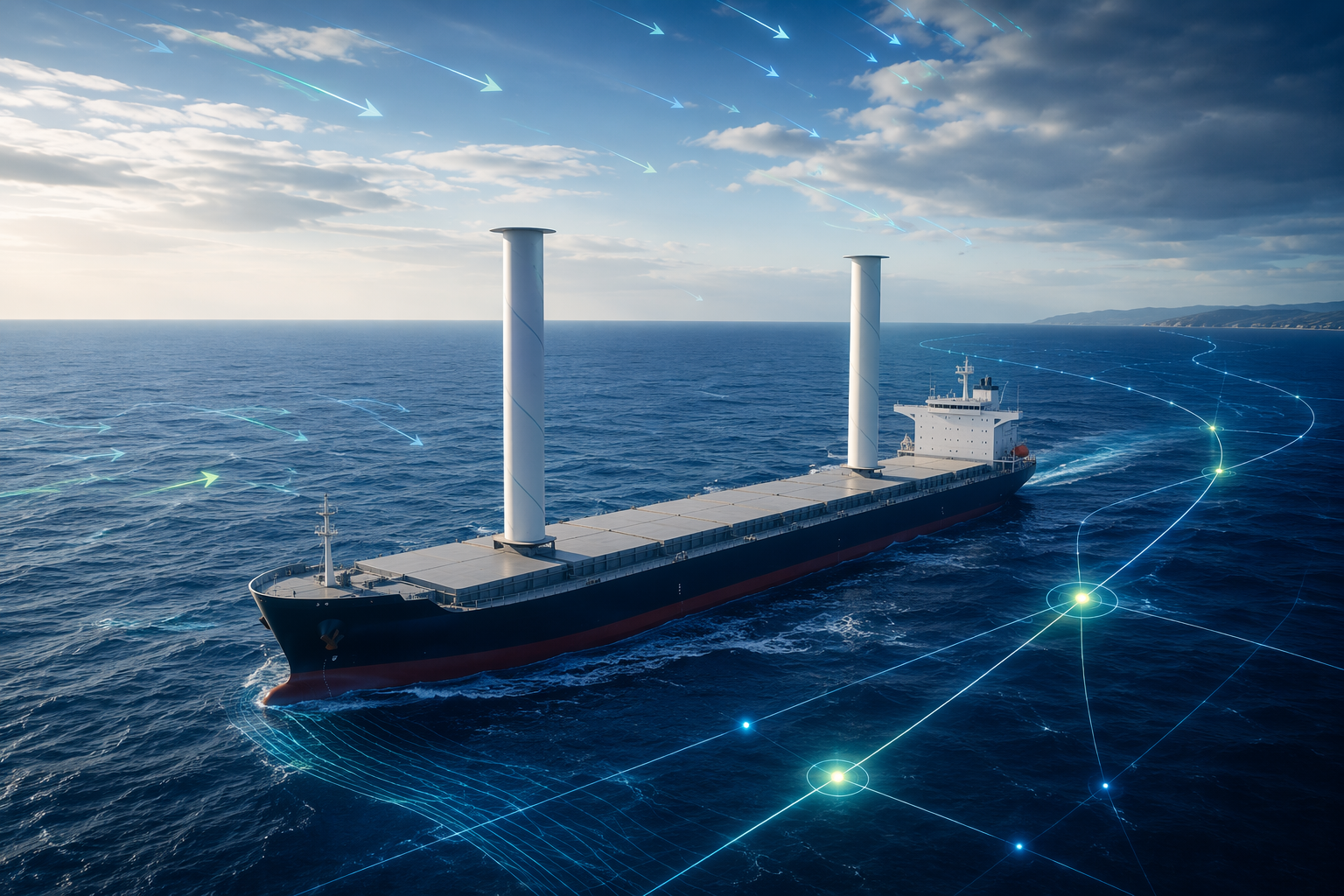
The last layer is performance accounting. For fleet operators, the value is not only a lower bunker bill on one voyage. The system also has to support Carbon Intensity Indicator monitoring and internal performance review. If a routing platform claims WAPS uplift, the operator needs to see whether the improvement appears in voyage reports, noon-report comparisons, emissions reporting, and longer-term vessel baselines. Otherwise, the claim is hard to defend after the installation photos have stopped circulating.
Promising Signals, With Qualifications Attached
The NAPA comparison is the cleanest evidence because it directly compares rotor sails alone with rotor sails plus routing. Other projects reinforce the direction of travel, but they should not be read as identical proof.
Connected Places Catapult has backed a deep reinforcement learning project for optimal weather routing of wind-assisted ships under uncertain metocean conditions.[3] That matters because uncertainty is the normal state at sea. A routing model that only performs well against stable forecasts is less useful than one designed to keep improving decisions as conditions change. The qualification is equally important: the project is still described as being in validation, not as a mature fleetwide commercial deployment.
Sofar Ocean and Berge Bulk have also reported a voyage-optimization demonstration using Sofar’s Wayfinder platform, comparing two identical vessels side by side and estimating 7.5% fuel savings per voyage for the AI-powered route.[4] The comparison structure is valuable, especially because identical-vessel comparisons are closer to the evidence operators want than a generic “up to” claim. But the result was simulation-based rather than a live A/B operational trial, so it belongs in the promising-evidence column rather than the settled-performance column.
Pyxis Ocean adds another kind of evidence: the operational visibility of large wind hardware. In comments reported by the International Chamber of Shipping, Yara Marine Technologies’ CEO said the Cargill-chartered Pyxis Ocean, fitted with two BAR Technologies WindWings, saved about 3 tonnes of fuel per day, and that each wing reduced CO2 emissions by about 4.65 tonnes per day.[5] That is a useful real-world signal, but it is not the same as a controlled estimate of routing uplift. It shows that wind hardware can produce daily fuel and emissions benefits; it does not by itself answer how much more could have been captured with a different voyage plan.
Why “Up to 30%” Needs a Route Attached
The shipping industry has a habit of letting the best case drift into the headline and the assumptions fall into the footnotes. Wind-assisted propulsion is especially vulnerable to that pattern because the hardware is visible and the physics are intuitive. If a wing looks powerful and the route is windy, a large saving feels plausible. That does not make it bankable.
CM Energy, a WAPS vendor, explains WAPS weather routing as a data-fusion process that uses wind, route, vessel, and weather inputs to maximize wind advantage.[6] That description is directionally right. It is also vendor-side material, so the claim needs to be read alongside more grounded ranges such as DNV’s 4.5% to 9% retrofit baseline and the NAPA/Norsepower/Sumitomo split between hardware-only and routed performance.[1][2]
There is also research indicating that AI-optimized wind propulsion can exceed 30% emissions reduction on favorable routes. The operative phrase is “favorable routes.” A vessel that regularly crosses wind-rich ocean corridors has a different ceiling from one assigned to short, variable, or heavily constrained trades. For investment purposes, the right question is not whether 30% can happen somewhere. It is whether the vessel under review will see enough usable wind, often enough, under its actual commercial constraints.
That distinction also matters for carbon reporting. A theoretical percentage reduction does not automatically translate into compliance value if the voyage mix changes, if port waiting time dominates the operating profile, or if the software recommendation is routinely overridden for schedule reasons. CII-related tracking can help close that loop, but only if the optimization system is connected to the vessel’s actual operational data and the operator is willing to review deviations rather than just archive them.
The Operational Friction Is Part of the Investment Case
The case for AI-powered WAPS optimization is strong only if the implementation is treated as operational infrastructure, not as an app bolted onto a retrofit. Several frictions can reduce the captured value.
- Data integration: legacy ECDIS, voyage-planning, performance-monitoring, and reporting systems may not exchange data cleanly without additional work.
- Bandwidth: VSAT constraints can affect the frequency and richness of metocean updates, especially when optimization depends on current forecasts and route recalculation.
- Crew adoption: a recommendation that is not trusted, understood, or aligned with bridge procedures will be treated as advisory noise.
- Commercial constraints: charter-party terms, arrival windows, canal slots, and port congestion can limit the room to exploit better wind.
- Evidence quality: simulated savings, validation-stage projects, operational averages, and controlled comparisons should not be mixed as if they carry the same weight.
This is why the software conversation has to include the master, the technical manager, the chartering desk, and the performance team. If the routing recommendation conflicts with commercial instructions, somebody must decide which constraint wins. If the system asks for a course adjustment, the bridge team needs to know whether the recommendation is robust or merely chasing a forecast artifact. If the savings do not appear in the post-voyage report, the operator needs a way to distinguish poor wind, poor routing, poor execution, and poor modeling.
How to Evaluate a WAPS Optimization Proposal in 2026
A defensible proposal should start with the actual trading pattern, not the maximum advertised saving. The vendor should be able to show how often the route exposes the vessel to useful wind, how the installed WAPS device performs at those apparent wind angles, how routing recommendations are updated, and how the operator will verify savings after the voyage.
The most useful questions are specific:
- What is the expected saving from the WAPS hardware alone on this vessel and route?
- What additional saving is attributed to weather routing or AI optimization, and how was that uplift calculated?
- Is the evidence modeled, simulated, validation-stage, operational, or a controlled comparison?
- How does the digital twin model WAPS thrust across wind speed, wind direction, vessel speed, and sea state?
- How often can the route be recalculated, and what data connection is required at sea?
- Who has authority to accept, reject, or modify the recommendation during the voyage?
Those questions do not weaken the case for AI. They make the case measurable. If the operator can only get a generic curve and a best-case percentage, the project is still in sales territory. If the operator can see a vessel-specific baseline, a route-specific optimization gain, and a post-voyage verification method, the investment discussion becomes more serious.
The conditional judgment for Q3 2026 is straightforward. AI-powered voyage optimization is essential if the aim is to move WAPS beyond marginal savings and toward a stronger decarbonization investment case. But the combined ROI still depends on vessel type, route geography, wind exposure, data integration, bandwidth, crew adoption, and the distance between simulation and live performance. Do not ask only what the device can save in theory. Ask what the routing and optimization layer can prove on the actual trading pattern where the vessel will operate.
References
- WAPS – Wind Assisted Propulsion Systems, DNV.
- How to maximize the efficiency of wind-assisted ships, NAPA.
- Deep reinforcement learning for optimal weather routing of wind assisted ships, Connected Places Catapult.
- Wind-assisted propulsion voyage optimization, Sofar Ocean.
- Potential of wind assisted propulsion hindered by perception and funding challenges, International Chamber of Shipping.
- How does WAPS weather routing maximize wind advantage, CM Energy.
Comments
Join the discussion with an anonymous comment.