
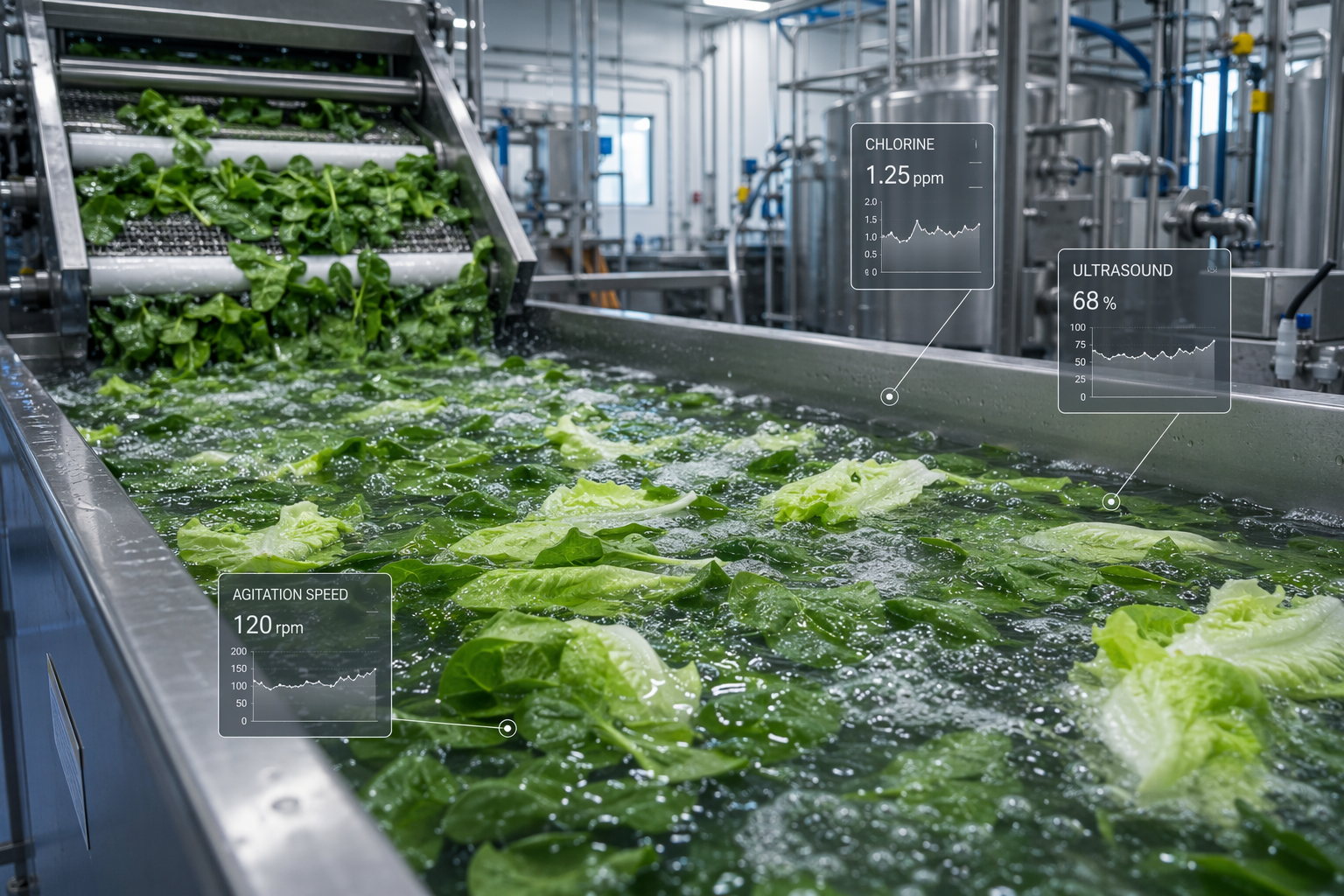
On a leafy greens wash line, the practical question is not whether the plant has heard of artificial intelligence. It is whether the operator can hold the right free chlorine level, agitation, produce load, cut size, and wash aid for the product in the flume without turning every deviation into a debate. For AI-defined produce washing guidelines to matter, they have to move from a model output to a defensible setpoint.
That is why the most useful number in the recent UC Davis work is not a model accuracy score. It is 20 mg/L free chlorine. In the study summarized by the UC Davis AI Institute for Next Generation Food Systems, wash water below that free chlorine threshold allowed bacterial survival risk to become a concern; at or above it, the threshold functioned as a practical minimum for preventing bacterial survival in the water itself.[1]
That distinction matters. A wash water threshold is not a promise that every pathogen attached to every leaf surface has been removed. It is a control point for the water that contacts the product, and it gives food safety teams something more concrete than a general instruction to optimize sanitizer.
The pressure behind the work is real enough without stretching it. CDC data cited by UC Davis linked 139 foodborne outbreaks to fresh vegetables from 2009 through 2018, and more than half were attributed to leafy greens.[1] That is the reason wash systems keep getting attention: when contamination moves through fresh-cut handling, QA is left explaining not only what the written program said, but whether the program matched the product actually running that day.
Why a Fixed Wash Recipe Breaks Down
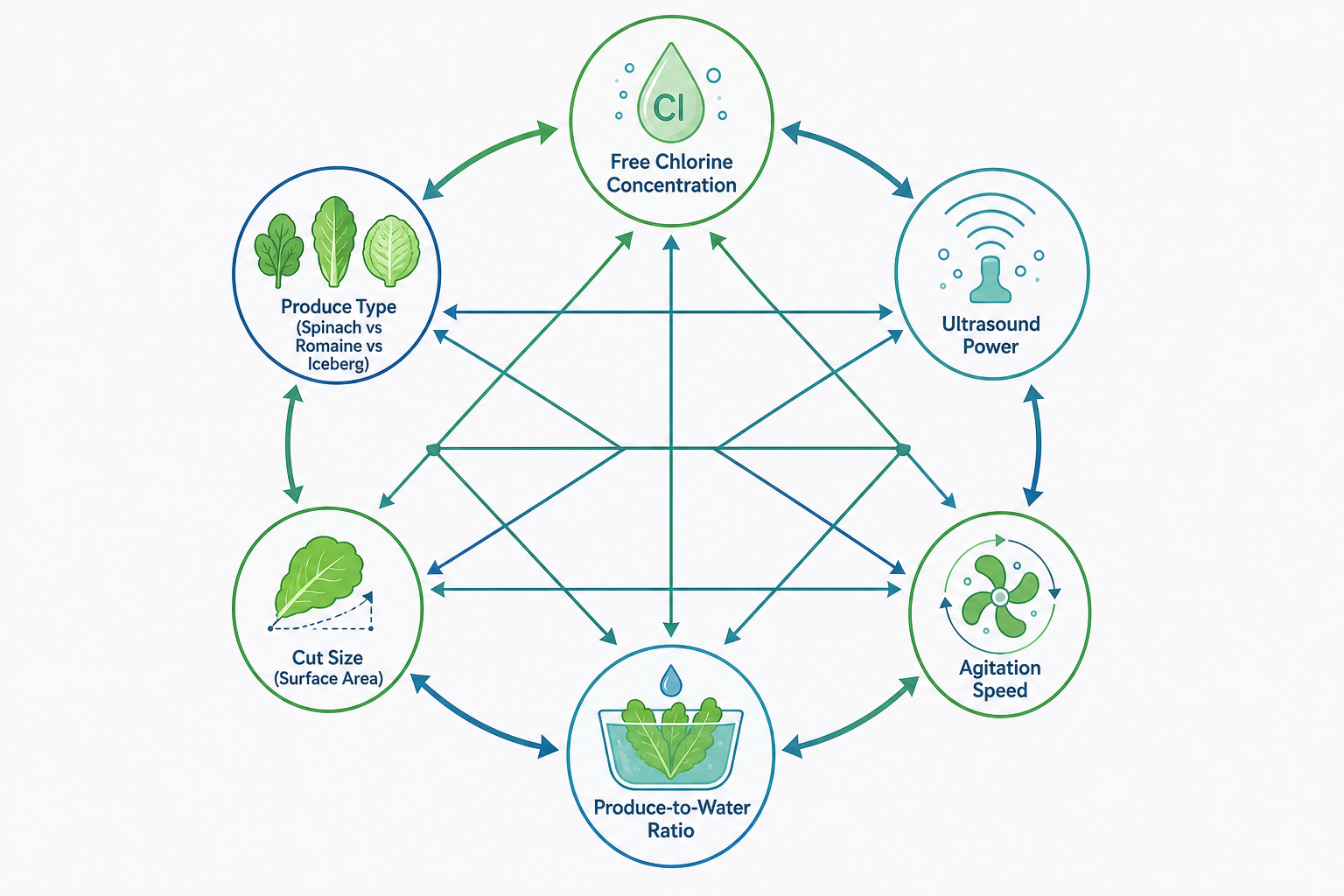
Fresh-cut washing is full of variables that refuse to stay independent. Add more cut surface and the water chemistry changes. Increase produce load and sanitizer demand can change. Run a different leafy green and the organic load may not behave like the last product did. Increase agitation or add ultrasound and the system is no longer just a chlorine question.
The UC Davis AIFS study is useful because it treated those variables as an interacting system instead of testing one knob at a time. The research covered 127 sanitation trials across spinach, romaine, and iceberg lettuce, varying chlorine concentration, ultrasound amplitude, agitation speed, produce-to-water ratio, and cut size.[1] The underlying peer-reviewed paper described the approach as a combined Taguchi Design of Experiments and machine learning method for modeling dynamic ultrasound-assisted sanitation of fresh-cut leafy greens.[2]
That approach is not just academic decoration. In a plant, trial-and-error testing tends to be expensive, slow, and incomplete. A facility can test a few chlorine levels on one product, or compare two agitation settings, but it is much harder to understand what happens when organic load, surface area, sanitizer level, produce type, and ultrasound power all move together. The point of the machine learning layer is to predict combinations that would be impractical to map by ordinary sequential trials.
The 20 mg/L Finding Is Narrow, Which Is Why It Is Useful
A 20 mg/L free chlorine minimum is the kind of result a QA lead can bring into a sanitation review. It can be written into monitoring expectations, checked against current practice, and challenged during validation. It also gives plant management a clearer boundary: the goal is not simply to keep raising chemical concentration, but to avoid dropping below a level where bacteria can survive in the wash water.
The UC Davis summary says the model identified 20 mg/L free chlorine as a minimum threshold for preventing bacterial survival in wash water.[1] That sentence should not be inflated. It does not establish a universal lethality claim across all leaf surfaces, all incoming loads, all water systems, or all commercial line speeds. It does give processors a specific candidate parameter to compare against their own monitoring data and validation work.
In practice, that means a food safety team could treat the finding as a defensible starting point for a wash water control discussion. If a line already maintains free chlorine above that level, the study may support the rationale for avoiding unnecessary increases. If the line regularly dips below it during high organic load periods, the finding points to a measurable risk that should be investigated before it becomes normal operating drift.
| Finding from the UC Davis work | What it can support now | What it does not prove by itself |
|---|---|---|
| 20 mg/L free chlorine minimum | A validation-ready wash water threshold for preventing bacterial survival in the water | A universal guarantee of pathogen removal from leaf surfaces |
| Different greens behaved differently | Product-specific wash protocols for spinach, romaine, and iceberg | A single standard recipe for all leafy greens |
| Models evaluated interacting variables | More informed setpoint selection than one-factor-at-a-time testing | Automatic commercial approval without plant-scale validation |
| Ultrasound was part of the optimized system | A candidate intervention to evaluate with chlorine and agitation | A drop-in change with no equipment, cost, or maintenance implications |
Iceberg Is Not Spinach
The strongest argument against one-size-fits-all leafy green washing is not philosophical. It is product behavior. UC Davis reported that iceberg lettuce released significantly more organic material into wash water than spinach.[1] That matters because organic material affects sanitizer demand and can change the conditions the operator is trying to hold.
A fixed protocol may be convenient for scheduling and training, but the biology and chemistry do not owe the plant that convenience. If iceberg contributes more organic load than spinach under the studied conditions, then the same free chlorine target, produce-to-water ratio, cut-size decision, or intervention strategy may not provide the same margin. The model did not merely label one green riskier than another; it showed why produce type belongs in the control logic.
That has direct operational consequences. A facility running multiple leafy greens should be careful about treating the wash system as if the product name changes only on the production schedule. Product-specific validation may be needed for the highest organic load combinations, for cut sizes that increase surface area, and for transitions where the wash water chemistry changes faster than the standard check frequency can catch.
Where Ultrasound Fits, and Where It Does Not
Ultrasound-assisted washing deserves attention in this study, but not a sales pitch. UC Davis described ultrasound-assisted cleaning paired with machine-learning-optimized chlorine dosing as improving pathogen removal without raising chemical levels.[1] The important phrase is paired with. Ultrasound was evaluated as part of a system that also included chlorine, agitation, produce-to-water ratio, cut size, and produce type.
For a processor, that makes ultrasound a capital and validation question, not a simple parameter adjustment. Adding ultrasound can mean equipment selection, installation constraints, maintenance needs, energy use, employee training, and verification that the intervention works under actual line conditions. It may reduce reliance on higher chemical levels in some optimized combinations, but the available evidence here does not make it a universal upgrade for every wash tank.
The more immediate lesson is broader than the technology itself: interventions should be judged in combination. If ultrasound changes the effect of chlorine, agitation, or cut size, then evaluating it as a standalone add-on misses the point of the study.
What Processors Can Responsibly Take Into Q3 2026
The UC Davis work does not give commercial processors a finished corporate standard. It does give them a better short list of questions for validation, sanitation review, and technology planning.
- Check whether routine wash water monitoring can demonstrate that free chlorine stays at or above 20 mg/L during the relevant run conditions, especially under heavier organic load.
- Separate wash protocol review by produce type instead of assuming spinach, romaine, and iceberg can share the same effective control settings.
- Review cut-size decisions as sanitation variables, not only as customer specifications or yield considerations.
- Treat ultrasound as a candidate system change that requires capital review and line validation, not as a software-style upgrade.
- Use machine learning outputs as setpoint candidates that still need plant evidence, audit-ready rationale, and documented limits.
This is also where AI becomes more practical than promotional. A dashboard that shows a risk score may be useful to management, but the wash line needs a target and a response. If the model helps define when a sanitizer level is too low, which product needs a different treatment window, or where additional equipment might matter, it has entered the daily control system rather than hovering above it.
The same logic applies elsewhere in food safety AI. Cold chain tools, for example, address temperature-related risk during transport and storage, while optimized washing addresses microbial risk during primary processing. ChainSignal's AI-driven food safety optimization for the cold chain is a complementary use case, not a substitute for wash-line validation.
The Commercial Validation Gap
The limiting fact is straightforward: the UC Davis work was lab/pilot-scale research, not a demonstration across commercial fresh-cut throughput. The study's 127 trials provide strong evidence that machine learning can model interacting wash conditions for spinach, romaine, and iceberg, but a production facility still has to verify performance at its own line speeds, water turnover, product loads, equipment geometry, monitoring frequency, and sanitation program constraints.[1]
That gap is not a reason to ignore the finding. It is a reason to keep the claim clean. A processor can say the study supports 20 mg/L free chlorine as a minimum wash water threshold to prevent bacterial survival under the studied conditions. It should not say the study proves full pathogen control across all leafy green operations.
Industry discussions of AI in produce safety have made the same broader point: AI can help identify patterns, support decision-making, and improve targeting, but it does not remove the need for food safety expertise, data quality, and operational validation.[3] The produce industry has enough experience with elegant tools that fail at shift change; the useful ones have to survive wet floors, incomplete data, calibration drift, and the auditor asking why the limit was chosen.
From Setpoints to Intelligent Sanitation
Dr. Hao Feng of UC Davis framed the work as a step toward more intelligent sanitation systems that could eventually adjust parameters in real time.[1] That future is plausible, but it is not the same as what processors can adopt today. Real-time adjustment would require dependable sensing, integrated controls, validated model boundaries, and procedures for what operators do when the system recommends a change.
Food safety technology coverage from IFT has similarly described AI as reshaping food safety through better prediction, monitoring, and decision support rather than replacing preventive controls.[4] In leafy green washing, the near-term value is narrower and more useful: machine learning has already produced a concrete sanitation parameter and a strong argument against fixed protocols for different greens.
For now, the right posture is neither hype nor refusal. The 20 mg/L free chlorine threshold belongs in validation conversations now. Product-specific wash logic belongs there too, especially where iceberg, spinach, and romaine are being treated as if they create the same wash water burden. What does not belong in policy yet is a blanket claim that an AI-defined protocol is commercially proven for every leafy green line.
That leaves a practical gap: today’s adoptable insight is a model-defined setpoint and product-specific validation agenda; tomorrow’s system may be real-time intelligent sanitation.
References
- Improving Food Safety with AI-Powered Produce Washing - UC Davis AIFS, Mar 2026.
- Machine Learning and Taguchi DOE Combined Approach for Modeling Dynamic Ultrasound-Assisted Fresh-Cut Leafy Green Sanitation - ACS Sustainable Chemistry & Engineering, 2024.
- The Role of AI in Managing Produce Safety - Produce Business.
- How AI Is Reshaping Food Safety - IFT Food Technology Magazine.
Comments
Join the discussion with an anonymous comment.