
The uncomfortable starting point for AI supply chain data breach protection is not that attackers are using better tools. It is that the clock no longer fits the operating model. Richard Watson, EY Global Cybersecurity Lead, is cited by SCMR as estimating that an AI-enabled attacker can compromise a target in about 52 seconds, while many organizations still need 5 to 10 minutes to detect the activity.[1] That figure should be treated as an industry expert estimate rather than a peer-reviewed measurement, but the operational implication is hard to ignore: by the time the security team sees the first clean signal, the attacker may already have touched the data flow, the vendor connection, or the automation path that keeps orders moving.
That gap changes the job. A prevention-only program asks whether access can be blocked, files can be scanned, vendors can be assessed, and systems can be hardened. Those controls still matter. Weak authentication, unmanaged integrations, exposed transfer systems, and careless data handling remain invitations. But in an AI-linked supply chain, the first failed control is not the end of the story. It is the beginning of a continuity problem.
After compromise, someone has to decide whether the EDI feed can still be trusted, whether carrier updates are authentic, whether a supplier portal is leaking demand signals, whether a forecast file has been altered, whether a managed file transfer system should be isolated, and whether customer commitments can still be made. The breach is not only a security event. It is a question of which business processes can keep running without spreading bad data.
The Timing Gap Makes Prevention-Only Protection Fragile
Prevention assumes there is enough time to stop the bad action before it matters. That assumption becomes unstable when compromise can unfold in seconds and detection still depends on tools, queues, triage, human review, and escalation. Even a capable security operation can be late if its first reliable signal arrives after credentials have been abused, data has been staged, or an integration has been used as a bridge.
Supply chains make this worse because they are deliberately porous. Customers, suppliers, logistics providers, contract manufacturers, brokers, SaaS vendors, and internal teams all need to exchange data. The work cannot simply stop at every boundary. Purchase orders, ASN messages, inventory updates, shipment status events, invoice records, model inputs, and planning files move because the business depends on them moving.
AI adds speed and scale to that dependency. It can help classify anomalies, compare behavior patterns, and accelerate response. It can also help attackers shape phishing, automate reconnaissance, adapt payloads, and exploit trusted workflows faster than a conventional review cycle can react. The problem is not that prevention is obsolete. The problem is that prevention cannot be the final proof of protection when the system being protected is designed for continuous external exchange.
The stronger test is what happens after the first miss. Can the organization notice abnormal behavior quickly? Can it isolate one supplier connection without freezing every order? Can it determine which data objects remain trustworthy? Can it recover clean operations before the breach becomes a multi-week argument between security, operations, legal, vendors, and customers?
Supply Chain Breaches Do Not Stay Inside Neat System Boundaries
The timing gap would be serious in any environment. In supply chains, it is compounded by the length of the breach lifecycle and the number of parties involved. Forbes, citing IBM’s 2025 Cost of a Data Breach Report, reports that supply chain compromise had a 267-day average lifecycle and a $4.91 million average cost, making it the longest and most expensive breach vector in that IBM data set.[2] Those numbers do not describe a brief technical incident. They describe a breach type that can remain embedded across relationships, workflows, and evidence trails for most of a year.
The same Forbes article reports IBM’s finding that 30% of AI breach incidents stemmed from supply chain compromise.[2] That does not mean every AI breach begins with a supplier, or that AI systems are always the initial target. It does mean that supply chain compromise is already a material path into AI-related incidents, which should make governance teams uncomfortable with programs that inspect the model while giving less attention to the data routes feeding and surrounding it.
Managed file transfer systems deserve particular attention because they sit exactly where supply chain partners exchange sensitive operational data. Forbes, again citing IBM’s 2025 data, reports that 44% of zero-day attacks targeted managed file transfer systems.[2] The significance is not abstract. These are systems used because partners need reliable exchange at scale. If they are compromised, the operational question becomes which files were touched, which partners used the pathway, which downstream systems consumed the data, and how quickly that channel can be replaced or contained.
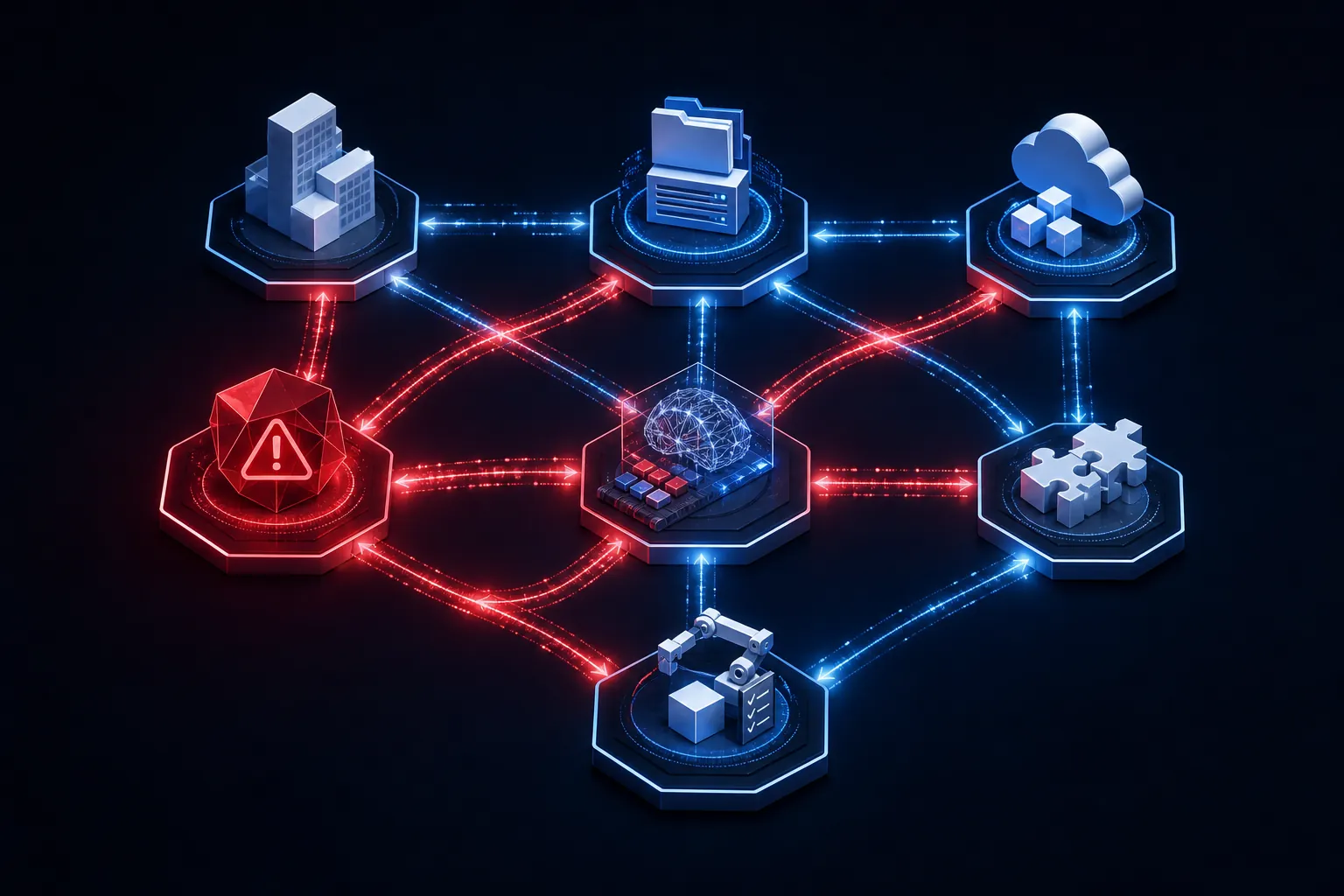
Third-party exposure is also becoming harder to treat as an edge case. Forbes summarizes Verizon DBIR 2025 data as showing third-party involvement doubling to 30%.[2] That is not proof that every supplier is a weak link, and it is not a license to push all blame onto vendors. It is evidence that breach protection has to account for the places where accountability is shared but technical control is divided.
AI Governance Is Still Too Thin Where Operations Are Most Exposed
The governance gap is especially visible in manufacturing. SCMR’s coverage of Kiteworks survey findings reported that only 7% of manufacturers conduct AI red-teaming, and 15% conduct privacy impact assessments.[3] The sample caveat matters: the manufacturing group consisted of 27 respondents within a total survey of 225, so the figures are better read as a directional warning than as a statistically broad manufacturing benchmark.[3]
Even with that caveat, the signal is not reassuring. AI red-teaming is one of the few ways to test how systems behave under adversarial pressure before a real incident. If organizations deploy AI into demand planning, supplier scoring, quality review, transportation visibility, procurement workflows, or customer service without testing how those systems can be manipulated, they are asking production operations to absorb risks that were never rehearsed.
This is where clean policy language often fails the people running the process. A policy may say that sensitive data should not enter an unapproved model or that a supplier integration must meet a security standard. But after a credential is abused or a file transfer tool is exploited, the live question is more specific: who can suspend the interface, who approves fallback transmission, who validates replacement data, who informs affected partners, and who decides when the automated workflow can be trusted again?
What Resilience Means in Practice
Resilience is sometimes used as a soft word, as if it means accepting breaches with better attitude. That is not useful. In AI supply chain data breach protection, resilience means the organization can measure and prove its ability to detect compromise, contain spread, preserve essential operations, restore trusted data flows, and explain those actions to counterparties and regulators.
A practical resilience model starts with monitoring that sees behavior, not just known malware or static access rules. Continuous monitoring should be able to identify unusual data movement, abnormal API calls, suspicious supplier portal activity, atypical model input patterns, and changes in file exchange behavior. In supply chain environments, the baseline has to be operationally aware. A spike in weekend order changes may be normal before a promotion and alarming in another context. A new carrier feed may be legitimate during onboarding and suspicious if it appears without a business event.
Behavioral anomaly detection is useful here because many AI-era attacks will not look like a known signature at first. The signal may be a vendor account reading an unusual category of forecast files, a workflow submitting requests at an odd cadence, a model pipeline pulling data from a source it rarely uses, or a managed transfer job sending a larger-than-normal bundle to a familiar partner. The alert has to be fast enough to matter and specific enough that operations can act without shutting down the entire network.
| Capability | Operational Test |
|---|---|
| Continuous monitoring | Can the team see abnormal data movement across vendors, SaaS platforms, model pipelines, and file transfer systems quickly enough to intervene? |
| Behavioral anomaly detection | Can alerts distinguish suspicious behavior from legitimate supply chain volatility? |
| Zero-trust AI-to-AI authentication | Can automated systems prove identity, authorization, and context before exchanging data or triggering workflows? |
| SBOM-driven visibility | Can the organization identify affected software components, vendors, integrations, and downstream dependencies during an incident? |
| Containment playbooks | Can one connection or workflow be isolated without stopping unrelated operations? |
| Recovery planning | Can trusted data, integrations, and decision processes be restored and documented under regulatory and partner scrutiny? |
Zero-trust AI-to-AI authentication becomes important as more decisions and handoffs occur between automated systems. It is not enough for a tool to be inside the network or historically trusted. Automated agents, model pipelines, integration services, and partner systems should authenticate continuously, carry only the permissions needed for the task, and be checked against context. A shipment-status service should not suddenly gain access to supplier financial files. A planning model should not accept a new input source simply because another connected system can reach it.
SBOM-driven visibility is the less glamorous part of resilience, but it is often what determines whether containment is disciplined or chaotic. During a breach, teams need to know which software components, libraries, vendors, hosted services, and integrations are in scope. Without that map, incident response turns into a conference call scavenger hunt. With it, the organization can narrow exposure, prioritize patches or isolation, and communicate with affected partners based on evidence rather than guesswork.
Containment playbooks should be written for business processes, not only for systems. A useful playbook does not merely say “disable the integration.” It names the order flow, data type, supplier group, fallback process, decision owner, customer impact threshold, and recovery validation step. If an inbound supplier forecast feed is quarantined, procurement and planning need to know whether to use the last trusted file, request manual confirmation, freeze certain decisions, or route exceptions through a temporary review process.
Regulators Are Moving Toward the Same Question
The regulatory direction is also moving away from a narrow prevention story. SCMR describes the EU Digital Operational Resilience Act, or DORA, as part of a shift toward demonstrating the ability to maintain operations through disruption, not merely proving that preventive controls exist.[1] DORA applies to the financial sector, but its logic is relevant beyond banking: critical organizations are increasingly expected to show that they can withstand, respond to, and recover from technology disruption.
That matters for supply chain leaders because counterparties often adopt regulatory expectations before every supplier is directly covered by the same law. A customer may ask for evidence of incident response testing. A logistics partner may require notification timelines. A manufacturer may need assurance that a software provider can segregate affected tenants or restore data integrity after compromise. The practical burden lands on documentation, test results, ownership, and recovery proof.
The best resilience programs therefore treat recovery as a governed capability. They define recovery time expectations for critical data flows, identify who can authorize degraded operations, rehearse partner notifications, and test whether restored data can be trusted. This is not paperwork for its own sake. It is how the organization avoids improvising under pressure while shipments, production schedules, invoices, and customer promises are waiting.
A Brief Case for Not Overweighting Anecdotes
An anonymized NeuralTrust case study describes a compromised logistics SaaS model disrupting more than 500 retailers.[4] The case is useful as an illustration of how an AI-linked supply chain platform can become a distribution point for operational disruption. It should not be treated as a broad frequency claim, because the company is not named and the case details cannot carry the same evidentiary weight as a transparent breach report or large data set.
Its value is still practical. A shared SaaS platform can sit between many businesses and the data they rely on for fulfillment, delivery promises, routing, inventory visibility, or exception handling. If the platform’s model behavior or data path is compromised, each customer has to answer the same operational questions: what decisions depended on that output, what downstream systems consumed it, and what evidence is needed before automation resumes?
Layered AI Helps, but It Does Not Replace Operating Discipline
AI can be part of the defense. SCMR’s discussion of layered AI security describes a progression from machine-learning detection to graph-based correlation and LLM or agentic response capabilities.[5] That architecture is useful because supply chain attacks rarely appear as one isolated log event. They show up as relationships: a vendor identity, a file movement, a model input, a workflow trigger, an unusual destination, and a business process that suddenly behaves differently.
But technology does not remove the need for operating rules. If an AI defense layer correlates suspicious behavior across a supplier portal and a managed file transfer job, someone still needs authority to act. If an agentic response tool recommends isolating an integration, the business still needs to know which orders will stop, which customers must be notified, and which manual workaround is acceptable. Resilience fails when detection improves but decision rights remain vague.
The same is true for data restoration. A backup is not a recovery plan unless the organization knows which version is trusted, which transactions need reconciliation, and which model outputs must be regenerated. In an AI supply chain, corrupted or manipulated data can have second-order effects: bad forecasts, misprioritized shipments, incorrect supplier risk scores, or automated decisions that appear valid because they came from an approved system.
The New Standard for AI Supply Chain Data Breach Protection
A credible protection model now has to answer four questions with evidence.
- Detection: How quickly can the organization identify abnormal behavior across vendors, integrations, AI systems, and data exchange channels?
- Containment: Can it isolate a compromised connection, workflow, account, or data path without causing avoidable disruption elsewhere?
- Trust restoration: Can it determine which data, decisions, and model outputs remain reliable after the incident?
- Operational proof: Can it document roles, tests, recovery steps, partner communications, and regulatory evidence before a real incident forces the issue?
These questions do not excuse weak prevention. Access control, encryption, vendor due diligence, secure development, patching, segmentation, and data minimization still reduce exposure. The mistake is treating those controls as if they settle the matter. They reduce the probability of compromise; they do not prove the organization can survive one.
The evidence points to a more demanding standard. A 52-second compromise estimate set against 5 to 10 minute detection windows exposes a broken timing model.[1] A 267-day supply chain breach lifecycle and $4.91 million average cost show the consequences when compromise persists across dependencies.[2] Managed file transfer exposure, third-party involvement, AI breach incidents linked to supply chain compromise, and thin AI red-teaming all point in the same direction: protection has to be judged by tested resilience, not by the confidence of the preventive design alone.[2][3]
The practical question is no longer whether an organization can claim it will stop every AI-powered breach. It is whether it can detect compromise quickly, limit spread across partners and systems, restore trusted operations, and prove those capabilities when customers, regulators, insurers, and internal operators ask what happened next.
References
- Supply chain cyber risk strategies shift toward resilience — SCMR, Feb 2026
- The Growing Cybersecurity Risks To The Supply Chain In The AI Era — Forbes, May 2026
- Manufacturers' AI adoption is outpacing cyber, compliance, and risk governance — Kiteworks / SCMR
- AI-Driven Supply Chain Attacks: The New Cyber Risk in 2026 — NeuralTrust
- Why a secure industrial supply chain depends on layered AI — SCMR, Mar 2026
Comments
Join the discussion with an anonymous comment.