
The AI stock market impact on supply chain investment is not a simple story of more money producing better decisions. The money is real. Goldman Sachs estimates roughly $7.6 trillion in cumulative AI capital expenditure from 2026 through 2031, with annual spending rising from $765 billion in 2026 to $1.6 trillion by 2031.[1] Morgan Stanley points to about $2.9 trillion in global data center construction through 2028 and estimates that AI contributes roughly 25% of U.S. GDP growth in 2026.[2] Those figures explain why every supply chain software demo now arrives with a sharper AI narrative, a larger roadmap, and a sales clock that seems to be counting down.
They do not explain whether a planning team will trust the forecast, whether transportation exceptions will fall, whether inventory will come down without hurting service, or whether the implementation will survive the first encounter with messy item masters and regional workarounds. That is the distinction supply chain leaders have to protect. Capital-market abundance can fund useful products. It can also turn a vendor’s urgency into the buyer’s risk.

The Three Signals Buyers Keep Mixing Together
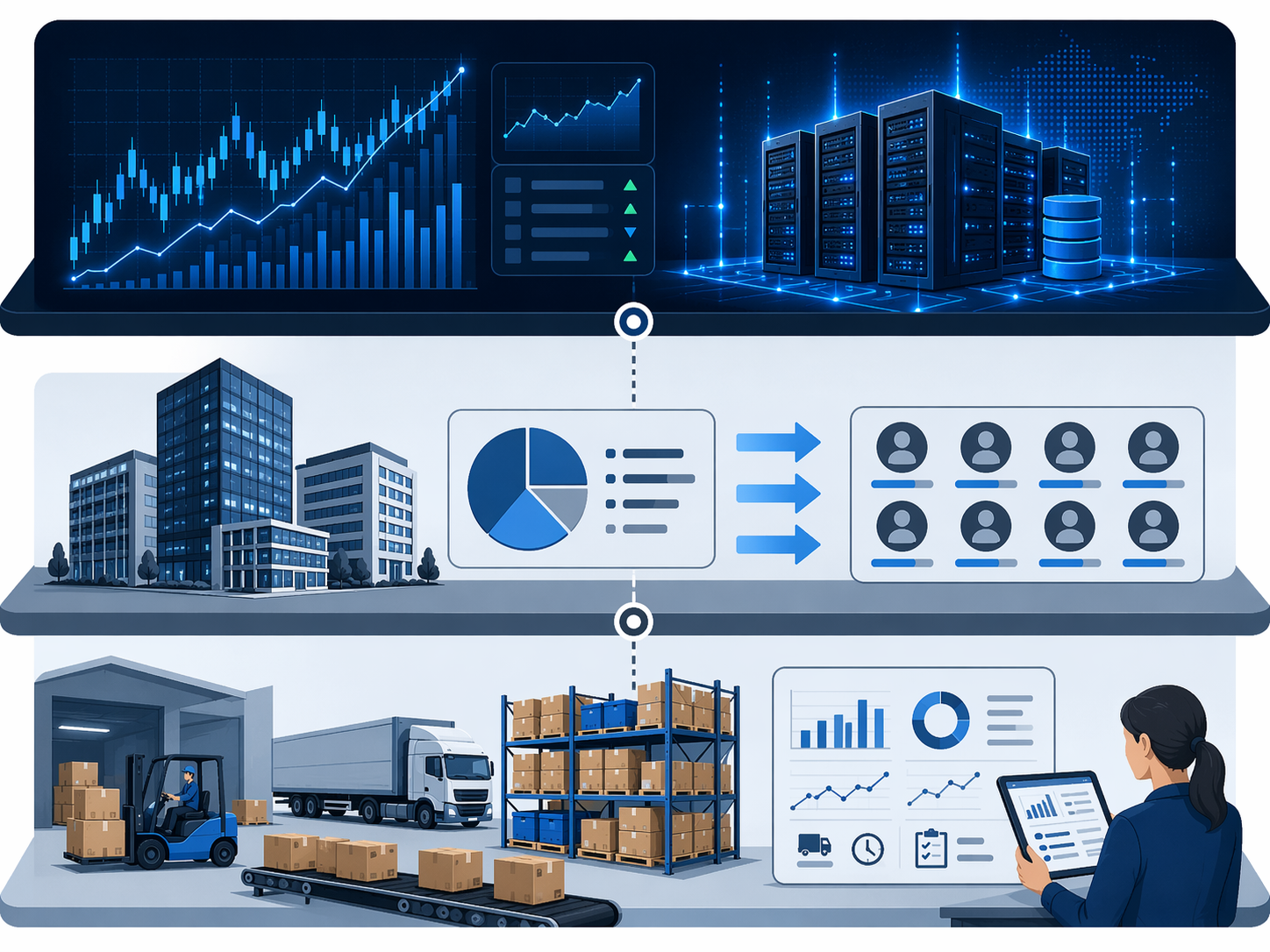
AI investment pressure usually arrives as one argument: competitors are spending, markets are rewarding AI exposure, and the company cannot wait. That argument blends three different signals that deserve different weight in a supply chain budget decision.
| Signal | What it tells you | What it does not prove |
|---|---|---|
| Capital-market signal | Infrastructure, software, and vendor funding are expanding quickly. | That a specific tool will reduce cost, improve service, or be adopted by planners. |
| Corporate-spending signal | Peers are allocating budget and treating AI as a strategic priority. | That fast enterprise-wide deployment is the right timing for your operating model. |
| Operational-return signal | A use case can be tied to measurable outcomes such as inventory, logistics cost, forecast accuracy, or exception reduction. | That the same result will scale without data, integration, workflow, and governance readiness. |
The first two signals justify attention. The third justifies commitment. Confusing them is how companies end up buying a platform because the market is hot, then asking operations to manufacture the ROI after procurement has already signed.
Capital Is Making Supply Chain AI Better, and Noisier
The optimistic part of the boom is easy to understate. When infrastructure capital, venture funding, and enterprise software budgets all move in the same direction, supply chain technology gets a faster feature cycle. Vendors can train and deploy more specialized models, hire domain talent, build connectors, and run more pilots in planning, procurement, warehousing, transportation, and inventory optimization. A thin feature that once looked like a dashboard add-on can become a workflow engine with exception triage, scenario generation, and human review built in.
The corporate-spending data also makes underinvestment look dangerous. BCG’s 2026 AI Radar, based on 2,360 executives, reports that corporate AI spending is doubling from 0.8% to 1.7% of revenues.[3] A Prologis/Harris Poll survey of 1,800 executives found that AI is the top capital investment priority for 75% of companies.[4] In supply chain specifically, one market estimate puts AI-in-supply-chain spending at roughly $20 billion in 2026, though market-size figures vary because analysts draw the category boundaries differently.[5]
That variation matters. A market estimate that includes warehouse robotics, planning software, predictive analytics, control towers, and generative AI assistants is not the same as one limited to AI planning applications. The larger number may accurately describe the investment climate while still saying little about the maturity of a particular demand-planning model or supplier-risk tool.
Capital also changes vendor behavior. More funding means more product development, but it also rewards fast growth narratives. Sales teams have an incentive to attach AI to every module, bundle pilots into larger platform commitments, and frame delay as strategic failure. Buyers should expect better tools in this environment. They should also expect more confident claims than the installed base can always support.
For teams scanning the market, a structured landscape review is more useful than a tour of the loudest claims. A vendor directory such as AI Supply Chain Companies 2026 can help separate planning, logistics, procurement, visibility, and inventory players before the evaluation turns into a generic AI bake-off.
Investors Are Becoming Less Patient With Empty AI Claims
One useful correction is already visible in the market itself. Morgan Stanley Research, analyzing 3,600 stocks, found that only 21% of S&P 500 companies cite AI benefits, while companies with measurable AI results show about twice the cash-flow margin expansion of the global average.[6] The same research notes that investors are increasingly punishing AI mentions that are not connected to evidence of returns.[6]
That is a better lesson for supply chain buyers than any individual stock chart. Stock dispersion can show enthusiasm, disappointment, or changing expectations, but trailing performance as of July 2026 is not a procurement framework and should not be treated as investment advice. The relevant point is narrower: even capital markets, which helped inflate the AI premium, are asking for proof. Operations should ask earlier.
A supply chain software buyer should not be easier to impress than an equity analyst. If a vendor’s story depends on being “AI-native,” “agentic,” or “real time” without showing how the system changes a planner’s decision, a buyer is being asked to underwrite the vendor’s positioning rather than the buyer’s outcome. The trust problem gets worse when marketing outpaces delivery, a dynamic explored in why AI advertising backlash is damaging supply chain trust.
The ROI Gap Is the Real Budget Constraint
The hard constraint is not whether AI can create supply chain value. It can. McKinsey reports that AI adopters average 12.7% logistics cost cuts and 20.3% inventory reductions.[7] Those are the kinds of numbers that deserve board-level attention because they map to operating statements rather than sentiment.
The timing is less comfortable. The same McKinsey research says 85% of companies are increasing AI spend year over year, but only 6% see ROI within 12 months, with most requiring two to four years.[7] PwC’s 2026 Digital Trends Survey adds the implementation warning: 89% of respondents say technology investments have not fully delivered, with integration complexity and data quality identified as the top reasons.[8]
That combination should change the shape of the business case. A proposal that assumes a clean first-year payback across multiple regions, product families, and systems is not ambitious; it is probably hiding the work. A stronger proposal names the operating lever, the baseline, the adoption dependency, and the integration burden before it asks for enterprise scale.
Inventory optimization is a useful proof-point category because the outcomes are visible and financially legible: excess stock, lost sales, markdowns, working capital, and service levels. Readers who want a narrower example can compare those mechanics with how AI inventory optimization delivers verified ROI for retailers. The larger point is not that every company should start there, but that the first serious AI investment should live where the measurement is hard to dodge.
Planner Trust Is Not a Soft Issue
AI adoption surveys often blur confidence with operational delegation. RELEX’s State of Supply Chain 2026 reports that 67% of supply chain leaders are more confident than last year, but only 10% trust AI for critical decisions without human review.[9] Gartner’s forecast is more aggressive on adoption: 60% of Fortune 1000 supply chains are expected to run generative AI orchestration by the end of 2026, up from 18% in 2023, yet only 23% have a formal AI strategy despite 94% planning AI use.[10]
Those numbers describe the operating gap better than a maturity model would. Executives are interested. Use cases are moving. Formal strategy, governance, and trust are lagging. In supply chain, that gap shows up in familiar places: exception overrides, forecast adjustments, frozen horizons, supplier substitutions, expedite decisions, and local workarounds that never appear in the software demo.
Human review is not evidence that the AI is weak. In many supply chain workflows, it is the control that makes deployment possible. The question is whether the system improves the human decision: fewer low-value alerts, clearer root-cause explanations, better scenario comparison, faster exception triage, and a record of why the recommendation was accepted or rejected.
This is where a domain-specific evaluation beats a generic AI questionnaire. A model that performs well on a benchmark may still fail if it cannot handle lead-time variability, substitution rules, constrained capacity, customer allocation policies, or regional planning calendars. A practical supply chain AI vendor checklist should ask how the tool behaves when the data is late, contradictory, incomplete, or politically contested.
What the Boom Changes in Vendor Selection
The funding environment changes procurement in four practical ways.
- Roadmaps get more ambitious. Buyers should distinguish available functionality from funded aspiration.
- Pricing can move ahead of proof. A vendor with strong investor backing may sell strategic scarcity before operational value is demonstrated.
- Integrations become the test. AI features that require clean, unified, real-time data may be mismatched to fragmented ERP, WMS, TMS, and supplier systems.
- Pilot discipline matters more, not less. TraxTech argues for contained projects that prove ROI before enterprise-wide commitment, a position that fits the wider evidence on delayed returns and integration risk.[11]
A funded vendor is not automatically safer. It may have better engineering resources and a longer runway. It may also have growth targets that push it toward larger contracts, broader claims, and faster expansion into modules where the product is not yet deep. The buyer’s job is to capture the upside of a well-funded market without becoming a reference account for unfinished capability.
That requires asking a less glamorous set of questions than the stock-market narrative encourages: Which systems must be integrated in phase one? Which data fields drive the recommendation? Who reviews exceptions? What is the fallback process when confidence is low? How often will planners override the output? Which metric moves first, and who owns it?
Underinvestment Has a Cost Too
Disciplined buying should not become a prettier name for delay. There are already cases where AI has produced material supply chain gains. Walmart’s Wally agent reportedly saved $55 million in waste during its 2025 rollout, while out-of-stock rates dropped 20% to 25%.[12] BCG also warns that organizations still in early-stage AI implementation risk competitive obsolescence, and its 2026 AI Radar reports that 50% of CEOs believe job stability depends on getting AI strategy right.[3]
Those facts should make a blanket wait-and-see posture uncomfortable. A company that delays every AI decision until the valuation cycle cools may miss the window to build data pipelines, redesign planning roles, and learn which use cases fit its network. Capability compounds inside the organization, not just inside the software.
The better distinction is between exploration budget and commitment budget. Exploration budget funds pilots, data-readiness work, integration assessment, process redesign, and narrow deployments with named owners. Commitment budget funds scale. The first can be justified by market momentum and competitive risk. The second needs operational proof.
A Timing Standard for 2026 AI Supply Chain Budgets
A supply chain leader does not need to predict whether AI valuations are too high to make a good software decision. The more useful question is whether the organization has enough evidence to move from attention to commitment.
- Move now when the use case has a measurable operating baseline, such as logistics cost, inventory, forecast accuracy, service level, expediting cost, waste, or planner productivity.
- Start contained when the value case is strong but the data, integration, or workflow dependencies are uncertain.
- Delay scale when the vendor cannot distinguish live functionality from roadmap, or when the business case depends on adoption behavior that has not been tested.
- Reject urgency when it is based mainly on market momentum, competitor anxiety, valuation language, or a claim that every buyer must transform at the same speed.
- Expand only when the pilot shows a path from recommendation quality to changed decisions and changed decisions to financial or service outcomes.
The same standard applies to adjacent AI supply chain bets, including visibility and sensing technologies. A use-case investment lens, like the one used for AI satellite supply chain tracking, is more reliable than treating every AI category as if it carries the same readiness, cost, and payback profile.
The practical middle path is not cautious for the sake of being cautious. It is a way to buy while the market is noisy without letting the market set the implementation calendar. Fund discovery. Run pilots where the economics are visible. Make data readiness part of the investment, not an afterthought. Require human-oversight design where the decision is material. Then scale the systems that prove they can change supply chain outcomes, not just investor narratives.
References
- Tracking Trillions, Goldman Sachs
- AI Market Trends 2026, Morgan Stanley
- AI Radar 2026, BCG
- Prologis/Harris Poll executive survey, Prologis and The Harris Poll
- AI in Supply Chain market data, Value Add VC
- Morgan Stanley Research analysis of 3,600 stocks, Morgan Stanley Research
- AI supply chain ROI research, McKinsey
- 2026 Digital Trends Survey, PwC
- State of Supply Chain 2026, RELEX
- Gartner generative AI supply chain orchestration forecast, Gartner
- Supply chain AI pilot program guidance, TraxTech
- Walmart Wally agent 2025 rollout, Walmart
Comments
Join the discussion with an anonymous comment.