
A launch schedule looks exotic only until the first dependency breaks. Then it starts to resemble the same problem that haunts aircraft assembly, shipyard work, refinery turnarounds, and heavy MRO: a finite set of bays, stands, crews, tools, safety windows, inspections, and promised dates, all tied together by work that cannot simply be moved because a manager wants the chart to look cleaner.
At NASA Kennedy Space Center, the version of that problem is unusually severe. Ground operations for launch vehicles involve thousands of interdependent tasks across shared cleanrooms, test stands, processing bays, and hazardous processing areas, with work sequenced against launch windows that cannot be treated like ordinary due dates. Aurora, Stottler Henke’s AI scheduling system, has been used for Kennedy Space Center ground operations since 1994, first for Space Shuttle processing and later for Space Launch System and Commercial Crew operations; it supports both short-term daily or weekly schedules and long-term schedules for the same facility set.[1]
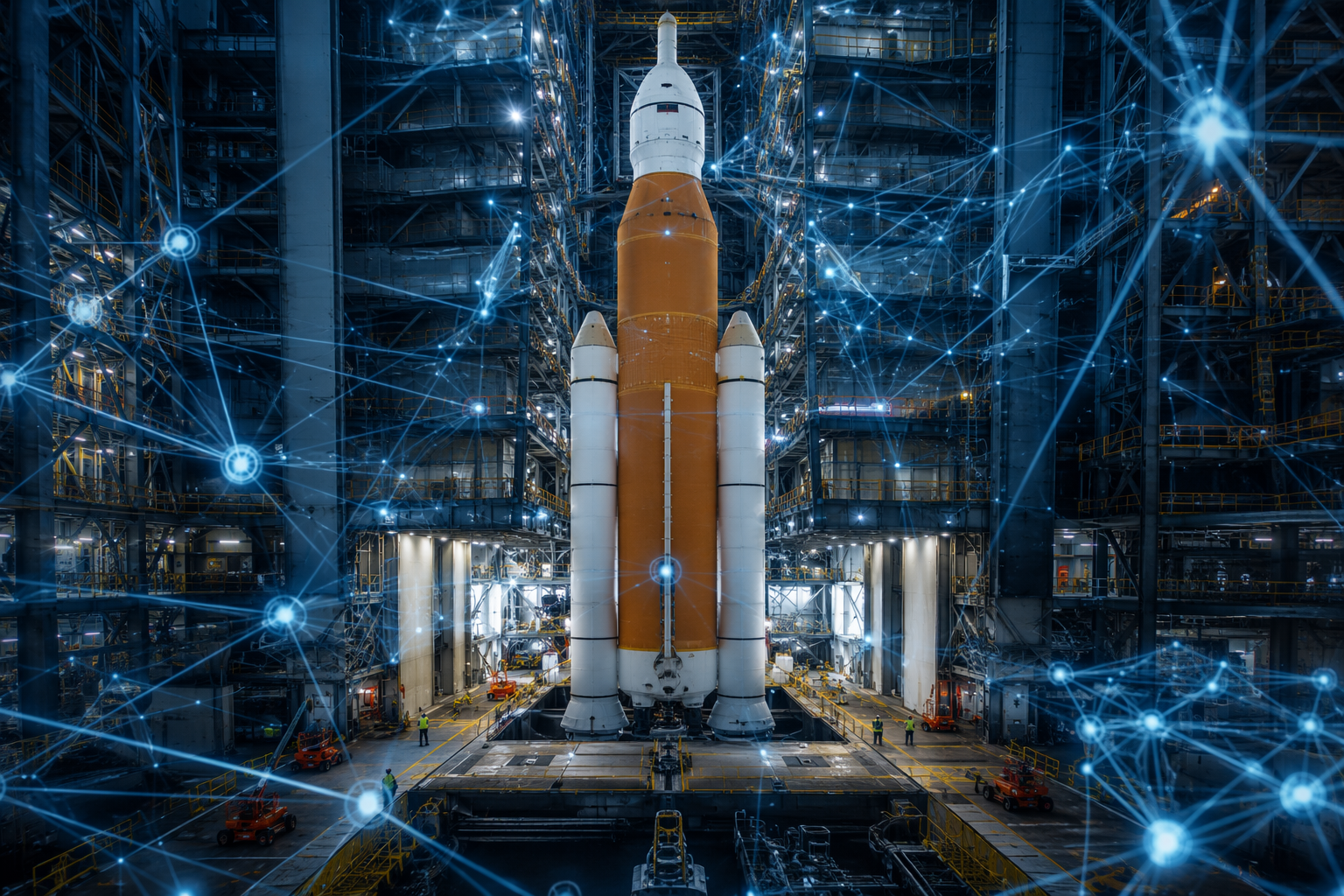
That deployment history matters because AI scheduling for space launch logistics is not a clean-room demo of optimization. It is a way of keeping real work executable when yesterday’s plan has been invalidated by a delayed payload, a facility conflict, a test result, a safety hold, or a missing specialist. The chart is only the visible artifact. The harder work is preserving the rules behind it.
Why launch ground operations are a brutal scheduling benchmark
A normal industrial schedule can already become unstable when a single critical-path task slips. Launch processing adds several layers that make casual rescheduling dangerous. Hazardous and non-hazardous work cannot always occupy the same place or time. Some tasks require specialized ground support equipment. Some require a particular facility configuration. Some wait on inspection signoffs. Others are pinned to vehicle, payload, or crew readiness. The scheduler is not merely placing activities on a calendar; the scheduler is protecting a chain of physical, safety, and regulatory conditions.
This is where conventional project management software begins to show its limits. Primavera P6 and Microsoft Project are capable planning tools, but their basic model is still one in which humans must define, maintain, and interpret much of the scheduling intelligence. They can hold activities, dependencies, resources, durations, and calendars. They do not automatically know, unless someone has encoded and maintained it, that a hazardous operation in one bay changes the feasible work pattern for other teams, or that a delayed test sequence creates a different class of downstream conflict than a late paperwork task.
Before Aurora, NASA relied on expert human schedulers who could take days or weeks to produce a single schedule for complex processing scenarios. The consequence was not only slower plan generation. It also meant that what-if analysis was often impractical: asking what would happen if a payload arrived late, a facility became unavailable, or a major test sequence moved could require so much replanning effort that only a narrow set of alternatives could be explored.[2]

Anyone who has watched a production-control team rebuild a plan late at night will recognize the hidden cost. The official schedule may be updated the next morning, but the intellectual labor happened earlier: deciding which constraint is truly hard, which resource can be shifted, which crew can work in parallel, which dependency is negotiable, and which shortcut would create a later failure. AI scheduling is useful only if it helps carry that load without erasing the judgment that makes the plan safe.
What constraint propagation actually changes
The important distinction is that Aurora is not described as a brute-force optimizer that tries every possible launch-processing schedule and announces the mathematically perfect one. The scheduling problem is too large and too conditional for that framing to be useful. Stottler Henke describes Aurora as using AI planning and scheduling techniques, including constraint propagation and heuristic search, to generate and repair schedules for complex operations.[1]
In operational terms, constraint propagation means the system does not wait until the end of planning to discover conflicts. When a task is placed, moved, delayed, or shortened, the implications ripple through related tasks, resources, calendars, and sequencing rules. If a processing bay is unavailable during a window, every task requiring that bay is narrowed or displaced. If one hazardous operation blocks nearby work, the feasible start times for other activities change. If a test must precede an inspection, which must precede vehicle closeout, then moving the test does not merely change one line on a Gantt chart; it changes a network of allowable positions.
The AI part is not magic. It is the combination of encoded domain knowledge and search discipline. Expert schedulers know which conflicts matter first, which combinations are usually impossible, which resource bottlenecks deserve early attention, and which local move can create a systemwide mess later. Aurora’s approach is to encode that kind of knowledge as rules and heuristics so the software can search intelligently rather than blindly.
| Scheduling element | Conventional tool burden | Constraint-propagation AI burden |
|---|---|---|
| Dependencies | Humans maintain and inspect logic across large networks | System propagates effects when related tasks move |
| Shared resources | Conflicts often require manual review and iterative leveling | Resource limits constrain feasible placements during search |
| Safety and sequencing rules | Domain experts must remember and enforce many conditions | Rules can be encoded so invalid schedules are rejected or repaired |
| Disruption response | Replanning can require substantial manual reconstruction | Schedule repair can focus search around the changed condition |
| What-if analysis | Often limited by planner time | Multiple alternatives can be generated fast enough to compare |
That difference explains why the comparison with Primavera P6 or Microsoft Project should not be reduced to “AI versus old software.” The deeper question is where scheduling intelligence resides. If most of it remains in the heads of a few senior planners, the software is a repository and display layer. If enough of that intelligence is encoded into constraints and heuristics, the software becomes an active scheduling partner. It still depends on human knowledge, but it can apply that knowledge faster and more consistently across a larger search space.
From one painstaking schedule to usable alternatives
The most practical gain is speed, but not speed in the executive-dashboard sense. The gain is that a schedule can be generated or regenerated while the answer can still change a decision. NASA’s Spinoff profile reported that Aurora reduced schedule generation turnaround from weeks to hours for complex scenarios.[2]
That shift changes the planner’s work. When one schedule takes days or weeks, the organization becomes conservative about asking questions. It may explore the most obvious recovery plan and stop there. When schedule generation takes hours, the team can compare alternatives: resequence testing, shift facility use, protect a scarce crew, pull a non-critical task forward, or evaluate how much margin remains if a late component arrives after a particular date. The point is not that the AI knows the right answer alone. The point is that humans can see more executable choices before the window closes.
Stottler Henke and NASA’s Spinoff coverage also report that Aurora produced schedules 20–30% shorter than schedules produced by conventional tools such as Primavera and Microsoft Project, and that planners were shifted from manual schedule generation toward higher-value analysis work.[2][3]
That number should be handled carefully. It is a published benchmark associated with Aurora’s vendor and NASA technology-transfer coverage, not a universal promise that every launch site, MRO shop, or factory will cut schedules by the same proportion. A shorter schedule is only valuable if it remains executable. In a hazardous processing environment, compressing the plan by violating safety logic would be worse than useless. The credible claim is narrower and stronger: when the hard constraints are represented accurately, AI-assisted search can often find feasible schedules that humans or conventional tools are unlikely to find quickly.
Deployment history is the reason the NASA case is useful
Many AI scheduling stories are still pilots, prototypes, or carefully bounded proofs of concept. Aurora’s Kennedy Space Center history is different. The system has been used for Space Shuttle ground processing since 1994 and has extended into Space Launch System and Commercial Crew operations. It supports both near-term operational schedules and long-range facility planning at the same center.[1]
That matters because short-term and long-term scheduling pull against each other. Daily and weekly schedules need enough detail to tell crews what to do now. Long-term schedules need enough fidelity to expose facility conflicts, campaign overlaps, and resource bottlenecks years ahead. If the long-range plan ignores the operational rules, it becomes fantasy. If the short-range plan ignores the long-range commitments, it creates local wins and systemwide trouble. A scheduling architecture that spans both horizons is doing more than drawing a better Gantt chart.
The other lesson is institutional. A system used across decades of changing vehicle programs has to survive changing procedures, facilities, stakeholders, and mission profiles. That does not prove perfection. It does suggest that the underlying approach has been adaptable enough to remain operationally relevant rather than frozen around one historical launch program.
The pressure on launch logistics is increasing
The launch market context is useful only after the scheduling mechanism is clear. More activity means more contention for ranges, facilities, crews, and suppliers, but volume alone does not explain why AI scheduling helps. The mechanism is the growing density of conflicts.
SupplyChainBrain, citing PwC and Aerospace Industries Association data, reported that roughly 3,700 objects were launched in 2025, about ten times the 2019 level.[4] ARC Advisory’s Logistics Viewpoints framed space in April 2026 as becoming part of supply chain infrastructure, rather than a distant specialty sector.[5]
Those facts do not mean every supply chain leader suddenly needs a launch-range scheduler. They do mean that the operational patterns are moving closer together. Space launch now has the cadence pressure of industrial logistics, while industrial logistics increasingly has the constraint density once associated with aerospace: scarce facilities, tight compliance rules, expensive downtime, and planning horizons that shift under real-time disruption.
Where the architecture travels
Aurora’s relevance to terrestrial supply chains is not based on analogy alone. Stottler Henke describes deployments of the same scheduling architecture for Boeing 787 Dreamliner assembly, General Dynamics Electric Boat submarine construction scheduling, and U.S. Navy maintenance, repair, and overhaul scheduling.[3]
Those domains share the traits that make launch processing hard. Aircraft assembly has thousands of tasks, limited workstations, specialized labor, certification requirements, and late engineering changes. Submarine construction has long-cycle work, dense physical interferences, constrained spaces, and major sequencing consequences. Navy MRO has inspection findings, parts uncertainty, dock and crew limits, and readiness deadlines. None of these is helped much by a black-box promise to “optimize.” They need explicit constraints, rapid repair, and a way to preserve expert planning logic when the plan changes.
Axiom Space’s selection of Aurora to manage astronaut schedules pushes the same point in a different direction. Crew scheduling is not ground processing, but it is still a constrained planning problem involving scarce human time, training events, mission requirements, and changing availability. Stottler Henke announced Aurora’s role in managing Axiom astronaut schedules in the 2020s, showing that the scheduling architecture can move from facilities and vehicles to people-intensive mission preparation.[6]
There are adjacent vendors as well. a.i. solutions provides launch range systems through its FreeFlyer platform, and tagup’s Manifest has been positioned as a military logistics decision engine for space launch scheduling. Those examples show activity around range and launch logistics, but they are not the center of the Kennedy scheduling story.[7]
What supply chain leaders should take from the NASA benchmark
The lesson is not that every industrial scheduler needs the same software NASA used. The lesson is that AI scheduling becomes credible when the problem has the right shape.
- Constraints are explicit enough to encode: safety rules, sequencing rules, resource limits, calendars, facility restrictions, certification gates, and precedence logic.
- Resources are shared and contested: bays, docks, test stands, tooling, inspectors, crews, machines, or specialists.
- Disruption is frequent enough that static planning loses value: late parts, failed tests, inspection findings, weather, labor availability, or facility downtime.
- The cost of a bad schedule is high: unsafe work, missed launch windows, idle assets, delayed vessels, aircraft out of service, or contractual penalties.
- Expert planners are scarce: the organization depends on a few people who understand the real constraints better than the formal planning system does.
If those conditions are absent, AI scheduling can become expensive decoration. A warehouse with simple slotting rules and abundant labor may need better execution discipline before it needs constraint-propagation AI. A factory whose routing data is inaccurate will not be rescued by a smarter search algorithm. A maintenance organization that cannot distinguish hard safety constraints from local preferences will encode confusion and receive confusion back faster.
Where the conditions are present, the NASA case gives leaders a more mature benchmark than the usual AI pilot. The right question is not whether the software uses AI. It is what knowledge has been encoded, which constraints are treated as unbreakable, how conflicts are exposed, how quickly the system can repair a disrupted plan, and whether expert schedulers are spending less time rebuilding calendars and more time evaluating tradeoffs.
That is the practical standard. AI scheduling is most convincing where the work is too interdependent for manual replanning, too safety-critical for casual compression, and too dynamic for a schedule that takes weeks to rebuild. NASA’s decades-long use of Aurora does not prove that space-launch AI will transform all supply chains. It does show that, in the right class of scheduling problem, AI has already moved well beyond experimentation.
References
- Aurora-KSC NASA Kennedy Space Center Ground Operations Scheduling, Stottler Henke
- Scheduling Software for Complex Scenarios, NASA Spinoff, 2006
- Aurora, Aurora Scheduling
- Report: Space Launch Boom Risks Outpacing Supply Chain Capacity, SupplyChainBrain
- Space Is Becoming Supply Chain Infrastructure, Logistics Viewpoints, April 9, 2026
- Aurora AI Software Manages Astronaut Schedules, Stottler Henke
- Launch Range Systems, a.i. solutions
Comments
Join the discussion with an anonymous comment.