
AI mitigation for storm surge supply chain disruption starts to matter at a very specific moment: when a forecast stops being a weather product and becomes a facility decision. A port terminal, a resin supplier, a cold-chain warehouse, a roofing-materials depot, or a cross-dock is either likely to be flooded, isolated, power-constrained, or serviceable in the next few days. Someone then has to decide whether to move inventory, split demand, reroute inbound freight, or hold position and accept the exposure.
That threshold is where storm surge deserves different treatment from a general hurricane alert. Storm surge is identified by NOAA and FIU as the leading cause of hurricane fatalities and property damage, with more than $1.5 trillion in U.S. damage since 1980 attributed to it.[1] For supply chains, the damage is not only water inside a building. It is also the road segment that becomes impassable, the port that cannot receive drayage, the supplier that remains physically intact but loses utility service, and the inventory that is in the wrong county when demand spikes somewhere else.
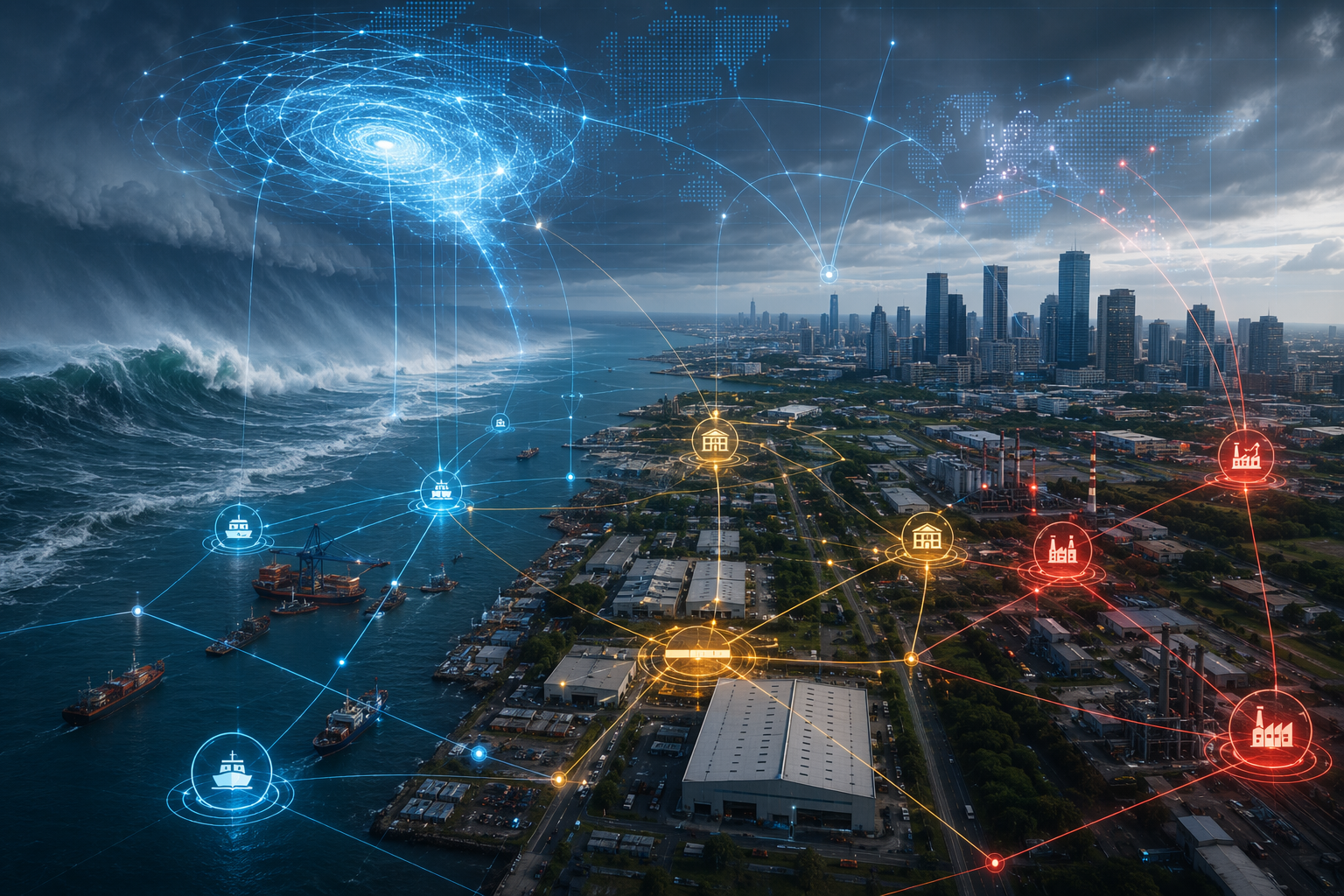
The useful promise of AI here is not that it can announce a hurricane earlier than a meteorologist. It is that physics-informed models can translate storm behavior into expected flood depth at operational locations, early enough for supply chain teams to do something expensive before landfall and defend that decision afterward.
From Forecast Cone to Facility Exposure
A forecast cone is too coarse for most planning meetings. It may justify convening the crisis team, but it does not tell procurement whether a Tier 2 supplier should be treated as unavailable, transportation whether to reserve capacity inland, or sales whether Florida demand should be served from a different distribution center.
The more operational question is narrower: which specific sites in the network are likely to face how much water, when, and with what confidence? Georgia Tech’s recent work is important because it addresses that level of granularity. Researchers reported that a physics-informed AI model forecasted building-level flood depth three to five days before Hurricane Sandy’s landfall with more than 90% accuracy, while standard hydrodynamic models can take hours to run a single scenario.[2]
That does not prove every coastal supply chain can now automate hurricane response. The result comes from a Hurricane Sandy test case, and performance may differ for other storm tracks, rapid intensification events, coastline geometries, or data environments. But it does change the planning conversation. A building-level flood-depth estimate three to five days out is early enough to place temporary inventory, pull forward shipments, change allocation rules, and line up alternate lanes before everyone else is bidding for the same capacity.
What the Model Has to Combine
A supply-chain-specific storm surge model is not just a flood map with facility pins dropped on top. The flood model and the network model have to meet. Otherwise the output stays in the risk dashboard while the purchase order, shipment plan, and allocation logic continue as if nothing has changed.
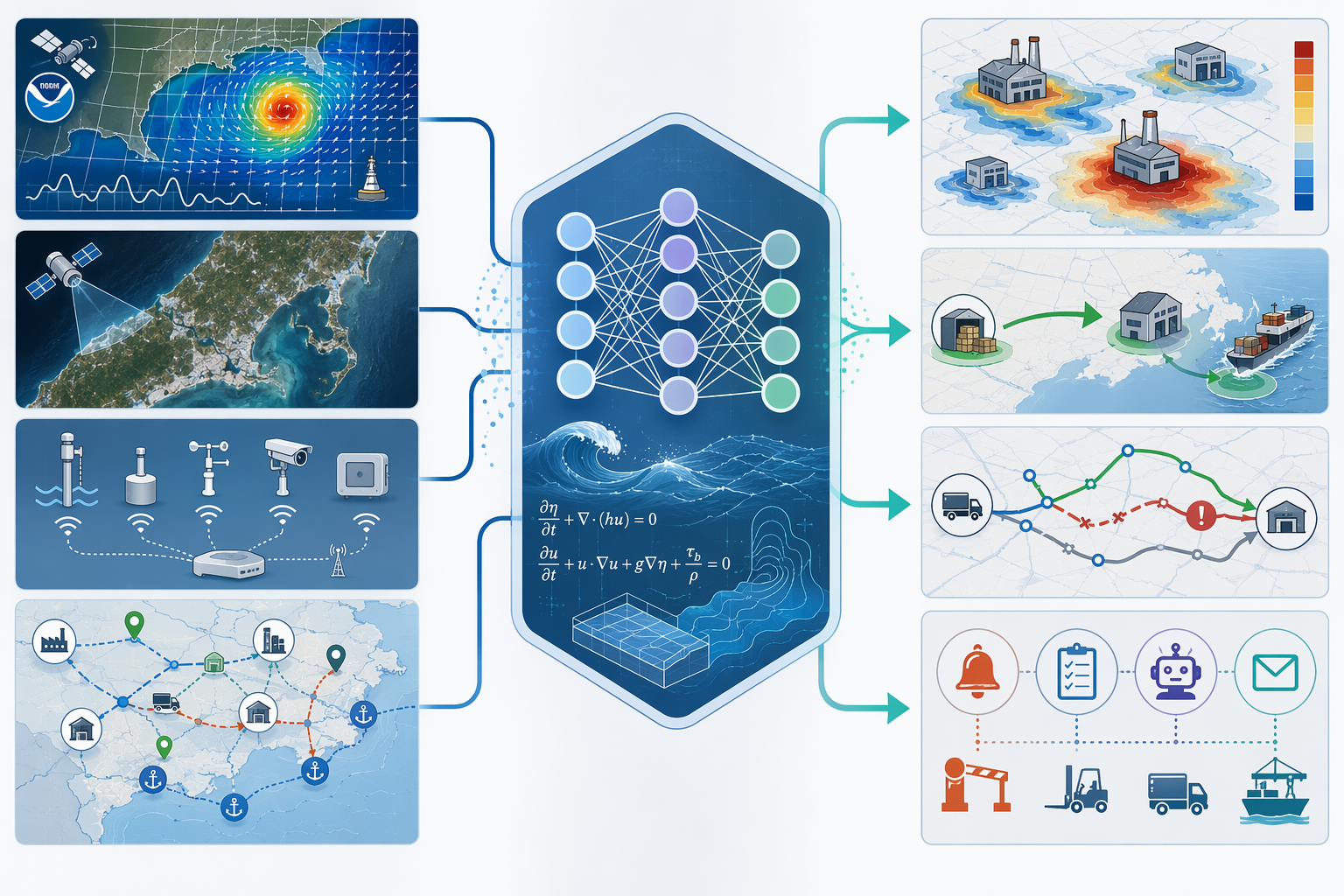
The technical stack usually has four layers. The first is meteorological and oceanographic: numerical weather prediction, NOAA wind and tide grids, storm track updates, surge physics, bathymetry, coastline shape, and elevation. The second is observational: satellite imagery, water-level sensors, IoT feeds, facility telemetry where available, and post-event records that help the model learn how water behaved in prior storms. The third is supply chain topology: supplier addresses, multi-tier dependencies, port and terminal usage, warehouse locations, lane maps, inventory positions, production constraints, and customer service commitments. The fourth is demand sensing: what customers are likely to need before, during, and after the event, and where that demand can be served from if the normal path fails.
| Input layer | What it contributes to the decision |
|---|---|
| Storm surge physics and weather grids | Expected water movement, timing, and depth around exposed coastlines |
| Satellite, sensor, and IoT feeds | Current conditions and validation signals as the event develops |
| Supplier, port, warehouse, and lane maps | Which operational nodes are exposed, isolated, or dependent on exposed infrastructure |
| Inventory and demand signals | Which stock can be moved, where demand may shift, and which customers face service risk |
| Planning-system rules | Whether the forecast can trigger purchase, routing, allocation, or sourcing actions |
The distinction matters because many organizations already receive severe-weather alerts. Those alerts may say a county is under threat. A supply chain mitigation model needs to say that a specific packaging supplier is inside the likely inundation zone, that the alternate supplier shares the same port dependency, that two days of finished goods can be moved to an inland DC before the lane becomes unreliable, and that demand allocation should be changed before orders arrive.
This is also where model speed has business value. If each new scenario takes hours to run, the planning team gets fewer updates and has less time to act. If a physics-informed AI model can approximate the relevant surge behavior faster while staying within an acceptable accuracy band, planners can revisit decisions as the track shifts instead of treating the first serious forecast as the last usable one.
The Output Should Be a Planning Object, Not a Warning
The most useful output is not “high risk.” It is a planning object that can be reviewed, challenged, and converted into action. For each site or lane, the model should expose the expected flood depth range, timing window, confidence level, operational dependency, and recommended mitigation option. The person approving the move needs to know whether the recommendation rests on surge depth, road access, port closure probability, supplier concentration, inventory scarcity, or a combination of those factors.
For a distribution network, that may produce a pre-landfall list of exposed facilities, inland alternatives, SKUs to stage, and lanes to reserve. For procurement, it may identify suppliers whose facilities appear safe but whose outbound ports or upstream dependencies are exposed. For sales and operations planning, it may shift promised supply away from a region that is likely to be unreachable for several days and toward customers that can still be served.
- Pre-position inventory when the cost of early movement is lower than the cost of late fulfillment failure.
- Reserve alternate transportation before emergency spot demand tightens capacity.
- Trigger alternate sourcing when exposed suppliers support constrained or high-service SKUs.
- Reallocate demand when the normal fulfillment node is likely to be flooded or cut off.
- Hold human approval for actions with high false-positive cost, such as large production changes or premium freight commitments.
Flood exposure deserves this level of attention because it is not an edge case in weather-driven disruption. Everstream Analytics reported that flooding accounted for 70% of weather-related supply chain disruptions in 2024.[3] That figure should not be read as proof that every flood forecast action pays back. It does show why resilience teams are right to treat flood-specific modeling as more than a seasonal dashboard feature.
Where Preemptive Mitigation Shows Up
The clearest business case is inventory that needs to be near the affected market after landfall but not sitting in the inundation zone before landfall. ClimateAi has published a case in which a building-materials producer used AI hurricane-risk forecasts to pre-position Florida-code-compliant roofing inventory ahead of Hurricane Ian and captured $15 million in incremental sales.[4]
That dollar figure is vendor-published, so it should be handled as a disclosed case outcome rather than an independent benchmark. The operating logic, however, is exactly what storm surge AI is supposed to enable: the company acted before demand materialized, placed the right inventory closer to the likely need, and avoided waiting until damaged roofs, closed lanes, and constrained capacity made the response more expensive.
In another category, a pharmaceutical manufacturer used SCAIR to assess hurricane impact on critical suppliers.[5] The relevance is not that pharma and roofing share the same response playbook. They do not. The relevance is that supplier exposure has to be resolved at the location and dependency level. A critical supplier outside the immediate surge zone may still rely on a threatened port, a vulnerable utility corridor, or an upstream site that the buying organization has not mapped.
The Vendor Roles Are Usually Split
Current deployments often stitch together capabilities rather than buying one complete storm-surge mitigation machine. ClimateAi is relevant for hurricane-risk forecasting and the pre-positioning case. Everstream Analytics is relevant for risk monitoring, disruption reporting, and scenario building. Resilinc is relevant where the hard problem is multi-tier supplier exposure. o9 Solutions is relevant when teams need a digital twin or planning layer to test inventory, demand, and fulfillment alternatives. SCAIR is relevant in supplier hurricane assessment, particularly where supplier criticality and regulated product flows matter.
The practical question is not which vendor has the most dramatic weather screen. It is where the forecast crosses into the planning system. If a flood-depth estimate cannot update scenario assumptions, flag constrained SKUs, change a sourcing trigger, or create an approval workflow for transportation and inventory moves, it remains intelligence rather than mitigation.
How Much Automation Belongs in the Decision
Some actions can be automated safely. A system can open a scenario, refresh exposed-site lists, notify supplier managers, recommend inventory transfers under a preapproved cost ceiling, or reserve optional carrier capacity. Other actions need an accountable owner because the cost of being wrong is material. Moving scarce inventory away from one region to serve another, expediting inbound supply, or switching constrained demand to alternate customers can create winners and losers before the storm has made landfall.
Gartner’s March 2026 forecast that 60% of supply chain disruptions will be resolved without human intervention by 2031 is useful as a signal of where the market is heading, not as evidence that storm-surge response can already be put on autopilot.[6] The more credible near-term pattern is bounded autonomy: the model prepares the decision, ranks options, executes low-risk moves under policy, and escalates high-cost or customer-sensitive moves to human approval.
A workable approval design separates actions by reversibility and downside. Updating ETAs, refreshing risk scores, and notifying account teams may require no approval. Holding capacity options may require a logistics manager. Moving inventory across regions may require supply planning and finance. Changing customer allocation may require sales leadership. The AI forecast earns its place by making those approvals earlier and better informed, not by removing accountability from them.
Explainability Is Part of the Control System
Storm surge models have to be explainable enough for decision owners to trust them under time pressure. A planner does not need a lecture on neural network architecture during a hurricane call. They do need to know why a facility moved from watch to action: forecast surge depth increased, tide timing worsened, protective elevation was lower than expected, the access road crossed a flood-prone segment, or the site supported inventory with no quick substitute.
Research on explainable AI methods for Gulf of Mexico storm surge forecasting is relevant because it addresses the operator’s need to interpret model output rather than simply receive a score.[7] In supply chain use, explainability should show both the physical driver and the network consequence. “Two feet of expected water” is one fact. “Two feet of expected water at the only warehouse holding this SKU within the promised service radius” is the planning issue.
This also helps after the event. If the storm veers and the expensive pre-positioning move looks unnecessary, the organization needs to review whether the model was wrong, whether the risk tolerance was appropriate, whether the action threshold was too conservative, or whether the move was rational given the information available at the time. Without that audit trail, every false positive becomes political memory, and the next warning gets discounted.
The Implementation Test
Before treating storm surge AI as a mitigation capability, a resilience team should test whether the organization has mapped the assets that the model is supposed to protect. Facility coordinates are only the beginning. The team needs supplier locations, criticality tiers, port dependencies, inventory positions, lane options, customer commitments, and planning rules that define who can approve which move at what cost.
The next test is lead time. Three to five days before landfall is valuable only if the operating model can act inside that window. If supplier qualification takes months, the sourcing trigger will not help this storm. If inventory transfer approvals take longer than the forecast window, the model may produce accurate regret. If transportation has no prearranged capacity options, the team may discover the exposure early and still buy at emergency rates.
The third test is false-positive economics. Some false positives are acceptable. Moving modest inventory inland, splitting shipments, or staging optional capacity may be cheap compared with missed service after a major surge. Other false positives are expensive: pulling inventory away from a stable market, disrupting production, or committing premium freight for a storm that weakens or shifts. The right automation boundary depends on that cost curve.
- Use facility-level flood depth, not only regional storm alerts, as the exposure trigger.
- Connect supplier and port dependencies before hurricane season, not during the event.
- Predefine which inventory, routing, and sourcing moves can be automated under cost limits.
- Require explanations that show both the surge driver and the supply chain consequence.
- Review misses and false alarms after each event so the action thresholds improve.
Physics-informed AI is credible enough to justify earlier storm-surge mitigation when the organization has mapped its facilities, suppliers, inventory, dependencies, and planning-system connections. It is not a plug-and-play ROI machine. This use case is strongest when the cost of cautious early action is lower than the cost of late recovery, and weakest when the model output cannot trigger timely inventory, sourcing, or routing changes.
References
- How AI can improve storm surge forecasts to help save lives, FIU News, 2025
- How AI-Powered Flood Forecasts Could Transform Hurricane Resilience, Georgia Tech Research, June 30, 2026
- Are You Prepared for the Supply Chain Disruptions of 2026?, Everstream Analytics
- Accurate Hurricane Forecasting Helps Roofing Materials Producer, ClimateAi
- Pharma Manufacturer Assesses Impact of Hurricanes on Critical Suppliers, SCAIR
- Gartner Predicts 60% of Supply Chain Disruptions Will Be Resolved Without Human Intervention by 2031, Gartner, March 2026
- Explainable Artificial Intelligence for Storm Surge Forecasting in the Gulf of Mexico, MDPI
Comments
Join the discussion with an anonymous comment.