
The hard part of defense aircraft upgrades is no longer proving that an old platform can be modified. The harder question is whether the right qualified parts, repair capacity, suppliers, materials data, and allocation decisions are visible early enough to keep aircraft available while the work happens.
That is where AI for defense supply chain aircraft upgrades becomes a practical question rather than a technology slogan. Predicting a component failure helps only if the sustainment system can see demand, find the part, judge the supplier base, and decide what to buy or repair before the aircraft is sitting idle.
The readiness numbers explain why this matters. The U.S. Air Force fleet-wide mission-capable rate fell to 67.15% in fiscal 2024, the lowest level in 20 years.[1] Defense News reported that a weighted average around 62% implied roughly 1,900 of 5,025 aircraft were out of commission at any given time.[2] Those figures are not an argument against modernization; they are a warning about modernization without enough sustainment visibility.
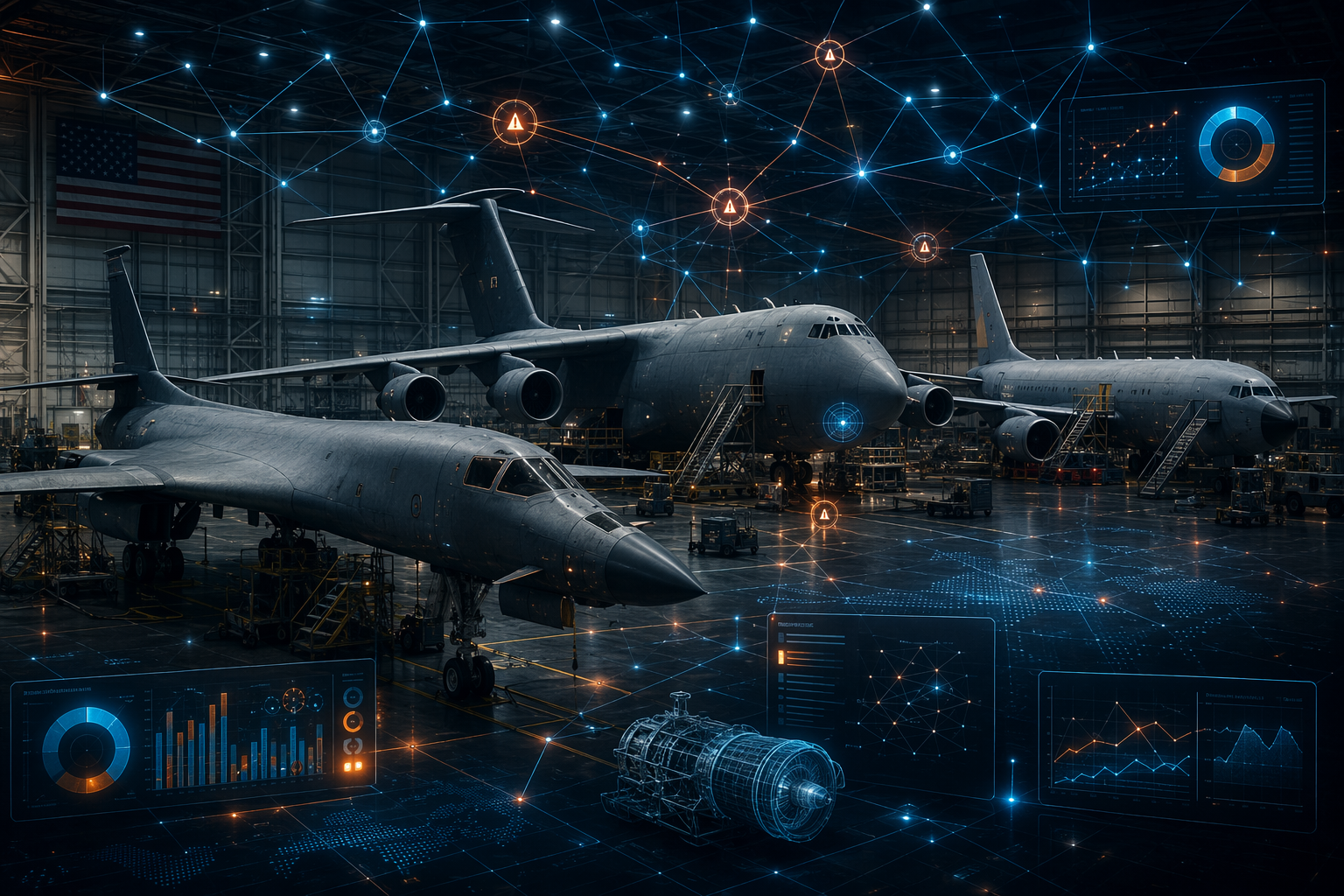
Age makes the problem less forgiving. The average Air Force aircraft reached roughly 32 years old in 2024, compared with about 17 years old in 1994.[2] On fleets that old, obsolescence stops being an occasional nuisance. Teams face discontinued components, shrinking repair sources, custom fabrication, and cannibalization from other aircraft.[2] An upgrade program can clear the engineering review and still lose time because the supply chain cannot show, with enough confidence, what will be available six months or five years from now.
Readiness Is Now a Visibility Problem
Aircraft availability is usually discussed as if the shortage is physical: not enough parts, not enough maintainers, not enough depot capacity. Those shortages are real. But in upgrade supply chains, the first failure is often informational. The program office cannot see that a part needed for a modification also feeds a maintenance backlog. A buyer cannot tell whether a nominally approved vendor depends on a fragile sub-tier source. A planner knows a legacy component is obsolete but cannot connect that fact to future aircraft induction schedules.
BCG made that point directly in a 2026 analysis of defense aviation readiness: parts availability is often a visibility issue, not simply an absolute shortage.[3] That distinction matters. If a part truly does not exist, the answer may be redesign, additive manufacturing, lifetime buy, or a new supplier qualification effort. If the part exists somewhere in the enterprise but the demand signal, allocation priority, repair status, or supplier risk is hidden, the answer is better planning and decision support.
AI is useful in this narrower, less theatrical sense. It can merge maintenance histories, configuration data, supply transactions, supplier records, obsolescence indicators, and repair flows into views that humans can act on. The value is not that a model says an actuator or engine component may fail. The value appears when that warning becomes a parts requirement, a supplier-risk question, a repair-capacity decision, and an upgrade-schedule constraint.
| Aircraft upgrade constraint | Why conventional planning struggles | Where AI can help |
|---|---|---|
| Component demand | Maintenance demand, modification kits, and repair cycles are often planned in separate views. | Forecast requirements across aircraft, time horizons, and platform configurations. |
| Supplier fragility | Approved vendor lists can hide sub-tier dependency, counterfeit risk, or single-source exposure. | Detect risk patterns across vendor records, procurement history, and external signals. |
| Obsolescence | Legacy parts may disappear before upgrade schedules fully account for replacement paths. | Link obsolete or at-risk parts to future work packages and sustainment demand. |
| Allocation | The same part may be needed by operational units, depot repair, and modernization programs. | Expose competing demand so planners can prioritize before a grounded-aircraft event. |
DLA Is Using AI Against the Supplier Base, Not a Demo Dataset
The Defense Logistics Agency is one of the more important examples because its problem is close to the real aircraft-upgrade bottleneck: too many parts, too many vendors, too many weak signals, and too much consequence if the wrong item enters the supply chain.
DLA reported in a May 2025 white paper that it operates more than 55 AI models across more than 200 use cases, with an AI Center of Excellence established in June 2024.[4] The numbers by themselves do not prove readiness impact. What matters is the type of work the models are being asked to do. DLA said its Business Decision Analytics Supplier Risk models analyzed 43,000 vendors and flagged more than 19,000 as high risk.[4] The agency also connected that work to a counterfeit-parts case that led to a guilty plea.[4]
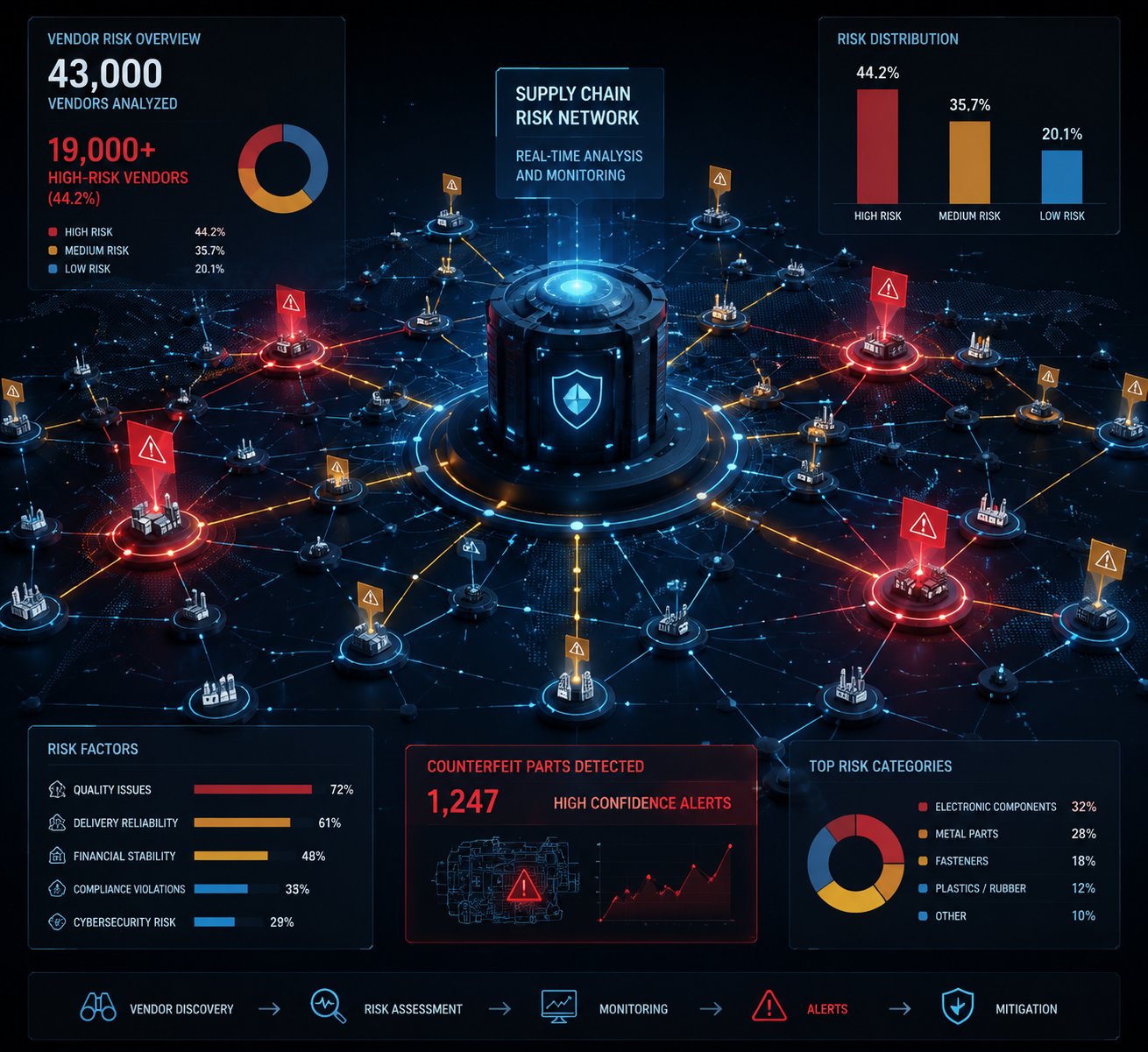
For aircraft upgrades, this is not a side issue. A modernization kit is only as reliable as the parts and sources behind it. Counterfeit parts, unstable suppliers, and missing material provenance can turn a planned modification into a grounded-aircraft problem. A system that can flag supplier risk across tens of thousands of vendors is addressing a real sustainment weakness, even if the exact readiness effect still needs to be measured program by program.
The same white paper cites a Government Accountability Office finding that the Department of Defense lacked data model requirements for 115 of 288 strategic and critical materials, or about 40%, and that more than 90% of shortfall materials had zero or one domestic supplier.[4] That finding reaches beyond aircraft, but it lands squarely in aviation sustainment. An upgrade program can choose a new component and still inherit a materials exposure that nobody sees clearly until production or repair demand rises.
There is a caveat. DLA’s white paper is a government self-report, not an independent audit of model performance. It supports a concrete conclusion, but not an unlimited one: DLA is applying AI to supplier risk, counterfeit detection, and supply chain illumination at operational scale. It does not, by itself, prove that those models have raised mission-capable rates across aircraft fleets.
PANDA Connects Predictive Maintenance to Parts Forecasting
Predictive maintenance is often sold as if the story ends when the model predicts a failure. In aircraft sustainment, that is only the first useful sentence. The next questions are whether the part is available, whether the repair source has capacity, whether other aircraft need the same item, and whether a planned upgrade will increase demand at the same time.
The U.S. Air Force’s PANDA toolkit is worth attention because it moves closer to that planning problem. According to the C3 AI and USAF Rapid Sustainment Office case study, PANDA monitors 3,110 aircraft across 16 platforms, has more than 800 active users, and has been designated the System of Record for predictive maintenance.[5] The case study also says PANDA generates five-year component requirement forecasts for the B-1B, C-5, and KC-135.[5]
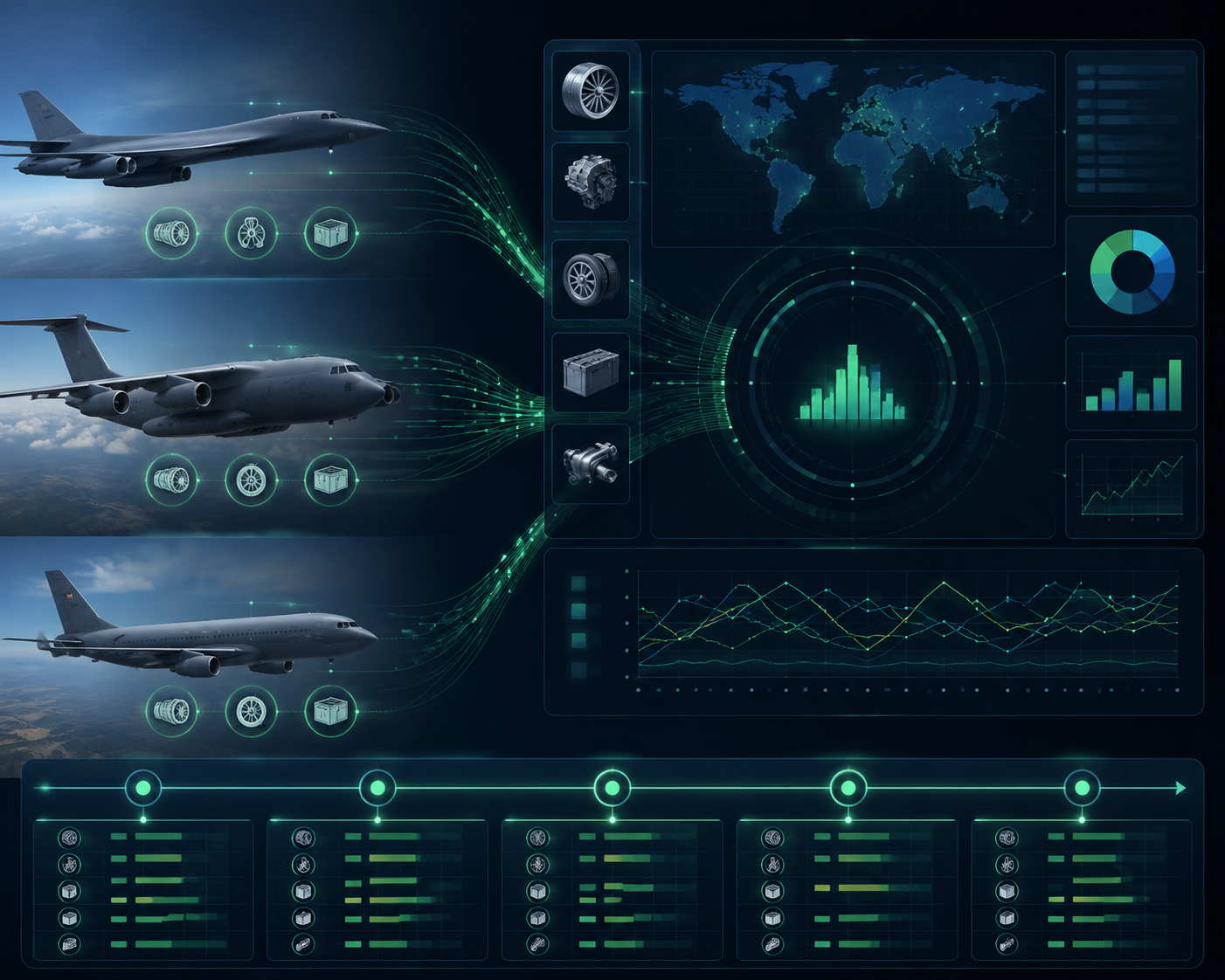
That five-year requirement horizon is the important part for aircraft upgrades. A B-1B, C-5, or KC-135 sustainment planner does not need another dashboard simply saying that a component is likely to fail. The planner needs to know whether projected failures, scheduled depot work, upgrade inductions, and supplier lead times are about to collide. A forecast that translates maintenance data into component requirements gives procurement and program offices a chance to act before the shortage becomes visible only as a grounded aircraft.
PANDA’s reported platform coverage and user base also matter because AI in sustainment dies quickly if it remains a specialist tool outside the maintenance workflow. More than 800 active users does not prove every recommendation is accurate, but it suggests the tool has moved beyond a pilot environment.[5] The System of Record designation is similarly important: it means the Air Force is treating the capability as part of the operating architecture, not as an experimental overlay.[5]
The remaining burden is evidence. A vendor and government case study can show deployment, scope, and intended function. It cannot substitute for independent measurement of how much downtime was avoided, how many upgrade delays were prevented, or how much demand forecast accuracy improved across different aircraft types. For now, PANDA is best read as strong evidence that AI is being operationalized for aircraft sustainment planning, not final proof that predictive maintenance alone can reverse fleet-wide readiness decline.
How the Mechanism Works in Upgrade Supply Chains
The practical mechanism is a chain of decisions. A model forecasts component demand. That forecast exposes future pressure on repair shops, suppliers, and inventory. Supplier-risk models identify which vendors may not be able to support the demand. Obsolescence analysis shows where a part may disappear before the upgrade plan reaches execution. Allocation tools then help decide whether scarce parts should go to fielded aircraft, depot lines, or modernization kits.
In a hypothetical aircraft upgrade program, this could mean noticing that a legacy avionics component used in a modification kit also appears in a maintenance-demand forecast for aircraft already in service. Without that combined view, the upgrade team may place an order that looks reasonable inside its own program schedule while the sustainment team is about to compete for the same source. With the combined view, the program office can adjust kit timing, qualify an alternate source, change repair priorities, or fund a lifetime buy earlier.
That is not glamorous. It is also the kind of work that keeps upgrade programs from creating readiness problems while trying to solve capability problems. The aircraft does not care whether the delay came from engineering, contracting, depot flow, or a supplier two tiers down. It is either available or it is not.
Primes and Tier Suppliers Are Moving the Same Direction
The government examples carry the main weight because they sit closest to fleet readiness and defense-wide supply risk. But primes and major suppliers are also building AI around the same functions: fulfillment, sourcing, allocation, maintenance planning, and documentation intelligence.
GE Aerospace expanded its Palantir AIP partnership in March 2026 for T-38 J85 engine sustainment, with the work described around fulfillment, sourcing, allocation, and maintenance, repair, and overhaul.[6] The T-38 is a useful example because engine sustainment sits at the intersection of aging aircraft, training availability, repair flow, and qualified parts. The announcement does not independently prove readiness improvement, but it shows the same operational target: connect demand, sourcing, allocation, and MRO decisions in one environment.
Lockheed Martin and MANTECH announced a strategic teaming agreement for combat-aircraft fleet-wide predictive sustainment, according to The Defense Post.[7] That phrasing is broad, and the available reporting does not provide enough public detail to judge effect size. Its significance is directional: major defense contractors are treating predictive sustainment as a fleet-level planning problem, not merely a sensor analytics problem.
L3Harris offers a nearby supply-chain example. In a Palantir-related discussion, the company described using AI to process millions of shipping documents into a Country of Origin data asset, enabling tariff-aware forecasting.[8] That is not aircraft-upgrade sustainment in the narrow sense, but it is relevant to the same discipline: turning buried documentation into a planning signal before costs, compliance issues, or sourcing constraints surprise the program.
For broader defense logistics context, ChainSignal’s companion piece on AI in military supply chain logistics covers DLA supplier risk and defense AI applications beyond aircraft. The aircraft-specific issue is narrower and more unforgiving: upgrade plans, depot schedules, aging components, and readiness metrics meet on the same calendar.
Where the Evidence Is Strong, and Where It Is Still Thin
The strongest evidence is not that AI has fixed aircraft readiness. It has not been shown publicly at that level. The strongest evidence is that deployed AI tools are now aimed at the right constraints: supplier risk, counterfeit detection, component forecasting, obsolescence exposure, sourcing, allocation, and MRO planning.
DLA’s 43,000-vendor analysis and 19,000-plus high-risk flags show scale against a real supplier-base problem.[4] PANDA’s 3,110 aircraft, 16 platforms, 800-plus active users, System of Record status, and five-year forecasts for B-1B, C-5, and KC-135 show that predictive maintenance is being connected to component planning.[5] GE Aerospace’s T-38 J85 work points to the same need inside industry: fulfillment, sourcing, allocation, and MRO have to be planned together.[6]
The weaker part is independent outcome measurement. Several sources are government or vendor case studies. They are useful for understanding deployment and function, but they should not be read as neutral proof of readiness gains. FY2024 is also the most recent comprehensive mission-capable release in the material available here; partial FY2025 reporting may point to continued pressure on specific aircraft, but it is not a substitute for a complete fleet-wide comparison.
That caveat does not make the tools irrelevant. It keeps the claim properly sized. AI is materially useful for aircraft upgrade supply chains when it gives program offices and suppliers earlier visibility into what parts will be needed, which sources are fragile, where obsolete components create schedule risk, and how maintenance demand competes with modernization demand. It is not a readiness cure on its own.
The practical test is simple. If an AI system cannot tell an aircraft upgrade program what parts will be needed, where the supply base is weak, which obsolescence risks are forming, and what readiness consequence is approaching before the aircraft is grounded, it is probably not solving the problem that matters.
References
- Air Force Mission Capable Rates Fell Again in Fiscal 2024, Air & Space Forces Magazine, Mar 2025
- Air Force aircraft readiness plunges to new low, alarming chief, Defense News, Mar 2025
- How AI Improves Defense Aviation Readiness, BCG, 2026
- Utilization of Artificial Intelligence (AI) to Illuminate Supply Chain Risk, Defense Logistics Agency, May 2025
- Improving US Air Force Mission Capability with AI, C3 AI / USAF Rapid Sustainment Office
- GE Aerospace, Palantir Expand Partnership to Transform Military Aircraft Readiness with AI, ASDNews, Mar 2026
- AI Aircraft Upkeep, The Defense Post, Dec 2025
- Palantir and L3Harris: Reindustrializing Defense Through AI-Powered, L3Harris, Dec 2025
Comments
Join the discussion with an anonymous comment.