
The immediate supply chain question is not whether your company intentionally bought a Chinese AI model. It is whether a demand-planning pilot, warehouse copilot, procurement automation layer, or logistics assistant is already running on a model backbone that the business owner cannot name. DeepSeek, Qwen, Kimi K3, or another Chinese open-source model may sit several layers below the user interface, behind a vendor wrapper, a fine-tune, an orchestration layer, or an API chain that was never described in procurement language.
That hidden lineage is why the potential sanctions impact on supply chain AI tools is now an operating issue, not just a legal headline. The AI Governance Institute’s July 2026 guidance recommends that enterprises immediately inventory Chinese open-source AI models, map each model to its originating legal entity, and create monitoring triggers tied to any OFAC designation event.[1] That is the right starting point because the risk does not begin with the model name on a sales slide. It begins with the entity behind the model and the organization’s ability to prove what it is still using after a designation.
On July 21, 2026, Treasury Secretary Scott Bessent said the Treasury was investigating Chinese AI labs over alleged IP theft through model distillation, including the charge that Chinese labs were using techniques that “watermark proprietary knowledge” from U.S. models.[2] TechCrunch reported Kimi K3 from Moonshot AI as an example discussed in that context.[3] As of July 22, 2026, the important operational fact is equally plain: no formal OFAC designations have been made.[2][3]
That combination—public investigation signal, no designation yet—is an uncomfortable zone for operators. It is too early to panic-replace every AI tool. It is also too late to leave model provenance as an informal answer from a vendor account team.
What could actually trigger supply chain exposure
The likely compliance trigger is not that a model is Chinese, open source, or popular. The trigger would be a formal sanctions action against a foreign person or entity connected to trade secret theft allegations. The Protecting American Intellectual Property Act of 2022 gives the president authority to impose any five of thirteen listed sanctions on foreign persons involved in trade secret theft, including measures such as asset blocking, export denial, and procurement bans.[4]
That statute has not been tested against AI model distillation as a form of trade secret theft.[4] This matters because supply chain leaders should not treat the legal theory as settled. Distillation can describe a range of training practices, and available reporting does not establish that every model trained with outputs from another model creates sanctionable conduct. The narrower, supportable conclusion is that Treasury has signaled an investigation theory and the existing IP sanctions statute gives the U.S. government a tool it could try to use.
For an operating team, the uncertainty does not remove the work. It changes the work. You are not being asked to decide whether model distillation is trade secret theft. You are being asked to know whether your company is using software derived from a developer that could become designated, and what your suspension, replacement, disclosure, and escalation paths would be if that happens.
The strict-liability point is the one that tends to get missed in AI rollout discussions. OFAC sanctions operate under strict-liability precedent, which means ignorance of a sanctioned developer’s designation is not a defense for continued use or distribution after designation.[1] A tool deployed in good faith before any designation may still create exposure if the company keeps using, distributing, paying for, or otherwise dealing with the sanctioned party after the designation.
That distinction should shape the response. Pre-designation use is a different question from post-designation conduct. The practical failure mode is not that a planner used a useful AI assistant last week. It is that no one knows the assistant’s model lineage next month, the originating developer is designated, and the company has no trigger that routes the tool to legal, security, procurement, and the process owner before use continues.
The 90-day job is provenance, not panic
The 60–90 day window before planned September 2026 U.S.-China AI talks gives supply chain organizations a useful planning horizon, even though those talks could accelerate, pause, or otherwise change the sanctions path.[5] Treat the period as a cleanup window for decision readiness. The deliverable is not a policy memo. It is a working inventory that can survive a Monday morning designation notice.
| Workstream | Operating question | Minimum evidence to capture |
|---|---|---|
| Inventory deployed and piloted AI tools | Where is AI making or recommending supply chain decisions? | Tool owner, business process, vendor, deployment status, user population, and whether outputs affect planning, buying, routing, labor, or inventory decisions |
| Identify model backbone | What model or model family sits under the product interface? | Model name, version if available, whether it is hosted, embedded, fine-tuned, distilled, or accessed through an API |
| Map originating legal entity | Which legal entity developed or controls the model backbone? | Developer name, corporate parent if known, country, vendor attestation, and source documentation |
| Separate pre- and post-designation risk | What changes if the developer is formally designated? | Use case criticality, ability to suspend, replacement option, contractual termination or support issues, and pending payments |
| Create monitoring triggers | Who is alerted if OFAC designates the entity? | Watchlist source, internal owner, escalation path, suspension review rule, and approval authority |
The first pass should include both production tools and pilots. In supply chain functions, pilots have a habit of becoming operational before anyone changes their label. A demand forecast generated for comparison may start influencing consensus planning. A procurement assistant used to summarize supplier bids may begin shaping award recommendations. A warehouse copilot presented as a training aid may become the fastest route to exception handling. The inventory should track use, not just formal deployment status.
Do not stop at the vendor product name. A vendor may describe its product as proprietary, open, open-weight, model-agnostic, or LLM-powered without naming the originating legal entity behind the backbone. Those labels are not enough for sanctions readiness. The field you need is more specific: the model developer or controlling legal entity whose designation would create a review obligation.
Where to look inside the supply chain stack
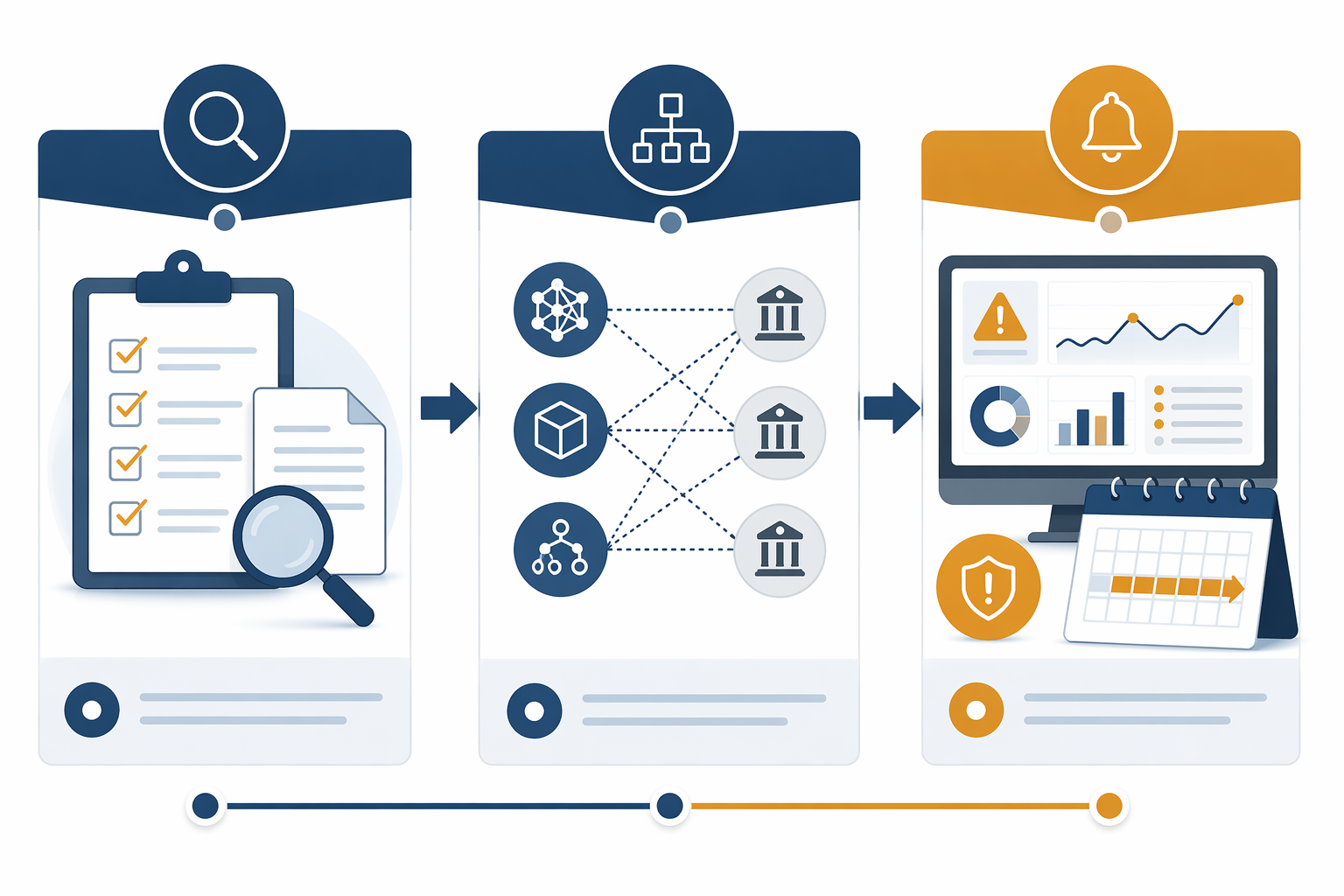
Start with systems that create leverage over physical or financial commitments. That usually means demand planning, inventory optimization, supplier selection, purchase-order automation, transportation routing, warehouse labor planning, customer allocation, trade compliance screening, and exception management. A chatbot that answers internal policy questions is still worth tracking, but a model that changes buy quantities or supplier recommendations deserves faster review.
- Business owner: the person accountable for the process using the AI output, not only the IT application owner.
- Decision role: whether the tool drafts, recommends, approves, executes, or merely summarizes.
- Model layer: foundation model, fine-tune, retrieval system, agent framework, embedded model, or third-party API.
- Originating entity: the developer or company behind the model backbone, including parent or affiliate information where available.
- Continuity option: suspend, degrade to rules-based workflow, switch model, route to human review, or keep under legal hold pending review.
This is also where procurement needs to be precise. A questionnaire that asks, “Do you comply with sanctions law?” will produce a comfortable answer and little evidence. A better questionnaire asks the vendor to name all foundation or open-source model backbones used in the product, identify the originating legal entities, disclose whether Chinese open-source models are used directly or through fine-tunes, describe any model substitution capability, and agree to notify the customer if a relevant developer is designated.
If the vendor uses a wrapper around multiple models, ask how routing decisions are made. If it uses a hosted model, ask who hosts it and who controls updates. If it fine-tuned an open-source model, ask for the base model and the fine-tune owner. If it says the model is “open,” ask open from whom. Openness is not provenance.
What changes if a developer is designated
A formal designation would not necessarily mean OFAC has sanctioned “the model weights” as if they were a standalone legal person. Available sources do not support that conclusion. Sanctions may target the developer company, parent, affiliate, or other legal entity associated with the alleged conduct. That is why entity mapping matters more than debating whether a downloaded model file can itself be sanctioned.
Once an entity is designated, the operational question becomes: what dealings continue? A supply chain organization may need to examine hosted access, support agreements, API calls, update downloads, redistribution, payments, contractual renewals, and vendor products that continue to depend on the designated entity. The exact legal analysis belongs with counsel, but the facts counsel will need come from the inventory.
For example, a hypothetical procurement automation tool might use a vendor’s proprietary interface while relying on an open-source model backbone for supplier-risk summaries. If the backbone developer were later designated, the buying company would need to know whether the model is still being accessed, whether the vendor can route to another model, whether historical outputs are stored, whether payments reach the designated entity, and whether any customer-facing or supplier-facing recommendations continue to be produced. Those are not questions to discover during an enforcement clock.
The same separation applies to pilots. A proof of concept that was harmless when launched can become a problem if it quietly remains connected to a sanctioned developer’s service. The risk is not moral hindsight. It is continued use after the compliance event.
Why the enforcement environment deserves attention
The sanctions threat is arriving in a broader enforcement environment that has been getting more muscular around technology controls. In January 2026, Applied Materials agreed to a $252 million penalty related to export-control issues, according to MoFo’s reporting.[6] In December 2025, Operation Gatekeeper dismantled a smuggling network valued at more than $160 million, according to Kharon’s coverage.[7] The research brief also notes a 23% BIS budget increase for FY2026.[7]
Those facts do not prove that AI model designations are coming. They do show that technology enforcement is not a paper exercise. If Treasury moves from investigation to designation, supply chain AI users should expect questions to become practical very quickly: who knew what, when did the company screen, what was suspended, what payments continued, and whether the organization had a reasonable control process once the risk was public.
This is the point where compliance work can look excessive until it suddenly looks cheap. The inventory fields are not glamorous. They are the difference between a controlled suspension review and a conference call where planning, IT, procurement, legal, and a vendor all learn at the same time that no one can name the model lineage.
A practical response plan for supply chain AI owners
The response should be sized to the current facts. There are no formal OFAC designations as of July 22, 2026.[2][3] The September talks could change the sanctions trajectory.[5] The legal application of the Protecting American Intellectual Property Act to AI distillation remains uncertain.[4] None of that supports a blanket ban on every Chinese AI model in every supply chain environment.
It does support a 90-day control build. The work is concrete enough to assign this week.
- Freeze new high-impact AI deployments until the vendor has disclosed model backbone and originating legal entity information.
- Inventory production tools, active pilots, and shadow workflows where AI outputs influence planning, procurement, logistics, warehouse, or inventory decisions.
- Require vendors to disclose whether DeepSeek, Qwen, Kimi K3, Moonshot AI models, or other Chinese open-source backbones are used directly, fine-tuned, embedded, or accessed through routing.
- Map each identified model to its originating legal entity and, where possible, parent or affiliate relationships.
- Classify each use case by operational criticality and define what happens if the entity is designated: suspend, switch, isolate, route to human review, or seek counsel-approved exception handling.
- Create an OFAC monitoring trigger that automatically notifies legal, compliance, procurement, IT architecture, cybersecurity, and the business process owner.
- Add contract language requiring prompt notice of model changes, sanctions-relevant entity changes, and substitution plans if a model developer becomes restricted.
Some organizations will find that a vendor can substitute models cleanly. Others will learn that the Chinese open-source backbone is embedded in a fine-tuned product with no tested fallback. The answer affects more than legal risk. It affects business continuity. A demand-planning tool that cannot run during a peak planning cycle creates a different operational exposure than a low-use internal assistant.
The monitoring trigger should be specific enough to work without interpretation. “Watch sanctions developments” is not a control. “If OFAC designates the originating legal entity for any model in the AI inventory, open a suspension review within one business day and route to named owners” is closer to something an operator can execute.
The same control should cover vendor change notices. A supply chain AI vendor may swap models to improve cost, latency, or performance. That change can alter sanctions exposure even if the user interface stays the same. Procurement and IT architecture should treat model substitution as a material change when the tool affects operational decisions.
The decision standard
A useful AI tool does not become irresponsible because Treasury announced an investigation. A Chinese open-source backbone does not automatically make a supply chain deployment prohibited. But a business-facing product that cannot identify its model lineage is now carrying a compliance defect that can become material if a developer is designated.
The disciplined move is to complete the model-provenance inventory, map model backbones to legal entities, and put OFAC designation triggers into the operating model within the next 90 days. That gives the company a chance to decide calmly before ambiguity becomes a strict-liability problem.
References
- AI Governance Institute July 2026 guidance, AI Governance Institute, July 2026.
- Treasury sanctions threat announcement, The Hill, July 21, 2026.
- Treasury sanctions threat announcement, TechCrunch, July 21, 2026.
- Protecting American Intellectual Property Act analysis, NatLawReview.
- September 2026 US-China AI talks brief, Briefs.co, July 2026.
- Export controls, MoFo, January 2026.
- Enforcement event, Kharon, December 2025.
Comments
Join the discussion with an anonymous comment.