
A delayed air cargo flight is not just a late aircraft. It can mean a missed handoff to line-haul, a consignee waiting with a production slot open, a customer service team rewriting promises, and an operations manager deciding whether to buy an expensive recovery move before anyone agrees who will pay. That is why AI flight delay prediction logistics hedging is worth taking seriously: the useful question is not whether an algorithm can call a delay, but whether that signal can be converted into money at the moment the logistics organization actually needs it.
The cost baseline is large enough to justify that question. One economic study puts air cargo delay costs at $8,000 to $38,000 per flight-hour, with an average around $20,000, and notes that these disruption costs are largely outside what traditional cargo insurance is built to cover.[1] In 2024, 22% of U.S. flights were delayed by at least 15 minutes, while OAG attributes roughly 60% of delays to industry-caused factors such as airline operations, maintenance, crew, or air traffic control.[2] Those are not all hedgeable losses, and not every 15-minute delay matters to cargo. But the figures explain why logistics teams are looking beyond claims files and apology emails.
The broader market language can get inflated quickly. Freightos and Otonomi have cited roughly $50 billion a year in supply chain delay losses, which is useful as industry color but should not carry the argument by itself.[3] A procurement or risk lead does not hedge a global estimate. They hedge a lane, a service promise, a customer penalty, a temperature window, a missed connection, or a portfolio of shipments where the same failure mode keeps showing up.
The prediction layer is becoming operational, but the proof is still narrow
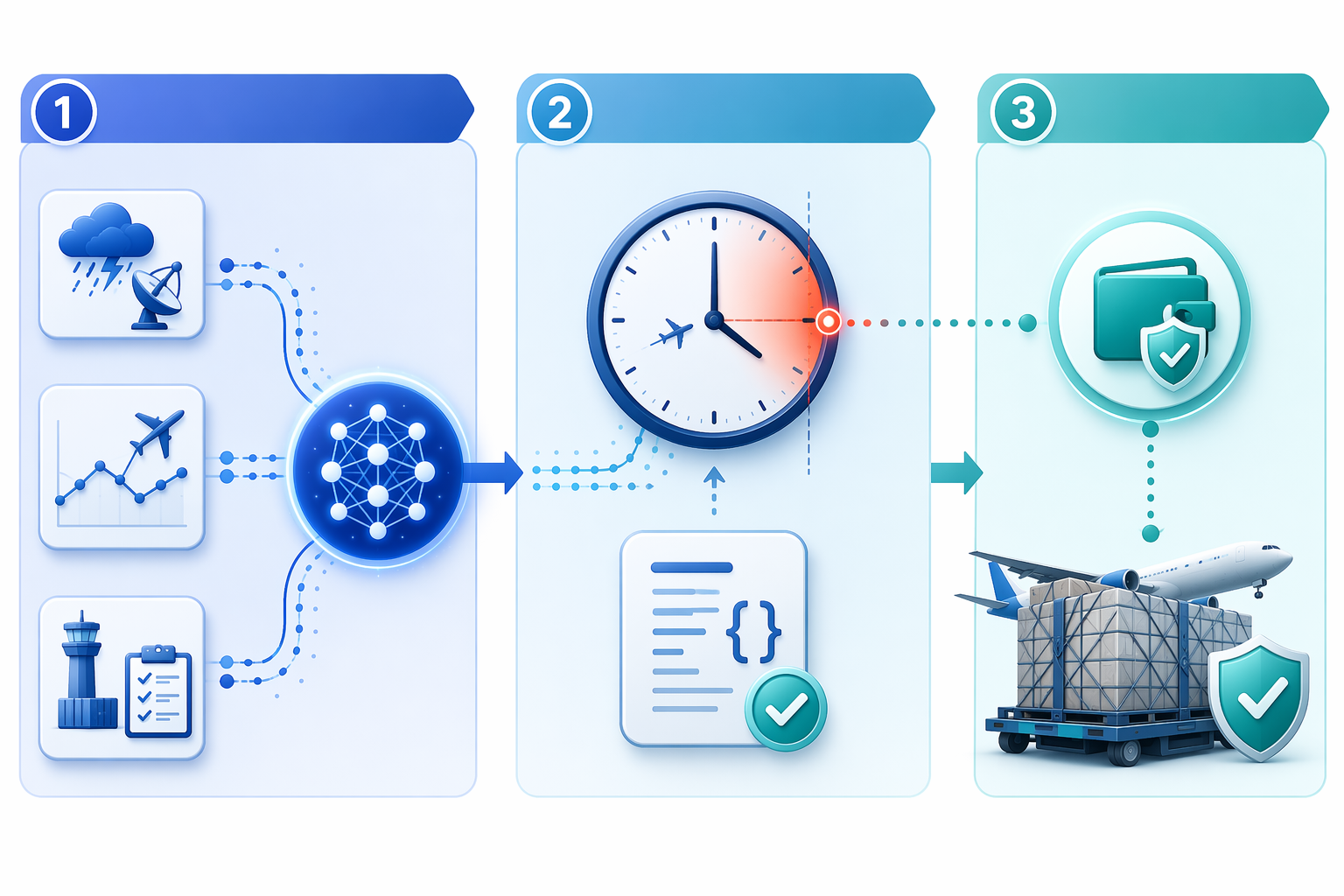
AI flight delay prediction usually starts with a practical blend of data rather than a mysterious model: weather, flight history, airport congestion, aircraft rotations, operational status, and disruption patterns. For readers who need the broader category first, this is one branch of predictive analytics in logistics. The freight-specific version matters because a prediction has to reach the people who can still change a consolidation plan, notify a customer, pre-book recovery capacity, or decide whether a financial trigger is likely to fire.
The Finnair, Silo AI, and AMD case is a useful signal that aviation delay prediction can run in production. The case study describes machine learning models that predict major delays more than 12 hours in advance using weather, operations data, and historical patterns, deployed on AMD EPYC CPUs.[4] That is meaningful for the prediction layer. It is not, by itself, evidence that a cargo shipper saved money on hedging, reduced expedite spend, or recovered a specific percentage of delay losses. The distinction matters.
OAG and Microsoft describe the aviation AI problem in the same data-layer terms: trusted aviation data has to be organized, connected, and usable before AI can support operational decisions.[5] That sounds obvious until a forwarder tries to connect carrier status updates, airport events, truck dispatch, warehouse appointment windows, customer order priority, and policy trigger data inside an older transport management stack. The model may be the newest component in the room; the workflow around it often is not.
Where prediction becomes a hedge
The financial structure is where the use case becomes different from ordinary disruption management. A delay prediction can help operations prepare. A parametric product or hedge attempts to predefine what happens financially when a measurable event occurs. The promise is not that anyone proves every invoice after the fact. The promise is that a specified delay event triggers a specified payment or risk position.
| Layer | What it does | What can go wrong |
|---|---|---|
| Prediction signal | Estimates delay probability from aviation, weather, operational, and historical data | The forecast may be late, incomplete, or poorly connected to cargo priority |
| Trigger design | Defines the delay threshold, index, route, shipment scope, and documentation rule | The trigger may fire without matching the actual loss, or fail to fire when the business still loses money |
| Payout or hedge action | Provides predefined compensation or supports a financial position against disruption exposure | The payment may be too small, too slow for the recovery decision, or unavailable in the relevant jurisdiction |
| Operational response | Uses the signal and expected financial treatment to decide whether to re-route, expedite, hold, or notify | The TMS, WMS, or control tower may not move fast enough to turn the signal into action |
Otonomi’s work with OAG is the clearest evidence cluster because it ties aviation delay data to a parametric insurance workflow. The OAG case study says Otonomi reduced claims resolution from 45 days under a traditional process to 45 minutes and cut administrative costs by about 90%.[6] That is not a small process improvement. For a logistics buyer, it changes the timing of the conversation: money can arrive while the disruption is still operationally relevant, rather than after the internal postmortem is already finished.
Marsh’s parametric air cargo delay product shows how the trigger can be packaged for buyers. The product page describes 3-hour, 6-hour, and 12-hour delay triggers, payout limits from $1,000 to $250,000, a 50% payout when the trigger is met, and an additional 5% per day after that.[7] Those details matter more than broad statements about AI because they define the commercial shape of the protection. A 3-hour trigger and a 12-hour trigger are not interchangeable if the cargo is feeding a line shutdown, a clinical shipment window, or a retail launch date.
The index side is also moving. Otonomi announced the OTO-USA-1 cargo delay index on Nasdaq, describing it as the first cargo delay index.[8] In April 2026, FIATA and Otonomi announced a partnership making parametric delay insurance available to more than 50,000 freight forwarding firms across about 150 territories.[9] That does not mean adoption is broad or claims performance is proven across all those firms. It does mean the category has moved past pitch decks into distribution channels, index infrastructure, and named market participants.
Freight hedging is adjacent rather than identical. NYSHEX, for example, positions freight hedging around managing freight-rate exposure through index-based instruments.[10] That is a different risk from a flight delay, but the logic is related: logistics organizations are trying to make volatile operating exposure financially manageable before it hits the P&L. Delay-linked parametric coverage sits closer to event risk; freight hedging sits closer to price risk. A mature risk program may eventually need both, but they should not be treated as the same product with different branding.
Reliability depends on fit, not just model accuracy
The weak point is basis risk. Parametric insurance pays when a defined trigger is met, not when the insured proves the actual financial damage. That is the feature that makes the payout fast, and it is also the reason the product can miss the business need. A shipment can be delayed enough to cause a customer penalty but not enough to meet the trigger. Another shipment can meet the trigger while the cargo still makes its downstream connection and creates little loss. In both cases, the product may be working exactly as written while the logistics team still feels exposed.
This is where buyers should separate three questions that often get collapsed into one sales conversation: Was the delay forecast useful? Did the trigger match the exposure? Did the payout arrive in a form and amount that supported the recovery decision? A model can be directionally right and still fail the hedge. A payout can be fast and still be too small. A trigger can be transparent and still miss the cost center that actually absorbed the loss.
A simple hypothetical shows the problem. Suppose a shipper has two air cargo moves delayed by the same number of hours. One shipment contains replaceable inventory with slack at destination. The other feeds a production line where the missed inbound slot forces an expedited recovery move and customer escalation. A uniform delay trigger sees the same event. The operating loss does not. The hedge design has to account for that difference through lane selection, shipment eligibility, coverage limits, deductibles or waiting periods, and internal rules for when to buy protection.
Data quality is the next constraint. Gartner has reported that 60% of AI projects fail because of messy data, and this use case is especially exposed to that problem.[11] Flight status may be available, but cargo handoff data, warehouse cutoffs, truck appointment times, and customer-criticality fields may sit in different systems or arrive too late to support automated decisions. In air cargo, the financially important delay is often not just wheels-up to wheels-down. It is the missed connection between flight, handler, customs, line-haul, appointment, and customer promise.
Fragmentation makes that harder. Airlines, airports, ground handlers, forwarders, brokers, trucking partners, and warehouse operators may all hold part of the truth. Some data is structured, some arrives by message, some is updated manually, and some is only known after a cutoff has already been missed. Legacy TMS and WMS environments can also struggle with the throughput required to move from live prediction to trigger monitoring to payout automation. A parametric product may be modern; the buyer’s execution layer may still be batch-oriented.
Jurisdiction matters too. Parametric insurance is not treated identically across markets, and a multinational shipper or forwarder may not be able to assume the same wording, claims treatment, admitted status, or distribution model everywhere. That issue becomes more important when a product is sold through broad forwarding networks or applied across many origins and destinations. A clean trigger is not a substitute for local insurance review.
What the market evidence can and cannot prove
The market context supports interest, but not inevitability. Global Market Insights estimates the broad parametric insurance market at $19.4 billion in 2025 and projects $63.8 billion by 2035, while the specialty parametric segment that includes marine and aviation delay is forecast to grow at a 13.5% CAGR through 2035.[12] Those estimates depend heavily on category definition. Agriculture, climate, catastrophe, marine, and specialty delay covers do not all validate the same logistics use case.
The better evidence for air cargo is more specific: Otonomi’s OAG-based claims automation, Marsh’s published trigger structure, the Nasdaq cargo delay index, and the FIATA distribution partnership. Together, they show that prediction data, event indexes, parametric wording, and freight-market distribution are being assembled into real products. They do not yet show standardized adoption, mature pricing benchmarks, long claims histories across multiple disruption cycles, or a settled view of which lanes and cargo types produce the best risk-transfer economics.
The Finnair case should be read in the same disciplined way. It supports the idea that aviation operators can put machine learning delay prediction into production more than 12 hours before major disruption.[4] It does not prove that shippers, 3PLs, or forwarders can turn every such signal into a reliable hedge. Passenger-airline optimization can still teach cargo teams something about data architecture, prediction windows, and operational adoption, but the financial exposure is different. Cargo has consignee penalties, service credits, temperature risk, missed assembly windows, inventory buffers, and downstream transport commitments layered on top of the flight event.
Where a pilot makes sense
The most credible adoption posture is selective. This is not yet a mature, broadly standardized risk-transfer category. It is an emerging use case with enough production evidence to justify pilots where the delay exposure is material, recurring, and measurable. A shipper moving low-margin, easily substituted goods through flexible networks may not need it. A forwarder managing premium air cargo commitments on delay-sensitive lanes may have a different answer.
- Start with lanes or customers where delay costs are already visible in expedite spend, penalties, service credits, or margin leakage.
- Compare the proposed trigger against the real loss pattern, not just against flight delay frequency.
- Test whether flight, cargo, warehouse, and customer-priority data can move fast enough to support both prediction and claim automation.
- Separate operational value from financial-transfer value: a useful early warning may still justify process changes even if the hedge is too expensive or too narrow.
- Review jurisdiction, policy wording, payout limits, and internal accounting treatment before treating the product as insurance-equivalent protection.
AI flight delay prediction can support logistics hedging when the prediction window is actionable, the trigger reflects the buyer’s real exposure, and the payout is fast enough to matter. The use case has crossed from theory into early production evidence, especially around Otonomi, OAG, Marsh, index infrastructure, and forwarding-channel distribution. It has not crossed into a category where buyers should assume that model accuracy or parametric speed equals full economic protection.
References
- Economic Costs of Air Cargo Flight Delays — ScienceDirect
- OAG/FAA flight delay data — OAG/FAA
- Otonomi Delay Insurance on Freightos — Freightos
- Finnair + AMD + Silo AI Case Study — AMD
- AI and Trusted Data — OAG + Microsoft
- Otonomi Case Study — OAG
- Parametric Coverage for Cargo Delay — Marsh
- Otonomi Cargo Delay Index — Otonomi
- FIATA + Otonomi Partnership — FIATA, April 2026
- NYSHEX Freight Hedging — NYSHEX
- Gartner Data Quality Research — Gartner
- Parametric Insurance Market 2026–2035 — Global Market Insights
Comments
Join the discussion with an anonymous comment.