
The hard part of AI infrastructure planning in 2026 is no longer just getting enough accelerators into the right region. A procurement team can approve the GPU budget, reserve floor space, and still watch capacity sit on a schedule because the site is waiting on utility interconnection, a transformer order, or a tariff decision nobody modeled when the business case was signed. That is the practical reason power-cost planning for AI data centers has become a supply chain problem rather than a facilities side note.
In major markets, grid interconnection approvals are being described in 24- to 36-month windows, while transformer lead times that were about 16 weeks in 2021 have stretched to 115-140 weeks in early 2026, with prices nearly four times 2021 levels.[1] Those are not abstract energy-transition numbers. They are lead times. They belong in the same planning conversation as HBM supply, advanced packaging capacity, rack delivery, and deployment sequencing.
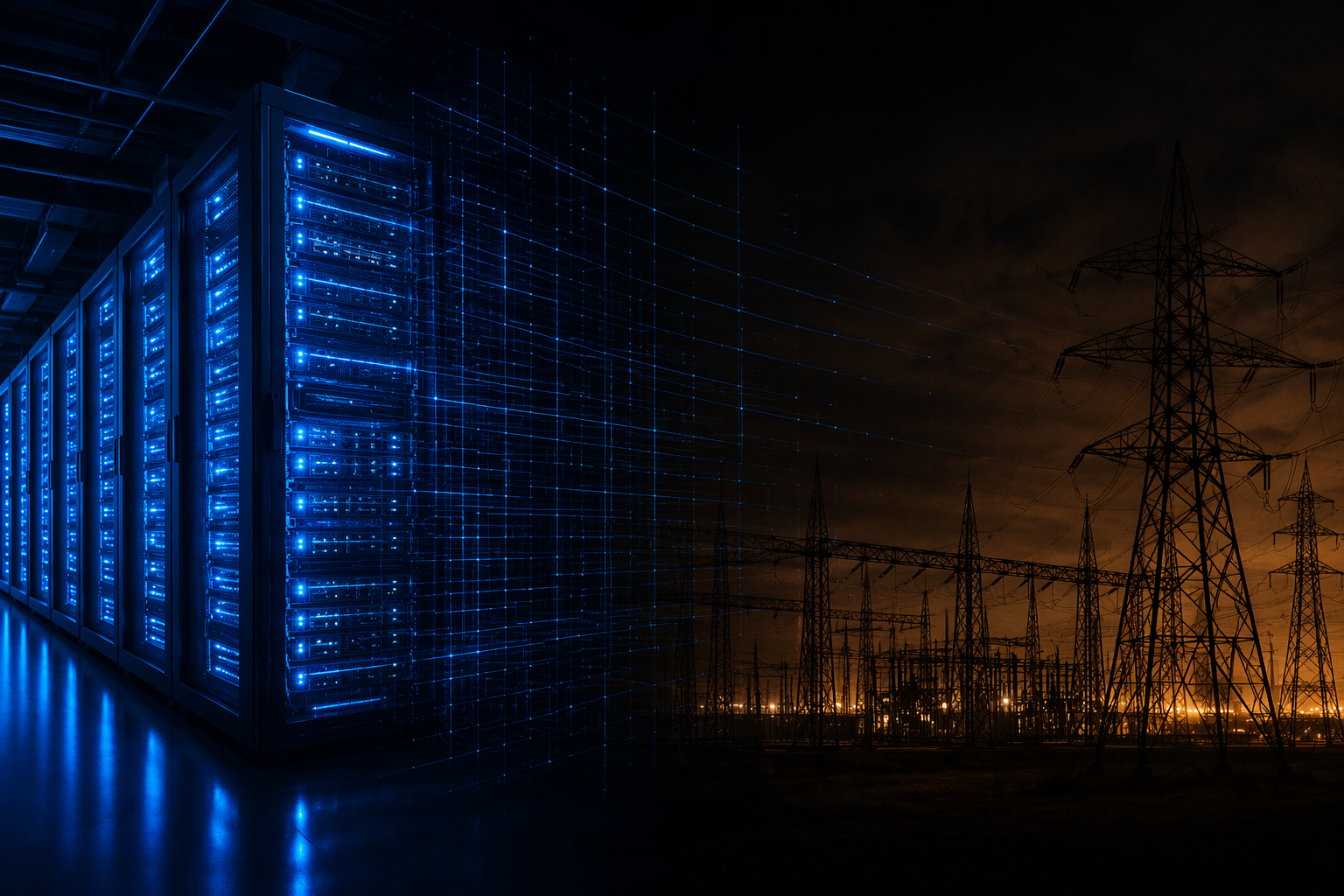
Power Is Now a Constrained Input
The global demand story matters, but only up to the point where it explains why individual projects are hitting the queue. The IEA Base Case estimates that data center electricity consumption was roughly 415 TWh in 2024 and could reach about 945 TWh by 2030, implying annual growth near 15% for data centers compared with less than 4% for all other sectors.[2] The Base Case assumes efficiency improvements, so it should not be read as a worst-case forecast. It is still enough to explain why utilities, developers, and procurement teams are competing for the same grid equipment and grid capacity.
Cooling turns the load problem into a site problem. Deloitte reports that cooling accounts for about 40% of data center electricity demand, and AI racks are especially heat-intensive.[3] A rack plan that looks clean in a compute model can become less clean when the real site model adds cooling load, redundancy, power usage effectiveness targets, and local grid constraints. The planner does not buy tokens; the planner reserves megawatts that must pass through utility approvals, switchgear, substations, transformers, and commercial rate structures.
The equipment side is not easing quickly. Deloitte notes that power companies have faced roughly 30% cost increases since 2019 for grid equipment.[3] Morgan Stanley expects utility capital expenditure to surpass $1 trillion cumulatively within five years as utilities and energy markets respond to rising demand.[4] Those investments may help over time, but they do not make a delayed interconnection disappear from a 2026 deployment plan.
The more useful conclusion is narrower than the headline version. The grid is not simply "unable to handle AI." Some sites will get power. Some regions will clear faster than others. Some operators will pay for upgrades, sign different contracts, or move workloads. The problem is that power now behaves like a constrained supply input with long lead times, volatile cost exposure, and limited substitution options. That changes who needs to be in the room before capacity is promised.
What AI Energy Procurement Actually Has to Do
A useful AI energy procurement system is not a dashboard that says electricity is expensive. It has to connect compute demand, rack power, cooling load, tariffs, contract options, and grid headroom tightly enough to change operating decisions. If it cannot recommend whether a workload moves, a batch job waits, a PPA covers exposure, or a site gets deprioritized until an interconnection clears, it is analytics rather than planning.
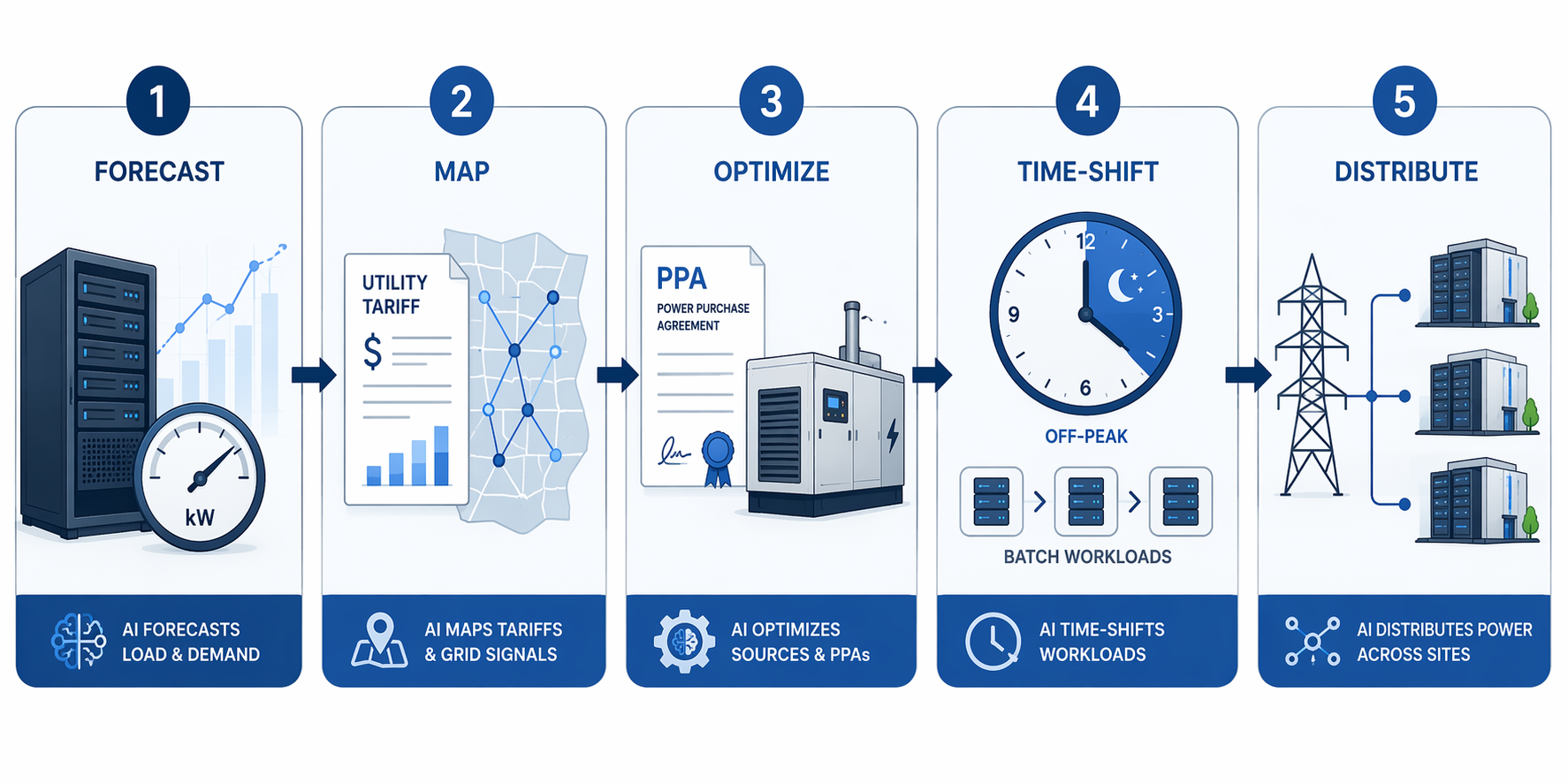
The workflow is simple to describe and hard to operate:
- Forecast compute load and rack-level power demand, including cooling assumptions and expected utilization.
- Map utility tariffs, interconnection status, grid capacity, and local operating restrictions by site.
- Optimize sourcing across utility tariffs, renewable PPAs, on-site generation, storage, and geography.
- Shift eligible batch inference and training support workloads into lower-cost windows where service levels allow it.
- Distribute capacity across independent grid connections when a single campus becomes the bottleneck.
The first step is the one many savings claims skip. Rack power demand is not a single static number. It changes with GPU type, utilization, workload mix, model serving pattern, cooling environment, redundancy design, and power capping policy. A planning model needs telemetry and engineering assumptions close enough to operations that it can distinguish between steady inference, bursty inference, batch inference, fine-tuning, and training support jobs. Otherwise, the procurement team is optimizing against an average that the site never actually experiences.
The second step is where energy procurement starts looking like supply chain planning. Tariffs are not just prices; they are rules. A site may face demand charges, time-of-use pricing, interruptible-rate options, curtailment exposure, capacity reservation terms, and penalties that make two megawatts at noon commercially different from two megawatts at midnight. The model has to know which loads can move, which ones cannot, and which contract terms create risk if utilization changes.
Dynamic Tariff Optimization Is Useful Only When It Reaches Dispatch
Rate optimization becomes operational when it affects dispatch. If a tool sees an off-peak window but the workload cannot move, the savings are theoretical. If the workload can move but the site has a demand-charge threshold that a batch run will breach, the model has to catch that before the job is scheduled. If a PPA hedge covers part of the load but not the marginal burst, the planner needs to see the uncovered exposure rather than a blended average price.
Vendor evidence is directionally interesting here, but it needs labels. Spheron, a distributed GPU cloud vendor, says per-token electricity costs can fall 23-29% through FP8 quantization and continuous batching on existing hardware, and that time-shifting batch inference to off-peak hours can reduce costs 30-50% in time-of-day rate markets.[5] Those numbers are not a universal tariff model. They are a signal that certain workloads, in certain markets, under certain technical assumptions, have enough flexibility for procurement and operations teams to capture real savings.
The mechanism is credible when the inputs are visible. FP8 quantization and batching affect compute efficiency and GPU utilization. Time-shifting affects when electricity is consumed. Tariff schedules determine whether the timing difference has financial value. Cooling load determines whether the facility-level power reduction follows the server-level improvement. A planner can work with imperfect models, but not with missing boundaries.
For batch inference, the practical question is not whether off-peak energy is cheaper. It often is in time-of-day markets. The question is which jobs can wait without breaking service-level commitments or business processes. Model evaluation runs, internal analytics, some content processing, and nonurgent inference queues may have scheduling flexibility. Real-time customer-facing inference generally has less. The procurement model should not flatten those categories into one assumed load-shift percentage.
| Planning Input | Why It Matters | Bad Assumption to Avoid |
|---|---|---|
| GPU and rack telemetry | Connects workload decisions to actual power draw | Using nameplate power as the operating forecast |
| Tariff and demand-charge rules | Determines whether load shifting creates savings or penalties | Treating average electricity price as the optimization target |
| Cooling and facility overhead | Shows whether server efficiency translates into site-level savings | Counting GPU savings without facility load effects |
| Workload service levels | Separates movable batch work from latency-sensitive inference | Assuming all AI demand can shift to off-peak windows |
| Interconnection and grid capacity status | Controls where capacity can actually come online | Sequencing racks against floor space rather than power availability |
Distributed Capacity Is a Bypass, Not a Free Pass
When a single site is waiting on a substation upgrade or transformer delivery, the cleanest spreadsheet answer is usually to push the go-live date. The operating answer may be to distribute capacity across locations that sit behind different grid connections. Spheron frames this as converting a 24- to 36-month infrastructure problem into on-demand OpEx by using distributed GPU capacity across independent grid connections.[5]
That claim is worth considering, and also worth testing hard. Distributed capacity can reduce dependence on one constrained interconnection. It may also introduce latency, data residency, security, orchestration, observability, egress-cost, and vendor-risk questions. For some batch or asynchronous workloads, those tradeoffs may be acceptable. For latency-sensitive inference or regulated data, they may not be. The point is not that distributed GPU capacity solves the grid queue; it creates another capacity option that supply chain planners can price against delay.
This is where procurement needs more than a cloud rate card. The comparison should include reserved capacity, expected utilization, workload transfer costs, network charges, SLA exposure, contract termination terms, and the cost of leaving owned racks idle while power work catches up. GEP cites a directional estimate of $3.1 million per month in revenue loss per 100 kW rack when constrained capacity cannot come online.[1] That figure should not become a universal business case, but it is a reminder that delay cost belongs in the model.
The Implementation Burden Sits Between Procurement, Planning, and Operations
The uncomfortable part of AI-enabled energy procurement is that it needs data from teams that are not always managed as one planning system. Energy procurement owns tariffs, PPAs, and supplier negotiations. Capacity planning owns deployment timing and utilization assumptions. Facilities and operations own rack power, cooling, redundancy, and incident constraints. Finance owns hurdle rates and exposure limits. Cloud or platform teams own workload placement and service levels.
An AI tool can improve the optimization layer, but it cannot invent clean inputs. It needs tariff data, grid-pricing feeds where relevant, contract terms, interconnection milestones, transformer and switchgear lead times, rack telemetry, GPU utilization, workload calendars, and service-level constraints. It also needs authority boundaries: which jobs can be delayed automatically, which require approval, which sites are eligible for new load, and which contracts allow curtailment or resale.
Enki AI cites Gartner's view that 40% of AI data centers could be power-constrained by 2027 and says electricity represents 20-30% of total data center OpEx.[6] Those figures make energy large enough for finance attention, but the operational issue is even more direct. A rack without power is not a depreciating sustainability concern. It is stranded capacity, missed deployment, and an escalation path that usually ends with procurement explaining why the original plan assumed away the slowest supplier in the chain.
What a Sensible 2026 Planning Model Looks Like
The useful model is not one master forecast. It is a set of linked planning views that can answer different questions without forcing every decision through the same average-cost assumption.
- For deployment sequencing: which racks can come online under confirmed power, and which depend on interconnection or equipment milestones?
- For sourcing: what share of load should sit under utility tariffs, PPAs, on-site generation, storage, or distributed capacity?
- For scheduling: which workloads can move into off-peak windows without violating service commitments?
- For risk: what happens if transformer delivery slips, tariff exposure rises, or the PPA generation profile does not match AI load?
- For commercial choice: when is paying for external GPU capacity cheaper than waiting for owned capacity to be energized?
This is also where AI is genuinely useful. The number of combinations is large: site, rack, workload, tariff, contract, hour, utilization, cooling condition, and grid constraint. Static quarterly planning can establish the envelope, but it cannot keep up with operational changes once workloads, prices, and grid conditions move. A model that updates recommended dispatch and sourcing decisions as those inputs change is not magic. It is the planning system catching up with the constraint.
The standard for adoption should be practical. Start with a site where tariffs, load, and workload flexibility are measurable. Validate the model against actual bills and telemetry. Separate savings from avoided delay. Keep vendor-sourced claims in their lane until they survive contract review and operational testing. The worst version of this category will sell rate arbitrage as if every AI job can be moved to midnight. The best version will tell a planner, before capacity is promised, which megawatts are real, which are conditional, and which are too expensive for the workload they are supposed to support.
Energy Procurement Belongs in the Supply Chain Plan
AI infrastructure teams spent the last few years learning that chip availability, packaging capacity, and server supply could set the pace of deployment. In 2026, power deserves the same treatment. It has suppliers, lead times, price volatility, allocation choices, contract structures, and failure modes. A utility queue can delay a launch as surely as a missing accelerator can.
AI-enabled energy procurement is not necessary because it makes energy easy. It is necessary because the old planning method is too static for the way AI capacity now consumes power. The teams that keep compute online will be the ones that model power as constrained supply, optimize across real commercial options, and make workload placement decisions before the bottleneck has already stranded the rack.
References
- AI Growth Hits a Wall: Power, Not Chips, Limits Scale, GEP, Mar 2026
- Energy and AI, IEA, 2025
- Can US infrastructure keep up with the AI economy?, Deloitte, 2025
- Energy Markets Race to Solve the AI Power Bottleneck, Morgan Stanley, Feb 2026
- Power-Bound, Not GPU-Bound, Spheron, 2026
- Data Center Power Crisis 2026, Enki AI, 2026
Comments
Join the discussion with an anonymous comment.