
The weak point in most earthquake recovery plans is not the binder. It is the assumption behind the binder: that the company already knows which suppliers matter, which inventory buffers will hold, which alternate lanes can absorb volume, and who can approve a recovery move when the first executive call starts. That assumption usually survives tabletop exercises. It does not survive a real seismic event.
For supply chain teams building earthquake disaster recovery plans with AI, the practical question is not whether AI belongs somewhere in the resilience roadmap. It is what must be connected before the ground moves so the first recovery decisions are made from a defensible operating picture instead of a supplier spreadsheet that was last cleaned during an audit.
The preparedness gap is uncomfortable. Samsara’s SOCO 2025 reporting found that only 3% of companies in disaster-prone regions have specific supply chain disruption plans for natural disasters, while organizations with an emergency plan were reported to resume operations within 3 days at a 97% rate.[1] The first number explains why earthquake exposure still turns into discovery work. The second explains why planning discipline is not administrative theater when it is tied to operational data.
The 2024 Taiwan earthquake showed the scale of what discovery can mean. Resilinc reported 13,000+ client sites, 5,800 parts, and 21,000 products potentially affected by the event.[2] Interos separately described roughly 70,000 tier-1 U.S.-Taiwan relationships, but more than 750,000 tier-3 connections.[3] That tier-3 number is where many static disaster recovery files start to fail. The problem is not that teams forgot to list their direct suppliers. It is that direct suppliers are only the visible edge of the dependency network.

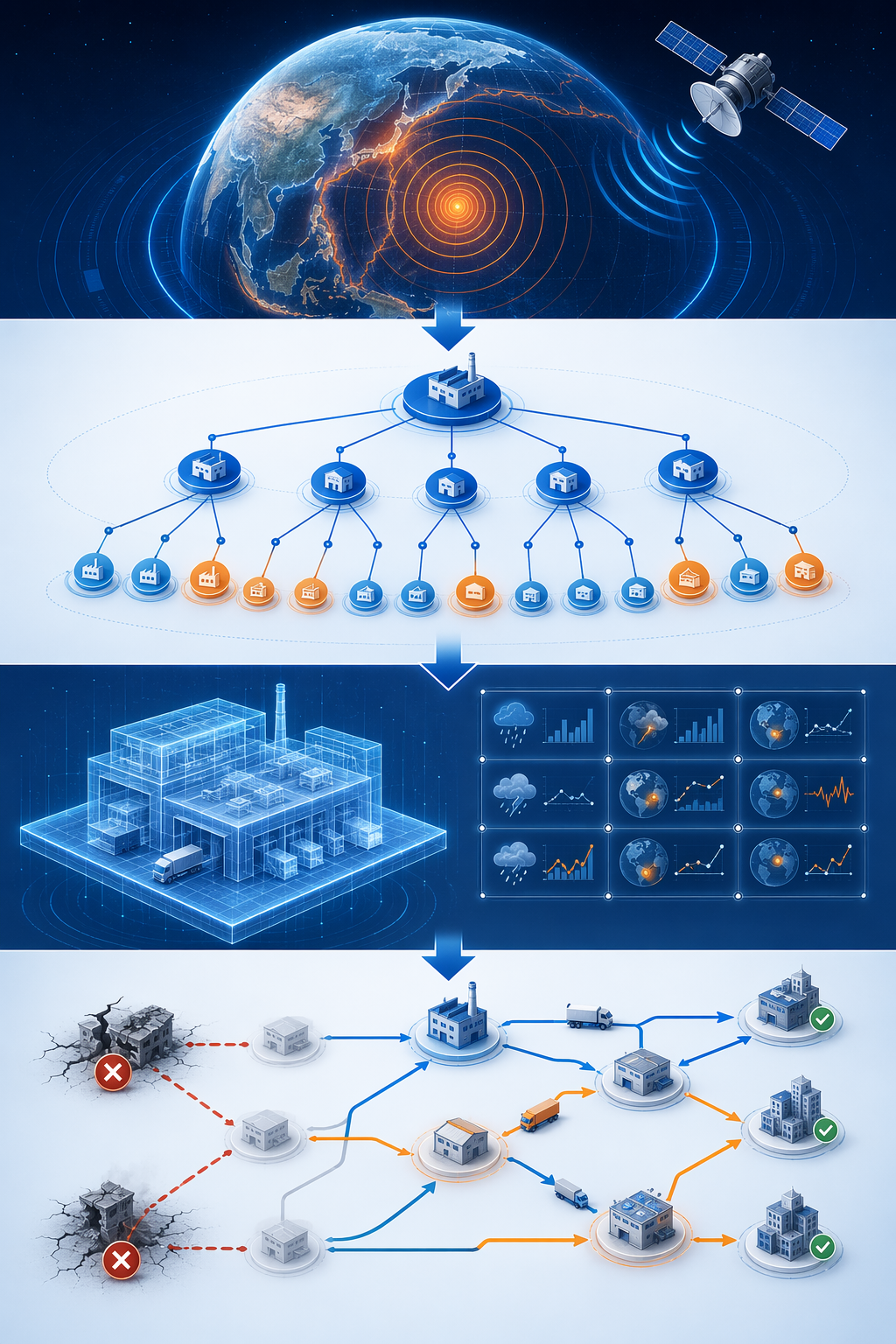
The Four-Layer Recovery Model
An AI-enabled earthquake recovery plan should not be built as a technology stack first. It should be built as a decision stack. Each layer has to reduce one kind of delay that appears after impact: waiting for a reliable event signal, waiting to understand exposure, waiting to compare recovery options, and waiting for approvals or execution handoffs.
| Layer | Operational Question | What Must Exist Before The Earthquake |
|---|---|---|
| Seismic intelligence | Which facilities, lanes, and supplier regions are likely exposed? | Seismic feeds, geocoded assets, alert thresholds, and confidence rules |
| Multi-tier supplier vulnerability mapping | Which parts, products, and customers are connected to exposed nodes? | Supplier network graph, part-to-site relationships, sub-tier inference, and ownership |
| Digital twin simulation | Which recovery playbooks work under constrained capacity? | Modeled sites, inventory, lanes, lead times, alternates, and scenario library |
| Automated recovery orchestration | Which approved actions can start now, and which require escalation? | Workflow triggers, approval rules, carrier and supplier constraints, and audit trail |
This is a stricter standard than adding a risk dashboard to a business continuity plan. A dashboard can show that a supplier is near an earthquake zone. A recovery model has to tell planners which constrained parts depend on that supplier, which customers are exposed, what alternate source is qualified, whether the alternate lane has capacity, and whether procurement is allowed to place an emergency order without waiting for a steering committee.
Layer 1: Treat Seismic Intelligence As A Risk Signal, Not A Magic Forecast
Earthquake planning needs faster warning and better regional risk signals. It does not need overconfident claims that every earthquake can be predicted in time to neatly rebalance a supply chain. The distinction matters because bad confidence rules can be worse than no automation at all. They push teams into false precision, trigger unnecessary allocation moves, or teach planners to ignore alerts after too many misses.
The strongest current use for AI in this layer is signal ingestion and interpretation: seismic monitoring feeds, early-warning alerts where available, geological hazard zones, aftershock probabilities, infrastructure advisories, and site-level exposure data. The model should translate those inputs into operational questions: which supplier sites sit inside the affected radius, which ports or logistics corridors may be impaired, which manufacturing regions should be treated as watch zones, and which existing orders are scheduled to move through exposed infrastructure.
There is promising work on AI-assisted earthquake forecasting, but it should be placed carefully in the plan. A University of Texas at Austin trial reported 70% accuracy at a one-week lead time in China, using a specific seismic monitoring network.[4] That is worth attention. It is not a reason to assume the same accuracy in California, Japan, Turkey, or any other region without validation against local seismic data and monitoring conditions.
For an operating plan, that means the seismic intelligence layer should classify signals by confidence and actionability. A confirmed earthquake alert can trigger immediate exposure mapping. A regional seismic forecast with limited validation may justify closer monitoring, supplier check-ins, or pre-staged scenario review, but not automatic customer allocation changes. An aftershock advisory may justify holding a recovery lane open longer than usual or delaying the assumption that a site is fully stable.
- Minimum data: geocoded internal sites, supplier sites, ports, warehouses, critical lanes, and customer-facing fulfillment nodes.
- Minimum governance: alert severity levels, confidence labels, named owners, and a record of which actions each alert level can trigger.
- Minimum discipline: no automated allocation, rerouting, or supplier switching from a signal whose regional performance has not been validated.
This layer can build on broader earthquake-specific AI planning work, but the recovery-plan version has a narrower job: move from “an event happened or may happen” to “these assets and dependencies require immediate exposure analysis.” For broader context, ChainSignal’s AI earthquake supply chain planning use case covers the wider planning pattern.
Layer 2: Map Exposure Beyond The Suppliers You Pay Directly
Most earthquake recovery delays start here. The event is known. The region is known. The direct supplier list is pulled. Then the questions begin: Which of those suppliers uses a sub-tier process in the affected region? Which contract manufacturer depends on a component that runs through the same industrial park? Which “alternate” supplier buys from the same upstream source? Which products share the constrained part even though they sit in different business units?
The Taiwan numbers are a warning against tier-1 comfort. Resilinc’s affected-part and affected-product counts show how quickly an earthquake can spread from geography to bill-of-material consequence.[2] Interos’s contrast between tier-1 and tier-3 U.S.-Taiwan connections shows why direct supplier records dramatically understate exposure in complex networks.[3] A disaster recovery plan that stops at tier 1 may look complete because every line has an owner. It is still blind to shared upstream dependencies.
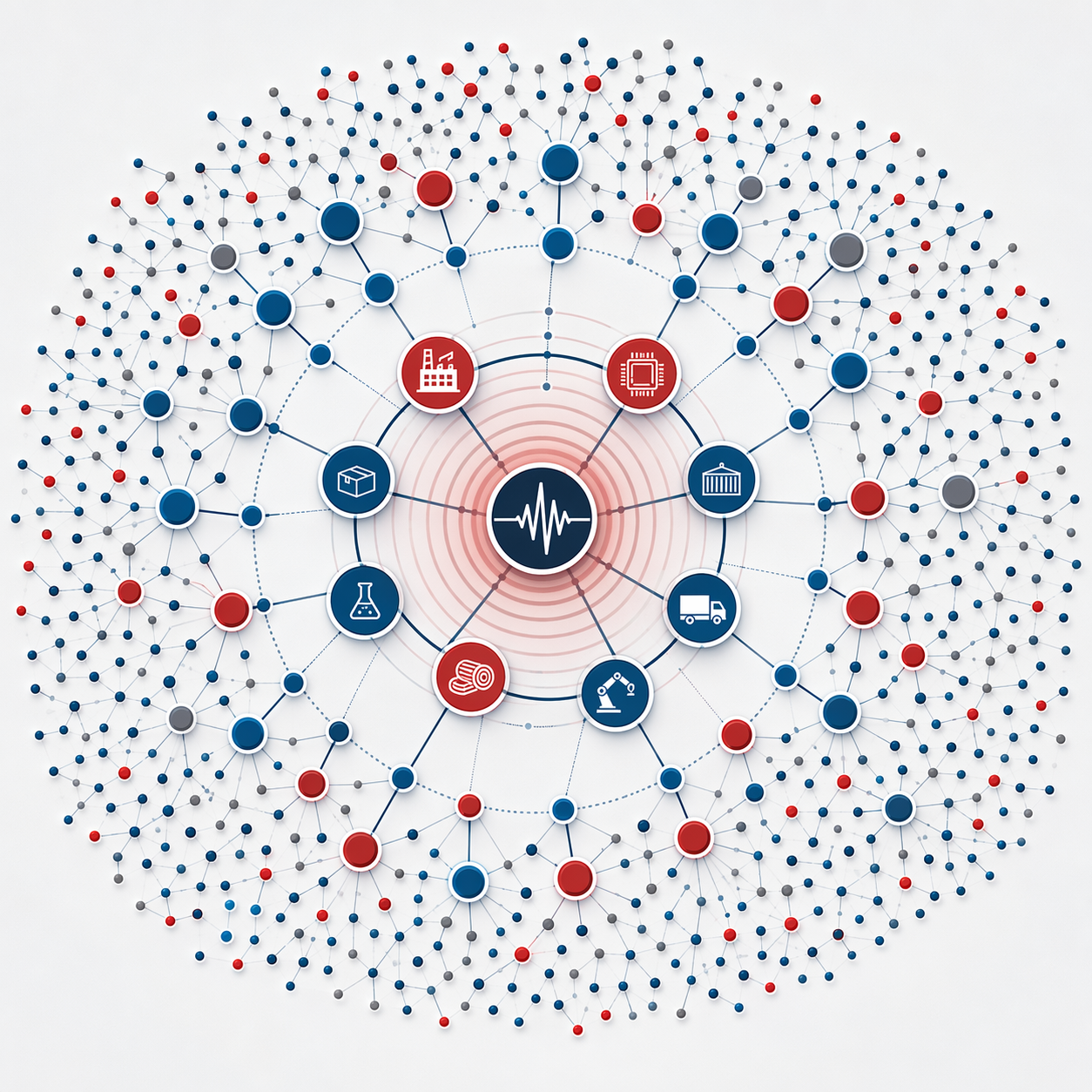
AI helps in this layer because multi-tier mapping is partly a data reconstruction problem. Procurement systems know purchase orders. ERP systems know approved vendors. Quality systems know qualified manufacturing sites. Logistics systems know shipping origins and destinations. Supplier questionnaires may know declared sub-tier sites, often with uneven completeness. External data may indicate corporate relationships, facility locations, news events, sanctions, financial stress, or regional hazards. The plan needs a model that can assemble these fragments into a network graph and flag weak evidence rather than quietly filling gaps with confidence it has not earned.
The practical artifact is not a prettier supplier map. It is an exposure table that can be refreshed fast after a seismic alert. For each exposed node, the table should connect site, supplier, tier, part number, product family, revenue or service commitment, inventory position, qualified alternates, open orders, in-transit shipments, and accountable decision owner. If a field is unknown, the field should stay visibly unknown. Hidden blanks are how a recovery call turns into a two-day email chase.
Teams often ask how far the mapping has to go. The honest answer is: far enough to find shared constraints that would change recovery decisions. For semiconductors, electronics, precision materials, automotive components, medical devices, and other high-dependency categories, tier 3 can matter more than tier 1. For lower-criticality categories with many substitutable sources, the mapping may stop earlier. The plan should not pursue infinite transparency. It should prioritize dependency paths where an upstream site can stop a product, a customer commitment, or a regulated process.
- Start with products whose missed delivery would create contractual, safety, revenue, or regulatory consequences.
- Map the parts and process steps that cannot be quickly substituted, expedited, or requalified.
- Identify shared upstream dependencies across suppliers that are labeled as alternates in the ERP.
- Assign data owners for supplier location, qualification, lead time, inventory, and commercial approval fields.
- Review stale records before earthquake season or regional risk windows, not after a major event.
For teams building this layer from fragmented records, ChainSignal’s multi-tier supplier mapping with AI explains the network reconstruction problem in more depth. The important point for earthquake recovery is that the map must be operational, not decorative. If it cannot produce a constrained-parts list in the first hours after impact, it is not yet a recovery tool.
Layer 3: Rehearse The Recovery Before Capacity Is Gone
Once exposure is visible, the next delay is choice. Should the team shift production, allocate scarce parts, expedite from another region, reroute through a different port, pull from safety stock, or protect one customer segment while delaying another? Those decisions cannot be improvised cleanly while everyone is waiting for updates from suppliers who may also be dealing with damaged facilities, power instability, blocked roads, or workforce disruption.
Digital twins are useful here because they let teams test recovery playbooks against modeled constraints before the event. The evidence is not earthquake-specific in every case, so it should be applied with care. Siemens is reported to model 500+ production scenarios daily, with approximately 20% downtime reduction and roughly 14% lower logistics cost volatility.[5] Gartner’s 2025 Resilience Benchmark, cited in the same SCMR/Rutgers analysis, found that companies embedding AI models with risk-sensitive metrics achieved 28% faster response and 19% shorter recovery cycles than manual contingency management.[5]
Those figures do not mean a company can buy a digital twin and declare earthquake recovery solved. They do show that scenario volume and model-driven response can change the tempo. A planner who has already seen the results of ten alternate allocation rules, five port closures, three supplier outage durations, and two expedited freight constraints is not starting from zero after the shock.
Earthquake scenarios should be designed around failure modes, not around dramatic maps. A useful scenario library includes supplier-site outage duration, partial capacity recovery, loss of local transport, port or airport disruption, inspection or quality hold after restart, power instability, aftershock-related shutdown, and simultaneous demand allocation pressure. The model should show consequences that operators can act on: projected stockout date, customer orders at risk, constrained part count, lane saturation, recovery cost, and approval points.
| Scenario Input | Recovery Output The Team Needs |
|---|---|
| Supplier site down for a defined recovery window | Parts constrained, products affected, alternate sources, and customer commitments at risk |
| Port or lane unavailable | Feasible reroutes, carrier capacity assumptions, transit-time impact, and cost exposure |
| Alternate supplier available but not fully qualified | Quality review requirement, expected qualification time, and executive approval threshold |
| Inventory buffer depleted faster than forecast | Allocation options, protected orders, shortage date, and escalation owner |
| Aftershock risk remains elevated | Hold-open decisions for alternates, inventory staging, and supplier restart assumptions |
The hard part is governance. Someone has to decide which assumptions are allowed in the model and how often they are refreshed. If an alternate lane has no contracted carrier capacity, it should not appear as a clean recovery option. If safety stock exists only on paper because the buffer was consumed during a demand spike, the simulation should show the shortage. If a supplier’s recovery lead time is an optimistic sales estimate, it should be labeled that way.
Warehouse and fulfillment modeling can be part of this layer, especially when the recovery problem involves rebalancing inventory or rerouting orders across facilities. ChainSignal’s digital twin warehouse coverage is relevant where the earthquake plan needs to understand facility-level execution constraints, not just supplier risk.
Layer 4: Automate The Hand-Offs That Do Not Need A Debate
Automation should come after the first three layers, not before them. A workflow engine can move fast in the wrong direction if supplier records are stale, alternates are unqualified, or lane capacity is imaginary. The valuable target is narrower: automate repeatable hand-offs and pre-approved actions while preserving human control over commercial, customer, regulatory, and quality decisions.
In a mature earthquake recovery plan, a confirmed seismic alert can open an incident workspace, pull the current exposure table, notify site and supplier owners, freeze the affected supplier data snapshot, request supplier status updates, check open orders and in-transit shipments, and prepare recommended recovery actions from the digital twin scenario library. None of that requires a vice president to approve the creation of a task list at 2 a.m.
Other actions should remain gated. Emergency allocation that disadvantages one customer for another, switching to a supplier with incomplete qualification, paying premium freight above a defined threshold, or making a public delivery commitment should require named approval. The point is not to slow recovery. The point is to avoid pretending that a model can absorb accountability for decisions the organization has not authorized.
| Can Usually Be Automated | Should Usually Be Escalated |
|---|---|
| Incident room creation and stakeholder notification | Customer allocation trade-offs |
| Exposure-table refresh from approved systems | Use of unqualified or conditionally qualified suppliers |
| Supplier status request workflow | Premium freight above pre-approved limits |
| Shipment visibility checks and exception flags | Contractual delivery commitment changes |
| Scenario recommendation packet preparation | Quality release after disruption-related process changes |
Agentic AI is moving in the direction of more autonomous recovery. Rutgers and MIT research summarized by SCMR suggests that closed-loop AI systems that autonomously reroute logistics when risk thresholds are crossed could reduce average disruption duration by 40% by 2030.[5] That is a useful directional signal, not a license to remove human approval from today’s earthquake recovery decisions. The safer path is to define which triggers the system may execute, which recommendations it may prepare, and which decisions it must route to accountable owners.
What To Build Before The First Alert
Broad AI adoption sentiment is no longer the main obstacle. ABI Research’s 2026 survey found that 65% of supply chain professionals consider AI or GenAI capabilities important or very important in purchase decisions.[6] The more stubborn gap is specificity. Buying teams may ask for AI. Recovery teams still need earthquake scenarios, geocoded suppliers, qualified alternates, lane constraints, and approval rules wired into a plan that can run under pressure.
A workable implementation sequence starts with one critical product family or one high-risk region. Trying to map the entire enterprise at once can bury the team in data-quality arguments. A smaller scope exposes the real work quickly: supplier location gaps, inconsistent part numbering, alternate-source assumptions, carrier capacity limits, unclear approval rights, and recovery playbooks that were never tested against a constrained scenario.
- Select a product family where earthquake disruption would create material customer, revenue, safety, or regulatory consequences.
- Geocode internal sites, supplier sites, critical lanes, logistics nodes, and customer-facing fulfillment points tied to that scope.
- Build the multi-tier dependency graph far enough to identify shared upstream constraints and non-substitutable process steps.
- Create a scenario library covering site outage, lane disruption, partial recovery, aftershock risk, and allocation pressure.
- Define workflow triggers, approval thresholds, named decision owners, and evidence required for each recovery action.
- Run a tabletop exercise using live data, then record every field, owner, and assumption that failed under time pressure.
The last step is where many polished programs become useful. A tabletop that lets people talk through generic actions is not enough. The exercise should ask the system to produce the constrained-parts list, exposed customer commitments, alternate-source options, reroute feasibility, inventory burn-down, and approvals needed within the same decision window the team would face after a real earthquake. If the data cannot support that, the plan is not ready.
Where Earthquake Planning Differs From Other Disaster Plans
Earthquakes are different from many weather-driven disruptions because the warning window may be short or uncertain, physical damage can be highly localized, and aftershocks can keep recovery assumptions unstable. A hurricane plan may have days of track updates. A flood plan may follow rainfall, river, or infrastructure signals. An earthquake plan often has to move quickly from event confirmation to exposure analysis, while admitting that facility status and infrastructure reliability may remain incomplete.
That does not make the four-layer model earthquake-only. The same operating logic can support hurricane supply chain planning, tsunami logistics response, and flood disruption planning. The inputs change. The discipline is the same: connect risk signals to exposure, exposure to modeled choices, and modeled choices to authorized execution.
The readiness threshold is practical. If the company can ingest seismic signals, map multi-tier exposure, rehearse recovery scenarios in a digital twin, and execute pre-approved orchestration rules, recovery shifts from discovery after impact to controlled execution after impact. AI can compress the interval between earthquake and defensible action, but only when the unglamorous work is already done: mapping, data maintenance, scenario governance, and approval design before the ground moves.
References
- AI and Planning Key to Addressing Supply Chain Disruptions in the Face of Disasters, Samsara SOCO, 2025
- Taiwan Earthquake: Supply Chain Shockwaves, Resilinc
- Navigating Semiconductor Supply Chain Disruptions: Insights from Taiwan’s Earthquake, Interos
- AI-driven earthquake forecasting shows promise in trials, PreventionWeb
- How AI and Digital Twins Are Rewriting the Rules of Supply Chain Recovery, SCMR/Rutgers, 2025
- Supply Chain Disruptions 2026: How to Build Resilience with AI and Automation, ABI Research, 2026
Comments
Join the discussion with an anonymous comment.