
Within a day of the June 24 earthquakes in Venezuela, developers working from Buenos Aires, Santiago, Miami, and San Francisco had put more than seven emergency coordination platforms online. They were not waiting for a procurement process, a cluster meeting, or a formal data architecture. They were using generative AI coding tools to assemble missing-person registries, supply-matching forms, resource maps, and low-connectivity access paths fast enough that families, volunteers, donors, and responders had to treat the outputs as operational information rather than side-channel chatter.[1]
That is the useful entry point for understanding AI in disaster response logistics in Venezuela. The notable object was not one clever app. It was an emergency logistics information layer built outside formal command, before the conventional humanitarian logistics stack had fully settled into place.
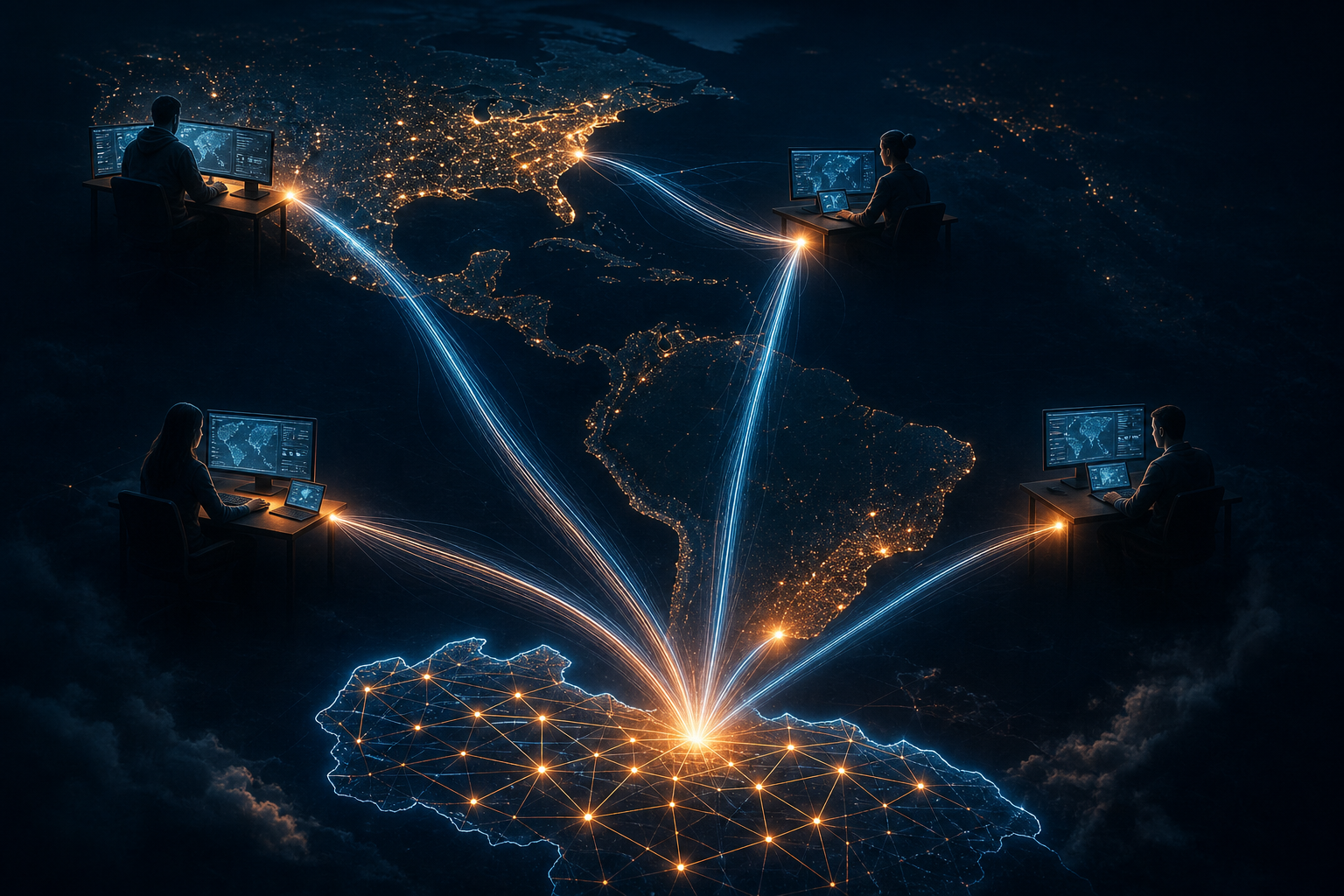
Jorge Bastidas, one of the developers cited in reporting on the response, said tools including Claude Opus 4.8, Replit, and Claude Code compressed one build from roughly 24 person-hours to three or four hours by removing boilerplate work.[1] That claim should be handled carefully. It is one developer’s account, not a controlled productivity benchmark, and it cannot separate the AI toolchain from the prior skill of the developers using it. Still, in emergency operations, the difference between a rough working form at hour four and a better-governed system at week two is not theoretical. People start making decisions with the thing that exists.
The first logistics layer was a cluster, not an app
The early citizen-built platforms covered different operational problems. Desaparecidos Terremoto Venezuela received more than 30,000 missing-person reports with biometric photos in 48 hours. Somos Acompañamiento passed 84,000 registrations and included hospital and shelter capacity data. Ayuda en Camino matched donated supplies against stated needs and offered a WhatsApp fallback for users with weak connectivity. Terremotove.com mapped collapsed buildings and resource distribution points.[2]
| Platform or function | Operational role | What the reported metric does and does not prove |
|---|---|---|
| Desaparecidos Terremoto Venezuela | Collected missing-person reports and biometric photos | 30,000-plus reports in 48 hours signals heavy use; it does not establish deduplicated missing-person counts |
| Somos Acompañamiento | Registered people and gathered hospital and shelter capacity information | 84,000-plus registrations indicates reach; verification and unique-user rates were not reported |
| Ayuda en Camino | Matched supply donations to stated needs with WhatsApp fallback | The fallback matters operationally because connectivity failure is part of the disaster environment |
| Terremotove.com | Mapped collapsed buildings and resource distribution points | The map could guide attention; accuracy depended on incoming reports and validation capacity |
Those distinctions matter. A missing-person report is not the same as a confirmed case. A registration count is not the same as verified coverage. A mapped resource point is not automatically a reliable inventory node. But each record can still change behavior: a family stops searching one channel and starts another; a volunteer redirects water or medicine; a donor chooses a route; a responder checks a civilian data source because it is the only compiled picture available.
The platforms became more than expressions of solidarity because they reduced coordination friction at the point where formal systems were still forming. They provided names, locations, needs, capacities, and contact paths. Some were reportedly treated as primary crisis data sources and cited in United Nations updates.[2] That does not make them official systems. It does mean the boundary between unofficial and operationally consequential had already been crossed.
Speed helped because the information clock and the freight clock were different
The clean but misleading version of the story is that citizen developers beat formal humanitarian logistics. That is not how emergency supply chains work. Moving cargo, opening storage, coordinating airport flow, arranging overland transport, and managing international relief partners operate on a different scale from launching a web form or map. Physical logistics has customs, security, handling capacity, fuel, warehousing, and route constraints that a software team cannot wish away.
DHL’s Disaster Response Team deployed on June 26, two days after the earthquake, and by July 9 had operated three flights moving about 109 tons of aid.[3] The WFP Logistics Working Group coordinated storage and overland transport from Simón Bolívar Airport and Puerto Cabello Port.[4] A U.S. partnership involving Amazon, Airlink, and the Logistics Cluster was described alongside more than $386 million in total U.S. assistance, though that figure included pre-earthquake humanitarian funding rather than only new earthquake-specific money.[5]
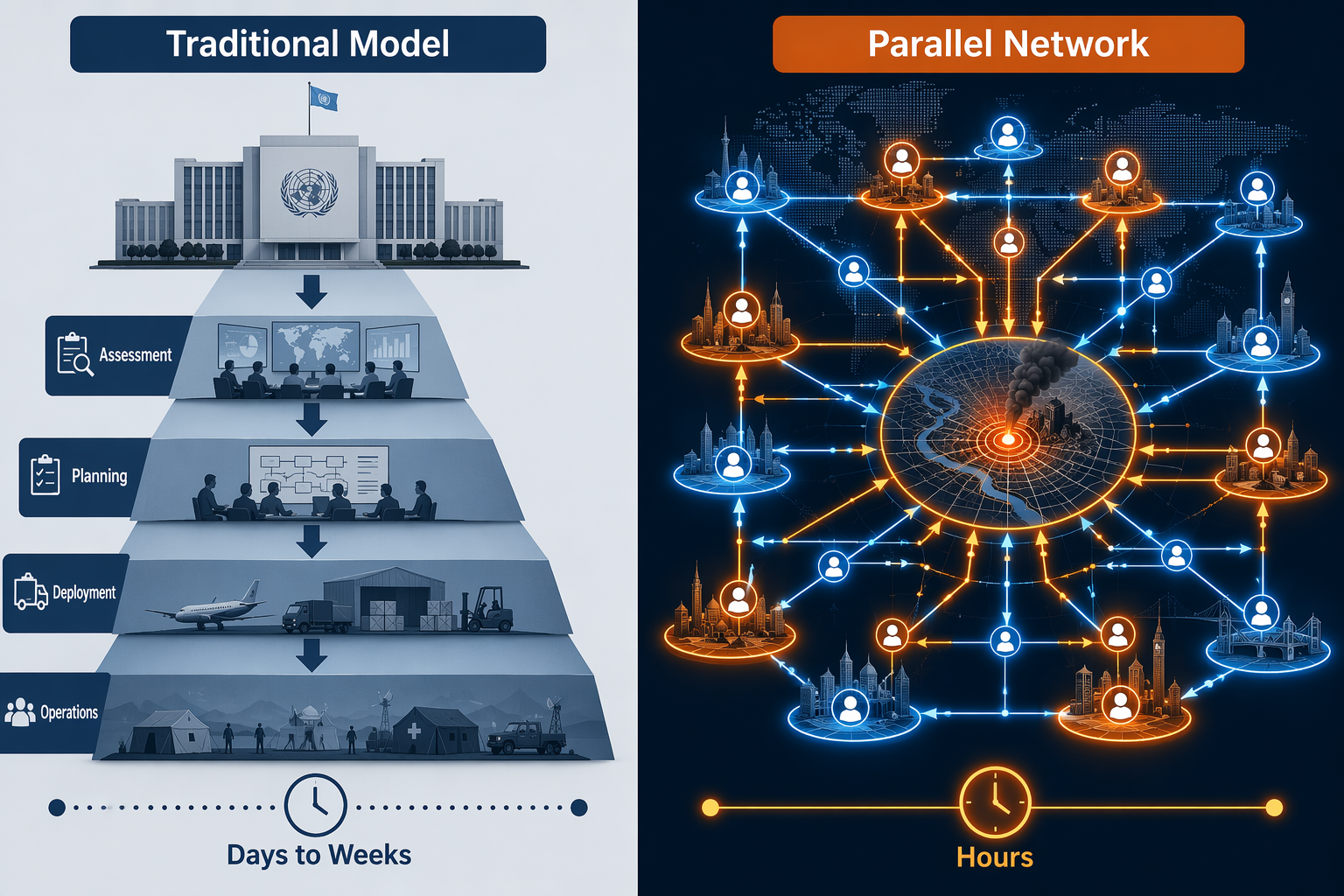
The sharper comparison is that information coordination and physical supply chains matured on different clocks. Citizen platforms were live in hours. Formal logistics systems, by the reporting available, took days to weeks to become fully operational.[3][4][5] During that gap, the question was not whether the citizen systems had formal authority. The question was whether responders and communities could afford to ignore them.
Institutional AI models for humanitarian logistics, such as WFP’s SCOUT-style supply chain optimization work, usually start from the assumption that an agency owns the planning environment, the data model, and the decision process. Structured response frameworks for AI-coordinated tsunami logistics make a similar assumption: detection, preparation, impact assessment, response, and recovery can be organized as phases under a managed operating model. The Venezuela case did not abolish those models. It exposed a period before they dominate, when the first usable data layer may come from people with no mandate but enough trust, urgency, and technical competence to become indispensable.
What generative AI actually changed
The useful claim is narrower than “AI saved the response.” Generative AI appears to have lowered the time and effort needed for already capable developers to produce functional tools: forms, databases, interfaces, matching logic, deployment scaffolding, and messaging integrations. Bastidas’ reported reduction from roughly 24 person-hours to three or four hours is best read as a directional indicator of reduced build friction, not as a universal efficiency ratio.[1]
That reduction has consequences. In older emergency technology cycles, a volunteer group might spend the first day deciding what to build, the second day getting infrastructure working, and the third day finding users. In this case, the build process appears to have compressed enough that the harder problems arrived sooner: deduplication, verification, moderation, privacy, handoff, data custody, and institutional recognition.
This is where admiration for improvisation has to become operationally exacting. A fast form that collects the right fields can be a lifeline. A fast form that becomes the de facto registry for missing people is also a record system. It needs rules for who can see it, correct it, export it, merge it, archive it, and retire it. Those needs do not wait until the codebase looks mature.
The moment a citizen system becomes a source of truth
Emergency logistics depends on records that are imperfect but actionable. A warehouse stock count may lag reality. A road-status update may be stale. A shelter capacity figure may change twice in one afternoon. The question is rarely whether the data is pristine. It is whether users understand its provenance, freshness, error modes, and consequences.
Citizen-built platforms complicate that question because they can accumulate operational authority before anyone has assigned accountability. If a hospital capacity field in Somos Acompañamiento informs where ambulances or supplies go, who validates the number? If Ayuda en Camino matches a donation to a need, who confirms delivery and closes the loop? If Terremotove.com shows a resource distribution point, who removes it when stock runs out? None of these questions undermine the value of the platforms. They identify the handoffs that determine whether useful improvisation becomes reliable infrastructure.
The same applies to missing-person data. Desaparecidos Terremoto Venezuela’s reported 30,000-plus reports in 48 hours were operationally powerful because they helped concentrate attention. They were also sensitive because they included biometric photos.[2] A dataset of faces, names, locations, and family contacts created during panic does not become less sensitive because the intent was humanitarian.
Governance risk is not a footnote
Reporting on the platforms noted the collection of biometric and location data without a legal basis or clear data-custodian framework, along with reported cyberattacks. Digital rights researchers from Fundación InternetBolivia.org cautioned about the absence of governance protocols.[1] For supply chain leaders, that is not an abstract privacy debate. It is a decision-quality risk.
If an aid organization uses an ungoverned citizen registry to prioritize delivery, it inherits uncertainty about consent, duplication, manipulation, and exclusion. If it refuses to use the registry, it may ignore the most current needs signal available. If it quietly copies the data into its own system, it may create a second uncontrolled version of sensitive records. Each option has operational and legal consequences.
Cybersecurity changes the logistics picture as well. A compromised needs-matching system can redirect scarce supplies. A poisoned map can send volunteers toward unsafe routes or empty distribution points. A scraped missing-person database can expose families already under stress. Once these platforms influence allocation, attacks on them become attacks on the response, not merely attacks on websites.
What emergency planners should assume next time
The repeatable pattern is not “every disaster will have a diaspora app.” It is more specific. Where a country has a skilled diaspora, affordable generative AI tools, high social motivation, and a weak or delayed state emergency response, parallel citizen-built logistics systems are now plausible in the first response window. The team behind the Civis missing-persons registry was already repurposing it as an AI early-warning system for floods and landslides using open-source satellite data and SMS or WhatsApp alerts.[1]
That moves the issue from novelty to preparedness. Organizations involved in emergency logistics need a way to discover citizen systems quickly, assess whether they are useful, and decide how to interface with them without pretending they are either official infrastructure or irrelevant noise.
- Discovery: monitor diaspora developer groups, local civil society channels, public maps, WhatsApp-based intake tools, and open crisis registries during the first hours of response.
- Validation: classify each platform by data type, update cadence, verification method, duplicate risk, access controls, and known maintainers.
- Interface: create lightweight pathways for importing, comparing, or querying citizen data without silently turning it into an official master record.
- Custody: define who can request deletion, correction, export, aggregation, or shutdown when a citizen platform contains sensitive humanitarian data.
- Transition: plan how records move from improvised systems into formal case management, logistics, or assessment workflows, and how conflicting records are resolved.
The mistake would be to wait until the next emergency and then debate legitimacy while responders are already using screenshots from a volunteer dashboard. The better planning assumption is that some citizen systems will be wrong, some will be useful, some will be attacked, and one or two may become the most important data sources before formal systems catch up.
The planning judgment
Venezuela’s June 2026 earthquake response does not prove that citizen AI should replace institutional disaster logistics. It shows that the first usable coordination layer can now be built by people outside the command structure, fast enough to shape what families report, what volunteers deliver, what donors fund, and what formal responders consult.
For supply chain planners, the practical issue is not whether to celebrate or condemn that inversion. It is whether their emergency protocols can discover, validate, interface with, and govern parallel citizen-built logistics infrastructure before the next crisis makes it the default record.
References
- Venezuela AI citizen disaster response, Rest of World, July 2026.
- Venezuela’s earthquake response was not built by the state or the UN — it was assembled in three hours by diaspora coders with Claude and Replit, and that inversion is the real story, Silicon Canals.
- DHL Group deploys Disaster Response Team to Venezuela, AJOT.
- Earthquake 2026, Logistics Cluster.
- US expands humanitarian response to Venezuela earthquake with new logistics partnership, Latin Times, July 2026.
Comments
Join the discussion with an anonymous comment.